How to Apply for U.S. Citizenship in 2026? Complete Guide to Requirements, Steps, and the Naturalization Test
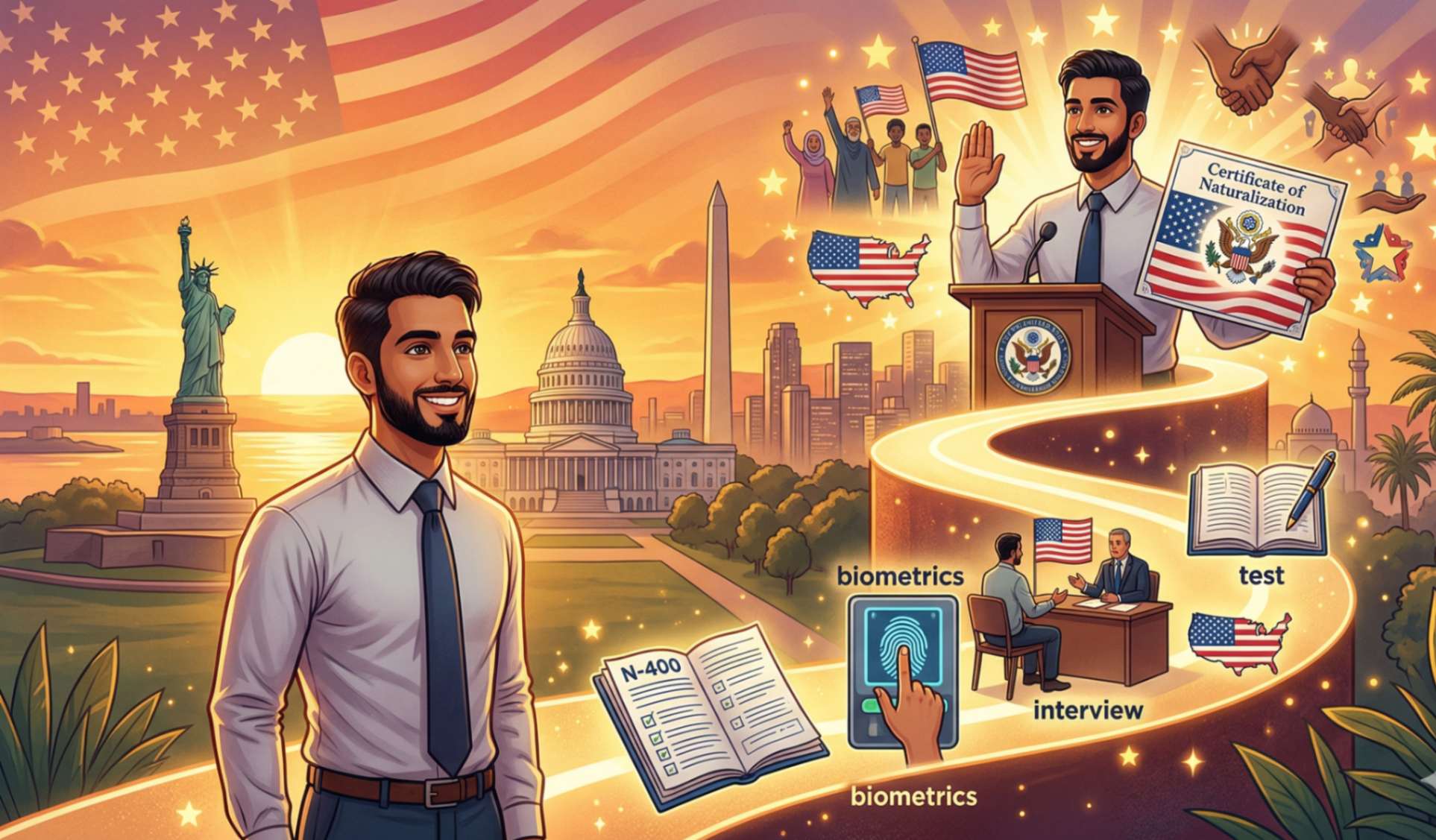
How to Apply for U.S. Citizenship in 2026? Complete Guide to Requirements, Steps, and the Naturalization Test
Picture this scene for a moment...
You are standing inside a vast ceremonial hall, surrounded by hundreds of faces representing every corner of the human spectrum. Everyone is dressed in their finest clothes. Eyes glisten with tears, and wide, irrepressible smiles are fixed on every face. Patriotic music swells softly in the background, and tiny American flags flutter in the hands of the attendees. Then, suddenly, your moment arrives. You rise to your feet. You raise your right hand. And with a voice that may tremble ever so slightly from the sheer weight of the emotion, you begin to recite: "I hereby declare, on oath..."
In that precise, suspended moment, a long and arduous chapter of your life draws to a definitive close, and an entirely new one swings open. You are no longer a "Permanent Resident" or a "Green Card Holder." You are now a United States Citizen. Yes, a full citizen, vested with all the rights and responsibilities that title confers. That distant, hazy dream that floated in your mind as you departed the airport in your home country years ago—that dream that once seemed impossibly far away—now stands before you, solid and real.
The Green Card was your first dream, your gateway to stability and the right to work. It meant protection from immediate deportation and the ability to build a dignified life. But U.S. Citizenship (Naturalization) is a step further and deeper. It is not merely an additional document or a bureaucratic upgrade. It is a fundamental transformation of your legal and human identity in this country that has become your second home. It signifies:
- The Right to Vote: A voice that actually matters in choosing who governs you—at the local, state, and federal levels. A tangible stake in the machinery of democracy.
- The U.S. Passport: One of the most powerful travel documents on the planet, unlocking visa-free or visa-on-arrival access to over 180 countries. This sense of freedom is truly priceless.
- Absolute Protection from Deportation: A U.S. citizen cannot be deported. Ever. This ultimate protection offers an indescribable peace of mind, especially for those who have navigated the complexities of immigration law for years.
- Faster and Broader Family Reunification: As a citizen, you can petition for a wider range of relatives (parents, siblings, married children) through categories that are often faster and less restrictive than those available to Green Card holders.
- A Sense of Complete Belonging: A profound internal shift—the feeling that you are no longer a guest, but a co-owner of the American house.
In this comprehensive and detailed guide for 2026, we will serve as your navigator through every single step of answering the question: How do I apply for U.S. Citizenship? We will dissect the legal requirements with surgical precision and help you untangle the nuanced difference between "Continuous Residence" and "Physical Presence"—arguably the most common source of costly errors. We will walk through Form N-400 question by question. We will take you inside the naturalization interview and tell you exactly what to expect. We will prepare you thoroughly for the English and Civics tests. And finally, we will experience the Oath Ceremony with you and guide you through the essential actions you must take immediately after becoming a citizen.
This is the final stage of your journey toward permanent legal stability. Let's walk this path together with confident, well-planned steps.
Before we dive deep, ensure your foundational documents are in order. If you need to renew your Green Card or passport before applying, review these essential guides first:
- How to Renew Your Green Card or Visa in America 2026
- How to Get Your SSN in America in 2026: A Step-by-Step Guide
📜 Chapter One: Green Card vs. Citizenship – What's the Fundamental Difference?
To truly grasp the significance of applying for citizenship, you must first understand the practical and legal distinctions between your status as a "Lawful Permanent Resident" (LPR) and that of a "U.S. Citizen." Many people remain on a Green Card for decades, held back by fear of the citizenship test or simply unaware of the substantial benefits they are leaving on the table.
| Comparison Point | Permanent Residence (Green Card) | U.S. Citizenship |
|---|---|---|
| Voting Rights | You cannot vote in any federal or state elections. | You have the right to vote in all elections. |
| Travel Document | You must use your home country's passport. | You obtain the U.S. Passport (the blue one). |
| Risk of Deportation | Exists. You can be deported for certain criminal convictions or for violating the terms of your residency. | Does not exist. A citizen cannot be deported. |
| Extended Travel Abroad | Trips over 6 months raise scrutiny. Trips over 1 year can lead to a presumption of abandoning residency. | No restrictions. You can live outside the U.S. indefinitely without losing your citizenship. |
| Family Reunification | You can petition for a spouse and unmarried children, but the priority is lower and wait times are longer. | You can petition for parents, siblings, and married children in addition to the above categories, often with higher priority. |
| Federal Government Jobs | Most federal jobs are restricted to U.S. citizens. | You are eligible to apply for millions of government jobs. |
| Document Renewal | The Green Card must be renewed every 10 years (with a fee). | Citizenship is permanent. Your Certificate of Naturalization never expires. |
| Taxes | You pay taxes on your worldwide income. | You pay taxes on your worldwide income (same obligation). |
A Real Story from the Field: "Abu Khaled," a Syrian businessman in Dearborn, Michigan, lived on his Green Card for 18 years. He was intimidated by the English test and kept postponing the process. One year, he had to make an emergency trip abroad for his son's medical treatment and ended up staying outside the U.S. for over 8 months due to complications. Upon his return to Detroit Metro Airport, he was detained by CBP officers and questioned under suspicion of "Abandonment of Residency." Abu Khaled recalls: "In those hours inside that interrogation room, I would have given anything to be a citizen. I would have walked right through without a single question." With the help of an attorney, he managed to retain his Green Card after that incident, but he filed for citizenship immediately upon his return and naturalized a year later. The lesson: Do not postpone your legal security.
⚖️ Chapter Two: Eligibility Requirements for Naturalization
Before you fill out a single form, you must ensure you meet every requirement. These are not suggestions; they are strict legal mandates.
1️⃣ Length of Permanent Residence
There are two primary paths:
- The General Path (5-Year Rule): You must have been a Lawful Permanent Resident (Green Card holder) for at least 5 continuous years immediately preceding the filing of Form N-400.
- The Marriage to a U.S. Citizen Path (3-Year Rule): If you are married to and living in marital union with a U.S. citizen, you may file after only 3 years of being a Green Card holder, provided your spouse has been a U.S. citizen for all of those three years.
2️⃣ Physical Presence in the United States
Simply holding a Green Card for 5 years is insufficient. You must have been physically present within the territorial United States for at least half of that required period.
- For the 5-Year Path: You must have been physically present for a minimum of 30 months (approximately 913 days) within the 5 years immediately preceding filing.
- For the 3-Year Path: You must have been physically present for a minimum of 18 months (approximately 548 days) within the 3 years immediately preceding filing.
How to Calculate Days? Compile all your departure and arrival dates to and from the U.S. for the relevant statutory period. Subtract the total days spent abroad from the total days in the period. This calculation is precise and critically important. Do not rely on memory. Refer to your travel records: flight tickets, old passport stamps, and most importantly, your official electronic I-94 Travel History from the CBP website.
3️⃣ The Continuous Residence Requirement
This is the requirement that causes the most confusion and the most denials. It means that your status as a permanent resident has not been "broken" by an extended absence from the United States.
- Absence of More Than 6 Months But Less Than 1 Year (181-364 days): This absence creates a rebuttable presumption that you have broken the continuity of your residence. This means the burden of proof shifts to you. You must provide evidence to demonstrate that you did not intend to abandon your U.S. residence (e.g., you maintained a U.S. job, continued to pay rent or a mortgage on a U.S. home, or your immediate family remained in the U.S.).
- Absence of 1 Year or More (365+ days): This absence automatically and categorically breaks the continuity of your residence, regardless of your intent. You will generally need to wait 4 years and 1 day from the date of your return from that long trip before you are eligible to apply for naturalization again (or 2 years if you qualify under certain exceptions, such as employment with the U.S. government).
- Form N-470 (Application to Preserve Residence for Naturalization Purposes): If you are employed abroad by the U.S. government, a recognized American research institute, or an American religious organization, you may file this form before your departure to attempt to preserve your continuous residence.
4️⃣ District or State Residence Requirement
You must have resided in the state or USCIS service district where you are filing your application for at least 3 months immediately prior to submitting Form N-400.
5️⃣ English Language Proficiency
You must demonstrate an ability to:
- Read: Read one sentence out of three correctly.
- Write: Write one sentence out of three correctly from dictation.
- Speak: Understand and respond to the questions posed by the USCIS Officer during the naturalization interview.
Exemptions (Crucial for Older/Long-Term Residents):
- 50/20 Exemption: If you are age 50 or older and have been a Permanent Resident for 20 years or more, you are exempt from the English language test. You may take the Civics test and conduct the interview in your native language with an interpreter.
- 55/15 Exemption: If you are age 55 or older and have been a Permanent Resident for 15 years or more, you are also exempt from the English test and may use an interpreter.
- Medical Disability Exception (Form N-648): If you have a permanent physical or developmental disability or mental impairment that prevents you from learning English or Civics, a licensed medical professional can complete this form to waive the requirements.
6️⃣ The Civics Test
You must demonstrate knowledge of the fundamentals of U.S. history and government.
- The USCIS Officer will ask you 10 questions drawn from an official pool of 100 questions.
- You must answer at least 6 questions correctly to pass.
- Applicants qualifying for the 65/20 exemption (age 65+ with 20 years of residency) study a simplified list of only 20 questions.
7️⃣ Good Moral Character (GMC)
You must establish that you have been a person of "Good Moral Character" during the statutory period (5 or 3 years).
- What Can Bar a Finding of GMC?
- Conviction for certain crimes (drug offenses, violent crimes, fraud).
- Willful failure to pay taxes.
- Lying to the U.S. government to obtain an immigration benefit.
- Failure to pay court-ordered child support.
- Habitual drunkenness or drug addiction.
- Polygamy.
- Do Routine Traffic Tickets Prevent Naturalization? No. Simple traffic infractions (speeding, parking tickets) that have been paid are not evidence of a lack of Good Moral Character. However, Driving Under the Influence (DUI) is treated as a very serious matter and can negatively impact your application. Consult an attorney if you have any criminal record or DUI history.
8️⃣ Attachment to the Constitution
You must be willing "to support and defend the Constitution and laws of the United States of America." You will be asked about this at your interview and again during the Oath of Allegiance.
📋 Chapter Three: Form N-400 – The Application, Step by Step
Form N-400 is the official application for naturalization. Online filing has become the preferred, fastest, and most efficient method.
💻 Why File Online?
- Instant electronic confirmation of receipt.
- Easy, secure electronic payment of fees.
- Reduced risk of data entry errors (the system flags missing information).
- Ability to upload supporting evidence documents directly.
📝 Key Sections You Must Prepare Before Starting the Form:
Gather this information with precision before you even open the online form:
1. Personal and Family Information:
- Your date and place of birth.
- Your marriage date and details about your spouse (including their date and place of naturalization, if a U.S. citizen).
- Information about prior marriages (divorce decrees or death certificates).
- Information about your children (even if they do not live with you).
2. Residence History:
- Your complete physical addresses (with zip codes) for the past five years (or three years, depending on your path).
3. Employment and Education History:
- Names and addresses of all employers and schools you attended during the past five years (with start and end dates).
4. Travel History (The Most Critical Section):
- This is the section most prone to errors. You must list every single trip you took outside the United States during the past five (or three) years that lasted 24 hours or longer.
- For each trip, you will need: Date of Departure (from U.S.), Date of Return (to U.S.), and Country Visited.
- Golden Tip: Use your official, electronic I-94 Travel History from the CBP website to obtain your exact travel dates. Do not rely on memory alone. Any discrepancy here can be used to challenge your credibility.
5. The Moral Character and Security Questions:
- This section contains numerous "Yes" or "No" questions covering a wide range of topics: criminal history, political affiliations, ties to terrorism, tax compliance, and military service.
- The Golden Rule: Read each question with extreme care. If you have any doubt whatsoever about the answer, consult an attorney before submitting the form. An incorrect answer—even if unintentional—can be construed as "misrepresentation" and may lead to denial and could jeopardize your underlying Green Card status.
💵 Filing Fees
Fees are subject to change. Always verify the current fee schedule on the official USCIS website.
- Base Filing Fee for Form N-400.
- Biometric Services Fee (often combined with the base fee).
- Fee Waiver (Form I-912): If your household income is below 150% of the Federal Poverty Guidelines, or you receive a means-tested public benefit (like SNAP or Medicaid), you may apply for a full fee waiver.
- Reduced Fee (Form I-942): If your income is between 150% and 200% of the Federal Poverty Guidelines, you may be eligible for a partial fee reduction.
📅 Chapter Four: The Expected Timeline for the Naturalization Journey
Understanding the timeline reduces anxiety. However, remember that processing times vary dramatically depending on your local USCIS Field Office. An office in a smaller city may be significantly faster than one in Los Angeles or New York City.
| Stage | Action | Estimated Duration (2026) |
|---|---|---|
| 1. Filing | Submitting N-400 online or by mail. | Day 0 |
| 2. Receipt Notice | Receiving Form I-797C via mail or online account. | 2-4 Weeks |
| 3. Biometrics | If previous biometrics are not reused, an ASC appointment is scheduled. | 3-8 Weeks from receipt |
| 4. Waiting for Interview | The longest phase. Depends heavily on your local Field Office's backlog. | 6-12 Months (can be significantly less or more) |
| 5. Naturalization Interview | The meeting with the USCIS Officer, plus English/Civics tests. | Single Day |
| 6. Decision & Oath Ceremony | If approved, the oath may be taken the same day or at a later ceremony. | Same Day to 2-3 Months |
| Total Estimated Time | 8-16 Months |
📚 Chapter Five: Preparing for the Citizenship Test – An Effective Study Plan
Do not let fear of the test delay your application. With proper preparation, passing is virtually guaranteed.
🔤 The English Language Test
Reading:
- You will be asked to read a sentence displayed on a digital tablet.
- Requirement: Read one sentence correctly out of three presented.
- Vocabulary: Focuses on civics and government words (e.g.,
President,Congress,White House,flag,citizens,vote). - How to Prepare: Download the official USCIS Civics Test Study Tools app. It contains the official vocabulary lists and sample sentences.
Writing:
- The USCIS Officer will dictate a sentence aloud, and you will write it on the tablet.
- Requirement: Write one sentence correctly out of three dictated (with acceptable spelling and grammar).
- Vocabulary: Similar to the reading list.
- How to Prepare: Practice writing the words from the official list. Have a friend dictate simple sentences to you.
Speaking:
- There is no separate, standalone speaking test. Your ability to speak and understand English is evaluated throughout the N-400 interview itself. As the Officer reviews the information on your form and asks you questions, they are assessing your comprehension and verbal responses.
- How to Prepare: Review your completed N-400 form thoroughly. Practice answering the personal questions on the form out loud (What is your name? Where do you live? When did you become a permanent resident?).
🇺🇸 The Civics Test
- The Sole Source: The official USCIS Citizenship Resource Center website.
- The Pool: 100 questions.
- The Test: The Officer selects 10 random questions. You must answer 6 correctly.
- Language: The test is administered in English (unless you qualify for an age-based exemption).
- How to Prepare:
- Don't just memorize; understand. For example, know why the President is the Commander in Chief, not just the fact.
- Use Multi-Media: The free USCIS app, YouTube videos (search
USCIS 100 Civics Questions 2026 Practice).
An Inspiring Story: "Umm Yousef," a 62-year-old Palestinian woman in Paterson, New Jersey, was terrified of the English and history test because she had never formally learned English. She discovered she qualified for the "55/15" exemption. She brought her adult son to the interview as her interpreter. In the interview, she confidently answered the Civics questions in Arabic. Umm Yousef says: "I cried tears of joy when I heard the officer say, 'Congratulations, you passed.'" Do not let age or language be an insurmountable barrier.
👨⚖️ Chapter Six: The Day of the Interview – What to Expect
The interview day is the culmination of all your preparation. Logistical and mental readiness ensures the day proceeds smoothly.
✅ Document Checklist
Bring these items with you in an organized folder. Bring originals and photocopies.
- Interview Appointment Notice.
- Permanent Resident Card (Green Card).
- Your Current Passport and All Expired Passports (even if expired).
- State-Issued Identification (Driver's License or State ID).
- If Applying Based on Marriage to a U.S. Citizen: Your marriage certificate, proof of your spouse's U.S. citizenship (birth certificate, passport, or naturalization certificate), and proof of termination of any prior marriages (divorce decrees or death certificates).
- If You Traveled Extensively: A printed copy of your electronic I-94 Travel History for reference.
- Any Additional Documents specifically listed in your appointment notice.
- If You Have a Criminal Record: Bring all certified court records and final dispositions (even for old or expunged cases).
🎭 What Happens Inside the Room?
- The Oath: The Officer will ask you to raise your right hand and swear to tell the truth.
- English and Civics Tests: This is often the first part of the interview.
- Reading Test.
- Writing Test.
- Civics Questions (asked until you answer 6 correctly).
- Review of Form N-400: This is the longest portion. The Officer will review your answers on the N-400 with you, question by question, to ensure no information has changed (e.g., new address, new marriage, new travel). This is your actual "speaking" test.
- The Decision:
- Granted: You passed everything and there are no outstanding issues. You will receive Form
N-652confirming your approval. - Continued: This happens if you are missing a required document (e.g., forgot a divorce decree) or if you failed one portion of the English or Civics test. You will be rescheduled for a new appointment within 60-90 days to submit the missing document or retake the failed test portion.
- Denied: Occurs in cases with substantial legal impediments.
- Granted: You passed everything and there are no outstanding issues. You will receive Form
🎉 Chapter Seven: The Oath Ceremony – The Crowning Moment
This is the moment you have been waiting for. After passing the interview, you will receive a notice scheduling your Oath Ceremony.
- Surrendering Your Green Card: You will be required to turn in your Permanent Resident Card at the beginning of the ceremony. You no longer need it.
- The Oath of Allegiance: You will stand, raise your right hand, and recite the Oath of Allegiance to the United States of America and its Constitution.
- Receiving Your Certificate of Naturalization: This is now your most important document.
- Check the Certificate Immediately: Before you leave the ceremony venue, carefully verify that your name and date of birth are printed correctly on the certificate. Any error must be corrected immediately.
🚀 Chapter Eight: What Comes After Citizenship? (Your Immediate Next Steps)
Congratulations! You are a U.S. citizen. Now, start leveraging the fruits of your labor:
- Apply for Your U.S. Passport: This should be your very first action. You will need your original Certificate of Naturalization + a passport photo + the required fees. You can apply at most Post Offices or Passport Agencies.
- Update Your Record with the Social Security Administration (SSA): Visit your local SSA office to update your citizenship status in their system. This is essential for ensuring your eligibility for future retirement benefits.
- Register to Vote: Register immediately so you can participate in the next elections. You can often register at the Oath Ceremony itself or online through your state's election website.
- Dual Citizenship: Check the laws of your country of origin. Does it permit dual citizenship? The United States generally does not prohibit dual citizenship, but some other nations (including certain Arab countries) may not recognize it or may automatically revoke your original citizenship. Consult your home country's embassy to understand the precise legal implications.
(Now that you are a citizen, you may want to build strong credit to purchase a home. Review our guide: How to Get a Credit Card in America Without Credit History 2026)
❓ Chapter Nine: Frequently Asked Questions About U.S. Citizenship (FAQ)
Q: Do I need an immigration lawyer to apply for naturalization? A: Not always. If your case is simple and clean (no long trips abroad, no criminal record, taxes paid, good English), you can likely file on your own. However, it is strongly advised to consult an attorney if you have: (1) Trips outside the U.S. exceeding 6 months. (2) Any criminal history or arrests (even without conviction). (3) Tax issues with the IRS. (4) Delinquent child support payments.
Q: I have traffic tickets (speeding). Do I need to list them on N-400? Will they prevent naturalization? A: Yes, you must list them if the fine was $500 or more. Routine traffic tickets that have been paid do not prevent naturalization and are not evidence of a lack of Good Moral Character. Warning: Driving Under the Influence (DUI) is considered a very serious offense in the immigration context and can lead to denial. Consult an attorney.
Q: My Green Card expires in 4 months. Can I apply for citizenship now or should I renew the Green Card first? A: You can apply for citizenship even if your Green Card is about to expire or has already expired. USCIS does not require a valid, unexpired Green Card for the duration of N-400 processing. However: If your Green Card expires, you may need to renew it (Form I-90) if you need to travel internationally while waiting for citizenship, or as proof of identity for work or a driver's license. We generally advise renewing it to avoid administrative headaches. See: How to Renew Your Green Card or Visa in America 2026
Q: Can I travel outside the U.S. after filing my N-400 application? A: Yes, short trips are permissible. But you must be extremely careful regarding:
- Attending Your Appointments: If you travel and miss your biometrics or interview appointment, your application may be denied.
- Not Exceeding Allowed Absences: Long trips can raise questions about "continuous residence."
- Ensure both your passport and Green Card are valid for the duration of your travel.
Q: What if I fail the Civics or English test? A: Do not panic. The law gives you a second chance. You will be rescheduled for a new interview within 60-90 days, and you will be tested only on the portion you failed (reading, writing, or Civics). If you fail a second time, the application will be denied.
Q: What if my N-400 application is ultimately denied? A: You have the right to appeal the decision. You must file Form N-336 (Request for a Hearing on a Decision in Naturalization Proceedings) within 30 days of the denial date. A hearing will be scheduled with a different USCIS Officer to review the decision.
Q: I am an Asylee who received a Green Card. When can I apply for citizenship? A: Your rules are unique. You receive credit for 4 years of "retroactive permanent residence" back to the date your asylum was granted. This effectively means you can apply for citizenship 4 years after the date your Green Card was approved (not 5). Consult an attorney to confirm the exact calculation for your specific case.
🌟 Conclusion: The Final Word
The journey to U.S. citizenship is the final chapter in the epic narrative of your immigrant struggle. It is not just about completing Form N-400. It is the culmination of years of patience, hard work, paying taxes, and abiding by the laws of a country that opened its doors to you. It is a pivotal moment when you transition from "resident" to "citizen," from "guest" to "co-owner of the house."
Do not let fear of the language test or the complexity of the form postpone your dream. As you have seen in this guide, the rules are clear, the resources are available, and the path is mapped out. Thousands of Arabs before you sit in Oath Ceremonies every single month, raise their right hands, and walk out as American citizens. Why shouldn't you be one of them in 2026?
Start today with one small, practical step: Open the USCIS website. Read the instructions for Form N-400. And begin compiling your travel history. The sooner you start, the closer your day of recognition becomes.
A Call for Interaction and Sharing: Where are you on your path to citizenship?
- Have you just started gathering your documents?
- Are you worried about the Civics test?
- Do you have an inspiring success story after becoming a citizen?
Share with us in the comments below. Your question might be the exact same one weighing on the minds of hundreds of others. And your experience could be the beacon that lights their way.
For more reliable and official information, please visit:
- USCIS Citizenship Resource Center:
www.uscis.gov/citizenship

Author: حسين عبد الله
Hussein Abdullah is a web developer and specialized content writer with more than eight years of experience enriching Arabic digital content. He combines an analytical programming mindset with a deep passion for writing to deliver accurate, reference-quality guides. On Arabian in USA (عرب في أمريكا), he focuses on simplifying complex steps for new immigrants and sharing reliable information on housing, work, and financial setup—so every newcomer has a trustworthy path toward stable life in the United States.


Continue reading
- How to Renew Your Residency or Visa in America in 2026? A Complete Guide to Green Card Renewal, Work Visas, Study Visas, and Visitor Extensions
- Muslim Population in America 2026: Complete State-by-State Guide, Statistics & Interactive Map
- Top 10 Best States for Muslims in America: Ultimate Guide (Updated 2026)
- Top 7 Best States for Arabs in America: Ultimate Guide (Updated 2026)
- Work in America for New Immigrants 2026: The Complete Guide from Day One to Your Dream Career [Step-by-Step Plan]
- Living in California 2026: The Complete Guide for Arabs & Immigrants [Housing, Jobs, Education & Mosques]