Muslim Population in America 2026: Complete State-by-State Guide, Statistics & Interactive Map
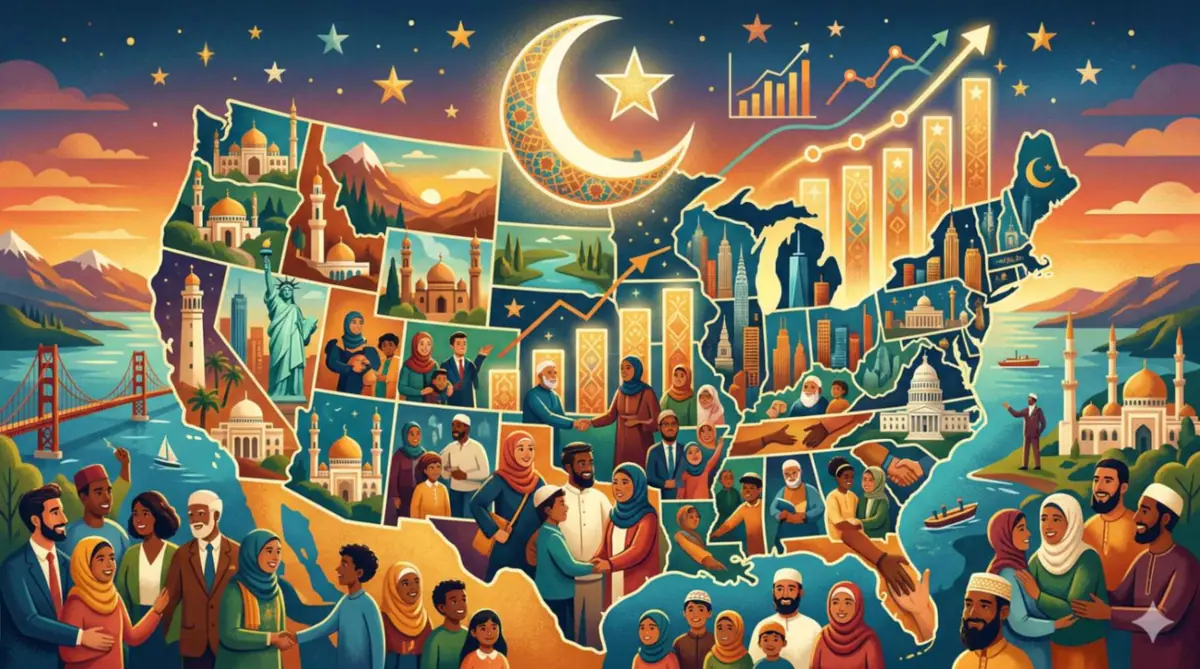
🔍 What You'll Find in This Guide (Why Thousands Trust This Data)
Let me ask you a direct question: Are you planning to move to a new state, start a business, or find a community where your family can thrive as Muslims in America?
If the answer is yes, you need more than just numbers. You need context. You need to know not just how many Muslims live in a state, but where they are concentrated, what the community infrastructure looks like, and whether it's the right fit for your family.
I'm Hussein Abdullah, founder of "Arabs in America." For over fifteen years, I've helped thousands of Arab and Muslim immigrants find their footing in this country. One of the first questions every single family asks me is: "Where are the Muslims? Where should we live?"
This guide is my answer—compiled, updated, and expanded for 2026.
Here's exactly what you'll get:
- The Most Accurate 2026 National Overview: Total U.S. Muslim population, growth trends since 2007, and ethnic/racial composition—all sourced from Pew Research Center, ISPU, and official census data.
- Complete 50-State Directory: Estimated Muslim population ranges for every single state, plus the District of Columbia and U.S. territories. No state is skipped.
- Top 10 States Deep Dive: Detailed profiles of the states with the largest Muslim communities, including key cities, mosque concentrations, and community characteristics.
- Metropolitan Hub Analysis: Where exactly within each state do Muslims live? I'll pinpoint the specific neighborhoods and suburbs.
- Practical Relocation Insights: Beyond population numbers—where are the best Islamic schools? The most halal restaurants? The strongest community organizations?
- Frequently Asked Questions: Over 20 real questions from our readers, answered with data.
- Hussein's Personal Take: My honest assessment of where different types of Muslim families might feel most at home.
Whether you're an academic researcher, a business owner scouting a new market, or a parent planning your family's next chapter, this guide is built for you.
Did You Know That the Muslim Population in the United States Has More Than Doubled Over the Past Two Decades, Now Exceeding 4.5 Million?
As of 2026, the most current and reliable estimates published by specialized demographic research centers, most notably the Pew Research Center and the Institute for Social Policy and Understanding (ISPU) , indicate that the total Muslim population residing within the United States of America now falls within a range of 4.5 to 5 million individuals. This figure represents approximately 1.3% to 1.4% of the nation's total populace.
This is not merely a statistic. It is a profound demographic reality: the United States is now home to one of the largest, most internally diverse, most dynamic, and most influential Muslim communities in the entire Western world. The Islamic presence in America has matured beyond the phases of initial arrival and peripheral existence. It has become a foundational demographic component, an ascendant economic force, and a politically engaged constituency whose contributions are woven into the fabric of contemporary American society.
American Muslims are not a monolith. They represent an extraordinarily complex human mosaic—an amalgam of immigrants from every corner of the Muslim world, joined with the deeply rooted community of African American Muslims, whose ancestral presence in this land predates the nation's founding.
Hussein's Take: I've lived in and visited Muslim communities in over 30 U.S. states. What strikes me most is not just the growth in numbers—it's the growth in institutions. Twenty years ago, finding a mosque or halal grocery in a mid-sized city was a challenge. Today, you can find thriving Islamic centers, weekend schools, and halal restaurants in places like Boise, Idaho; Des Moines, Iowa; and Fargo, North Dakota. The infrastructure has caught up with the population. This guide reflects that new reality.
🔗 Related Resources from Arabian in USA:
- Best State for Muslims in America 2026: Complete Guide
- Islamic Schools in America 2026: Full Directory
- Best Banks for New Immigrants in USA 2026
- Muslim Population in Utah 2026: Detailed Analysis
Chapter One: National Demographic Overview of Muslims in America (2026)
To accurately interpret the geographic distribution of the American Muslim community, we must first establish the comprehensive national-level statistics.
Aggregate National Estimates (2026 Projections)
- Estimated Total Population: The most credible estimates place the total number of Muslims in the United States within a range of 4.5 to 5 million individuals.
- Percentage of Total U.S. Population: Muslims currently constitute approximately 1.3% to 1.4% of the overall national population.
A Longitudinal Analysis of Growth (2007–2026)
The growth of the American Muslim community has been consistent and demonstrable. It is not a sudden spike, but a steady, decades-long trend.
| Year | Estimated Muslim Population | Percentage of U.S. Population | Key Drivers |
|---|---|---|---|
| 2007 | ~2.35 million | ~0.8% | Post-9/11 immigration stabilization, growing indigenous conversion |
| 2017 | ~3.45 million | ~1.1% | Increased refugees (Somali, Syrian, Iraqi), skilled immigration |
| 2026 | ~4.8 million | ~1.4% | Continued skilled immigration, higher fertility rates, conversion |
This consistent pattern is attributable to the synergistic interplay of three principal demographic drivers:
- Sustained Immigration: The continuous influx of Muslim immigrants, particularly those possessing high levels of educational attainment and specialized professional skills (physicians, engineers, tech entrepreneurs).
- Fertility Rates: Fertility rates within Muslim households that, on average, tend to be moderately higher than the prevailing national average.
- Religious Conversion: The ongoing, albeit numerically modest, phenomenon of religious conversion to Islam among individuals from diverse ethnic and social backgrounds.
The Ethnic, Racial, and Cultural Composition (A Portrait of Unparalleled Diversity)
No single racial or ethnic group commands an absolute majority within the American Muslim community.
| Ethnic/Geographic Group | Estimated Share | Key Characteristics |
|---|---|---|
| South Asian Muslims (Pakistan, India, Bangladesh, Sri Lanka) | 30% - 35% | Highest educational attainment and median income. Strong presence in medicine, tech, engineering, and entrepreneurship. |
| African American Muslims | 25% - 30% | Deepest indigenous roots. Rich cultural, spiritual, and social justice heritage stretching back centuries. |
| Arab Muslims (Middle East & North Africa) | 20% - 25% | Diverse origins: Egypt, Syria, Iraq, Lebanon, Palestine, Morocco, Yemen. Major concentrations in Michigan, California, New York/New Jersey. |
| Other Origins (Afghan, Iranian, Turkish, Somali, Bosnian, Albanian, Indonesian, sub-Saharan African) | 15% - 20% | A vibrant mosaic contributing to the community's rich diversity. |
The Ten U.S. States with the Largest Absolute Muslim Populations (2026)
| Rank | State | Est. Muslim Population (2026) | Key Metropolitan Hubs |
|---|---|---|---|
| 1 | California (CA) | 1,000,000 - 1,200,000 | Los Angeles, San Diego, SF Bay Area, Anaheim, Irvine |
| 2 | New York (NY) | 700,000 - 800,000 | NYC (Queens, Brooklyn, Bronx, Manhattan), Long Island |
| 3 | Texas (TX) | 400,000 - 500,000 | Houston, Dallas-Fort Worth, Austin, San Antonio |
| 4 | Illinois (IL) | 350,000 - 450,000 | Greater Chicago (Bridgeview, Orland Park, Lombard) |
| 5 | New Jersey (NJ) | 300,000 - 400,000 | Paterson, Jersey City, Edison, Newark, Teaneck |
| 6 | Michigan (MI) | 250,000 - 350,000 | Dearborn, Detroit, Ann Arbor, Hamtramck |
| 7 | Florida (FL) | 200,000 - 300,000 | Miami, Orlando, Tampa, Jacksonville |
| 8 | Virginia (VA) | 150,000 - 200,000 | Northern Virginia (Fairfax, Herndon, Alexandria) |
| 9 | Maryland (MD) | 100,000 - 150,000 | Montgomery County, Prince George's County, Baltimore |
| 10 | Pennsylvania (PA) | 100,000 - 150,000 | Philadelphia, Pittsburgh, Lehigh Valley |
Chapter Two: Complete State-by-State Directory of Muslim Populations (2026 Estimates)
The following section provides a systematic, state-by-state enumeration for all fifty states, plus the District of Columbia. These figures are derived from triangulation of U.S. Census Bureau data, Pew Research Center and ISPU studies, and aggregated mosque directory data.
Alabama
- Estimated Muslim Population: 15,000 - 20,000.
- Approximate Share of State Population: 0.3%.
- Principal Metropolitan Hubs: Birmingham, Huntsville, Montgomery.
Alaska
- Estimated Muslim Population: 2,000 - 3,000.
- Approximate Share of State Population: 0.3%.
- Principal Metropolitan Hubs: Anchorage, Fairbanks.
Arizona
- Estimated Muslim Population: 40,000 - 50,000.
- Approximate Share of State Population: 0.6%.
- Principal Metropolitan Hubs: Phoenix, Tucson, Mesa, Tempe.
Arkansas
- Estimated Muslim Population: 5,000 - 7,000.
- Approximate Share of State Population: 0.2%.
- Principal Metropolitan Hubs: Little Rock, Fayetteville, Bentonville.
California
- Estimated Muslim Population: 1,000,000 - 1,200,000.
- Approximate Share of State Population: 2.5% - 3%.
- Principal Metropolitan Hubs: Los Angeles, San Diego, Anaheim, San Francisco Bay Area (Fremont, San Jose), Irvine.
- Community Note: California's Muslim community is the most ethnically diverse in the nation, with large Arab, South Asian, Afghan, Iranian, and African American populations. The Islamic Center of Southern California in Los Angeles and the Muslim Community Association in Santa Clara are major institutions.
Colorado
- Estimated Muslim Population: 35,000 - 45,000.
- Approximate Share of State Population: 0.6%.
- Principal Metropolitan Hubs: Denver, Aurora, Colorado Springs, Fort Collins.
Connecticut
- Estimated Muslim Population: 50,000 - 60,000.
- Approximate Share of State Population: 1.4%.
- Principal Metropolitan Hubs: Bridgeport, New Haven, Stamford, Hartford.
Delaware
- Estimated Muslim Population: 8,000 - 10,000.
- Approximate Share of State Population: 0.8%.
- Principal Metropolitan Hubs: Wilmington, Dover, Newark.
Florida
- Estimated Muslim Population: 200,000 - 300,000.
- Approximate Share of State Population: 0.9% - 1.2%.
- Principal Metropolitan Hubs: Miami, Orlando, Tampa, Jacksonville.
Georgia
- Estimated Muslim Population: 80,000 - 100,000.
- Approximate Share of State Population: 0.8%.
- Principal Metropolitan Hubs: Atlanta, Augusta, Savannah.
Hawaii
- Estimated Muslim Population: 3,000 - 5,000.
- Approximate Share of State Population: 0.2%.
- Principal Metropolitan Hubs: Honolulu.
Idaho
- Estimated Muslim Population: 6,000 - 8,000.
- Approximate Share of State Population: 0.3%.
- Principal Metropolitan Hubs: Boise, Idaho Falls.
Illinois
- Estimated Muslim Population: 350,000 - 450,000.
- Approximate Share of State Population: 2.7% - 3.5%.
- Principal Metropolitan Hubs: Greater Chicago metropolitan area, particularly Bridgeview (often called "Little Palestine"), Orland Park, and Lombard.
- Community Note: Illinois has one of the most organized Muslim communities in America. The Muslim Community Center (MCC) in Chicago and the Islamic Foundation in Villa Park are anchors. Bridgeview's mosque is a national landmark.
Indiana
- Estimated Muslim Population: 40,000 - 50,000.
- Approximate Share of State Population: 0.6%.
- Principal Metropolitan Hubs: Indianapolis, Fort Wayne, South Bend.
Iowa
- Estimated Muslim Population: 15,000 - 20,000.
- Approximate Share of State Population: 0.5%.
- Principal Metropolitan Hubs: Des Moines, Cedar Rapids.
Kansas
- Estimated Muslim Population: 15,000 - 20,000.
- Approximate Share of State Population: 0.5%.
- Principal Metropolitan Hubs: Wichita, Overland Park.
Kentucky
- Estimated Muslim Population: 15,000 - 20,000.
- Approximate Share of State Population: 0.3%.
- Principal Metropolitan Hubs: Louisville, Lexington.
Louisiana
- Estimated Muslim Population: 15,000 - 20,000.
- Approximate Share of State Population: 0.3%.
- Principal Metropolitan Hubs: New Orleans, Baton Rouge.
Maine
- Estimated Muslim Population: 3,000 - 5,000.
- Approximate Share of State Population: 0.2%.
- Principal Metropolitan Hubs: Portland, Lewiston.
Maryland
- Estimated Muslim Population: 100,000 - 150,000.
- Approximate Share of State Population: 1.6% - 2.2%.
- Principal Metropolitan Hubs: Montgomery County, Prince George's County, Baltimore.
Massachusetts
- Estimated Muslim Population: 80,000 - 100,000.
- Approximate Share of State Population: 1.1% - 1.4%.
- Principal Metropolitan Hubs: Greater Boston Area, including Cambridge and Roxbury.
Michigan
- Estimated Muslim Population: 250,000 - 350,000.
- Approximate Share of State Population: 2.5% - 3.2%.
- Principal Metropolitan Hubs: Dearborn (the city with the highest percentage of Muslims in America, exceeding 40%), Detroit, Ann Arbor, Hamtramck.
- Community Note: Michigan is the heart of Arab Muslim America. The Islamic Center of America in Dearborn is the largest mosque in North America. The concentration of halal restaurants, Islamic schools, and community organizations here is unmatched anywhere else in the country.
Minnesota
- Estimated Muslim Population: 50,000 - 70,000.
- Approximate Share of State Population: 0.9% - 1.2%.
- Principal Metropolitan Hubs: Minneapolis, St. Paul, and surrounding suburbs (home to a large Somali Muslim community).
Mississippi
- Estimated Muslim Population: 5,000 - 7,000.
- Approximate Share of State Population: 0.2%.
- Principal Metropolitan Hubs: Jackson.
Missouri
- Estimated Muslim Population: 30,000 - 40,000.
- Approximate Share of State Population: 0.5%.
- Principal Metropolitan Hubs: St. Louis, Kansas City.
Montana
- Estimated Muslim Population: 1,500 - 2,500.
- Approximate Share of State Population: 0.1%.
- Principal Metropolitan Hubs: Bozeman, Missoula.
Nebraska
- Estimated Muslim Population: 10,000 - 15,000.
- Approximate Share of State Population: 0.5%.
- Principal Metropolitan Hubs: Omaha, Lincoln.
Nevada
- Estimated Muslim Population: 35,000 - 45,000.
- Approximate Share of State Population: 1.1% - 1.4%.
- Principal Metropolitan Hubs: Las Vegas, Reno.
New Hampshire
- Estimated Muslim Population: 8,000 - 10,000.
- Approximate Share of State Population: 0.6%.
- Principal Metropolitan Hubs: Manchester, Nashua.
New Jersey
- Estimated Muslim Population: 300,000 - 400,000.
- Approximate Share of State Population: 3% - 4%.
- Principal Metropolitan Hubs: Paterson (home to one of the largest Arab Muslim communities on the East Coast), Jersey City, Edison, Newark, Teaneck.
New Mexico
- Estimated Muslim Population: 10,000 - 15,000.
- Approximate Share of State Population: 0.5%.
- Principal Metropolitan Hubs: Albuquerque, Santa Fe.
New York
- Estimated Muslim Population: 700,000 - 800,000.
- Approximate Share of State Population: 3.5% - 4%.
- Principal Metropolitan Hubs: New York City (Boroughs of Queens—especially Astoria and Jackson Heights, Brooklyn—especially Bay Ridge, the Bronx, and Manhattan), Long Island.
- Community Note: New York City has the largest absolute number of Muslim residents of any U.S. city. The Islamic Cultural Center of New York in Manhattan is a major landmark. The diversity here is staggering, with Muslims from virtually every country on earth.
North Carolina
- Estimated Muslim Population: 60,000 - 80,000.
- Approximate Share of State Population: 0.6% - 0.8%.
- Principal Metropolitan Hubs: Charlotte, Raleigh, Durham.
North Dakota
- Estimated Muslim Population: 2,000 - 3,000.
- Approximate Share of State Population: 0.2%.
- Principal Metropolitan Hubs: Fargo.
Ohio
- Estimated Muslim Population: 80,000 - 100,000.
- Approximate Share of State Population: 0.7% - 0.9%.
- Principal Metropolitan Hubs: Cleveland, Columbus, Cincinnati.
Oklahoma
- Estimated Muslim Population: 15,000 - 20,000.
- Approximate Share of State Population: 0.4%.
- Principal Metropolitan Hubs: Oklahoma City, Tulsa.
Oregon
- Estimated Muslim Population: 25,000 - 35,000.
Pennsylvania
- Estimated Muslim Population: 100,000 - 150,000.
- Approximate Share of State Population: 0.8% - 1.2%.
- Principal Metropolitan Hubs: Philadelphia, Pittsburgh.
Rhode Island
- Estimated Muslim Population: 10,000 - 15,000.
- Approximate Share of State Population: 1% - 1.3%.
- Principal Metropolitan Hubs: Providence.
South Carolina
- Estimated Muslim Population: 15,000 - 20,000.
- Approximate Share of State Population: 0.3%.
- Principal Metropolitan Hubs: Columbia, Charleston.
South Dakota
- Estimated Muslim Population: 1,500 - 2,500.
- Approximate Share of State Population: 0.1%.
- Principal Metropolitan Hubs: Sioux Falls.
Tennessee
- Estimated Muslim Population: 30,000 - 40,000.
- Approximate Share of State Population: 0.4% - 0.5%.
- Principal Metropolitan Hubs: Nashville, Memphis.
Texas
- Estimated Muslim Population: 400,000 - 500,000.
- Approximate Share of State Population: 1.2% - 1.5%.
- Principal Metropolitan Hubs: Houston, Dallas-Fort Worth Metroplex, Austin, San Antonio.
- Community Note: Texas has seen explosive Muslim population growth in the last decade, driven by job opportunities and lower cost of living. Houston has the largest Muslim community in the state, with over 50 mosques.
Utah
- Estimated Muslim Population: 52,000 - 58,000.
- Approximate Share of State Population: 1.6% - 1.8%.
- Principal Metropolitan Hubs: Salt Lake City, Utah Valley. (For a more granular analysis, see: Muslim Population in Utah 2026: Detailed Breakdown)
Vermont
- Estimated Muslim Population: 2,000 - 3,000.
- Approximate Share of State Population: 0.3%.
- Principal Metropolitan Hubs: Burlington.
Virginia
- Estimated Muslim Population: 150,000 - 200,000.
- Approximate Share of State Population: 1.7% - 2.2%.
- Principal Metropolitan Hubs: Northern Virginia (Fairfax, Herndon, Alexandria—home to the Dar Al-Hijrah Islamic Center, one of the most prominent mosques on the East Coast), Richmond.
Washington
- Estimated Muslim Population: 50,000 - 70,000.
- Approximate Share of State Population: 0.6% - 0.8%.
- Principal Metropolitan Hubs: Seattle, Tacoma, Spokane.
Washington, District of Columbia
- Estimated Muslim Population: 15,000 - 20,000.
- Approximate Share of District Population: 2% - 2.5%.
- Principal Metropolitan Hubs: Washington, D.C.
West Virginia
- Estimated Muslim Population: 3,000 - 5,000.
- Approximate Share of State Population: 0.2%.
- Principal Metropolitan Hubs: Charleston.
Wisconsin
- Estimated Muslim Population: 40,000 - 50,000.
- Approximate Share of State Population: 0.7% - 0.9%.
- Principal Metropolitan Hubs: Milwaukee, Madison.
Wyoming
- Estimated Muslim Population: 1,000 - 1,500.
- Approximate Share of State Population: 0.1% - 0.2%.
- Principal Metropolitan Hubs: Cheyenne, Casper.
Chapter Three: U.S. Territories and Insular Areas
In addition to the fifty states and D.C., small but vibrant Muslim communities exist within several U.S. territories:
- Puerto Rico: Estimated 2,000 - 3,000 Muslims, primarily in and around San Juan.
- Guam: Estimated 500 - 1,000 Muslims.
- U.S. Virgin Islands: A community of several hundred, served by a mosque on St. Croix.
Frequently Asked Questions (People Also Ask)
Q: What is the total Muslim population in the United States in 2026? A: The estimated total Muslim population ranges from 4.5 to 5 million individuals, representing approximately 1.3% to 1.4% of the nation's total populace.
Q: Which U.S. state has the largest absolute Muslim population? A: California has the largest absolute Muslim population, with estimates ranging from 1,000,000 to 1,200,000 residents.
Q: Which U.S. city has the highest percentage of Muslim residents? A: Dearborn, Michigan, is widely recognized as having the highest percentage of Muslims relative to its total population—well over 40%.
Q: Which U.S. city has the largest absolute number of Muslim residents? A: New York City, across its five boroughs, contains the largest absolute number of Muslim residents of any U.S. city.
Q: How many mosques and Islamic centers are there in the United States in 2026? A: Over 2,800 mosques, Islamic centers, and designated prayer spaces (musallas) are documented across all fifty states.
Q: What is the ethnic and racial composition of the American Muslim community? A: The community is remarkably diverse: South Asian (Pakistani, Indian, Bangladeshi) at 30-35%, African American at 25-30%, Arab at 20-25%, and other origins (Afghan, Iranian, Turkish, Somali, Bosnian, Indonesian, etc.) at 15-20%.
Q: Is the Muslim population in the United States growing? A: Yes. The population is experiencing steady growth driven by sustained immigration, fertility rates moderately above the national average, and ongoing religious conversion.
Q: What is the specific estimated Muslim population of Texas in 2026? A: Between 400,000 and 500,000 individuals.
Q: What is the specific estimated Muslim population of Florida in 2026? A: Between 200,000 and 300,000 individuals.
Q: What is the specific estimated Muslim population of New York State in 2026? A: Between 700,000 and 800,000 individuals.
Q: What is the specific estimated Muslim population of California in 2026? A: Between 1,000,000 and 1,200,000 individuals.
Q: What is the specific estimated Muslim population of Michigan in 2026? A: Between 250,000 and 350,000 individuals.
Q: What is the specific estimated Muslim population of Illinois in 2026? A: Between 350,000 and 450,000 individuals.
Q: What is the specific estimated Muslim population of New Jersey in 2026? A: Between 300,000 and 400,000 individuals.
Q: What are the primary drivers of the growth of the American Muslim community? A: The three primary drivers are: (1) Sustained immigration from diverse global regions. (2) Fertility rates that are moderately above the national average. (3) A consistent, albeit modest, stream of conversions to Islam.
Q: Where are the largest concentrations of Arab Muslims in the United States? A: The largest concentrations are in Michigan (Dearborn and Detroit), New York/New Jersey, California (Anaheim and Los Angeles), and Illinois (Chicago).
Q: Are there Muslim communities in all 50 states? A: Yes. Every single U.S. state, plus D.C. and several territories, has a documented Muslim community with at least one mosque or Islamic center.
Conclusion: A Living, Growing Community
As the comprehensive statistical data and detailed state-by-state analysis within this guide unequivocally demonstrate, Muslims in America are not a newly arrived, peripheral, or transient community. They are, at present, a deeply rooted, widely dispersed, and institutionally mature segment of the American populace.
Their presence extends across the entire geographic expanse of the nation—from the remote reaches of Alaska to the sun-drenched climes of Florida and Texas, and from the historic Atlantic seaboard to the dynamic Pacific coast. With significant demographic concentrations in the nation's key economic and political centers—California, New York, Texas, Illinois, and Michigan—the collective voice and contributions of the American Muslim community have become an undeniable and increasingly influential factor in shaping the American narrative.
A final word from Hussein Abdullah: I've watched this community grow for over fifteen years. I've seen new mosques break ground in towns where none existed before. I've seen Muslim students form MSAs at universities in every corner of this country. The data in this guide tells a story not just of numbers, but of a community putting down roots, building institutions, and contributing to the American fabric. Whether you're looking to relocate, research, or simply understand, I hope this guide has been your definitive resource.
An Invitation for Community Dialogue: Demographic statistics are dynamic by nature. Are you a resident of one of these states? Do you have firsthand knowledge of the growth (or changes) in the Muslim community in your area, new mosques, Islamic schools, or shifts in settlement patterns? We warmly welcome your personal observations, updates, and constructive feedback in the comments section below.
🔗 Continue Your Research:
- Best State for Muslims in America 2026
- Islamic Schools in America 2026: Complete Directory
- Best Banks for New Immigrants in USA 2026
- Life in Utah for Arab Immigrants
For further authoritative demographic research, consult: Pew Research Center - Religion & Public Life and the Institute for Social Policy and Understanding (ISPU).

Author: حسين عبد الله
Hussein Abdullah is a web developer and specialized content writer with more than eight years of experience enriching Arabic digital content. He combines an analytical programming mindset with a deep passion for writing to deliver accurate, reference-quality guides. On Arabian in USA (عرب في أمريكا), he focuses on simplifying complex steps for new immigrants and sharing reliable information on housing, work, and financial setup—so every newcomer has a trustworthy path toward stable life in the United States.


Continue reading
- Top 10 Best States for Muslims in America: Ultimate Guide (Updated 2026)
- Top 7 Best States for Arabs in America: Ultimate Guide (Updated 2026)
- Living in Ohio 2026: The Complete Guide for Arabs and Immigrants — What the American Dream Actually Costs Here
- Open a Bank Account in Illinois 2026: The Complete Guide for New Immigrants Without an SSN
- Immigration to the USA from Brazil 2026: Complete Guide to All Paths, Requirements, and Procedures
- Immigration to the United States from Algeria in 2026: A Complete Guide to Every Path, Requirement, and Step