Muslim Population in Utah 2026: Full Statistics and Community Analysis
Muslim Population in Utah 2026: Full Statistics and Community Analysis
Let me start with a number that surprised even me when I first compiled it. In 1990, a reasonable estimate placed fewer than 5,000 Muslims in the entire state of Utah. There was one purpose-built mosque, a handful of prayer spaces, and a community so small that most Utahns had never knowingly met a Muslim. Thirty-six years later, in 2026, that number has increased more than tenfold. The Muslim community in Utah now numbers approximately 55,000 people — roughly the population of a mid-sized city, embedded within a state of 3.4 million. When I share this statistic with Arab families considering relocation, their first reaction is often disbelief. "Utah? That many Muslims? Are you sure?" I am sure. And the growth trajectory is accelerating, not slowing.
This guide is designed to answer the questions that families and researchers actually ask when they inquire about the Muslim presence in Utah. How many Muslims live here? Where exactly do they cluster? What ethnic and cultural backgrounds do they represent? What mosques and schools serve them? What challenges does the community face, and where is it headed over the next five years? The answers draw on community-based demographic counts, institutional participation records from mosques and Islamic schools, Pew Research Center trend data on American Muslim populations, and U.S. Census Bureau American Community Survey indicators for immigrant-origin communities.
For a practical directory of mosques with addresses, services, and program schedules, pair this guide with Mosques in Utah 2026: Islamic Centers Guide. For Arab-specific community context, read Arabs in Utah: Complete Community Guide. For national comparison, see Muslim Population in America by State 2026.
🔍 What You Will Find in This Analysis
- 📊 A detailed estimate of Utah's Muslim population in 2026 — the total number, growth rate since 2010, and the sources behind the figures
- 🏙️ A city-by-city breakdown — where Muslims actually live in the Salt Lake Valley and beyond, with estimated concentrations for each major metro area
- 📜 A short history of the community — from the first student families in the 1970s to today's diversified, institution-building population
- 🕌 The mosque and school infrastructure — how many Islamic centers exist, where they are located, and whether educational capacity matches family demand
- 🌍 The ethnic and cultural composition — the Arab, South Asian, Somali, Bosnian, and other communities that make up Utah's Muslim fabric
- ⚠️ The challenges the community still faces — from school capacity pressures to long-term cemetery planning
- 📈 A growth forecast through 2030 — and what the drivers of that growth mean for families considering relocation
1) Muslim Population Statistics in Utah — The Core Numbers for 2026
Measuring religious minority populations in the United States is inherently difficult. The U.S. Census Bureau does not ask about religious affiliation. National surveys from organizations like the Pew Research Center provide excellent trend data but are not granular enough to capture state-level counts with precision, especially for smaller communities. The figures presented here are triangulated from multiple sources: mosque registration and attendance records, Islamic school enrollment data, community organization estimates, Pew demographic trend projections, and American Community Survey data on immigrant-origin populations from Muslim-majority countries.
Estimated Total Population
The Muslim population in Utah in 2026 is estimated at 52,000 to 58,000, with a midpoint of approximately 55,000. This represents roughly 1.6% to 1.8% of Utah's total population of approximately 3.4 million residents. To put that percentage in perspective: Utah's Muslim community is now proportionally comparable to the Muslim population of states like Washington or Virginia — not as large as Michigan or New Jersey, but firmly in the second tier of American Muslim populations and growing faster than many.
Growth Trajectory
| Year | Estimated Muslim Population | Growth Since Previous Benchmark |
|---|---|---|
| 1990 | ~4,000-5,000 | — |
| 2000 | ~15,000-18,000 | Significant increase driven by Bosnian refugee resettlement and early professional migration |
| 2010 | ~25,000-28,000 | Continued immigration and natural growth |
| 2020 | ~40,000-42,000 | Accelerated by internal U.S. migration from higher-cost states |
| 2026 | ~52,000-58,000 | Approximately 35-40% growth since 2020 |
A 35-40% growth rate in six years is unusually high for an established religious community in the United States. It reflects three simultaneous forces: natural population increase (Muslim families in Utah tend to be younger and have more children than the state average), continued international immigration (particularly from the Middle East, South Asia, and East Africa), and — critically since 2020 — internal migration of Muslim families from California, Washington, and Illinois seeking lower housing costs and safer communities.
يوسف, a Palestinian engineer who moved his family from Orange County, California to South Jordan in 2022, told me: "In California, we were one of maybe three Muslim families in our children's school. In South Jordan, my daughter's second-grade class has five Muslim kids. She came home and said, 'Baba, I'm not the only one who doesn't eat pepperoni pizza anymore.' That sentence alone told me the move was right."
2) History of the Muslim Community in Utah — From a Borrowed Room to a Network of Campuses
The Muslim story in Utah follows a pattern familiar across the American West: a small beginning rooted in education and specialized professions, followed by waves of humanitarian migration, and eventually the building of permanent institutions.
The Early Phase (1970–1990)
The first Muslims to settle in Utah in meaningful numbers were international students — particularly from the Middle East and South Asia — drawn to the University of Utah, Brigham Young University, and Utah State University for graduate and professional programs. A smaller number arrived as physicians and engineers recruited to the state's growing healthcare and technical sectors. These early families and individuals practiced their faith quietly, often in living rooms and rented community halls.
The pivotal institutional moment came in 1975, when the Islamic Center of Utah was established in Salt Lake City in a converted building. It was the state's first permanent mosque. The congregation was small — perhaps a few dozen families on a good Friday — but the act of creating a physical address for Islam in Utah was symbolically enormous.
The Growth and Diversification Phase (1990–2010)
The 1990s brought a significant demographic shift. The Bosnian War resulted in the U.S. government resettling thousands of Bosnian Muslim refugees, and Utah was among the receiving states. The Bosnian community, with its distinct European Islamic tradition, established itself quickly, opening businesses and joining the existing mosque communities. Somali refugees began arriving in the late 1990s and early 2000s, followed by Iraqis after the 2003 U.S. invasion. These humanitarian migration waves diversified the community by class, language, and tradition far beyond its initial student-and-professional base.
During this period, mosque activity expanded beyond the original Salt Lake City location. Prayer spaces opened in West Valley City, which was becoming the community's demographic center of gravity. Weekend Islamic schools began operating with volunteer teachers.
The Institution-Building Phase (2010–2026)
The most recent period has been defined by a shift from rented spaces to owned campuses, and from weekend-only education to full-time Islamic schooling. The Utah Islamic Center in West Valley City — the largest mosque in the state — opened its current facility and launched the Utah Islamic Academy, a full-time K-12 school. Khadija Mosque opened in 2016 in southern West Valley City to serve the community's expanding geography. Masjid Al-Salam in South Jordan and the Islamic Center of Sandy followed, extending mosque access into the suburbs where professional families were buying homes.
The community's civic and political engagement has also matured. Organizations like the Utah Muslim Civic League now coordinate voter registration, candidate forums, and community-police dialogue. Muslim professionals serve on city commissions and hospital boards. The sense of being a small, embattled minority has not disappeared entirely — no Muslim community in America is free from Islamophobia — but it has been joined by a growing confidence and a determination to shape Utah's future rather than merely inhabit it.
3) Where Muslims Live in Utah — City-by-City Distribution
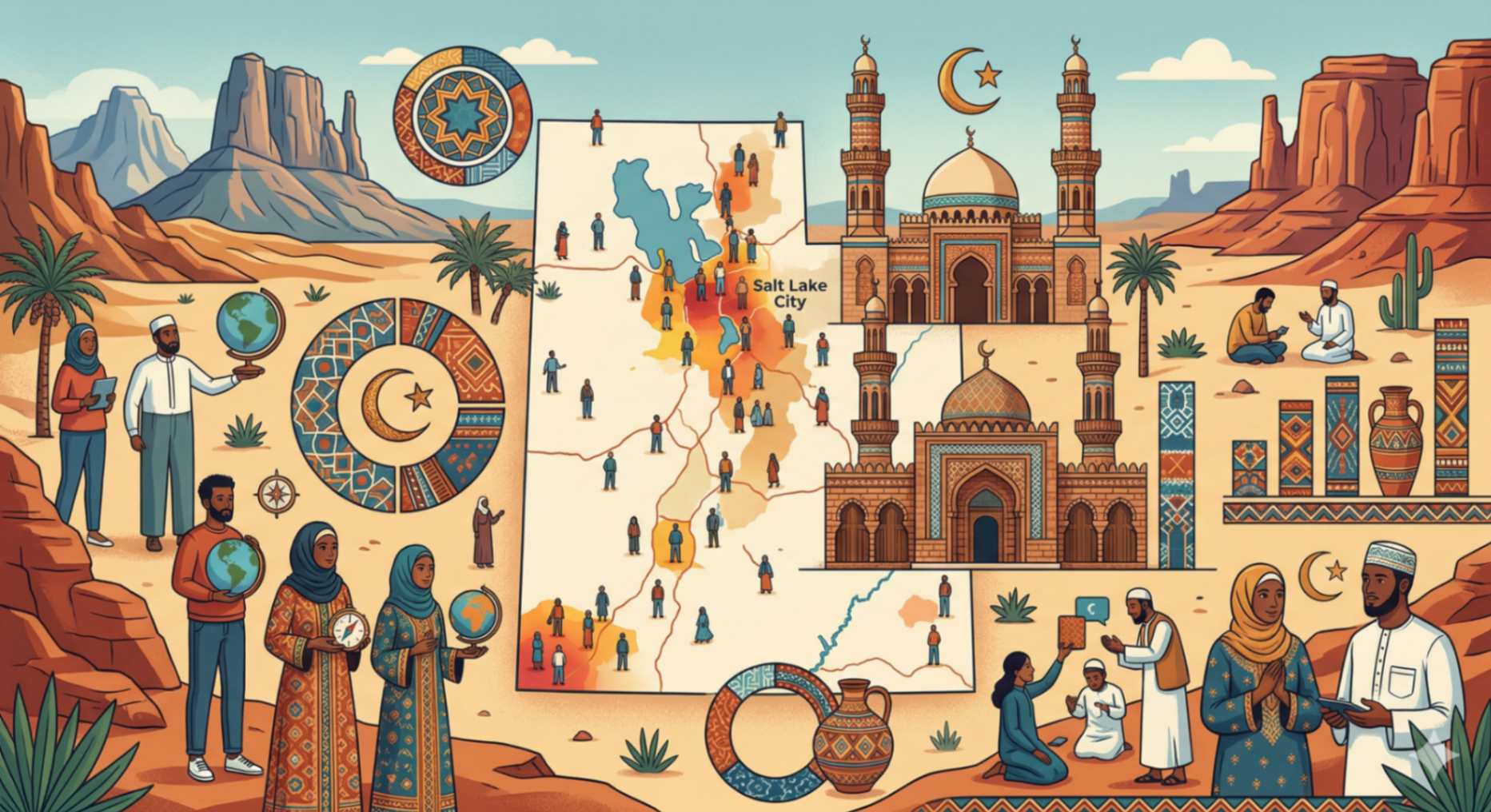
Utah's Muslim population is highly concentrated in the Salt Lake Valley and the immediately adjacent suburbs. Over 85% of the state's Muslims live within a 30-minute drive of downtown Salt Lake City.
| City/Area | Estimated Muslim Population | Community Character |
|---|---|---|
| Salt Lake City | 12,000–15,000 | Historic core of the community. Home to the oldest mosque and the University of Utah MSA. Diverse mix of students, professionals, and working families. |
| West Valley City | 10,000–12,000 | The demographic and cultural heart of Utah Islam. Highest concentration of mosques, halal groceries, Arab restaurants, and Islamic institutions. Majority-minority city with large Latino, Pacific Islander, and Muslim populations. |
| South Jordan / West Jordan | 8,000–10,000 | Affluent suburban corridor attracting professional families with children. Strong public schools, larger homes, and growing mosque infrastructure. |
| Sandy / Draper | 5,000–7,000 | Southern valley communities. Many families commute to West Valley or Salt Lake mosques for Friday prayer. Local services are growing. |
| Ogden | 3,000–5,000 | Northern anchor with a stable, working- and middle-class community. Served by the Islamic Center of Ogden. Proximity to Weber State University. |
| Provo | 3,000–5,000 | University-centered community with a significant student presence at BYU. Fewer institutional services than the Salt Lake metro, but an active MSA. |
| Other (Logan, St. George, Park City, etc.) | 2,000–4,000 combined | Small but present. Logan has a university-linked community. St. George is seeing early growth from retirees and remote workers. Park City has a small professional community tied to the resort economy. |
For families considering relocation, the practical implication is straightforward. If living within walking or short driving distance of a major mosque and halal grocery is a high priority, West Valley City is the clear choice. If you prioritize top-rated public schools and larger homes and are willing to drive 15-20 minutes to the mosque, South Jordan, Sandy, and the surrounding southern suburbs are excellent options. For those seeking maximum housing affordability, Ogden offers a genuine cost advantage while maintaining a functional mosque community.
4) Mosques and Islamic Centers — The Institutional Map
As of 2026, Utah has approximately 10 to 12 formally recognized mosques and Islamic centers with regular programming, five daily prayers, and organized leadership. The full directory with addresses, services, and contact information is provided in Mosques in Utah 2026: Islamic Centers Guide.
The key institutions are:
- Islamic Center of Utah (Salt Lake City): Founded in 1975. The oldest mosque in the state. Offers daily prayers, Jumu'ah in Arabic and English, a Sunday School, youth programs, and social services including zakat distribution.
- Utah Islamic Center (West Valley City): The largest mosque in Utah by attendance and physical footprint. Houses the Utah Islamic Academy (K-12). Large events hall. Extensive youth and family programming.
- Khadija Mosque (West Valley City): Opened in 2016. Known for strong women's programming, a popular Quran Club for children, and a modern, meticulously maintained facility.
- Masjid Al-Salam (South Jordan): Serves the rapidly growing southern suburban Muslim community. Family-oriented with regular classes in tafsir and seerah.
- Islamic Center of Sandy (Sandy): Neighborhood mosque for the Sandy and Draper communities.
- Islamic Center of Ogden (Ogden): The primary Islamic institution for northern Utah.
The geographic distribution of these mosques tells a clear story. The community's center of gravity has shifted from a single point in downtown Salt Lake City to a multi-nodal network anchored in West Valley City, with spokes extending south into the affluent suburbs and north into Ogden.
5) Islamic Schools in Utah — Education and Identity Preservation
The availability of Islamic education is the single most important institutional question for many Muslim families considering relocation. Utah's Islamic educational infrastructure has developed significantly but remains smaller and less resourced than in states with larger Muslim populations like Texas, Michigan, or California.
Full-Time Islamic Education
Utah Islamic Academy (UIA): Located in West Valley City on the Utah Islamic Center campus, UIA is the only full-time Islamic school in the state serving kindergarten through 12th grade. The school follows the Utah state-approved core curriculum — mathematics, sciences, English language arts, and social studies — integrated with daily Quran memorization, Arabic language instruction, and Islamic studies. Current enrollment is between 300 and 400 students. The school is accredited and its graduates have been accepted at the University of Utah, Utah State University, and out-of-state institutions.
UIA is a legitimate, functional option for families seeking full-time Islamic education. It does not yet have the national reputation or resources of Brighter Horizons Academy in Dallas or Al-Huda Academy in Houston, but it provides the essential service of an environment where students can be fully Muslim and fully academically prepared. Sibling discounts are available, and the school works with families on financial aid.
Weekend and Supplementary Education
For the majority of Muslim families who enroll their children in public schools during the week, every major mosque in Utah operates weekend or evening programs. The Islamic Center of Utah's Sunday School is the oldest and largest. Khadija Mosque and the Utah Islamic Center offer Quran memorization tracks and evening Arabic classes. The quality and intensity of these programs vary, but collectively they serve thousands of children across the Salt Lake Valley.
The practical strategy many Arab Muslim families adopt is to live in a suburb with highly rated public schools — South Jordan, Sandy, parts of Salt Lake City — and enroll children in weekend Islamic school for Arabic, Quran, and Islamic studies. This combination preserves academic quality while maintaining religious and linguistic identity at a fraction of the cost of full-time private Islamic schooling.
For national comparison, see Islamic Schools in America: The Complete 2026 Guide.
6) Ethnic and Cultural Composition of Utah Muslims
Utah's Muslim community is not monolithic. It is a genuinely global congregation, and that diversity is one of its strengths — families from different continents, speaking different languages, and carrying different traditions, praying side by side.
- Arabs: The largest single ethno-cultural bloc. Palestinian, Syrian, Iraqi, Egyptian, and Jordanian backgrounds predominate. Arabs are heavily represented in medicine, engineering, small business ownership, and academia. Many Arab families have been in Utah for two or three generations; others arrived within the past five years.
- South Asians: Pakistani, Indian, and Bangladeshi communities are large and growing, with particularly strong representation in technology, medicine, and entrepreneurship. The Urdu-speaking community maintains active cultural organizations alongside mosque participation.
- Somalis and East Africans: Concentrated heavily in West Valley City and Salt Lake City. Many arrived through the U.S. refugee resettlement program. The Somali community is commercially active, with a visible presence in the service sector, transportation, and small business.
- Bosnians: The Bosnian Muslim community arrived primarily in the 1990s as refugees from the Balkan Wars. They are now a well-established, multigenerational community with their own cultural institutions and strong mosque participation. The Bosnian Islamic tradition — European, moderate, and community-oriented — has contributed significantly to Utah's broader Muslim fabric.
- Other communities: Afghan, Iranian, Turkish, Malaysian, and Indonesian Muslims have smaller but meaningful presences. The convert community is also notable: a steady stream of Utahns — some from LDS backgrounds, some from no religious background — have embraced Islam, and the mosques have developed specific programs for new Muslims.
This diversity means that on any given Friday, a khutbah may be delivered in Arabic with an English summary, the women's section may contain abayas next to shalwar kameez next to jeans, and the post-prayer socializing shifts fluidly between English, Arabic, Somali, and Urdu.
7) Key Challenges Facing Muslims in Utah
Any honest community analysis must address difficulties, not only achievements. Utah's Muslim community faces several structural challenges.
1. Educational capacity does not fully meet demand. The Utah Islamic Academy, while functional and growing, cannot accommodate all families who would prefer full-time Islamic education. Weekend and evening programs are helpful supplements but cannot replace the immersive environment of a full-time Islamic school. Families for whom full-time Islamic education is non-negotiable should research waitlist timelines and enrollment procedures early.
2. The community remains concentrated in a narrow geographic corridor. Over 85% of Utah's Muslims live in the Salt Lake Valley. This concentration creates critical mass for institutions but also means that families seeking to live in more affordable or rural parts of the state — St. George, Cedar City, the Uinta Basin — will find little to no Muslim community infrastructure.
3. Arabic-language religious programming is available but not universal. The major mosques offer Arabic-language khutbahs and classes. Smaller mosques and youth programs are often English-dominant. For recently arrived older immigrants with limited English, this can create a sense of exclusion.
4. Halal food availability is good in the core metro but thin outside it. West Valley City and Salt Lake City have multiple halal butchers, Arab groceries, and halal-friendly restaurants. The suburbs are improving. Rural Utah has essentially no halal infrastructure.
5. Long-term community planning needs attention. The community has grown faster than its planning infrastructure. Islamic cemetery space — a mundane but critical need — requires long-term land acquisition and zoning work. This is underway but requires sustained effort.
6. Islamophobia exists but is not the dominant experience. Isolated incidents of harassment, school bullying of Muslim children, and online hostility occur, as they do anywhere in the United States. However, the broader cultural context in Utah — with an LDS majority that values religious practice, modesty, and family — creates an environment that many Muslims describe as more comfortable than the secular, permissive cultures of major coastal cities. The community's civic organizations, including the Utah Muslim Civic League and CAIR's regional presence, provide advocacy and legal support when incidents arise.
8) Growth Outlook to 2030
Based on current demographic, migration, and institutional trends, the Muslim population of Utah is projected to reach approximately 70,000 to 80,000 by 2030. This represents continued robust growth, though likely at a somewhat moderated pace compared to the 2020-2026 acceleration.
The primary growth drivers are expected to remain consistent:
- Internal U.S. migration from higher-cost states. As housing in California, Washington, and the urban Northeast remains prohibitive, Utah will continue to attract professional Muslim families seeking homeownership, safety, and good schools.
- Natural population growth. Muslim families in Utah tend to be younger than the state average and have higher fertility rates, contributing to organic growth that does not depend on immigration.
- Institutional maturity. As mosques, schools, and halal infrastructure improve, Utah becomes more attractive not only to individual families but to extended family networks. The "pioneer" phase — where a family moves alone and builds community from scratch — is giving way to a "chain migration" phase, where families follow siblings and cousins who have already established themselves.
Cautions on the outlook: Growth could accelerate further if housing affordability in other states deteriorates sharply or if Utah's technology sector ("Silicon Slopes") continues its rapid expansion and draws more Muslim tech professionals from the Bay Area and Seattle. Growth could decelerate if housing costs in Utah rise to the point where the cost-of-living advantage over coastal states narrows significantly — a risk that is real and worth monitoring.
9) Islamic Life in Utah — Ramadan, Eid, and the Annual Calendar
Demographic statistics describe a population. Community life describes a people. For Muslims in Utah, the annual religious calendar provides the rhythm that binds the community together.
Ramadan: The holy month transforms the mosques. Every major Islamic center organizes community iftars — often on weekends, sometimes nightly in the last ten days — where hundreds of worshippers from every ethnic background break their fast together. The food tells the community's story: Somali sambusas, Pakistani pakoras, Arab lentil soup, Bosnian bread, American dates. Tarawih prayers are held at all major mosques. Several centers run itikaf programs during the last ten nights. Utah's long summer days — when Maghrib can arrive after 9 PM — make Ramadan a particular physical challenge, but the community's spirit of shared endurance strengthens bonds.
Eid: Congregations routinely overflow mosque capacity on Eid morning. The Utah Islamic Center and the Islamic Center of Utah often rent large halls or convention center spaces to accommodate the crowds. In some years, the community has gathered at Liberty Park for a unified outdoor prayer. After salah, the celebration continues — children receive eidiyah, families embrace, and vendors sell halal food, sweets, and gifts.
Annual community events: The Utah Halal Food Festival in Salt Lake City has grown into a major annual event that bridges Muslim and non-Muslim Utahns. Thousands attend to sample Arab, South Asian, and Somali cuisine. The Utah Muslim Youth Conference, organized through the mosque network, addresses identity, mental health, and professional development for teenagers and young adults.
For the full community context beyond statistics, read Arabs in Utah: Community and Life Guide.
10) Regional Comparison — Utah vs. Neighboring States
| State | Estimated Muslim Population (2026) | Share of State Population | Community Character |
|---|---|---|---|
| Utah | 55,000 | 1.6% | Fast-growing, institutionally maturing, diverse by origin |
| Nevada | 40,000 | 1.2% | Heavy Las Vegas concentration; service-sector employment base |
| Colorado | 35,000 | 0.6% | Growing Denver-area community; university and tech-sector anchor |
| Idaho | 8,000 | 0.4% | Smaller, refugee-linked communities in Boise and Twin Falls |
| Wyoming | 1,500 | 0.2% | Very limited institutional presence; scattered families |
Utah's regional leadership in Muslim population and institutional development is clear. For families considering the Mountain West, Utah offers a meaningfully larger and more organized Muslim community than any neighboring state.
Frequently Asked Questions
How many Muslims live in Utah in 2026? An estimated 52,000 to 58,000, with a midpoint of approximately 55,000, representing roughly 1.6% to 1.8% of the state's population.
Where do most Muslims live in Utah? Over 85% live in the Salt Lake Valley — primarily Salt Lake City, West Valley City, South Jordan, West Jordan, Sandy, and Draper. Ogden to the north and Provo to the south have smaller but stable communities.
How fast is the Muslim population growing in Utah? The community has grown approximately 35-40% since 2020, driven by internal U.S. migration from higher-cost states, international immigration, and natural population growth. The trajectory is expected to continue, with a projected population of 70,000-80,000 by 2030.
Are there mosques in Utah? Yes. As of 2026, there are approximately 10 to 12 formally recognized mosques and Islamic centers with regular programming. The largest concentrations are in West Valley City and Salt Lake City. A complete directory is available in the Mosques in Utah 2026 Guide.
Are there full-time Islamic schools in Utah? Yes. The Utah Islamic Academy in West Valley City offers full-time K-12 education with an integrated academic and Islamic curriculum. Enrollment is between 300 and 400 students. Weekend and evening Islamic education programs are available at all major mosques for public school families.
Is halal food readily available in Utah? Yes, in the Salt Lake City and West Valley City areas. Multiple halal butchers, Arab and South Asian groceries, and halal-friendly restaurants operate in the core metro. Availability is thinner in suburban and rural areas but expanding.
Is Utah safe for Muslim families and hijab-wearing women? Utah consistently ranks among the safer U.S. states by violent crime rate. The dominant LDS culture places high value on religious practice, modesty, and family — creating an environment that many Muslims find more culturally comfortable than highly secular coastal cities. Hijab-wearing women in the Salt Lake metro generally report safe daily experiences. Isolated incidents of ignorance or bias occur, as they do everywhere in America, but systematic harassment is uncommon.
Which Utah city is best for Muslim families? West Valley City is the demographic and institutional heart of the community, with the highest concentration of mosques, halal services, and Islamic education. South Jordan and Sandy offer top-rated public schools and larger homes in exchange for a longer drive to mosque services. The choice depends on whether immediate mosque proximity or school quality and home size is the higher priority.
Conclusion
The Muslim population of Utah in 2026 tells a story that the numbers alone cannot fully capture. It is a story of a community that grew from borrowed rooms to owned campuses. From a handful of families wondering if they would ever belong in a state defined by another faith, to tens of thousands of families who have built mosques, schools, businesses, and civic organizations that make Utah their home by choice and by right.
The trajectory is clear. With continued migration, natural growth, and institutional investment, Utah's Muslim community is on track to reach 70,000 to 80,000 by 2030. It is becoming one of the more significant Muslim population centers in the western United States — not through a single dramatic event, but through the quiet, persistent, and powerful accumulation of families choosing to build their lives here.
If you are in Utah, share your experience in the comments below. What part of the state do you live in, and what has your family's experience been with the mosques, schools, and community life? Your perspective is the real data that helps other families make informed decisions.
🔗 Explore More About Muslims in Utah and America
- Mosques in Utah 2026: Complete Islamic Centers Guide — Addresses, services, and programs for every major mosque in the state
- Arabs in Utah: Community, Life, and Opportunities — The Arab experience in Utah, from neighborhoods to careers
- Muslim Population in America by State 2026 — How Utah compares with all 50 states
- Best States for Muslims in America 2026 — A family-focused ranking of all 50 states
- Islamic Schools in America: The Complete 2026 Guide — Full-time and weekend options nationwide
- Cost of Living in Utah 2026: Complete Budget Guide — Housing, taxes, and monthly expenses for families
- Health Insurance in America: A New Immigrant's Guide — Understanding your options
- Work in America for New Immigrants — Job search strategy and career pathways
Author: حسين عبد الله
Hussein Abdullah is a web developer and specialized content writer with more than eight years of experience enriching Arabic digital content. He combines an analytical programming mindset with a deep passion for writing to deliver accurate, reference-quality guides. On Arabian in USA (عرب في أمريكا), he focuses on simplifying complex steps for new immigrants and sharing reliable information on housing, work, and financial setup—so every newcomer has a trustworthy path toward stable life in the United States.


Continue reading
- Mosques in Utah 2026: Complete Guide to Islamic Centers and the Muslim Community
- Arabs in Utah 2026: The Complete Guide to the Arab Community, Life, Jobs & Best Neighborhoods
- Muslim Population in America 2026: Complete State-by-State Guide, Statistics & Interactive Map
- Cost of Living in Utah 2026: The Complete Guide to Rent, Taxes, and a Real Monthly Budget
- Top 10 Best States for Muslims in America: Ultimate Guide (Updated 2026)
- Top 7 Best States for Arabs in America: Ultimate Guide (Updated 2026)