Cost of Living in Utah 2026: The Complete Guide to Rent, Taxes, and a Real Monthly Budget
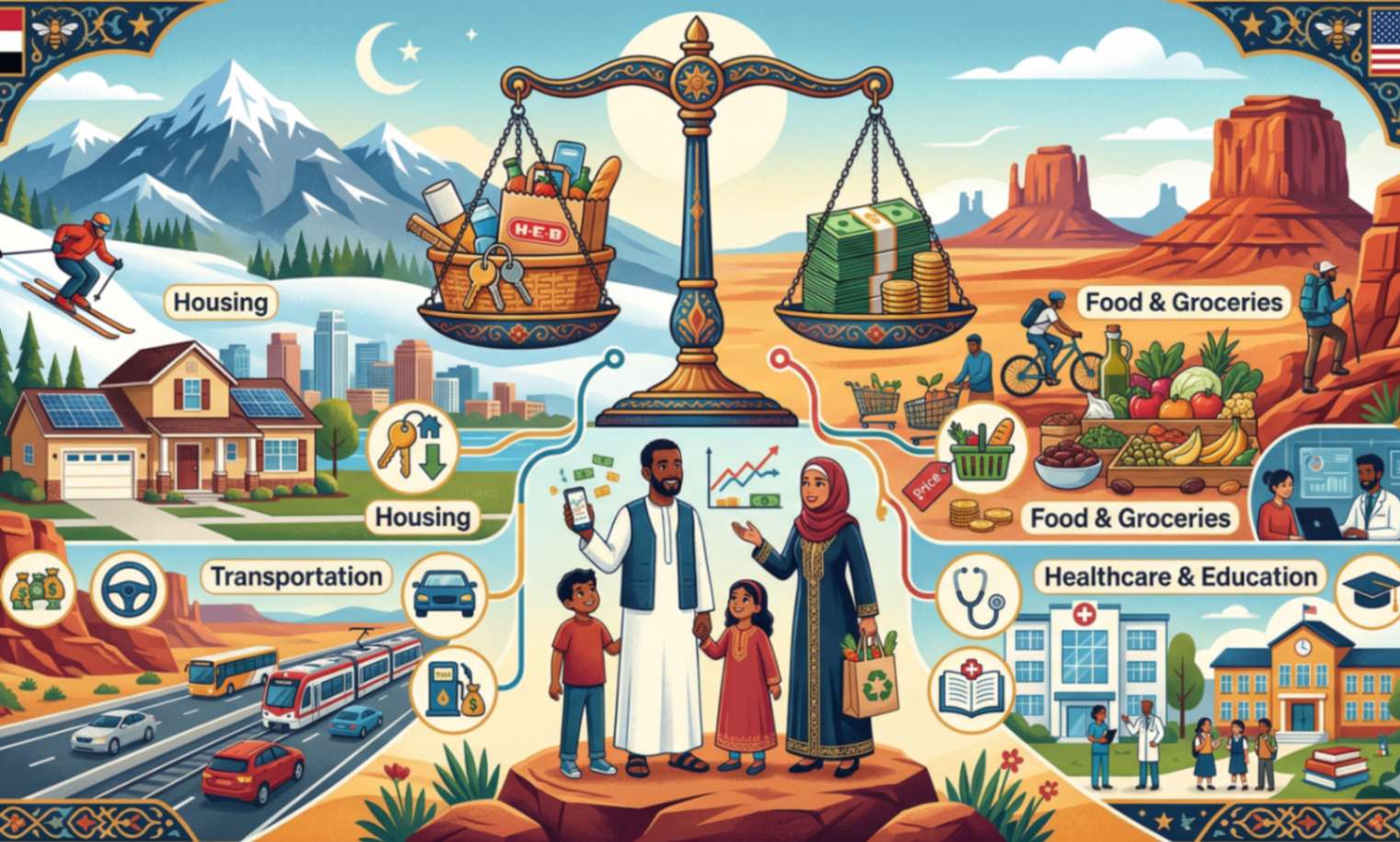
Cost of Living in Utah 2026: The Complete Guide to Rent, Taxes, and a Real Monthly Budget
Let me tell you a story that captures why families choose Utah. A Syrian-American software developer I know — let's call him Tarek — spent five years in the Bay Area after landing his first U.S. job. He earned $145,000 a year. His wife worked part-time. They had one child, then another. And yet, every month felt like a financial knife fight. Their two-bedroom apartment in San Jose consumed $3,600. Daycare cost more than in-state college tuition. They saved nothing. The traffic was an hour each way. On a Wednesday evening, stuck on the 101 freeway for the third time that week, Tarek called me. "Hussein," he said, "I'm looking at a job in Utah. The salary is $115,000. My friends say I'm crazy to take a pay cut. What do you think?"
I asked him one question: "What do you think your rent would be on that $115,000 salary?" He hadn't calculated it. So we did the math together. A two-bedroom in West Valley City, near a mosque, near a good school: $1,600. That was $2,000 less per month than San Jose — $24,000 a year in housing savings alone. Add the difference in state income tax, gas prices, and general daily costs, and Tarek's $115,000 Utah salary would deliver a higher quality of life than his $145,000 California salary. He took the job. Two years later, he owns a home in South Jordan. His children ride bikes in the street. He saves 15% of his income. The pay cut was not a pay cut. It was a life upgrade disguised as a smaller number.
This is the story I have watched repeat dozens of times. Utah in 2026 is not the cheapest state in America — but for Arab families earning professional salaries, it delivers one of the strongest value propositions in the country: housing costs significantly below coastal levels, a simple and moderate flat income tax, property taxes that are genuinely low by national standards, and a quality-of-life premium in safety and natural beauty that is difficult to quantify but impossible to ignore once you experience it.
hussin advice: After 15 years of watching Arab families budget their way across America, I can tell you this: the families who thrive financially don't just chase the highest salary. They calculate the effective salary — what remains after housing, taxes, and transportation. In that calculus, Utah frequently outperforms states with higher nominal wages. The key is budgeting honestly for winter utilities and understanding the tax structure before you arrive.
🔍 What You'll Get in This Guide
- 🏠 Real 2026 rent and home prices for Salt Lake City, West Valley City, South Jordan, Sandy, Provo, and Ogden — not averages, but neighborhood-level bands you can actually use
- 🚗 The true cost of transportation in Utah — gas, insurance, and why UTA's TRAX and FrontRunner can actually replace a second car for some families
- 🛒 Grocery and halal food costs — from WinCo and Walmart discipline to the growing halal meat infrastructure in West Valley City
- 🏫 Islamic school tuition benchmarks — what Utah Islamic Academy and weekend programs actually cost
- 🏥 Healthcare and winter utility realities — the heating bills that spike in January, and how to budget for them
- 💰 The Utah tax chapter — flat 4.85% income tax explained, plus Utah's hidden advantage: genuinely low property taxes compared to Texas
- 📊 Two complete sample monthly budgets — a comfortable West Valley City family of four, and a lean Ogden starter plan
- 💡 Immigrant-tested money-saving strategies — winter insulation, pharmacy discount apps, and Utah's free outdoor recreation as family entertainment
Pair this budget guide with Arabs in Utah: Community, Mosques, and Life Guide for neighborhood context, mosques, and community networks. For the detailed Muslim demographic picture, see Muslims in Utah: 2026 Statistics and Analysis. For cross-state comparisons, use Cost of Living in California and Cost of Living in Texas. For national guidance, start with Best U.S. States for Arabs to Live.
After landing, prioritize Health Insurance in America and Opening a U.S. Bank Account. Job seekers should read Work in America for New Immigrants.
Chapter One: Why Utah? The Financial Comparison That Matters
When Arab families ask me "Is Utah actually affordable, or is that outdated information?", here is the data I show them. Utah is not the bargain it was in 2010 — housing costs have risen significantly — but for professional families relocating from California, New York, or Seattle, the math still works powerfully.
Utah vs. California: The Migration That Makes Financial Sense
| Cost Factor | Utah | California | Your Annual Savings |
|---|---|---|---|
| State income tax (on $100k) | $4,850 (flat) | $6,000-$9,300 | $1,150-$4,450/year |
| 2BR rent (good area) | $1,500-$2,100 | $2,800-$4,200 | $1,300-$2,100/month |
| 4BR home purchase | $400k-$600k | $800k-$1.5M+ | $400k-$900k+ debt avoided |
| Gas (per gallon) | $3.20-$3.80 | $4.50-$5.50 | $1.30-$1.70/gallon |
| Property tax rate | ~0.8-1.1% | ~0.7-1.0% (but on far higher values) | Massive dollar savings |
The housing differential alone — saving $1,300-$2,100 monthly on rent — funds a significant portion of a family's entire annual food, transportation, and utility budget. Over five years, the cumulative savings versus California can exceed $100,000 for a middle-class family.
Utah vs. Texas: The Tax Tradeoff
This comparison is more nuanced. Texas offers 0% state income tax, which is its signature advantage. Utah charges a flat 4.85% income tax. But Utah often offsets this difference partially with significantly lower property taxes.
| Tax Factor | Utah | Texas |
|---|---|---|
| State income tax | Flat 4.85% | 0% |
| Effective property tax rate | ~0.8-1.1% | ~1.8-2.2% |
| Property tax on $450k home | ~$3,600-$4,950/year | ~$8,100-$9,900/year |
| Sales tax (combined) | ~6.1-7.35% | ~8.25% |
For a family earning $100,000 that purchases a $450,000 home:
- In Utah: $4,850 income tax + ~$4,500 property tax = $9,350 total state taxes
- In Texas: $0 income tax + ~$9,000 property tax = $9,000 total state taxes
The total tax burden is remarkably similar. The decision between Utah and Texas, then, should be driven by climate preference, community size, job market specifics, and lifestyle priorities — not by an assumption that Texas is automatically cheaper.
خالد, a Palestinian accountant who moved his family from Dallas to Sandy, Utah, explains: "Everyone in Texas talked about 'no state income tax' like it was free money. But my property tax bill on a $400,000 home in Plano was almost $8,000 a year. In Sandy, my home is worth $520,000 but my property tax is around $4,500. And my kids can play outside in July without heat stroke. The tax advantage in Texas is real for renters, but for homeowners, Utah is much closer than people realize — and the quality of life, the mountains, the safety... that is the real difference."
Chapter Two: Housing in Utah — Your Biggest Monthly Line Item
Housing is the lever that determines whether your Utah budget breathes or suffocates. Price variation between cities and neighborhoods is significant.
Directional Monthly Rent for a Two-Bedroom Apartment (2026)
| City | Budget & Older Areas | Typical "Good" School Zones | Premium/Downtown | Best For |
|---|---|---|---|---|
| Salt Lake City | ~$1,300 | $1,600-$1,900 | $2,400+ | Job proximity, urban lifestyle |
| West Valley City | ~$1,200 | $1,500-$1,800 | $2,200+ | Largest Arab/Muslim concentration |
| South Jordan | ~$1,400 | $1,700-$2,100 | $2,600+ | Top schools, upscale suburbs |
| West Jordan | ~$1,300 | $1,600-$1,900 | $2,300+ | Growing Arab community, good value |
| Sandy | ~$1,400 | $1,700-$2,000 | $2,500+ | Quiet, mountain access |
| Provo | ~$1,200 | $1,500-$1,800 | $2,200+ | College town, conservative culture |
| Ogden | ~$1,100 | $1,400-$1,700 | $2,000+ | Most affordable major option |
فاطمة, an Iraqi mother of three who rents in West Valley City, shares: "We first looked in Salt Lake City proper. For $1,700, we could get a decent two-bedroom but the neighborhood felt transient. In West Valley City, we pay $1,550 for a three-bedroom, the Khadija Mosque is ten minutes away, and my kids' school has other Muslim children. The Arabic grocery on Redwood Road knows us by name. Saving $150 a month on rent versus Salt Lake while gaining community proximity — that is a double win."
Directional Home Purchase Prices (2026)
| City | Typical 4BR Home Price Band | Approx. Annual Property Tax (0.8-1.1%) | All-In Monthly (Mortgage+Tax+Insurance) |
|---|---|---|---|
| Salt Lake City | $450k-$550k | ~$3,600-$4,950 | ~$2,800-$3,600 |
| West Valley City | $400k-$480k | ~$3,200-$4,300 | ~$2,500-$3,200 |
| South Jordan | $550k-$700k | ~$4,500-$6,300 | ~$3,500-$4,800 |
| Sandy | $500k-$600k | ~$4,000-$5,400 | ~$3,200-$4,200 |
| Provo | $450k-$550k | ~$3,600-$4,950 | ~$2,800-$3,600 |
| Ogden | $350k-$450k | ~$2,800-$4,050 | ~$2,200-$3,000 |
Three Critical Housing Rules in Utah
1. Utah property taxes are among the lowest in the nation — this is a genuine, underappreciated advantage. The effective rate of 0.8-1.1% means a $500,000 home carries roughly $4,000-$5,500 in annual property tax, compared to $9,000-$11,000 for a similarly priced home in many Texas counties. Over a 30-year mortgage, this difference alone can exceed $150,000.
2. Suburbs often offer better value than Salt Lake City proper for families. West Valley City provides the best combination of Arab community proximity, mosque access, and housing affordability in the entire state. South Jordan and Sandy offer premium schools and larger homes at a higher price point. Salt Lake City itself commands a premium for urban proximity that many families find unnecessary, especially when the suburban commute is manageable by car or TRAX.
3. Winter utility costs are a real budget line — and they vary dramatically by housing quality. A well-insulated apartment built after 2010 may have a January gas bill of $80-$120. A charming but drafty older home from the 1950s can easily run $250-$350 that same month. During apartment tours, ask the landlord for average winter utility bills. For home purchases, request the seller's utility history for the previous 12 months. This due diligence can prevent budget shocks.
Chapter Three: Transportation — Cars, TRAX, and the Commute Equation
Utah's transportation landscape is more balanced than many states. The car is still dominant, but the Utah Transit Authority (UTA) system — TRAX light rail and FrontRunner commuter rail — is genuinely useful for specific corridors.
The Real Monthly Cost of One Car (2026 Directional)
| Cost Factor | Budget (Older Paid-Off Car) | Moderate (Financed Reliable Sedan) | Premium (New SUV/Truck) |
|---|---|---|---|
| Car payment | $0 | $300-$500 | $550-$850 |
| Gasoline ($3.20-$3.80/gal) | $100-$150 | $120-$180 | $160-$250 |
| Insurance | $70-$100 | $80-$120 | $110-$170 |
| Maintenance | $40-$70 | $50-$80 | $70-$120 |
| Monthly Total | $210-$320 | $550-$880 | $890-$1,390 |
Gasoline context: Utah gas prices in 2026 typically range $3.20-$3.80 per gallon — higher than Texas but lower than California. The state's refineries and distribution infrastructure keep prices moderate by Western U.S. standards.
Insurance context: Utah auto insurance rates are lower than the national average, reflecting the state's relatively safe driving environment and lower accident rates. Many families report $70-$120 monthly per vehicle.
Public Transit: A Real Option for Some
UTA's TRAX light rail serves Salt Lake City, South Salt Lake, Murray, Sandy, Draper, West Valley City, and the University of Utah. FrontRunner commuter rail connects Ogden to Salt Lake City to Provo. For families with one spouse working downtown or at the University, and living near a TRAX or FrontRunner station, a single-car household is genuinely feasible — a significant budget advantage. Monthly transit passes run approximately $85-$100, far less than the monthly cost of a second car.
Airport access: Salt Lake City International Airport (SLC) is a Delta hub with growing international service. Direct flights to Europe are available; flights to the Middle East typically connect through major Eastern hubs.
Chapter Four: Food & Groceries — From WinCo to the Halal Butcher
Monthly Grocery Budget for a Family of Four (2026 Directional)
| Budget Tier | Monthly Spend | Shopping Pattern |
|---|---|---|
| Lean (disciplined) | $500-$700 | WinCo + Walmart + bulk Costco runs, almost all home cooking |
| Comfortable Middle | $700-$900 | Smith's or Harmons primary, halal butcher for meats, occasional imported specialty items |
| Premium/Imported | $900-$1,200+ | Whole Foods or Harmons premium, frequent specialty Arab grocery runs |
The halal meat infrastructure: West Valley City and Salt Lake City have multiple halal meat markets serving the Arab, Somali, Bosnian, and broader Muslim communities. Competition keeps halal prices reasonable — typically a 15-25% premium over conventional meat. The selection of Middle Eastern specialty products (za'atar, sumac, tahini, Arabic coffee, frozen molokhia, imported labneh) has expanded significantly in the past three years.
The WinCo advantage: Utah is one of the few states with WinCo Foods, an employee-owned discount grocer that consistently undercuts even Walmart on staples. Many Arab families in the Salt Lake Valley use WinCo for bulk grains, spices, produce, and dairy, reserving the halal butcher and specialty stores for meats and imported goods. This combination discipline is the most effective way to control grocery costs.
Dining out: Fast food $8-$12/person. Casual ethnic (kebab, shawarma, Middle Eastern) $10-$18/person. Upscale $25-$50/person before 18-20% tip. Delivery apps add 30-40% in fees — limit these to preserve your budget.
Chapter Five: Education & Islamic Schools — Planning for Tuition
For Arab families, education costs are often the second-largest monthly outlay after housing. Utah's public schools are strong in select suburban districts, and the Islamic educational infrastructure, while smaller than in Texas or Michigan, is growing.
Public Schools: Tuition-Free, With Ancillary Costs
Public schools are free for all Utah residents, including immigrant families. Quality varies by district:
- Strong districts for Arab families: Jordan School District (South Jordan, West Jordan), Canyons School District (Sandy, Draper), and select Salt Lake City School District magnet programs.
- Ancillary costs to budget: School supplies $50-$150/year per child, activities/sports/field trips $100-$500/year, uniforms if required $100-$300/year, school meals ~$2-$3/day (free/reduced programs available).
Islamic Private Education
- Utah Islamic Academy (associated with the West Valley Muslim community): Estimated annual tuition $4,000-$6,500 per child depending on grade level. Sibling discounts are typically available. The school provides Islamic studies, Arabic language instruction, and a standard academic curriculum.
- Weekend Islamic schools at Khadija Mosque and the Utah Islamic Center offer Arabic, Quran memorization, and Islamic studies at significantly lower cost — typically $500-$1,500 per year per child. Many families use public school Monday-Friday combined with weekend Islamic school as a cost-effective strategy that preserves both academic quality and faith education.
Higher Education
- University of Utah (Salt Lake City): In-state tuition approximately $9,000-$12,000/year. Strong engineering, medical, and business programs. Active Muslim Student Association.
- Utah State University (Logan): In-state tuition approximately $7,000-$10,000/year.
- Brigham Young University (Provo): Private, LDS-affiliated. Tuition approximately $6,000-$8,000/year for LDS members; higher for non-members. Some Muslim students attend, but the cultural environment requires honest evaluation.
- Community colleges (Salt Lake Community College, etc.): $2,000-$5,000/year — an excellent, underused strategy for the first two years of a bachelor's degree.
For the national picture, see Islamic Schools in America 2026.
Chapter Six: Healthcare & Winter Utilities — The "Surprise" Budget Categories
Health Insurance
- Employer family plan: Budget employee contribution at $200-$500/month.
- ACA marketplace without subsidies: Family coverage can run $700-$1,200/month.
- ACA with income-based subsidies: Many families pay $100-$300/month.
- Cash-pay doctor visits: Primary care $100-$180, specialist $150-$250, emergency room visit often $800-$2,000+ before insurance adjustment.
Do not go uninsured. A Utah winter slip on an icy sidewalk can result in a broken wrist and a multi-thousand-dollar ER bill. Read the complete insurance strategy in Health Insurance in America. If you face a gap in coverage, see What to Do If You Get Sick Without Insurance.
Winter Utilities: The Budget Line That Surprises Newcomers
Utah winters are real. December through February, temperatures routinely drop below freezing overnight, and daytime highs often sit in the 30s. Heating costs spike accordingly.
- Natural gas heating (winter months): $100-$250 for a two-bedroom apartment depending on insulation quality; $150-$350 for a single-family home. Older, drafty homes push toward the upper end.
- Electricity (summer months): $80-$150 for most apartments; $120-$250 for homes. Utah's dry heat means AC usage is lower than in Texas or Arizona.
- Water, trash, fast internet bundle: $100-$150/month combined in most areas.
- Annual average utility budget: $200-$350/month when smoothed across seasons.
Winter budgeting strategies:
- Request a home energy audit before purchasing an older home.
- Use a programmable thermostat to lower temperatures during sleeping hours and work hours.
- Check window seals and door weatherstripping before signing a lease — drafts are the primary driver of winter heating costs.
Chapter Seven: Taxes in Utah — Simple, Moderate, and Often Fairer Than You Expect
Utah's tax structure is uncomplicated by design. There is no progressive bracket system at the state level — one flat rate applies to all taxable income.
The Flat Income Tax: 4.85%
Every Utah taxpayer, whether earning $30,000 or $3,000,000, pays the same 4.85% state income tax rate on taxable income. This is higher than Texas's 0% but lower than California's progressive brackets (which can exceed 13% for high earners), and simpler than the multi-bracket systems in New York or New Jersey. A family earning $100,000 in adjusted gross income pays approximately $4,850 in Utah state income tax — often less after credits and deductions.
Property Tax: Utah's Hidden Financial Weapon
Utah's effective property tax rates, at roughly 0.8-1.1% of assessed value, are among the lowest in the United States. This is the factor that makes Utah homeownership surprisingly affordable compared to states with no income tax but high property taxes.
Sales Tax
The state base is 4.85%, with local add-ons bringing combined rates to roughly 6.1-7.35% depending on the specific city and county. Grocery food is taxed at a reduced rate in Utah (unlike many states that exempt groceries entirely), but the combined rate on most purchases remains lower than many jurisdictions in California, Texas, or Illinois.
The honest tax summary: For most middle-class and upper-middle-class families who own a home, Utah's total tax burden is competitive with — and often lower than — states with flashier "no income tax" branding. The combination of moderate flat income tax, low property tax, and reasonable sales tax creates a predictable, budget-friendly environment.
Chapter Eight: Two Real Monthly Budgets for an Arab Family of Four (2026)
Model A — West Valley City (Comfortable Middle-Class Family)
This family rents a three-bedroom apartment near the mosque and community services, cooks mostly at home, drives one financed car, and sends two children to the Utah Islamic Academy or equivalent weekend program.
| Category | Estimated Monthly Cost | Notes |
|---|---|---|
| Rent (3BR, near community) | $1,600-$2,000 | West Valley City area |
| Groceries + halal meat | $700-$950 | WinCo/Smith's + halal butcher |
| One car (financed + gas + insurance + maintenance) | $600-$850 | Toyota Camry or similar, 15-mile commute |
| Health insurance (employer plan) | $300-$500 | Family coverage, employer-subsidized |
| Utilities (electricity, gas, water, internet) | $250-$350 | Winter heating included in annual average |
| Islamic education (2 children, weekend + tutoring) | $200-$600 | Weekend school + private Arabic tutoring |
| Personal, clothing, entertainment | $250-$450 | Streaming, weekend outings, modest clothing |
| Savings, emergency fund | $500-$1,000 | Crucial for long-term stability |
| Total Net Monthly Spend | $4,400-$6,700 | Requires gross household income ~$75k-$105k |
Model B — Ogden (Lean, Dignified Starter Budget)
This family rents a two-bedroom in a mid-tier complex, drives a paid-off car, uses public schools, and cooks entirely at home.
| Category | Estimated Monthly Cost | Notes |
|---|---|---|
| Rent (2BR, mid-tier) | $1,200-$1,500 | Ogden area, older building |
| Groceries | $550-$750 | WinCo + Costco discipline |
| One car (paid off: gas + insurance + maintenance) | $350-$500 | Liability-focused insurance |
| Health insurance (high-deductible plan) | $250-$450 | Marketplace or employer bare-minimum |
| Utilities | $200-$300 | Winter gas discipline essential |
| Public school costs | $0-$100 | Supplies and incidental fees only |
| Personal, minimal | $150-$250 | Essentials and occasional modest outings |
| Total Net Monthly Spend | $2,700-$3,850 | Requires gross household income ~$48k-$65k |
These figures are net of taxes — representing actual spending after federal tax, state income tax, Social Security, and Medicare deductions. Your gross salary must be higher. For banking and credit context, see Opening a U.S. Bank Account and Build Credit Score from Scratch.
Chapter Nine: Salary Benchmarks — What Income Supports Which Life?
| Household Configuration | Comfortable Life (Gross Annual) | Lean But Dignified (Gross Annual) |
|---|---|---|
| Single adult, no children | $50,000-$65,000 | $35,000-$45,000 |
| Couple, no children | $65,000-$80,000 | $48,000-$60,000 |
| Family of four (comfortable suburb) | $80,000-$110,000 | $60,000-$75,000 |
| Family of four (South Jordan premium) | $95,000-$130,000 | $70,000-$85,000 |
Directional gross salaries by occupation (2026):
- Software Engineer: $85,000-$130,000
- Registered Nurse: $65,000-$85,000
- Civil/Structural Engineer: $70,000-$100,000
- Accountant: $55,000-$75,000
- Teacher: $50,000-$65,000
- Warehouse/Delivery Worker: $35,000-$45,000
For the broader employment landscape, including the Silicon Slopes tech sector, see Work in America for New Immigrants.
Chapter Ten: Seven Money-Saving Strategies Immigrant-Tested in Utah
1. Consider a TRAX/FrontRunner commute before buying a second car. If one spouse works downtown or at the University of Utah, and you live near a TRAX or FrontRunner station, a monthly $85-$100 transit pass can replace a $500-$900 monthly second-car expense. The Wasatch Front is one of the few Western U.S. corridors where this math genuinely works.
2. WinCo + Costco discipline beats Harmons and Whole Foods. WinCo for dry goods, produce, and dairy; Costco for bulk halal meat, rice, and household supplies; the halal butcher for specialty meats. This combination consistently produces the lowest grocery bills.
3. Winter-proof your housing. Before signing a lease, check window seals, door weatherstripping, and the age of the HVAC system. A well-insulated apartment costs $100/month less to heat in January than a drafty one — $400-$500 saved over a winter.
4. Use GoodRx for prescription savings. The price difference between insurance copay and GoodRx cash price can be dramatic. Always compare before swiping your insurance card.
5. Leverage Utah's free outdoor recreation. The Wasatch Mountains, national parks, hiking trails, and lakes are low-cost family entertainment. A $45 annual state parks pass replaces expensive weekend activities.
6. Build a Utah winter emergency fund. Aim for $8,000-$12,000 in reserves. Winter car repairs, heating system failures, and unexpected medical bills are the most common financial shocks for newcomers. The buffer is essential.
7. File for Utah's renter's credit if eligible. Utah offers a renter's credit (a partial property tax refund mechanism) for qualifying renters. Check with the Utah State Tax Commission annually to see if your income qualifies.
Chapter Eleven: Utah Metro Comparison Table (2026 Directional)
| Factor | Salt Lake City | West Valley City | South Jordan | Provo | Ogden |
|---|---|---|---|---|---|
| 2BR Rent (good area) | $1,600-$1,900 | $1,500-$1,800 | $1,700-$2,100 | $1,500-$1,800 | $1,400-$1,700 |
| 4BR Home Purchase | $450k-$550k | $400k-$480k | $550k-$700k | $450k-$550k | $350k-$450k |
| Gas (per gallon) | $3.40-$3.80 | $3.40-$3.80 | $3.40-$3.80 | $3.30-$3.70 | $3.30-$3.70 |
| State Income Tax | 4.85% flat | 4.85% flat | 4.85% flat | 4.85% flat | 4.85% flat |
| Effective Property Tax | ~0.9-1.1% | ~0.8-1.0% | ~0.9-1.1% | ~0.9-1.1% | ~0.8-1.0% |
| Family-of-4 Budget (Net) | $4,500-$6,200 | $4,200-$5,800 | $4,800-$6,500 | $4,200-$5,800 | $3,800-$5,200 |
| Best For | Urban convenience, jobs | Arab community + value | Elite public schools | College town, conservative | Maximum affordability |
Frequently Asked Questions: Cost of Living in Utah
Q: Is Utah genuinely affordable compared to other states? A: Utah is mid-pack nationally — significantly more affordable than California, New York, or Massachusetts, but generally pricier than Texas, Ohio, or Indiana on housing. Utah's value proposition is strongest for professional families who benefit from the combination of strong salaries (especially in tech and healthcare), moderate income tax, and very low property taxes.
Q: What is the cheapest city in Utah for an Arab family? A: Ogden offers the lowest housing costs among the major Wasatch Front cities. West Valley City offers the best combination of affordability and Arab community infrastructure (mosques, halal groceries, Islamic education).
Q: What is the most expensive city in Utah? A: Park City is the most expensive by a wide margin, driven by the resort economy. Among family-oriented suburbs, South Jordan and Sandy command the highest prices due to elite public school ratings and proximity to the Silicon Slopes tech corridor.
Q: Can I live comfortably on $60,000 a year in Utah? A: As a single adult or couple without children: yes, in most cities outside premium Salt Lake neighborhoods. As a family of four: it will be tight. You will need to choose Ogden or West Valley City, use public schools, and maintain strict budgeting discipline. Comfortable family life generally requires gross household income of $80,000-$110,000 depending on city and schooling choices.
Q: Is the 4.85% flat income tax punitive? A: No. For most middle-class families, a flat 4.85% rate is simpler and often lower than the progressive brackets they would face in California, New York, or New Jersey. The flat rate also means your taxes remain predictable as your income grows.
Q: Are Utah property taxes really that low? A: Yes. Utah's effective property tax rate of 0.8-1.1% is among the lowest nationally. This is a significant and underappreciated advantage for homeowners, partially offsetting the 4.85% income tax.
Q: Do I need a car in Utah? A: Probably at least one. The Wasatch Front has functional public transit (TRAX, FrontRunner, buses), and some families can manage with one car if one spouse commutes by rail. But a car-free life is difficult unless you live and work within walking distance of a TRAX station.
Q: Are winter heating bills really that bad? A: In older, poorly insulated homes, yes. A drafty 1950s house can cost $250-$350 per month to heat in January. A well-insulated apartment built after 2010 may cost $80-$120 for the same month. Insulation quality matters enormously — investigate before renting or buying.
Q: How much is Islamic school tuition in Utah? A: Directionally, $4,000-$6,500 per child per year for full-time Islamic education at Utah Islamic Academy. Weekend Islamic school programs at mosques are significantly less expensive, typically $500-$1,500 per year.
Q: Is Utah a good financial choice for Arab families compared to California or Texas? A: Utah offers a distinct value proposition: lower costs than California across the board, lower property taxes than Texas, and a level of safety and natural beauty that neither state can match. The job market is strong but smaller than in Texas. The Arab community is growing but still much smaller than in either California or Texas. The right choice depends on whether you prioritize the highest possible salary and largest Arab community (California), maximum economic value and no income tax (Texas), or safety, quality of life, and a simpler tax structure (Utah).
Conclusion: Utah Rewards the Planner
Utah in 2026 offers Arab and immigrant families something increasingly rare in America: a state where a professional salary still buys a genuine middle-class life. Housing costs are not cheap, but they are manageable. The flat 4.85% income tax is moderate and predictable. The property taxes are genuinely low. The job market — especially in Silicon Slopes tech, healthcare, and education — is strong and growing.
But Utah is not a financial fairy tale. Winter heating bills will spike. The car is still necessary for most families. The Islamic educational infrastructure, while growing, is not yet as developed as in Texas or Michigan. Budgeting honestly — accounting for winter utilities, transportation costs, and education expenses — is the difference between a family that thrives here and one that struggles.
The families I have watched succeed in Utah are the ones who chose their city based on housing costs and mosque proximity, not just job salary. They redirected the savings from Utah's low property taxes and moderate income tax into emergency funds and home down payments. They learned to love the mountains as free recreational therapy. And they built community through the mosques and Islamic centers that are working hard to anchor a growing Arab and Muslim presence in the state.
Your turn: Are you living in Utah now, or planning a move? What city are you in, and what does your real monthly budget look like? What surprised you most about the cost of living — and what is your best money-saving tip for the next Arab family arriving? Share your experience below. Your numbers could be exactly what someone else needs to build their own Utah plan with confidence.
🔗 Explore More Financial and Relocation Guides
- Arabs in Utah: Community, Mosques, and Life Guide — Neighborhood context, mosques, and the growing Arab social landscape
- Muslims in Utah: 2026 Statistics and Analysis — Detailed demographic picture of the Muslim community
- Mosques in Utah 2026: Islamic Centers & the Muslim Community — Full directory with addresses and programs
- Cost of Living in California: Rent, Taxes, and Budget — The coastal alternative, fully budgeted
- Cost of Living in Texas: Rent, Taxes, and Budget — Compare Utah with the no-income-tax powerhouse
- Best U.S. States for Arabs to Live — National comparison of all major Arab population centers
- Work in America for New Immigrants — Job search strategy, resume preparation, and salary negotiation
- Health Insurance in America — Understanding ACA, employer plans, and your options

Author: حسين عبد الله
Hussein Abdullah is a web developer and specialized content writer with more than eight years of experience enriching Arabic digital content. He combines an analytical programming mindset with a deep passion for writing to deliver accurate, reference-quality guides. On Arabian in USA (عرب في أمريكا), he focuses on simplifying complex steps for new immigrants and sharing reliable information on housing, work, and financial setup—so every newcomer has a trustworthy path toward stable life in the United States.


Continue reading
- Arabs in Utah 2026: The Complete Guide to the Arab Community, Life, Jobs & Best Neighborhoods
- Muslim Population in Utah 2026: Full Statistics and Community Analysis
- Muslim Population in America 2026: Complete State-by-State Guide, Statistics & Interactive Map
- Mosques in Utah 2026: Complete Guide to Islamic Centers and the Muslim Community
- Top 10 Best States for Muslims in America: Ultimate Guide (Updated 2026)
- Top 7 Best States for Arabs in America: Ultimate Guide (Updated 2026)