Mosques in Utah 2026: Complete Guide to Islamic Centers and the Muslim Community
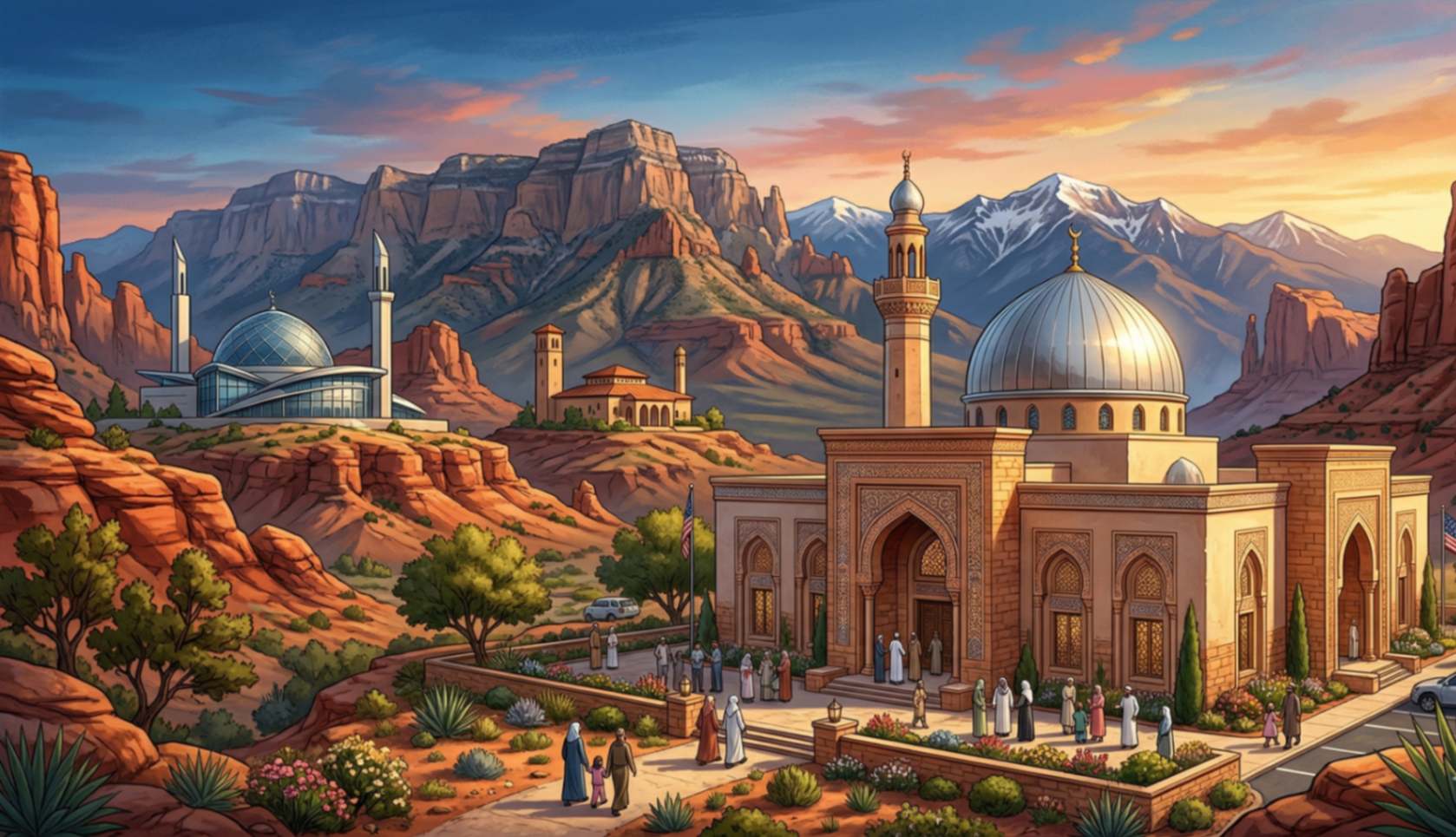
Mosques in Utah 2026: A Complete Guide to Major Islamic Centers and the Muslim Community
Let me take you back to a moment that still moves me. In the late 1990s, a small group of Muslim families in Salt Lake City gathered in a rented community hall for Jumu'ah. They laid down simple rugs on a cold floor. The imam stood in front of a folding partition. The children sat cross-legged, wide-eyed, not fully understanding why their fathers had tears in their eyes during the khutbah. Those men were not crying from sadness. They were crying because, for the first time in a state where they had felt invisible, they were praying together — a small congregation in a borrowed room, planting the seed of a community that would one day fill stadiums on Eid morning.
Fast forward to 2026. That borrowed room has been replaced by purpose-built Islamic campuses with full-time schools, gymnasiums, and parking lots that overflow every Friday. The Utah Muslim community, now estimated at roughly 55,000 according to community-based demographic counts, is no longer a curiosity. It is an established, respected, and increasingly visible part of the state's religious landscape. The mosques described in this guide are the physical, spiritual, and social anchors of this transformation.
In this complete 2026 guide, I will walk you through every major mosque and Islamic center in Utah — from the historic Islamic Center of Utah in Salt Lake City, the first permanent mosque in the state, to the sprawling, multi-purpose Utah Islamic Center in West Valley City, and the thriving suburban congregations in South Jordan and beyond. Whether you are relocating your family, arriving as a student, or visiting and looking for a welcoming place to pray, this is your map.
When I first visited Utah's mosques more than a decade ago, I remember thinking the community was small but unusually warm. Today, visiting the same centers, I see packed prayer halls, children reciting Quran in weekend schools, and families building genuine lives here. The growth is real, and it happened while the rest of the country was not looking.
🔍 What You'll Get in This Guide
- 🕌 Detailed profiles of 8 major mosques and Islamic centers — location, services, unique strengths, and who they best serve
- 📊 Demographic context — how many Muslims live in Utah, where they cluster, and what ethnic and cultural diversity means for mosque life
- 🎓 Full-time Islamic education options — a close look at the Utah Islamic Academy and the weekend school network
- 🌙 Ramadan and Eid in Utah — where the community gathers, what to expect, and how to prepare
- 🗺️ A practical newcomer's guide — how to find the nearest mosque, what to know about parking and prayer times, and how to connect quickly
- ❓ Answers to the most common questions — safety, Arabic-language services, women's programming, and more
For the complete demographic picture, pair this guide with Muslim Population in Utah 2026: Statistics and Analysis. For community life beyond the mosque, read Arabs in Utah: Complete Community Guide. For a comparison with a larger mosque network, see Mosques in California 2026. For the national Islamic school picture, visit Islamic Schools in America.
1) The Muslim Population in Utah — Understanding the Community Behind the Mosques
To appreciate why Utah's mosques look and feel the way they do, you must first understand the community that fills them. Utah's Muslim population is one of the fastest-growing in the Rocky Mountain region, and its composition is more diverse than many people expect.
Total Muslim population: Community estimates for 2026 place the number between 52,000 and 58,000 — approximately 1.6% to 1.8% of Utah's total population. This represents genuine growth from previous decades, driven by both international immigration and internal migration from higher-cost states.
Geographic distribution: Utah's Muslims are not scattered randomly. They cluster in specific, identifiable corridors:
- Salt Lake City: 12,000–15,000 Muslims. The political and economic capital draws professionals, students, and service workers.
- West Valley City: 10,000–12,000 Muslims. This is the community's commercial and cultural heart — where you find the highest concentration of halal groceries, Arab restaurants, and Islamic institutions.
- South Jordan and West Jordan: 8,000–10,000 Muslims. Affluent suburban areas attracting established families and professionals seeking larger homes and highly rated public schools.
- Sandy and Draper: 5,000–7,000 Muslims. Southern valley communities with growing Islamic infrastructure.
- Ogden and Provo: 3,000–5,000 Muslims each. Smaller but stable clusters tied to universities, hospitals, and manufacturing.
Ethnic and cultural composition: Utah's Muslim community is genuinely global. A large Arab cohort — Palestinian, Syrian, Iraqi, Egyptian, Jordanian — forms a significant share. Major South Asian communities from India, Pakistan, and Bangladesh add another layer. Somali immigrants, many of whom arrived through refugee resettlement programs, have built a commercially active presence. And a well-established Bosnian community, dating to the 1990s, brought with it a distinctly European Islamic tradition. This diversity means that on any given Friday, you might hear a khutbah delivered in Arabic with English summary, then join an iftar where Somali sambusas sit next to Pakistani biryani and Bosnian baklava. The full demographic story is told in Muslim Population in Utah 2026. For Arab-specific context, see Arabs in Utah.
2) How Many Mosques Are in Utah in 2026?
The question "how many mosques in Utah" is more layered than it sounds. If you count every musalla, campus prayer room, and rented hall where Friday prayer is offered, the number may reach 15 or more. If you count only established, community-governed Islamic centers with regular programming, five daily prayers, and formal leadership, the number is approximately 10 to 12.
The growth trajectory is the real story. In 1990, there was essentially one mosque in all of Utah — the Islamic Center of Utah in Salt Lake City, operating from a converted building. By 2010, that number had grown to roughly five. By 2026, it has more than doubled, with the most significant recent growth occurring in the suburban communities south of Salt Lake City, where professional families are purchasing homes and demanding Islamic services within driving distance.
3) Major Mosques and Islamic Centers in Utah — A Detailed Guide
1. Islamic Center of Utah — Salt Lake City
This mosque is not simply a building. It is the primary witness to the modern history of Islam in this state.
Location: 1019 West 200 South, Salt Lake City, UT 84104. It sits near downtown, easily accessible from I-15.
Founded: 1975. This is the oldest mosque in Utah, established when the Muslim community numbered perhaps a few hundred people. The original building was modest, but the congregation's persistence built an institution that has outlasted every demographic prediction.
Core services:
- Five daily prayers on a reliable, published schedule.
- Jumu'ah with khutbahs delivered in Arabic and English, reflecting the center's role as a bridge between immigrant generations and their American-born children.
- A weekend Sunday School teaching children Quran, Islamic studies, and Arabic literacy.
- Youth and family programs — critical for a community where teenagers navigate identities as both practicing Muslims and typical American adolescents.
- Gender-specific classes in fiqh and creed.
- Robust social services: zakat collection and distribution, financial assistance for families in crisis, and resettlement support for newly arrived refugees.
Seasonal programming: During Ramadan, the center organizes large community iftars that draw hundreds. Tarawih prayers are held nightly, often featuring guest reciters. Eid prayers, when weather permits, are sometimes moved to rented convention spaces to accommodate the crowds.
Who it best serves: Muslims living in and near downtown Salt Lake City, University of Utah students, and anyone seeking the most established, historically grounded Islamic institution in the state.
يوسف, a Palestinian grandfather who has prayed at this mosque since 1982, told me: "I remember when we were thirty men on a good Friday. Now, subhanAllah, the parking lot is full an hour before the khutbah. My grandchildren attend the same Sunday School my children attended. That continuity is what a community is."
2. Utah Islamic Center — West Valley City
If the Islamic Center of Utah is the community's historical root, the Utah Islamic Center is its thriving, expansive present.
Location: 1159 West 900 South, West Valley City, UT 84119. The building is visible from the main road, a modern structure with clear Islamic architectural elements — dome, minaret, and Arabic calligraphy at the entrance.
Description: This is widely considered Utah's largest mosque by both physical footprint and weekly attendance. On a typical Friday, the main prayer hall fills to capacity, with overflow into adjacent rooms. The congregation reflects West Valley City's diversity: Arabs, South Asians, Somalis, Bosnians, African American converts, and a growing number of Latino Muslims.
Core services:
- Five daily prayers and a Jumu'ah that can draw over a thousand worshippers.
- Utah Islamic Academy: A full-time Islamic school serving kindergarten through 12th grade, housed within the center's campus. This is the crown jewel of Utah's Islamic educational infrastructure, offering a Utah-approved academic curriculum alongside Quran memorization, Arabic language, and Islamic studies.
- A fully equipped events hall used for weddings, 'aqiqah celebrations, memorial gatherings, and community conferences.
- Intensive youth programs: summer camps, sports leagues, and mentorship that compete seriously for teenagers' attention in an age of digital distraction.
- Daily and weekly Quran memorization and tajwid classes for children and adults.
Who it best serves: Families with school-age children seeking full-time Islamic education, Muslims living in West Valley City and the central Salt Lake Valley, and anyone looking for the most comprehensive Islamic campus in the state.
3. Khadija Mosque — West Valley City
Named after one of the most beloved figures in Islamic history, Khadija Mosque represents the second wave of mosque-building in Utah — purpose-built, modern, and community-funded.
Location: 2544 West 4700 South, West Valley City, UT 84118. It serves the southern end of West Valley City and adjacent communities.
Opened: 2016. The construction was funded almost entirely through community donations, a multi-year fundraising effort that became a unifying project for hundreds of families.
Core services:
- Five daily prayers and Jumu'ah in a beautiful, light-filled prayer hall.
- Exceptionally strong women's programming: The mosque features dedicated women's spaces and runs a full calendar of sisters' study circles, social events, and wellness programs. For Muslim women in Utah, Khadija Mosque has become a particularly welcoming space.
- Children's programs, including a popular "Quran Club" that blends memorization with age-appropriate activities.
- Weekly lectures in Arabic and English.
Who it best serves: Families in southern West Valley City, women seeking engaged Islamic programming, and anyone who appreciates a clean, modern, and meticulously organized mosque environment.
4. Masjid Al-Salam — South Jordan
As Utah's Muslim professional class grew — physicians, engineers, tech workers, academics — many families moved south to suburbs like South Jordan, seeking larger homes and top-rated public schools. This demographic shift created demand for Islamic services closer to home.
Location: 1257 West South Jordan Parkway, South Jordan, UT 84095. It sits in a quiet suburban setting, surrounded by residential neighborhoods and parks.
Core services:
- Five daily prayers and Jumu'ah serving the southern valley.
- Weekly tafsir and seerah classes.
- Regular family social events that strengthen neighborhood bonds.
- Teen programs addressing the specific challenges of growing up Muslim in an affluent, predominantly non-Muslim suburban environment.
Who it best serves: Professional families living in South Jordan, West Jordan, Riverton, and Herriman — particularly those who value a calm, family-oriented community at a manageable distance from the busier urban mosques.
5. Islamic Center of Sandy — Sandy
Location: 8745 South 700 East, Sandy, UT 84070.
Core services: Daily prayers, Jumu'ah, a local Quran school for children, and small-scale youth and sports activities. This center serves as the neighborhood mosque for Muslims in Sandy and Draper who prefer not to drive to the larger West Valley or Salt Lake mosques for daily prayers.
6. Islamic Center of Ogden — Ogden
Northern Utah's Muslim community is smaller but stable, anchored by professionals at nearby hospitals and universities, as well as manufacturing workers.
Location: 2450 Monroe Boulevard, Ogden, UT 84401.
Core services: Five daily prayers, Jumu'ah, religious classes, and simplified dhikr gatherings. The center also serves Muslim students at Weber State University and provides a northern base for community gatherings that would otherwise require a 45-minute drive to Salt Lake City.
7. University of Utah Muslim Student Association — Salt Lake City
Campus ministry is the backbone of any growing Muslim community in America. The University of Utah MSA serves hundreds of Muslim students, including many from the Middle East studying engineering, medicine, and computer science.
Location: Prayer space and offices on the University of Utah campus, Salt Lake City.
Core services: Regular Jumu'ah during the academic year, Islamic Awareness Week and other cultural and educational events, and academic and social support for international Muslim students navigating a new country and a rigorous university system.
8. Brigham Young University Muslim Student Association — Provo
Brigham Young University is owned and operated by The Church of Jesus Christ of Latter-day Saints, and its honor code and religious environment are distinctly Mormon. Yet Muslim students attend — some drawn by the university's strong academic programs and remarkably low tuition.
Location: On the BYU campus, Provo.
Core services: Weekly gatherings for Muslim students to discuss faith and daily life, social events that ease the isolation of being a religious minority on a religiously homogeneous campus, and coordination of Jumu'ah when space and university policy permit.
4) Summary Table: Major Utah Mosques in 2026
| Mosque | City | Key Services | Best For |
|---|---|---|---|
| Islamic Center of Utah | Salt Lake City | Prayers, Sunday School, social services, Ramadan iftars | Downtown residents, university students, historical connection |
| Utah Islamic Center | West Valley City | Full-time Islamic school (K-12), large events hall, youth programs | Families with children, comprehensive services |
| Khadija Mosque | West Valley City | Strong women's programs, Quran Club for kids | Women, families in southern West Valley |
| Masjid Al-Salam | South Jordan | Prayers, classes, calm family environment | Professional families in southern suburbs |
| Islamic Center of Sandy | Sandy | Prayers, basic Quran school | Local Sandy/Draper residents |
| Islamic Center of Ogden | Ogden | Prayers, classes, northern anchor | Northern Utah families, Weber State students |
| University of Utah MSA | Salt Lake City | Campus Jumu'ah, student support | University students and faculty |
| BYU MSA | Provo | Student gatherings, faith discussions | Muslim students at Brigham Young University |
5) Islamic Education in Utah — Preserving Identity Across Generations
For Arab and Muslim families immigrating to the United States, the most persistent anxiety is not financial. It is this question, asked quietly between spouses after the children are asleep: "How do we preserve their faith? How do we keep the Arabic alive? How do we ensure they grow up Muslim in a land where everything pulls them away?"
Utah's community has not solved this challenge entirely — no community in America has — but it has built institutions that give families a fighting chance.
Utah Islamic Academy (UIA): Located in West Valley City on the Utah Islamic Center campus, UIA offers the only full-time Islamic education in the state from kindergarten through 12th grade. The school follows the Utah state-approved core curriculum — mathematics, science, English language arts, social studies — while integrating Quran memorization, Arabic language instruction, and Islamic studies into the daily schedule. Enrollment sits between 300 and 400 students. The school's graduates have gone on to attend the University of Utah, Utah State University, and out-of-state institutions. UIA does not yet have the national reputation of Brighter Horizons Academy in Dallas or Al-Huda Academy in Houston, but it provides an essential service: an environment where a child can be fully Muslim and fully academically prepared simultaneously.
Weekend and evening programs: For the majority of Muslim families who use public schools Monday through Friday, every major mosque in Utah operates supplementary programs. The Islamic Center of Utah's Sunday School is the oldest and most established. Khadija Mosque's Quran Club and the Utah Islamic Center's evening memorization classes provide additional options. These programs vary in quality and intensity, but their collective reach is broad — thousands of Utah's Muslim children receive at least some formal Islamic education through the mosque network.
For national comparison, see Islamic Schools in America: The Complete Guide.
6) Muslim Life in Utah — Ramadan, Eid, and the Social Calendar
Mosques are not merely houses of worship. For a minority community dispersed across a vast state, they are the heartbeat of social life — particularly during the seasons that make an immigrant feel the ache of distance from home, then fill that ache with the warmth of adopted family.
Ramadan in Utah: During the holy month, the mosques transform. Every major center — the Islamic Center of Utah, Utah Islamic Center, Khadija Mosque — organizes community iftars, often on weekends, where hundreds of worshippers from every conceivable background break their fast together. The food reflects the community's diversity: Somali sambusas, Pakistani pakoras, Arab lentil soup, Bosnian bread. Tarawih prayers are held nightly. In the last ten nights, several mosques run itikaf programs, with worshippers spending the night in the mosque in intensified prayer. Utah's long summer days — when Maghrib can arrive after 9 PM — make Ramadan a particular physical challenge. The community compensates with a spirit of shared endurance that strengthens bonds.
Eid in Utah: Congregations routinely overflow mosque capacity on Eid morning. The Utah Islamic Center and Islamic Center of Utah often rent large halls or convention center spaces. In some years, the community has gathered at Liberty Park in Salt Lake City for a unified outdoor prayer. After the salah, the celebration continues — children receive eidiyah, families exchange embraces, and stalls selling halal food, sweets, and gifts turn the prayer venue into a festival ground.
Annual events beyond the religious calendar: The Utah Halal Food Festival, held annually in Salt Lake City, has become a bridge to the broader community. Thousands of non-Muslim Utahns attend to sample Arab, South Asian, and Somali cuisine, wander through cultural exhibits, and engage with their Muslim neighbors in a setting of shared enjoyment. The Utah Muslim Youth Conference, an annual program run through the mosque network, gathers teenagers and young adults to discuss identity, mental health, navigating high school and college as Muslims, and building a future that integrates faith with professional ambition.
7) Practical Tips for Visitors and Newcomers
How to find the nearest mosque: Use apps like Muslim Pro or Athan, which locate nearby Islamic centers via GPS. Google Maps is equally effective — search "mosque near me" or "Islamic center near me" for addresses, hours, and community reviews.
Prayer times and seasonal shifts: Utah observes daylight saving time and experiences dramatic seasonal variation in daylight hours. Fajr in June can be before 4:30 AM, while Isha in December can be before 6:30 PM. Use your mosque's printed timetable or a reliable app, and recalibrate when clocks change.
Jumu'ah and parking: Friday is the busiest day. At the Utah Islamic Center and Islamic Center of Utah, parking fills quickly. Arrive 20–30 minutes before the khutbah to park legally. Overflow parking on surrounding streets is sometimes available, but local parking regulations are enforced — do not assume a warning before a ticket.
Connecting quickly: Do not rush out immediately after prayer. Stay for a few minutes and introduce yourself to those around you. Utah's Muslims are generally warm toward newcomers, and the community is small enough that personal connections form rapidly. Facebook groups such as "Muslims of Utah" and "Arabs of Utah" are active and practical — they are often the fastest way to find housing, used cars, halal food sources, and unposted job openings.
Dress and etiquette: Mosques in Utah are generally casual and welcoming. Modest dress is expected — long sleeves and pants or long skirts — but you will see everything from thobes and abayas to jeans and button-down shirts. Remove your shoes at the entrance. If you are visiting and unfamiliar with Islamic prayer etiquette, simply observe quietly from the back or ask anyone for guidance.
8) Frequently Asked Questions About Utah Mosques
How many mosques are there in Utah? In 2026, approximately 10 to 12 major, formally recognized Islamic centers with regular programs, plus several smaller musallas and campus prayer rooms.
Where is the highest concentration of mosques? Salt Lake County — specifically West Valley City, which hosts the state's two largest Islamic centers, and Salt Lake City proper, home to the oldest mosque. South Jordan is the fastest-growing suburban mosque location.
I am an Arabic speaker with limited English. Will I find Arabic-language khutbahs and services? Yes. The Islamic Center of Utah and Utah Islamic Center deliver Jumu'ah khutbahs in Arabic, often with English summaries. Many imams are fluent Arabic speakers. The diversity of the congregation ensures Arabic remains a primary language of mosque life.
Is there full-time Islamic schooling for my children? Yes. Utah Islamic Academy in West Valley City offers kindergarten through 12th grade with an integrated academic and Islamic curriculum. For public school families, weekend and evening programs are available at all major mosques.
I am a woman. Will I find dedicated programming and space? Yes, particularly at Khadija Mosque, which has developed a reputation for strong women's programming — study circles, social events, and dedicated prayer space. The Utah Islamic Center and Islamic Center of Utah also maintain women's sections and programs.
Is Utah safe for Muslims and visibly Muslim women? Utah consistently ranks among the safer U.S. states by violent crime rate. The dominant LDS culture, while distinct from Islam, places high value on religious practice, modesty, and family — creating a social environment that many Muslims find more comfortable than the secular, permissive cultures of major coastal cities. Hijab-wearing women in the Salt Lake metro area generally report safe daily experiences. As always, isolated incidents of ignorance can occur, but systematic harassment is uncommon.
How do I enroll my child in a weekend Islamic school? Contact the mosque closest to you directly. Most weekend and evening programs have rolling enrollment and flexible start dates. The Islamic Center of Utah's Sunday School is the largest, but Khadija Mosque and Utah Islamic Center also operate robust programs. Visit the mosque office or call ahead for registration forms and fee schedules.
Conclusion
In closing, Utah is no longer a brief stopover for Muslims passing through the Mountain West. It has become a genuine, warm, and increasingly well-institutionalized home for a community that now numbers in the tens of thousands. The mosques described in this guide are not merely buildings where prayers are offered. They are the places where children learn the Arabic alphabet and the stories of the prophets. They are where families gather on Ramadan evenings, breaking fast with strangers who become neighbors who become family. They are the places where, on a cold Friday in January, a thousand people park their cars, remove their shoes, and stand shoulder to shoulder before their Creator — in the shadow of the Wasatch Mountains, in the heart of a state that most Americans still do not associate with Islam.
If you are moving to Utah, visiting, or simply researching, know that there is a community here waiting to welcome you. The mosques are open. The imams are approachable. The coffee after Jumu'ah — cardamom-scented, Arabic-style — is waiting.
Your turn: Do you pray at one of Utah's mosques, or are you planning a visit with questions about programs, schools, or community life? Share your experience, your impressions, or your questions in the comments below. Your words may be the exact thread of guidance another Muslim family needs as they consider making Utah their home.
🔗 Explore More About Muslims in Utah and America
- Muslim Population in Utah 2026: Statistics and Analysis — Detailed demographic breakdown of the community
- Arabs in Utah: Community, Life, and Opportunities Guide — The Arab experience in Utah, from neighborhoods to careers
- Mosques in California 2026: Islamic Centers Guide — Compare Utah's mosque network with the largest on the West Coast
- Islamic Schools in America: The Complete 2026 Guide — Full-time and weekend options across the country
- Muslim Population in America by State 2026 — How Utah compares with the rest of the nation
- Best States for Muslims in America 2026 — A family-focused ranking of all 50 states
Author: حسين عبد الله
Hussein Abdullah is a web developer and specialized content writer with more than eight years of experience enriching Arabic digital content. He combines an analytical programming mindset with a deep passion for writing to deliver accurate, reference-quality guides. On Arabian in USA (عرب في أمريكا), he focuses on simplifying complex steps for new immigrants and sharing reliable information on housing, work, and financial setup—so every newcomer has a trustworthy path toward stable life in the United States.


Continue reading
- Muslim Population in Utah 2026: Full Statistics and Community Analysis
- Arabs in Utah 2026: The Complete Guide to the Arab Community, Life, Jobs & Best Neighborhoods
- Muslim Population in America 2026: Complete State-by-State Guide, Statistics & Interactive Map
- Top 10 Best States for Muslims in America: Ultimate Guide (Updated 2026)
- Cost of Living in Utah 2026: The Complete Guide to Rent, Taxes, and a Real Monthly Budget
- Work in America for New Immigrants 2026: The Complete Guide from Day One to Your Dream Career [Step-by-Step Plan]