Arabs in Utah 2026: The Complete Guide to the Arab Community, Life, Jobs & Best Neighborhoods
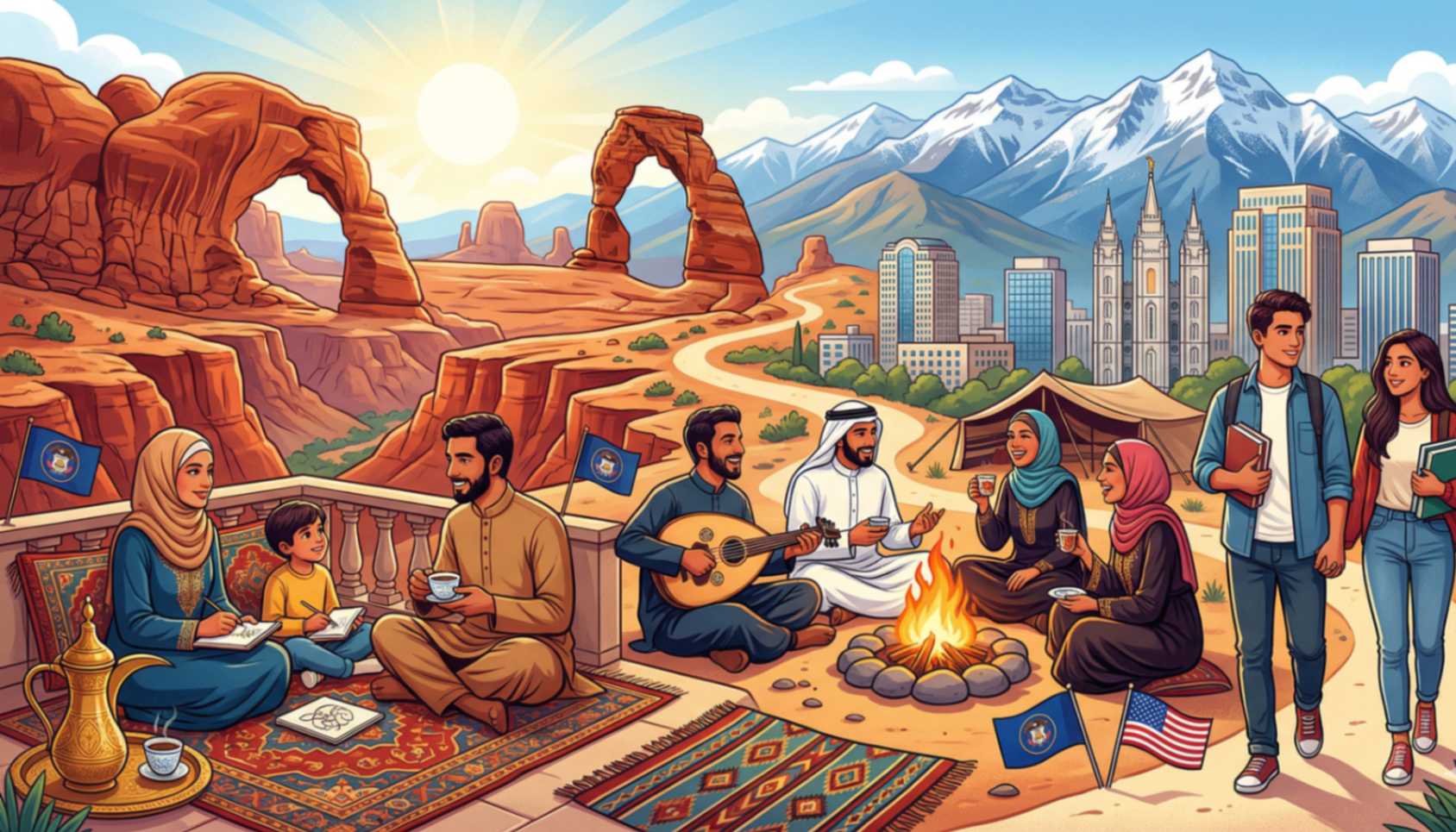
Arabs in Utah 2026: The Complete Guide to the Arab Community, Life, Jobs & Best Neighborhoods
Let me tell you about a conversation I had recently. A Palestinian software engineer I've known for years called me from his apartment in San Jose, California. He and his wife had just had their second child. Their two-bedroom rent was $3,800. Their commutes were soul-crushing. They had no family nearby. He told me, "Hussein, I'm looking at a job in a place I never thought I'd consider. Utah. Tell me honestly — will we survive there as Arabs? Will we find a mosque? Will we be the only ones?" I laughed. Then I told him the truth: "You won't just survive. You might actually breathe again. And no, you will not be the only ones."
Utah. When people hear that name, the mental images are predictable: snow-capped mountains, the Mormon Tabernacle, and perhaps a vague sense of a place that is beautiful but not for "people like us." That assumption — that Utah is culturally inaccessible to Arab and Muslim families — is perhaps the single most outdated stereotype in American migration conversations right now. In 2026, Utah has quietly built a growing, organized, and increasingly confident Arab and Muslim community, concentrated in the Salt Lake Valley, supported by a booming tech economy nicknamed "Silicon Slopes," and sustained by a cost-of-living equation that makes coastal professionals weep with envy.
According to community estimates drawing on data from the Arab American Institute (AAI), the Migration Policy Institute, and local mosque registration counts, the Arab community in Utah now likely numbers between 25,000 and 35,000 people statewide. That figure may sound modest compared to Michigan or Texas. But the trajectory is what matters: internal migration from California, Washington, and Illinois has accelerated noticeably in the past three years, driven by families seeking safety for their children, purchasing power for their paychecks, and a social environment that — despite its unique religious landscape — aligns more closely with conservative family values than most coastal metros.
This guide is your practical, honest map to Arabs in Utah in 2026: where the community lives, where it prays, where it sends its children to school, and where it works. It includes numbers you can budget, neighborhoods you can compare, and the unvarnished pros and cons I would tell a friend over coffee.
hussin advice: After 15 years helping Arabs settle across America, I've learned that the best places are often the ones that aren't obvious. Utah is not for everyone — if you need a massive, multigenerational Arab community on every corner, it cannot compete with Dearborn or Houston. But if you want safety, career growth in tech or healthcare, and a clean, family-oriented environment where your dollar still has dignity, Utah deserves a serious, informed look.
🔍 What You'll Get in This Article
- 🏔️ A realistic portrait of the Arab and Muslim community in Utah — its size, growth trajectory, and why families are leaving California for the Wasatch Front
- 🕌 A mosque-by-mosque guide — the active Islamic centers in Salt Lake, West Valley, and beyond, with the programs that anchor Arab family life
- 🏡 The neighborhoods where Arabs actually live — and why West Valley City has become the gravitational center of the community
- 💼 The Utah job engine — "Silicon Slopes" tech salaries, healthcare demand, and the entrepreneurship opportunities that are quietly multiplying
- 🍽️ The halal food and Arab grocery map — what exists now, what's missing, and how the community compensates
- 🎓 Education strategy for Arab families — public schools, Islamic weekend programs, and the university ecosystem
- 💰 Cost of living reality — rent, home prices, and why Utah's value proposition is eroding in some areas but still compelling for professionals
- 📊 A honest comparison: Utah vs. California vs. Texas for Arab families
- 📋 Answers to the hard questions — "Will my hijab be a problem?" "Is alcohol served everywhere?" "Can I find a Muslim pediatrician?"
For the complete mosque map with addresses and school profiles, pair this guide with Mosques in Utah 2026: Islamic Centers & the Muslim Community. For the line-by-line budget breakdown — rent, utilities, winter heating, and a realistic monthly plan — read Cost of Living in Utah 2026. For national context, see Best States for Arabs in America and Best States for Muslims in America. For coastal comparison, review Cost of Living in California.
Chapter One: Why Are Arabs Choosing Utah in 2026?
The motivations are more rational than they may initially appear. Arabs moving to Utah are not making a random, contrarian decision. They are responding to a specific set of structural incentives that have become increasingly powerful since the pandemic.
The Five Forces Driving Arab Migration to Utah
1. Safety — the non-negotiable priority for families. Utah consistently ranks among the five safest U.S. states by violent crime rate. For Arab parents who have experienced the property crime, street harassment, or school safety concerns in larger coastal cities, this single factor often overrides every other consideration. The suburban communities where Arabs concentrate — West Valley City, South Jordan, West Jordan, Sandy — report crime rates that are a fraction of comparable neighborhoods in Los Angeles, Oakland, or Chicago.
2. A social structure that respects family conservatism. This is the point that surprises many newcomers. Utah's dominant culture, rooted in Mormon tradition, places an unusually high value on family cohesion, modesty in public life, and abstention from alcohol and drug culture. Arab Muslim families often report feeling culturally more comfortable in suburban Utah than in the hyper-individualistic, openly permissive environments of major coastal cities. The dress code, the family-oriented weekend rhythm, the expectation that children will be supervised rather than left to roam — these align with conservative Arab parenting values in ways that frequently exceed expectations.
3. Economic momentum that is real and diversifying. The "Silicon Slopes" tech corridor, stretching from Salt Lake City south through Provo and Lehi, now hosts major operations for Adobe, Oracle, Microsoft, eBay, and a rapidly growing startup ecosystem. Healthcare and education are enormous employers. The state's unemployment rate has been consistently below the national average. For Arab professionals in software, engineering, medicine, or finance, job availability is not a theoretical concern — it is a current reality.
4. Nature and quality of life as a daily asset. The Wasatch Front offers outdoor access — hiking, skiing, mountain biking, lakes — that is integrated into daily life, not reserved for occasional vacations. For Arab families accustomed to weekend outings and outdoor socializing, this aligns well. The air is cleaner than Los Angeles. The traffic, while worsening, remains manageable compared to the Bay Area or Houston.
5. A still-viable cost-of-living equation. Utah is not cheap in 2026. Rents and home prices have risen sharply since 2020. But for professionals relocating from California, New York, or Seattle, the differential remains compelling — often 30-40% lower on housing costs, with state income tax rates that, while present (unlike Texas), are moderate at a flat 4.65%. For the detailed budget math, read Cost of Living in Utah 2026.
ليلى, a Syrian-American pharmacist who moved her family from Orange County, California to South Jordan, Utah, explains: "In California, I was working six days a week to afford a condo with thin walls and a parking space that was never guaranteed. My kids were in a school where they were the only Muslims, and my hijab drew stares and occasional comments. In South Jordan, I work five days a week, own a four-bedroom house with a yard, my children have Muslim friends in their public school, and the only comments I get about my hijab are from other Muslim women asking where I bought it. The move saved my sanity and my marriage."
Chapter Two: The Arab Community in Utah — Size, Composition, and Geography
How Many Arabs Live in Utah in 2026?
There is no single definitive census number. The U.S. Census Bureau's American Community Survey provides lagged estimates that significantly undercount Arab populations due to the way the "White" racial category absorbs Middle Eastern respondents. Community-based counting drawing on mosque registration data, Arabic-language school enrollments, and community organization estimates suggests a current Utah Arab population of 25,000 to 35,000.
This number is concentrated — not evenly distributed across the state. Over 85% of Utah's Arab population lives within Salt Lake County and the immediately adjacent suburbs of Davis and Utah counties.
Who Are Utah's Arabs?
The community is not monolithic, but certain origin groups predominate:
- Palestinians: Historically among the earliest Arab immigrants to Utah, often arriving as students or professionals in medicine and engineering. A significant share of the established Arab business community in Salt Lake is Palestinian-owned.
- Syrians: Growing substantially since 2011, including both refugee families and professionals. Syrian doctors are well-represented in the University of Utah and Intermountain Healthcare systems.
- Egyptians: A smaller but established presence, concentrated in academia, engineering, and small business.
- Iraqis: Both early waves (1990s) and post-2003 arrivals, many resettled through refugee programs, with a strong community network in West Valley City.
- Jordanians, Lebanese, and Gulf Arabs: Smaller numbers, often connected to university studies, tech employment, or business investment.
The Geographic Heart: Salt Lake County
The Wasatch Front — the urbanized corridor running north-south along the Wasatch Mountains — contains almost the entirety of Utah's Arab community. The key concentrations:
West Valley City: This is the undisputed center of gravity. More affordable than Salt Lake City proper, more diverse (with significant Latino, Pacific Islander, and Muslim populations alongside the Arab community), and home to the Khadija Mosque and the Utah Islamic Center. West Valley City is where you go when you want to live within the Arab community, not just near it.
Salt Lake City proper: The capital city itself has a smaller but visible Arab presence, concentrated near the University of Utah (students and faculty), and in neighborhoods with older, more affordable housing stock. Better access to the limited but real halal restaurant scene.
South Jordan / West Jordan / Sandy: These are the suburban, professional-family destinations. Larger homes, better public school ratings, quieter streets. The tradeoff is less immediate Arab community density — you are driving 15-20 minutes to the mosque rather than walking. But for families who prioritize school quality and home size over being next door to the halal grocery, these suburbs deliver.
Provo / Orem: University-anchored cities in Utah County to the south. Smaller Arab presence, heavily student and academic. Fewer halal options, fewer mosques, but some families choose them for access to Brigham Young University or the tech companies in Lehi.
Chapter Three: Mosques and Islamic Centers — The Spiritual and Social Anchors
The mosque ecosystem in Utah, while smaller than in Michigan or Texas, is active, growing, and genuinely community-driven. These are not just prayer halls — they are the institutions that organize Eid celebrations, Arabic classes, youth sports leagues, marriage counseling, and newcomer welcome networks.
The Major Islamic Centers
Khadija Mosque (Islamic Society of Greater Salt Lake) — West Valley City: Named after Khadija, the first wife of the Prophet Muhammad (PBUH), this is the oldest and most established Islamic center in the state. It serves a large, diverse congregation including Arabs, South Asians, and Bosnians. Friday prayers pack the main hall and overflow into additional spaces. The mosque runs a weekend Islamic school, Quran classes for children and adults, and active women's programming.
Utah Islamic Center (UIC) — West Valley City: A newer, purpose-built facility known for its strong youth and family focus. UIC has developed a reputation for well-organized programs for teenagers and young adults — a critical demographic for community retention. The center hosts interfaith events, new-Muslim support groups, and regular community dinners that serve as de facto welcome gatherings for recently arrived families.
Additional prayer spaces: Smaller musallas serve students at the University of Utah and Utah Valley University. The Bosnian and Somali Muslim communities maintain their own prayer and community spaces, often intersecting with Arab community events.
For the full directory with addresses, program schedules, and leadership contacts, see Mosques in Utah 2026: Islamic Centers & the Muslim Community. For comparison with a much larger mosque network, see Mosques in California 2026.
أحمد, an Egyptian father of four who has lived in West Valley City for eight years, tells me: "When we first arrived, I was worried there would be no community. Now my kids play on a Muslim youth soccer team organized through the Utah Islamic Center. My wife attends a weekly Arabic-language book club with ten other women. It isn't Dearborn. But it is real, and it is ours."
Chapter Four: Education for Arab Families in Utah
Education is the primary long-term consideration for most families. Utah offers a specific, functional combination: strong public schools in select suburban districts, supplemented by Islamic and Arabic instruction through the mosques.
Public Schools: The Foundation
Public education in Utah is funded by state income tax and local property taxes. School quality varies significantly by district and, within districts, by neighborhood. The districts that Arab families most frequently cite as desirable:
- Jordan School District (West Jordan, South Jordan): Large, diverse, with several high-performing elementary and middle schools. South Jordan in particular is popular with middle-class Arab families.
- Canyons School District (Sandy, Draper): Higher per-pupil spending in some areas, strong academic reputation.
- Salt Lake City School District: More mixed; some excellent magnet and charter school options, but neighborhood schools vary significantly in quality and diversity.
What Arab parents should know about Utah public schools:
- Most districts are respectful of religious accommodation requests — prayer space, Ramadan fasting accommodations for student-athletes, and halal dietary awareness are generally handled without major friction, though individual school administrators vary in their familiarity.
- The Muslim student population in districts like Jordan and Canyons is now large enough that teachers and administrators have experience with Muslim families. You will not be the first.
- Charter schools are an active option in Utah and some Arab families choose them for smaller class sizes or specific academic focuses.
Islamic and Arabic Supplementary Education
Utah lacks a full-time Islamic school on the scale of Brighter Horizons Academy in Dallas or Al-Huda Academy in Houston. This is a genuine limitation that families must factor into their decision. However, the compensatory infrastructure is active:
- Weekend Islamic schools at Khadija Mosque and UIC: Arabic language, Quran memorization, and Islamic studies for children from kindergarten through high school.
- Private Arabic tutoring networks: Growing, often organized through mosque WhatsApp groups and Facebook communities.
- Summer camps and youth programs: UIC runs popular summer programming that combines Islamic education with outdoor activities, leveraging Utah's natural environment.
Higher Education:
- University of Utah (Salt Lake City): The state's flagship public research university, with strong engineering, medical, and Middle East studies programs. A significant number of Arab and Muslim students attend, and the campus Muslim Student Association (MSA) is active.
- Utah Valley University (Orem): Large, access-oriented public university; growing Muslim student population.
- Brigham Young University (Provo): Private, Mormon-affiliated, and academically rigorous. Some Muslim students attend, but the cultural environment is distinctly LDS. A legitimate option for some, but the fit must be evaluated honestly.
For national Islamic school comparisons, see Islamic Schools in America 2026.
Chapter Five: Jobs and Economic Opportunity in Utah — The "Silicon Slopes" Engine
Utah's economy in 2026 is one of the most dynamic in the United States. The state has led national job growth rankings multiple times in the past decade, and its diversification beyond traditional sectors has accelerated.
The Technology Sector: Silicon Slopes
The corridor from Salt Lake City through Lehi and down to Provo is now colloquially — and officially — known as "Silicon Slopes." It hosts major operations for:
- Adobe (Lehi campus)
- Oracle (multiple facilities)
- Microsoft
- eBay
- Pluralsight
- Qualtrics (headquartered in Provo)
- Domo
- A rapidly growing startup ecosystem
For Arab software engineers, data scientists, cybersecurity specialists, and product managers, the opportunity is genuine. Salaries for experienced professionals range from $90,000 to $150,000+, which — when adjusted for Utah's cost of living — produces stronger purchasing power than equivalent roles in the Bay Area or Seattle.
Healthcare: The State's Largest Employer
Intermountain Healthcare and the University of Utah Health system are enormous, stable, and perpetually hiring. For Arab physicians, nurses, pharmacists, and allied health professionals, Utah's healthcare sector is a reliable employer with strong benefits. Credentialing pathways for foreign-trained medical professionals follow the standard U.S. process (USMLE for physicians, NCLEX for nurses, WES evaluation for degrees).
Engineering, Construction, and Professional Services
Utah's population growth drives constant demand for civil engineers, construction managers, architects, and related trades. The state's infrastructure expansion is visible and sustained.
Entrepreneurship and Small Business
Arab-owned businesses in Utah remain concentrated in restaurants, halal groceries, and medical practices. The market is not as saturated as in larger Arab hubs, which creates genuine opportunity for entrepreneurs who move early and establish themselves.
For a broader job search strategy, read Work in America for New Immigrants. For comparison with a larger but more competitive market, see Best Jobs for Arabs in California.
كريم, a Jordanian software engineer who moved from Chicago to Lehi to join Adobe, shares: "In Chicago, I was one of three Arab engineers in a company of 500. Here, my team alone has engineers from Egypt, Pakistan, and India. The tech sector is genuinely diverse. And I can see the mountains from my office window. That matters more than I thought it would."
Chapter Six: Cost of Living and Housing — The Real Numbers
Utah is not the bargain it was in 2015. Housing costs have risen sharply. But for professionals relocating from California, New York, or Seattle, the math still works. For a complete line-item budget, refer to Cost of Living in Utah 2026.
Directional Housing Costs (2026)
| City/Area | 2BR Apartment Rent | Median Home Price | Property Tax (Annual Est.) |
|---|---|---|---|
| Salt Lake City | $1,500-$2,100 | $450,000-$600,000 | ~$2,500-$3,500 |
| West Valley City | $1,300-$1,800 | $380,000-$480,000 | ~$2,200-$3,000 |
| South Jordan | $1,500-$2,000 | $500,000-$650,000 | ~$3,000-$4,000 |
| Sandy | $1,400-$1,900 | $480,000-$620,000 | ~$2,800-$3,800 |
| Provo/Orem | $1,200-$1,700 | $400,000-$520,000 | ~$2,300-$3,200 |
State Income Tax
Utah has a flat state income tax of 4.65%. This is higher than the 0% offered by Texas or Washington, but significantly lower than California's progressive brackets that top out over 13%. For a family earning $100,000, state income tax in Utah is $4,650 — compared to roughly $6,000-$9,300 in California.
The Overall Budget Picture
A family of four renting a two-bedroom in West Valley City, cooking mostly at home, driving one financed car, and using public schools plus weekend Islamic school can expect total monthly core expenses (housing, food, transportation, utilities, health insurance) in the range of $4,500-$6,000 net, depending on specific choices. A comfortable professional-family life with Islamic school tuition, nicer housing, and more discretionary spending more commonly runs $6,500-$8,500 net monthly.
Chapter Seven: Halal Food, Arab Groceries, and Social Life
The halal food infrastructure in Utah is functional but not abundant. It requires more planning than in Houston or Dearborn — but it exists.
Halal Groceries and Butchers
- West Valley City: Multiple halal meat markets serve the Muslim community. The selection of Middle Eastern products — za'atar, sumac, tahini, Arabic coffee, frozen molokhia, imported feta — has expanded markedly in the past three years.
- Salt Lake City: Several Mediterranean and Middle Eastern groceries, including specialty importers.
- Chain grocery stores (Smith's, Harmons, WinCo): Increasingly stock halal chicken and occasionally lamb, reflecting growing demand. The selection is inconsistent, but trending positive.
Halal Restaurants
The restaurant scene is small but growing. Expect:
- Several well-regarded Mediterranean/Arab restaurants (Lebanese, Palestinian, Persian-influenced)
- A growing number of halal-certified or halal-friendly fast-casual spots
- Iraqi, Afghan, and Pakistani options that expand the halal dining map
- Significant concentration in West Valley City and near the University of Utah
The honest truth: You will not have the endless halal restaurant variety of Houston or Northern Virginia. But you will have enough options for weekend family dinners, and the community compensates with robust home entertaining — potluck iftars during Ramadan, backyard barbecues in summer, and a strong culture of hosting.
Social Life and Community Events
- Eid prayers and celebrations: Held at the mosques and, for the larger Eid, often at rented convention spaces. The community turns out in force.
- Ramadan iftars: Mosques host community iftars throughout the month; families also host rotating private iftars.
- Arab cultural events: Smaller than the Arab festivals of Houston or Dallas, but growing. University MSA events, Palestinian cultural nights, and Syrian refugee community gatherings provide social anchors.
Chapter Eight: Safety, Culture, and the "Utah Difference"
Arab families consistently cite safety as the number-one reason they chose Utah. This section addresses the cultural dimension honestly.
Crime and Physical Safety
Utah's violent crime rate is among the lowest in the United States, and property crime rates in the suburban communities where Arabs live (West Valley City, South Jordan, Sandy) are moderate to low. The feeling of safety that families report is not abstract — it translates into children walking to school, families using public parks in the evening, and a general reduction in ambient anxiety about theft or confrontation.
The LDS (Mormon) Cultural Context
This is the question every Arab family asks, and it deserves an honest answer. The Church of Jesus Christ of Latter-day Saints (LDS) is the dominant cultural institution in Utah. Approximately 55-60% of the state's population identifies as Mormon, though this percentage is lower in Salt Lake City proper and higher in suburban and rural areas.
What this means for Arab Muslim families, practically:
- The value overlap is real. Mormon culture emphasizes family, modesty, abstention from alcohol and tobacco, community service, and strong social networks — values that overlap significantly with conservative Arab Muslim family norms. Many Arab families report that this makes the social environment more comfortable, not less, compared to the openly permissive cultures of major coastal cities.
- Religious proselytizing exists but is rarely aggressive in professional and suburban contexts. Your coworkers may invite you to church events. Your neighbors may be friendly and curious. Active attempts to convert are uncommon in daily professional and social life.
- Alcohol is not omnipresent. Unlike many American cities where alcohol saturates social and professional events, Utah's culture and liquor laws mean that many social gatherings are dry or lightly alcohol-present, which reduces social pressure for Muslims who abstain.
- The political landscape is conservative. Utah is a reliably Republican-voting state. Arab Muslims who are politically liberal may find this dissonant. Arab Muslims who hold conservative social values often find the political climate more aligned with their views than the progressive politics of coastal cities.
- Hijab and visible Muslim identity: Generally safe and accepted in the Salt Lake metro area, especially in diverse suburbs. The University of Utah and the tech sector are visibly diverse environments. As with any American city, isolated incidents of ignorance or bias can occur, but systematic harassment is rare.
مريم, an Egyptian-American teacher in West Jordan who wears hijab, explains: "I was terrified before we moved. I had heard Utah was all white people who had never met a Muslim. It is not that at all. My school has kids from 30 countries. My principal asked me what I needed for Ramadan. The Mormon parents and I talk about our shared values — family, modesty, not drinking. We have real conversations. I did not expect that."
Chapter Nine: Practical Relocation Tips for Arab Families Moving to Utah
1. Choose your neighborhood based on your core priority.
- Community immersion first? → West Valley City.
- School quality and larger homes? → South Jordan, West Jordan, Sandy.
- University employment or study? → Near the University of Utah or Utah Valley University.
2. Secure employment before moving if possible. Utah's job market is strong, but the professional network is smaller than in major hubs. A written job offer eliminates significant stress. LinkedIn, Indeed, and the state's official job portal are all active.
3. Prepare for winter driving. Utah winters are real. Snow tires are advisable. The state's road-clearing infrastructure is above-average, but newcomers from the Middle East or Southern California need an honest adjustment period.
4. Join the community WhatsApp and Facebook groups immediately. The "Muslims in Utah" and "Arabs in Salt Lake City" Facebook groups, along with mosque-specific WhatsApp groups, are the fastest way to find housing, jobs, halal food sources, and community events. The community is small enough that personal connections form quickly.
5. Make an exploratory visit before signing a long-term lease. If feasible, spend a week in Salt Lake County. Visit the mosques on a Friday. Drive through the neighborhoods you are considering during school pickup and evening hours. Eat at the halal restaurants. Talk to people. The feel of a place cannot be assessed remotely.
6. Understand the elevation. Salt Lake City sits at approximately 4,300 feet above sea level. It takes a week or two to acclimate physically, especially if you are exercising or exerting yourself. Hydration matters more than at sea level.
Chapter Ten: Honest Comparison — Utah vs. California vs. Texas for Arab Families
| Factor | Utah | California | Texas |
|---|---|---|---|
| Safety | Very high | Mixed, city-dependent | Moderate to good |
| Arab community size | Medium (25-35k, fast-growing) | Very large (500k+) | Large (300k+, growing) |
| Tech job opportunities | Strong, less competitive | Very strong, highly competitive | Very strong |
| Cost of living | Moderate (rising) | Very high | Low to moderate |
| State income tax | Flat 4.65% | Progressive, up to 13.3% | 0% |
| Muslim infrastructure | Growing, concentrated | Extensive, mature | Extensive, mature |
| Climate | Four seasons, real winter | Mild coastal, varied | Hot summers, mild winters |
| Cultural vibe | Family-conservative, outdoorsy | Diverse, open, fast-paced | Confident, business-oriented |
| Best for | Professionals seeking safety, nature, and family focus with growing community | Those who want the largest Arab ecosystem and coastal lifestyle | Those seeking maximum economic value, housing affordability, and large community |
Frequently Asked Questions: Arabs in Utah
Q: Is the Arab community in Utah large enough to feel like a real community? A: In Salt Lake County — specifically West Valley City and surrounding suburbs — yes. It is not Dearborn or Houston in scale, but the numbers are growing, the mosque life is active, and the social networks are strong. If you join the community actively, you will find it.
Q: Will my hijab be a problem in Utah? A: In the Salt Lake metro area, generally no. The university, tech sector, and diverse suburban schools are accustomed to visible religious diversity. As in any setting, occasional stares or ignorant comments are possible but not the norm.
Q: Does Utah have full-time Islamic schools? A: Not on the scale of Brighter Horizons Academy in Texas or Al-Huda in Houston. The Islamic educational infrastructure is primarily weekend-based. This is a genuine limitation for families who require full-time Islamic schooling.
Q: Is alcohol served everywhere in Utah? A: No. Utah's liquor laws are among the most restrictive in the United States. Many restaurants do not serve alcohol at all, and bars exist but are not the default social venue. This is a practical comfort for many Muslim families.
Q: What is the biggest cultural challenge for Arabs in Utah? A: The smaller community size can feel isolating initially, especially if you are accustomed to large, multigenerational Arab neighborhoods. Building a social life requires active effort — joining mosque activities, attending community events, and reaching out to make connections rather than expecting them to happen automatically.
Q: Are there Arabic-speaking doctors in Utah? A: Yes, particularly at the University of Utah Hospital and Intermountain Medical Center. The number is not as large as in Houston or Michigan, but Arabic-speaking physicians exist in internal medicine, pediatrics, cardiology, and other specialties.
Q: How do Utah public schools treat Muslim students? A: In the diverse suburban districts (Jordan, Canyons), generally well. Accommodations for prayer, Ramadan fasting, and halal dietary needs are made. The key is proactive communication with teachers and administrators at the beginning of each school year.
Q: Is Utah politically hostile to immigrants? A: Utah's political class is conservative on immigration policy at the federal level, but the state has a practical, business-oriented approach to legal immigrants and refugees. The tech sector and healthcare system rely on foreign-born talent extensively. The day-to-day professional environment is generally welcoming.
Conclusion: Utah — The Underrated Contender
In 2026, Utah has moved from a curiosity to a legitimate, rational choice for Arab families seeking a different kind of American life. It will not satisfy those who measure community by the square mile of Arab groceries. It will not compete with Dearborn's density or Houston's energy.
What it offers is more specific and, for many families, more valuable: a genuinely safe place to raise children, a job market that rewards professional skill, a natural environment that heals rather than stresses, and a social culture that — unexpectedly — aligns with conservative Arab Muslim values more closely than almost any other American setting.
The Arab community here is building itself in real time. Mosques are expanding. Businesses are opening. The weekend Arabic school has a waiting list. If you come, you will not just be joining a community — you will be part of building one.
Your turn: Are you considering Utah, or already living here? What has surprised you most — positively or negatively? What would you tell an Arab family in California or New York who is curious but uncertain about the move? Share your experience below. Your story could be the clarity someone needs to make the best decision for their family.
🔗 Explore More Guides for Your American Journey
- Mosques in Utah 2026: Islamic Centers & the Muslim Community — Full directory with addresses and programs
- Cost of Living in Utah 2026: Rent, Taxes & Monthly Budget — Complete line-item budget breakdown
- Best States for Arabs in America — National comparison of all major Arab population centers
- Best States for Muslims in America — Islamic infrastructure across all 50 states
- Work in America for New Immigrants — Job search strategy, resume preparation, and visa realities
- Health Insurance in America — Understanding ACA and employer plans
- Islamic Schools in America 2026 — National overview of full-time and weekend options
- Cost of Living in California — Compare Utah's numbers with the coast
Author: حسين عبد الله
Hussein Abdullah is a web developer and specialized content writer with more than eight years of experience enriching Arabic digital content. He combines an analytical programming mindset with a deep passion for writing to deliver accurate, reference-quality guides. On Arabian in USA (عرب في أمريكا), he focuses on simplifying complex steps for new immigrants and sharing reliable information on housing, work, and financial setup—so every newcomer has a trustworthy path toward stable life in the United States.


Continue reading
- Mosques in Utah 2026: Complete Guide to Islamic Centers and the Muslim Community
- Muslim Population in Utah 2026: Full Statistics and Community Analysis
- Cost of Living in Utah 2026: The Complete Guide to Rent, Taxes, and a Real Monthly Budget
- Top 10 Best States for Muslims in America: Ultimate Guide (Updated 2026)
- Top 7 Best States for Arabs in America: Ultimate Guide (Updated 2026)
- Work in America for New Immigrants 2026: The Complete Guide from Day One to Your Dream Career [Step-by-Step Plan]