What to Do If You Get Sick Without Health Insurance in America 2026: The Complete Survival Guide to Low-Cost Care and Avoiding Medical Debt
🔍 What You'll Get in This Article (Your Uninsured Healthcare Survival Kit)
If you are an immigrant in the United States without health insurance—and the mere thought of getting sick or injured fills you with financial dread—this guide is your comprehensive survival manual. By the time you finish reading, you will know exactly:
- ✅ The real, unvarnished costs of medical care in America without insurance—from a simple doctor's visit to major surgery—so you can prepare mentally and financially.
- ✅ Exactly where to go when you get sick (and, critically, where not to go) because choosing the wrong facility can needlessly cost you thousands of dollars.
- ✅ A step-by-step emergency action plan for what to do immediately if illness or injury strikes while you are uninsured.
- ✅ Professional-grade strategies for negotiating medical bills and slashing them by 50%, 70%, or even securing complete forgiveness.
- ✅ How to obtain your prescription medications for pennies on the dollar—or entirely free— using tools and programs most people don't know exist.
- ✅ Your full legal rights under the federal EMTALA law for emergency care and the "No Surprises Act" for billing transparency.
- ✅ How to protect your credit score and financial future from the devastating trap of medical debt collections.
- ✅ Real, inspiring stories of Arab immigrants who faced serious illnesses and accidents without insurance and successfully navigated the financial crisis.
Let's turn your fear into a concrete, actionable plan.
🏥 Introduction: When Physical Pain Morphs into a Financial Nightmare
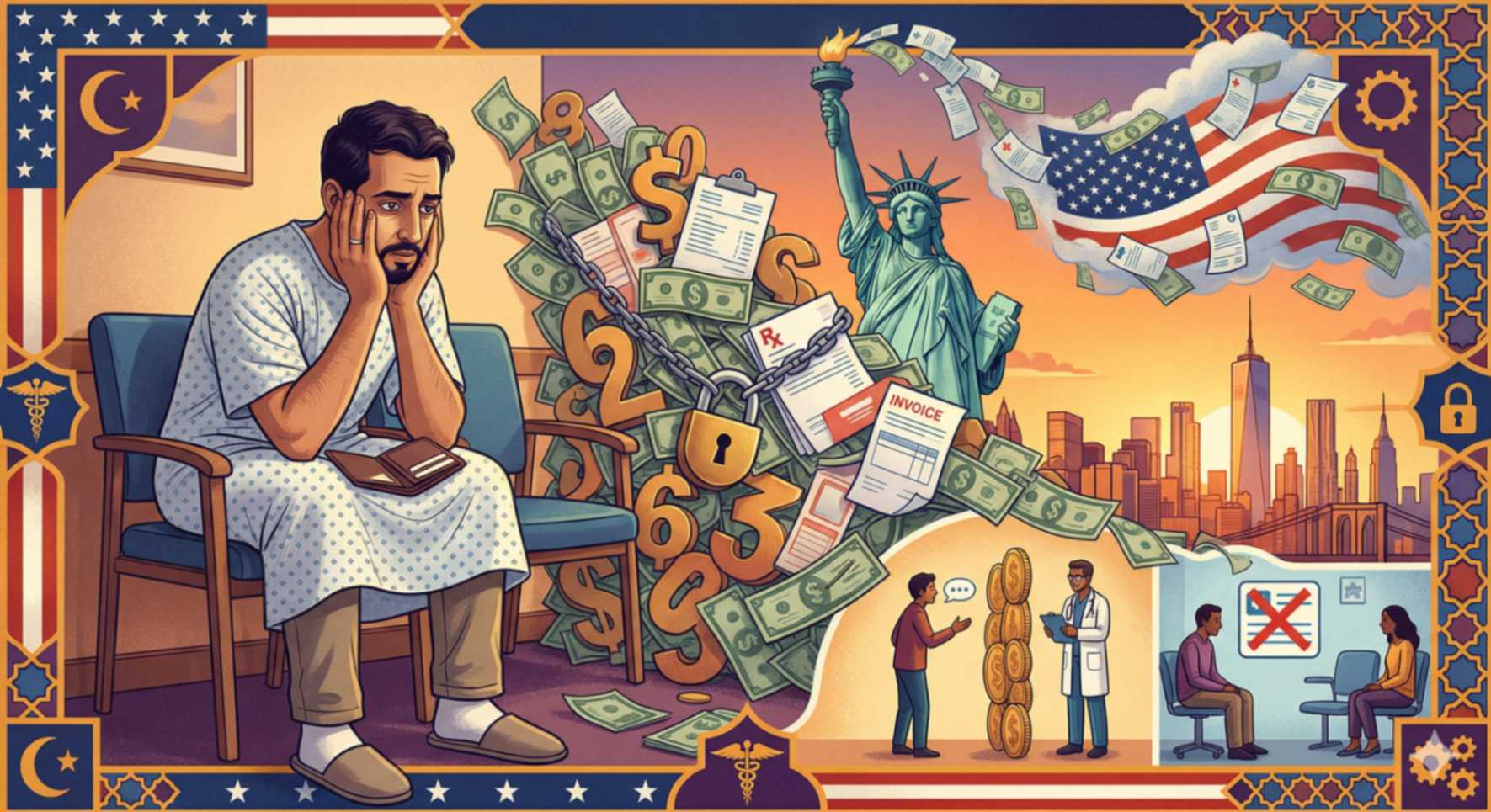
Picture this all-too-common and deeply unsettling scenario: You wake up in the dead of night, jolted by a sharp, persistent pain in the right side of your abdomen. The pain is relentless, and nausea washes over you. You do not have health insurance—perhaps because you are newly arrived in America, between jobs, or simply because the exorbitant monthly premiums are beyond your current financial reach. A nearby friend insists you go immediately to the nearest Emergency Room (ER). You hesitate, terrified of the cost, but the pain overrides your fear. You arrive at the hospital, are quickly triaged, given some pain medication and intravenous fluids, and undergo a few basic tests. After several anxious hours of waiting, a doctor informs you that it was "likely just a severe intestinal spasm or the start of a viral infection" and advises rest and hydration. You leave feeling somewhat relieved physically, and you temporarily push the financial worry to the back of your mind.
Then, several weeks later, a thick white envelope arrives in the mail. With a trembling hand, you tear it open to find a medical bill for $6,500. Yes, six thousand five hundred dollars. For a few hours of observation and some pain relief. The shock hits you like a physical blow. How can a simple, non-critical ER visit cost such an astronomical sum? And what if the situation had been more serious? What if you had actually needed an emergency appendectomy that night? The bill could have easily skyrocketed to $35,000 or even $45,000. That is an amount capable of wiping out years of painstaking savings and plunging you into an endless, suffocating spiral of debt and collection calls.
The United States stands alone among the world's advanced industrial nations as a place where a sudden illness, a simple broken bone, or even the birth of a child can trigger complete personal or familial bankruptcy and derail a financial future for years to come. This nightmare scenario is magnified exponentially if you lack the protective shield of health insurance. In 2026, despite expansions in certain public programs, millions of people in the U.S.—including a significant number of newly arrived immigrants—continue to live without any health coverage. The reasons are varied: gaps between jobs, initial ineligibility for Medicaid, or simply the stark reality that the cost of monthly premiums is unaffordable during the fragile early stages of building a new life.
However—and this is the most crucial message you must internalize—lacking health insurance does not ever, under any circumstances, mean you should ignore your health, suffer in silence, or delay seeking necessary medical care out of fear of the eventual bill. Such a decision can be literally fatal, or it can transform a minor, easily treatable health issue into a complex, life-threatening, and astronomically expensive medical emergency. The American healthcare system, for all its maddening complexity and jaw-dropping costs, contains legal loopholes and community-based, ethical pathways specifically designed to assist uninsured and low-income individuals. There are entirely legal and safe avenues to obtain excellent medical care at a very low cost or even for free. Furthermore, there are professional secrets and negotiation strategies that healthcare providers rarely volunteer—secrets that can slash those terrifying medical bills by 70%, 80%, or even result in complete debt forgiveness.
In this practical, comprehensive, and potentially life-saving guide, we will answer the question that haunts millions with brutal honesty and total transparency: What should you do if you get sick without insurance in America? We will detail the true costs of care in 2026, show you exactly where to go for treatment (and, just as importantly, where not to go unless it is a dire emergency), reveal how to obtain your medications for a fraction of the retail price, and teach you how to confront hospital and lab bills with intelligence and savvy to protect both your health and your financial future from the monster of medical debt.
📊 Chapter One: The Shocking Truth—What Medical Care Actually Costs Without Insurance in 2026
To fully grasp the immense financial risk associated with making the wrong choice about where to seek care, you must first confront the updated, approximate price list for self-paying (Self-Pay) patients in 2026. These figures are not exaggerations or worst-case hypotheticals; they represent national averages reflecting the current reality of the U.S. healthcare market.
Part 1: Basic Medical Services and Clinic Visits (Without Insurance):
- Primary Care Physician Visit (Family Doctor/Internist): The cost for the office visit alone ranges from $150 to $300. This fee covers only the consultation and examination. Any additional tests or prescribed medications will be billed separately.
- Specialist Consultation (e.g., Cardiologist, Dermatologist, Orthopedist): Expect to pay between $250 and $500 for a single specialist office visit.
- Routine Blood Work: The cost can vary widely from $50 for a very basic panel to $200 or more if multiple laboratory panels are ordered (e.g., a comprehensive metabolic panel, complete blood count, and thyroid function tests).
- Standard X-Ray (e.g., to check for a fracture or pneumonia): Costs typically range from $100 to $500, depending on the number of views required and whether the X-ray is performed in a hospital or an independent imaging center.
- CT Scan (Computed Tomography): This is a significantly more expensive diagnostic tool. Costs range from a low of approximately $500 at a freestanding imaging center to $3,000 or more if performed within a hospital's emergency department.
- MRI (Magnetic Resonance Imaging): The most expensive common diagnostic scan. Costs range from $1,000 to $5,000 and can be even higher if contrast dye is required.
Part 2: The Emergency Room (ER) Financial Trap: This is the single largest financial pitfall for uninsured individuals. Emergency departments operate on a fundamentally different pricing model, charging an enormous "Facility Fee" simply for walking through the door, which is then layered on top of the physician's fees and any diagnostic tests.
- Very Minor ER Visit (Triage and Discharge): If you present with minor pain, are seen briefly by a nurse or physician assistant, given a pain reliever, and discharged within an hour with virtually no testing, expect a bill of $1,000 to $3,000.
- Moderate ER Visit (with Labs and Imaging): If your condition requires blood work, an X-ray or CT scan, and evaluation by an emergency physician, the bill will rapidly escalate to between $2,000 and $8,000.
- Ambulance Ride: If your condition necessitates calling 911 and being transported by ambulance, be aware that this short ride is billed separately and typically costs between $500 and $2,500. It is often not subject to the same discounts as hospital bills.
Part 3: Hospitalization and Surgical Procedures: This is the tier where costs reach truly astronomical and potentially bankrupting levels.
- One Night in the Hospital (Observation Stay Only): $5,000 to $15,000.
- Appendectomy (Appendix Removal Surgery): $15,000 to $40,000.
- Vaginal Childbirth (Without Complications): $15,000 to $30,000.
- Cesarean Section (C-Section) Childbirth: $25,000 to $50,000.
- Open Heart Surgery (e.g., Coronary Artery Bypass Graft): $100,000 to $300,000 or more.
The Inescapable Conclusion: Seeking medical care in the United States without the safety net of health insurance is, by any objective measure, a guaranteed financial catastrophe if you follow the unthinking, traditional path of simply going to the nearest hospital or private doctor without a plan. However, as we will now detail, smarter, alternative options are not only available—they are highly effective.
🧭 Chapter Two: A Strategic Guide to Choosing the Right Place for Care (Saving Thousands by Making the Right Choice)
The single most impactful decision on your wallet is choosing the appropriate facility for your level of illness or injury. Making the wrong choice here can be the difference between a $100 bill and a $5,000 bill for the exact same medical issue.
Option 1: Federally Qualified Health Centers (FQHCs) - Your First and Best Line of Defense
These are the hidden gems of the American healthcare system. Community Health Centers, officially designated as Federally Qualified Health Centers (FQHCs), are located in underserved areas across the entire country. Their core mission is to provide high-quality, comprehensive primary and preventive care to all individuals, regardless of their insurance status or ability to pay.
- Ideal For: Routine check-ups, management of chronic conditions (diabetes, high blood pressure, asthma), initial prenatal care, treatment of minor illnesses (colds, flu, sore throat, ear infections), vaccinations, and even some basic mental health and dental services.
- How the Cost Works: The Sliding Fee Scale: FQHCs operate on a "Sliding Fee Discount Program." This means the amount you are charged for a visit is calculated based on your annual household income and family size. If you have a very low income or no income at all, you may pay a nominal fee of $20 to $50 per visit, or you may qualify for completely free care.
- How to Find the Nearest FQHC: Use the official search tool provided by the Health Resources and Services Administration (HRSA) at:
findahealthcenter.hrsa.gov. Look for centers that explicitly state they offer translation services, as many have Arabic-speaking staff or access to medical interpreters.
Option 2: Urgent Care Centers - The Perfect Middle Ground
These walk-in clinics are the ideal solution for medical problems that are not life-threatening but cannot wait several days or weeks for a scheduled appointment with a primary care doctor, and yet are not severe enough to warrant the cost and chaos of an Emergency Room.
- Ideal For: Sprained ankles, minor cuts requiring stitches, severe cold or flu symptoms, ear infections, strep throat, urinary tract infections (UTIs), fever, rashes, persistent vomiting or diarrhea.
- Approximate Cost: Pricing at Urgent Care centers is far more transparent and predictable than at an ER. Most visits for a self-pay patient will cost between $100 and $250. This fee often bundles the consultation and any rapid tests performed on-site (e.g., flu or strep test).
- Crucial Warning: Never use Urgent Care for critical or life-threatening conditions. These include: crushing chest pain or pressure, severe difficulty breathing or shortness of breath, uncontrollable major bleeding, signs of a stroke (sudden weakness on one side, facial drooping, difficulty speaking), or significant head trauma. These conditions demand an immediate visit to the nearest Emergency Room.
Option 3: The Emergency Room (ER) - For Genuine, Life-Threatening Emergencies Only
The Emergency Room is the last line of defense, designed and equipped exclusively to save lives and preserve limbs in critical situations. Do not use it as a substitute for a doctor's office or an Urgent Care clinic.
- Use ONLY For: The critical symptoms listed above, major accidents, compound fractures, severe burns, suspected poisoning, or suicidal thoughts.
- Your Federal Legal Right (EMTALA): Under a federal law known as the Emergency Medical Treatment and Labor Act (EMTALA), any hospital that participates in the Medicare program (which includes the vast majority of U.S. hospitals) is legally obligated to provide you with an appropriate medical screening examination and necessary stabilizing treatment for an emergency medical condition, regardless of your ability to pay, your insurance status, or even your immigration status. They cannot legally turn you away if you are experiencing a genuine medical emergency. The bill will arrive later, and that is when the negotiation strategies detailed in Chapter Four become essential.
Option 4: Free and Charitable Clinics
These are non-profit clinics staffed largely by volunteer physicians and nurses who donate their time to provide basic medical services at no cost to the patient.
- Services Offered: Basic primary care, management of some stable chronic conditions, and sometimes limited dental or vision services.
- Limitations: They typically have very restricted operating hours (e.g., only open on certain evenings or weekends), long waiting lists for appointments, and do not offer emergency care or complex specialty services.
Option 5: Telehealth (Virtual Doctor Visits)
This is an excellent, convenient, and affordable option for minor, straightforward health concerns. You can speak with a licensed physician via video call or telephone.
- Cost: Significantly less expensive than an in-person office visit, with consultations typically ranging from $40 to $100.
- Platforms: Services like Teladoc, Doctor on Demand, and Amwell offer this, and some community health centers are also beginning to provide telehealth appointments.
📊 Table 1: Comprehensive Comparison of Healthcare Options for the Uninsured
| Type of Facility | Best Suited For | Typical Self-Pay Cost | Typical Wait Time | When to AVOID This Option |
|---|---|---|---|---|
| Community Health Centers (FQHCs) | Routine, preventive, and chronic care | $20 - $100 (or free, based on income) | Days to weeks (for appointments) | True medical emergencies |
| Telehealth | Simple consultations, colds, allergies | $40 - $100 | Minutes to hours | Conditions requiring a physical exam |
| Urgent Care | Non-life-threatening urgent issues | $100 - $250 | Usually under 1 hour | Life-threatening emergencies (chest pain, etc.) |
| Emergency Room (ER) | ONLY life-threatening emergencies | $1,000 - $10,000+ | Several hours (often) | Any condition treatable at Urgent Care or FQHC |
| Free Clinics | Very basic primary care | Free | Very long (waiting lists) | Emergencies and specialty care |
🚨 Chapter Three: Your Immediate Emergency Action Plan (What to Do the Moment You Get Sick or Injured)
If you find yourself in a health crisis while uninsured, follow this protocol step-by-step to minimize both physical and financial harm:
- Objectively and Calmly Assess the Severity of Your Condition: Ask yourself the critical triage question: "Is this condition potentially life-threatening or likely to cause permanent disability?" If the answer is YES (e.g., crushing chest pain, sudden severe shortness of breath, uncontrollable hemorrhage, stroke symptoms), proceed immediately to the nearest Emergency Room or call 911. Do not allow financial anxiety to delay life-saving care. If the answer is NO, proceed to the next step.
- Proactively Ask for the Price Upfront: At any facility other than an ER (e.g., Urgent Care, imaging center, or lab), you have every right to inquire about the cost before receiving the service. At the registration desk, ask clearly: "What is your Self-Pay rate for this visit/procedure?" Furthermore, under the federal "No Surprises Act," you have the legal right to request a written "Good Faith Estimate" of the expected total charges before receiving non-emergency care. This helps prevent shocking, unexpected bills later.
- Inquire About a Prompt Pay or Cash Discount: Many healthcare facilities, particularly independent imaging centers and laboratories, offer a substantial discount—often 20% to 40% or even more—if you are able to pay the full balance immediately with cash or a debit card on the day of service. Ask explicitly: "Do you offer a prompt pay discount if I pay in full today?"
- Assert Your Right to a Medical Interpreter: If you are not 100% comfortable discussing your precise medical symptoms and history in English, you have a legal right under federal law (Title VI of the Civil Rights Act) to request a professional, qualified medical interpreter at no cost to you in any facility that receives federal funding (which includes virtually all hospitals and FQHCs). This ensures you receive an accurate diagnosis and appropriate treatment and prevents dangerous misunderstandings. Tell the staff member: "I need an Arabic medical interpreter, please." (A bilingual friend or family member, while helpful, is not a substitute for a trained, neutral medical interpreter).
🧾 Chapter Four: Advanced Strategies for Taming a Catastrophic Medical Bill (Never Pay the Full Sticker Price!)
The bill you dreaded has arrived. The total seems impossibly high. Do not panic. Do not despair. You are not obligated to pay that full, inflated amount. Follow these strategies in order.
Step 1: Never, Ever Ignore a Medical Bill. Ignoring bills is the single worst action you can take. It will eventually result in the debt being sold or assigned to a third-party Collection Agency. This will severely damage your Credit Score, making it difficult to rent an apartment, finance a car, or even pass a background check for certain jobs in the future. Confront the bill immediately upon receipt.
Step 2: Demand an Itemized Bill. The summary bill you initially receive is often just a vague, unhelpful final number. You must call the hospital or clinic's Billing Department and request an "Itemized Bill." This document will list every single charge separately: each lab test, each imaging scan, each dose of medication, each minute of operating room time. Review this document with a fine-toothed comb. Look for common billing errors: Were you charged for a medication you never received? For a test that was canceled? For an extra day of room charges? Identifying even one error gives you grounds to dispute and have that portion of the bill removed.
Step 3: Formally Apply for Charity Care or Financial Assistance. Under federal law, all non-profit hospitals (which constitute the vast majority of large U.S. hospitals) are required to have a written Financial Assistance Policy (FAP) —often called "Charity Care"—for patients who cannot afford their medical bills. This is not an act of charity; it is a legal obligation tied to their enormous tax-exempt status. Go to the hospital's official website and search for "Financial Assistance" or "Charity Care." Download the application and submit it, even if you think you might not qualify. If your household income is low (even if you are employed), you may be granted a 50% to 100% full forgiveness of your bill.
Step 4: Aggressively Negotiate an Uninsured/Self-Pay Discount. If you do not qualify for full Charity Care, or even before applying, call the billing department and state clearly: "I am uninsured and paying out of my own pocket. This bill reflects your chargemaster rates for insurance companies, not a realistic self-pay price. I would like to discuss a Self-Pay Discount. I am prepared to make a partial payment today if we can agree on a significantly reduced total amount." Hospitals often prefer to collect 30-40% of the billed amount in guaranteed cash rather than incur the long, expensive, and uncertain process of debt collection, or risk receiving nothing at all.
Step 5: Negotiate a No-Interest Monthly Payment Plan. If the bill is reduced to a manageable amount but you still cannot pay it in a single lump sum, request to set up a monthly payment plan. Negotiate for the monthly installments to be as low as possible (even $25 or $50 per month) and, crucially, for the plan to be interest-free. As long as you consistently make your monthly payments on time, the hospital will not send your account to collections.
Step 6: Seek Help from Patient Advocacy Non-Profits. There are wonderful, free non-profit organizations like Dollar For (dollarfor.org) that specialize in helping patients navigate the Charity Care application process and negotiate with hospital billing departments. Do not hesitate to contact them.
💊 Chapter Five: How to Obtain Expensive Prescription Medications for Pennies—or for Free
Prescription drug prices in the U.S. are the highest in the developed world. Never simply pay the full retail price at the pharmacy counter.
- Harness the Power of GoodRx: This is your number one secret weapon. Download the free GoodRx app or visit
www.goodrx.com. Search for the exact name and dosage of the medication you have been prescribed. The app will instantly display a list of the actual cash prices for that drug at every pharmacy in your vicinity (CVS, Walgreens, Walmart, Costco, and local independents) and provide you with free digital coupons. The price difference can be staggering—a drug that retails for $200 might be available for $18 with a GoodRx coupon. Simply show the coupon on your phone to the pharmacist when you drop off your prescription. - Utilize Low-Cost Generic Drug Programs at Major Retailers: Big-box and grocery store pharmacies like Walmart and Costco maintain extensive lists of commonly prescribed generic medications that are available at flat, rock-bottom prices (e.g., $4 for a 30-day supply or $10 for a 90-day supply) even without insurance. Always ask the pharmacist if your prescription is on their low-cost generic list.
- Investigate Manufacturer Patient Assistance Programs (PAPs): If you require an expensive, brand-name medication for a chronic condition (such as a novel diabetes drug, a biologic for an autoimmune disease, or a specialty heart or cancer medication), most major pharmaceutical companies operate Patient Assistance Programs. These programs are designed to provide the medication at no cost or a very low cost to eligible uninsured and underinsured patients who meet certain income guidelines. Search online for:
"[Name of your brand-name drug] patient assistance program".
👥 Chapter Six: Real Stories of Resilience (You Are Not Alone in This Fight)
Story 1: Layla and the Emergency C-Section in Texas
Layla and her husband Ahmed arrived in Houston in early 2026. Layla was seven months pregnant, and they were in the gap between jobs with no active health insurance. They had planned for a lower-cost birth center delivery. However, Layla went into premature, emergency labor and required an urgent C-section at a large non-profit hospital. A month later, a bill for $42,000 arrived. The couple was devastated. But Ahmed remembered the advice in this guide. He called the billing office, requested an itemized bill, and then formally applied for the hospital's Charity Care/Financial Assistance program, submitting proof of their modest income. After several weeks of follow-up, they received a letter granting them 100% forgiveness of the entire bill. "That program saved us from financial ruin," Layla says. "We just had to know it existed and have the courage to apply."
Story 2: Karim and the Broken Arm in Chicago
Karim, an Egyptian graduate student in Chicago, slipped on an icy sidewalk and fractured his arm. His roommate immediately yelled for him to go to the ER, but Karim remembered that the break was not a compound fracture. He chose instead to go to a nearby Urgent Care center. He paid $180 total for the consultation, X-ray, and splinting. "If I had gone to the ER," Karim calculates, "I would have easily paid ten times that amount. Then, I used GoodRx for the prescribed pain medication and paid only $12 instead of the $45 retail price."
Story 3: Fatima and Chronic High Blood Pressure in Michigan
Fatima, a homemaker in Dearborn, struggles with chronic high blood pressure. Without insurance, she was paying $90 per month out-of-pocket for her medication at a CVS pharmacy. She discovered a nearby FQHC community health center. She now pays just $25 for a doctor's visit every three months. Moreover, she learned that the in-house pharmacy at the FQHC sells her exact same blood pressure medication for only $15 per month. "I had no idea these community centers even existed," Fatima says. "They have completely changed my life."
❓ Chapter Seven: Frequently Asked Questions (FAQ)
Q1: Can I really go to the Emergency Room if I have no money and no insurance? A: Yes. Legally, under the federal EMTALA law, a hospital must screen and stabilize you if you have a genuine medical emergency, regardless of your ability to pay. The bill will arrive later, and you must address it immediately using the strategies outlined in this guide.
Q2: Can unpaid medical debt lead to my deportation or affect my citizenship application? A: Generally, no. Medical debt is a civil financial obligation, not a criminal matter. Hospitals and collection agencies do not report patients to Immigration and Customs Enforcement (ICE) for unpaid medical bills. However, a large amount of unresolved, delinquent debt could theoretically be viewed as a negative factor in the "good moral character" determination during the very final stages of a naturalization (citizenship) application. Therefore, it is always best to proactively manage the debt through a payment plan or financial assistance application.
Q3: What is the real, primary danger of medical debt? A: The greatest and most immediate danger is the severe negative impact on your Credit Score once the debt is reported to the credit bureaus by a collection agency. A poor credit score will make it exceedingly difficult and expensive to rent an apartment, secure a car loan, or obtain a credit card. Fortunately, recent federal regulations (effective in 2025) have begun to lessen this impact by removing small medical debts under $500 from credit reports and extending the grace period before larger debts can be reported. However, proactive negotiation remains the best defense.
Q4: How can I ensure I get an Arabic interpreter at a hospital? A: You have a legal right to one. Upon arrival at the registration desk or when speaking with a nurse, state clearly and firmly: "I need an Arabic interpreter, please." The hospital is legally obligated to provide one at no cost to you, either in person, via telephone, or through a video remote interpreting service.
🏁 Conclusion: Knowledge is Your Most Powerful Health Insurance Policy
In conclusion, there is no denying that facing a sudden illness or injury in the United States without health insurance is a deeply stressful and financially perilous situation. However, it is equally critical to understand that this situation is not a dead end, nor is it an automatic sentence of bankruptcy or a denial of necessary care. The American healthcare system, for all its daunting complexity and inflated costs, contains legal, ethical, and humanitarian pathways specifically designed to protect individuals in your exact circumstances.
The golden key to emerging from this crisis with minimal financial damage is prior knowledge and swift, organized action. If you follow the steps detailed in this guide—starting with choosing the right, most cost-effective place for care (an FQHC or Urgent Care instead of an unnecessary ER trip), proactively asking for a price estimate, and then confronting any large bills head-on with requests for financial assistance and negotiations for self-pay discounts—you can slash your costs dramatically and protect both your financial future and your credit score from collapse.
Do not let the fear of a bill prevent you from seeking care when your body truly needs it. Your health is your most valuable, non-renewable asset. And once you navigate this acute crisis, make it a top priority to obtain health insurance—any form of health insurance—during the very next Open Enrollment Period or if you experience a Qualifying Life Event (like starting a new job).
A Call to Share and Build Collective Wisdom: Now, we want to hear from you. Have you personally navigated the U.S. healthcare system without insurance? How did you handle the bills? Do you have any specific recommendations for low-cost clinics, imaging centers, or pharmacies in your city? Please share your invaluable experience in the comments section below this article. Your contribution could be the lifeline that another frightened, uninsured individual desperately needs.

Author: حسين عبد الله
Hussein Abdullah is a web developer and specialized content writer with more than eight years of experience enriching Arabic digital content. He combines an analytical programming mindset with a deep passion for writing to deliver accurate, reference-quality guides. On Arabian in USA (عرب في أمريكا), he focuses on simplifying complex steps for new immigrants and sharing reliable information on housing, work, and financial setup—so every newcomer has a trustworthy path toward stable life in the United States.


Continue reading
- Muslim Population in America 2026: Complete State-by-State Guide, Statistics & Interactive Map
- Top 10 Best States for Muslims in America: Ultimate Guide (Updated 2026)
- Top 7 Best States for Arabs in America: Ultimate Guide (Updated 2026)
- Work in America for New Immigrants 2026: The Complete Guide from Day One to Your Dream Career [Step-by-Step Plan]
- How Much Does It Cost for a Family to Live in California in 2026? A Complete Breakdown for New Immigrants
- What Are the Cheapest Cities to Live and Rent in California 2026? The Complete Guide for New Immigrants