Cost of Living in Texas 2026: The Complete Immigrant's Guide to Rent, Taxes, and a Real Monthly Budget
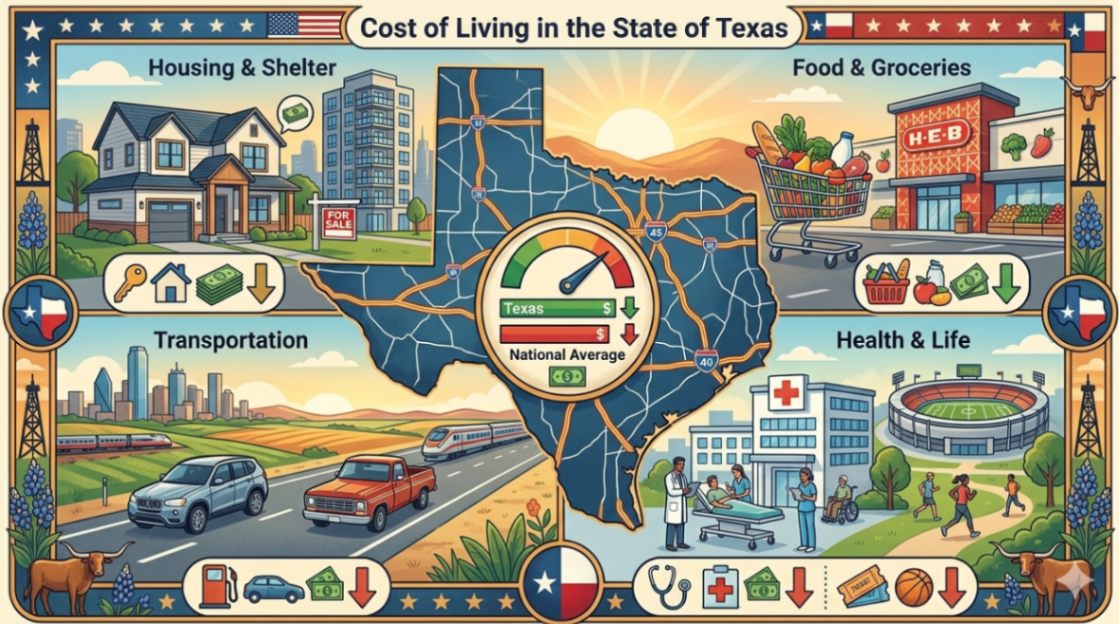
Here's a truth I've learned the hard way. You land in Texas after months of dreaming. You've read the headlines: "No state income tax!" "Housing half the price of California!" "The economy is booming!" Friends back home in Cairo or Amman have filled your head with stories of six-figure salaries and massive backyards. Then, in your second week, you stand in an H-E-B grocery aisle holding a receipt that makes your eyes widen. The rent you just paid on your new apartment was supposed to be "cheap," but after the deposit, the pet fee, the admin fee, and the first month's rent, your savings account is gasping. You start to wonder: Did I miscalculate? Are the numbers real? Can I actually afford this?
Let me answer you directly: Yes, the numbers are real, and yes, you can afford this — but only if you budget Texas the way Texas actually is, not the way the internet summarizes it in three-word slogans. The "no state income tax" advantage is legitimate, but it comes with a property-tax tradeoff that will punch you in the face if you don't see it coming. The rents are lower than the coasts, but they vary violently by city and zip code. And the summer electric bill? We'll talk about that.
In this 2026 breakdown, I'm giving you the real, usable numbers: what you will actually pay for a two-bedroom apartment, how much that car-dependent lifestyle truly costs, what groceries and halal meat run per month, what Islamic school tuition looks like, and how to build a realistic monthly budget that doesn't just survive — it builds savings. These numbers draw from the U.S. Bureau of Labor Statistics (BLS), Zillow and RentCafe rental data, AAA fuel tracking, community-reported costs from Arab families on the ground, and the Texas Comptroller's Office tax data.
خلاصة حسين: After 15 years of helping Arab families settle across the U.S., I can tell you that the families who thrive in Texas don't just earn well — they budget obsessively in their first 24 months. They choose their city based on housing cost, not just job salary. They understand the property-tax line before they buy. And they build a six-month emergency fund before they inflate their lifestyle. This guide is that discipline, written down.
🔍 What You'll Get in This Guide
- 🏠 Real 2026 rent and home prices for Austin, Houston, Dallas, Fort Worth, and San Antonio — not averages, but neighborhood-level bands
- 🚗 The true cost of Texas car dependence — gas, insurance, maintenance, and why you must budget this as a fixed line, not an afterthought
- 🛒 Grocery and halal food costs — from Aldi discipline to the Phoenicia import-shopping trap
- 🏫 Islamic school tuition benchmarks — what Brighter Horizons, Al-Huda, and Austin Islamic Academy actually charge
- 🏥 Healthcare and utility realities — summer AC bills, employer insurance premiums, and cash-pay doctor visits
- 💰 The tax chapter everyone needs — no state income tax vs. property tax vs. sales tax, explained with real dollars
- 📊 Two complete sample monthly budgets — a comfortable Houston suburban family of four, and a lean San Antonio starter plan
- 💡 Immigrant-tested money-saving playbook — the specific strategies that work for Arab families
Pair this guide with Living in Texas: The Daily Life Guide for Arabs for schools, mosques, and neighborhood maps. For the community landscape, read Arabs in Texas: Community and Cities Guide. And for the coastal comparison everyone asks about, see Cost of Living in California.
Chapter One: The Headline Comparison — Texas vs. the Coasts vs. the Midwest
Before we zoom into your personal budget spreadsheet, let's anchor the big numbers that drive migration to Texas. When Arab families ask me "Is Texas actually cheaper, or is that just a myth?", here is the data I show them.
Texas vs. California: The Great Migration's Math
| Cost Factor | Texas | California | Your Savings |
|---|---|---|---|
| State income tax (on $100k) | $0 | $6,000-$9,300 | $6k-$9.3k/year |
| 2BR rent (good area) | $1,500-$2,200 | $2,800-$4,200 | $1.3k-$2k/month |
| 4BR home purchase | $300k-$500k | $800k-$1.5M+ | $500k-$1M+ in debt avoided |
| Gas (per gallon) | $2.80-$3.20 | $4.50-$5.50 | $1.50-$2.30/gallon |
These are not small differences. Over five years, a family earning $100,000 annually in Texas rather than California can save $40,000-$60,000 in state income tax alone — and potentially $60,000-$100,000 more in housing cost differences. That's a down payment on a Texas home, or a college fund, or the startup capital for a small business.
Texas vs. New York
The comparison with New York City and its inner suburbs is similarly stark. NYC and its satellite communities often run 30-40% more expensive than major Texas metros across housing, transportation, and everyday dining. New York state income tax brackets range from roughly 4% to 10.9%, plus an additional NYC resident tax for those living in the five boroughs. In Texas, the state income slice remains zero.
Texas vs. the Midwest (Michigan, Ohio, Indiana)
Compared to its Great Lakes neighbors, Texas is often similarly priced on housing but more expensive on property taxes and summer utilities. Michigan and Ohio offer lower property tax rates in many areas. The tradeoff: Texas generally has stronger job growth, warmer winters, and the no-income-tax advantage that most Midwestern states do not fully replicate. For full context, explore Living in Michigan and Cost of Living in Michigan.
كريم, an Egyptian accountant who moved his family from Chicago to Houston, tells me: "In Chicago, my $85,000 salary was decent, but state income tax, high property tax, and brutal winters made everything feel tight. We moved to Houston, my salary actually increased to $92,000, and the zero state income tax alone saved us over $4,000 a year. Plus, I haven't bought a winter coat in three years. The math works. You just have to respect the summer electric bill and the hurricane risk."
Chapter Two: Housing in Texas — Your Biggest Budget Line, Decoded
Housing is the lever that determines whether your Texas budget breathes or suffocates. And price variation within Texas is massive — far more than newcomers expect.
Directional Monthly Rent for a Two-Bedroom Apartment (2026)
| City | Budget & Older Areas | Typical "Good" School Zones | Premium/Downtown Luxury | Who It Suits |
|---|---|---|---|---|
| Austin | ~$1,600 | $2,000-$2,300 | $3,000+ | Tech professionals willing to pay the Austin premium |
| Dallas | ~$1,300 | $1,700-$2,000 | $2,500+ | Corporate and telecom professionals |
| Houston | ~$1,200 | $1,600-$1,900 | $2,400+ | Energy, medical, and the largest Arab community |
| Fort Worth | ~$1,100 | $1,500-$1,800 | $2,200+ | Families wanting Dallas jobs with calmer, cheaper living |
| San Antonio | ~$1,000 | $1,400-$1,700 | $2,000+ | Budget-first families and military/healthcare workers |
| Major Suburbs (Sugar Land, Plano, Frisco, Katy) | $900-$1,200 | $1,300-$1,600 | $1,800-$2,200 | Families prioritizing schools and Islamic community proximity |
سارة, a Syrian mother of three who rents in Sugar Land, explains: "We looked at apartments inside Houston proper first. For $1,800, we could get a decent two-bedroom but the school ratings were terrible. In Sugar Land, we pay $1,750 for a three-bedroom in a complex where my kids walk to a 9/10-rated public school, and the Islamic center is five minutes away. The rent is not 'cheap' — but the total package is unbeatable."
Directional Home Purchase Prices (2026)
| City | Typical 4BR Home Price Band | Approx. Annual Property Tax (1.8-2.2%) | All-In Monthly (Mortgage+Tax+Insurance) |
|---|---|---|---|
| Austin | $450k-$650k | ~$9,000-$13,000 | ~$3,200-$4,500 |
| Dallas | $350k-$500k | ~$7,000-$10,000 | ~$2,600-$3,600 |
| Houston | $300k-$450k | ~$6,000-$9,000 | ~$2,200-$3,200 |
| Fort Worth | $280k-$400k | ~$5,500-$8,000 | ~$2,100-$3,000 |
| San Antonio | $250k-$350k | ~$5,000-$7,500 | ~$1,800-$2,700 |
Three Critical Housing Rules in Texas
1. The property tax is not hidden — but it will feel hidden until your first escrow statement. Texas funds local government, schools, and services primarily through property taxes because there is no state income tax. Effective rates typically range from 1.8% to 2.2% of your home's assessed value annually. On a $400,000 home, you owe roughly $7,200 to $8,800 per year — an extra $600-$730 per month beyond your mortgage payment. The homestead exemption can reduce your taxable value by a significant amount (commonly $40,000-$100,000 depending on the taxing jurisdiction), which helps. File for it immediately upon purchasing.
2. Suburbs often beat the city center, and not just on price. Sugar Land, Katy, and Cypress around Houston. Plano, Frisco, and Allen around Dallas. Cedar Park and Round Rock around Austin. These suburbs frequently offer a combination of lower crime, better-rated public schools, and closer proximity to major mosques and Islamic schools — often at a lower per-square-foot cost than living inside the city core. Unless your commute is brutally location-dependent, start your housing search in the suburbs.
3. Do not cheap out on air conditioning. This sounds trivial. It is not. Texas summers routinely exceed 100°F for weeks on end. A poorly insulated apartment with an undersized AC unit will generate summer electric bills of $350-$500 — and make your family miserable. During apartment tours, ask what the average July and August electric bills were for the unit. If the landlord hesitates, walk away. For homeowners, budget for HVAC maintenance and replacement. It is not an optional appliance here.
Chapter Three: Transportation — The Line Item You Can't Escape
Texas metros sprawl. Houston's metropolitan area alone covers over 10,000 square miles. You will drive — to work, to the mosque, to the grocery store, to your children's school, to visit friends in the next suburb over. Budgeting transportation as a fixed, non-negotiable cost is essential.
The Real Monthly Cost of One Car (2026 Directional)
| Cost Factor | Budget (Older Paid-Off Car) | Moderate (Financed Reliable Sedan) | Premium (New SUV/Truck) |
|---|---|---|---|
| Car payment | $0 | $300-$500 | $550-$850 |
| Gasoline (2.80-$3.20/gal) | $100-$160 | $120-$200 | $160-$280 |
| Insurance | $80-$120 | $100-$160 | $140-$220 |
| Maintenance (oil, tires, wear) | $50-$80 | $60-$100 | $80-$150 |
| Monthly Total | $230-$360 | $580-$960 | $930-$1,500 |
Gasoline context: Texas benefits from enormous refining capacity, keeping per-gallon costs typically $2.80-$3.30 in 2026 — consistently below the national average and radically cheaper than California. This is one of the subtle but real advantages of living in an energy-producing state.
Insurance context: Texas auto insurance is not cheap. Hail damage, highway accident rates, and a high percentage of uninsured drivers push premiums upward. Shop your insurance every 12 months — rates change, and loyalty is rarely rewarded.
عمر, an Iraqi-American who commutes from Katy to downtown Houston, sighs: "I budgeted for gas. I did not budget for the toll roads. The Westpark Tollway alone costs me $120 a month. In Houston and Dallas, tolls are how the highways actually move. Add it to your line items before you sign a lease 30 miles from your job."
Public Transit: Limited But Worth Knowing
- Houston METRO: Buses and a limited light-rail system. ~$1.25 per trip. Functional for certain central corridors. Not useful for most suburban life.
- Dallas DART: Light rail and buses. $2.50-$6.00 per trip depending on distance. Connects some suburbs but rarely eliminates car need.
- Austin CapMetro: Buses and a commuter rail line. ~$1.25-$2.50 per trip.
The bottom line: Most Arab families in Texas will own at least one car, and often two. Budget accordingly from day one.
Chapter Four: Food & Groceries — From H-E-B to the Halal Butcher
Food costs in Texas are broadly reasonable by U.S. standards, thanks to competitive grocery chains, agricultural production within the state, and a thriving halal-meat infrastructure in the major metros.
Monthly Grocery Budget for a Family of Four (2026 Directional)
| Budget Tier | Monthly Spend | Shopping Pattern |
|---|---|---|
| Lean (disciplined) | $500-$700 | Aldi + Walmart + bulk Costco runs, almost all home cooking, limited imported specialty items |
| Comfortable Middle | $700-$900 | H-E-B or Kroger primary, halal butcher for meats, occasional Phoenicia or imported items, eat out 2-4 times/month |
| Premium/Imported | $900-$1,200+ | Whole Foods or Central Market, frequent specialty Arab grocery runs, restaurant meals weekly |
The halal meat factor: In Houston and Dallas, competitive halal butchers keep prices reasonable — you might pay a 15-25% premium over conventional meat for halal beef and lamb. Chicken is often similarly priced. In Austin and San Antonio, fewer halal suppliers can push prices higher. Houston's Phoenicia market is legendary, but it is also a trap for the undisciplined — you walk in for za'atar and labneh and walk out with $200 of imported goods. Budget your Phoenicia trips.
Dining out: Fast food $8-$12 per person. Casual ethnic (shawarma, mandi, kebab) $12-$18 per person. Upscale $30-$60 per person before the 18-20% tip. Delivery apps (DoorDash, Uber Eats) easily add 30-40% in fees and tip — a $15 meal becomes $25. Limit delivery. It is the silent budget killer.
Chapter Five: Education & Islamic Schools — Planning for Tuition
For many Arab families, education costs are the second-largest monthly outlay after housing. Texas offers excellent public schools in its top suburban districts at zero tuition cost, but Islamic schools require real budgeting.
Public Schools: Tuition-Free, With Ancillary Costs
Public schools in Texas are free for residents, including immigrant families regardless of immigration status. Ancillary costs to budget:
- School supplies: $50-$150/year per child
- Activities, sports, field trips: $100-$500/year per child
- Uniforms (if required by the specific school): $100-$300/year
- School meals: ~$2-$3 per day (free/reduced-price programs exist for qualifying income levels)
Islamic Private School Tuition: Directional Annual Ranges (2026)
| School | City | Estimated Annual Tuition Per Child |
|---|---|---|
| Brighter Horizons Academy (BHA) | Plano (DFW) | $5,000-$7,500 |
| Al-Huda Academy | Houston | $4,000-$6,500 |
| Iqra Academy | Houston | $3,500-$5,500 |
| Austin Islamic Academy | Austin | $3,500-$5,500 |
| San Antonio Islamic School | San Antonio | $3,000-$5,000 |
Many schools offer sibling discounts, financial aid, or monthly payment plans. Ask during the admissions process — these are not always advertised prominently.
ليلى, a Palestinian mother in Plano with three children at BHA, says: "The tuition is real money. We pay about $18,000 a year for three kids with a sibling discount. But the education is phenomenal, the Islamic environment is in every classroom, and my children are fluent in Arabic. We drive older cars and cook at home to make it work. For us, it's worth the sacrifice."
Higher Education: Texas Public Universities
For families planning ahead, Texas in-state public university tuition is relatively affordable:
- UT Austin, University of Houston, Texas A&M: roughly $10,000-$15,000 per year in tuition and fees (in-state residency applies after meeting Texas domicile requirements).
- Community colleges: $2,000-$5,000 per year — an excellent, underused strategy for the first two years.
- Private universities (Rice, SMU, Baylor): $40,000-$60,000 per year.
Chapter Six: Healthcare & Utilities — The "Surprise" Budget Categories
Health Insurance
If your employer offers a family plan, budget your employee contribution at $300-$600 per month. If you buy through the ACA marketplace without subsidies, family coverage can run $800-$1,500 per month. With income-based subsidies, many families pay $100-$400 per month. Cash-pay doctor visits: primary care $100-$200, specialist $150-$300, emergency room visit often $1,000-$3,000+ before insurance adjustment. Do not go uninsured. One ER visit can wipe out a year of savings. Read the complete insurance strategy in How to Get Health Insurance in America.
Utilities: The Summer Electric Bill Reality
Texas utilities are highly seasonal. Expect:
- Electricity (summer months June-September): $150-$350 for a two-bedroom apartment with heavy AC; $250-$500 for a single-family home. Older, poorly insulated homes push toward the higher end.
- Electricity (winter months): $60-$120 for the same spaces.
- Water, gas, internet bundle: $100-$200 per month combined in most areas.
- Annual average utility budget: $250-$400 per month when smoothed across seasons.
خلاصة حسين: Set your thermostat to 75-78°F during summer daytime hours. Program it to cool down only when you're home. Change your AC filter every 30 days during heavy-use months. These three habits alone can save $50-$100 per month in July and August.
Chapter Seven: The Texas Tax Chapter — Everyone's Favorite and Most Misunderstood Topic
Every Arab professional moving to Texas hears about the "no state income tax" before they hear anything else. It is real. It is meaningful. And it is not the whole story.
The Income Tax Savings Are Legitimate
A family earning $100,000 in Texas pays exactly $0 in state income tax. That same family in California would pay roughly $6,000-$9,300, depending on deductions and filing status. In New York, they'd pay roughly $5,500-$8,000. Over a decade, this is $55,000-$93,000 in saved taxes — enough to fund a child's college education or pay off a significant portion of a mortgage.
The Property Tax Tradeoff
Texas property taxes are among the highest in the nation by effective rate — typically 1.8% to 2.2% of assessed home value annually. On a $400,000 home, that's $7,200-$8,800 every single year. Renters pay this indirectly through higher rents. Homeowners pay it directly, often through an escrow account that adds $600-$730 to the monthly mortgage payment.
The homestead exemption: File for it. It reduces your taxable home value by a meaningful amount (often $40,000-$100,000 depending on your specific county and school district), saving hundreds to thousands annually. This is not automatic — you must apply with your county appraisal district.
Sales Tax
Texas state sales tax is 6.25%, with local jurisdictions adding up to 2%, bringing most purchases to 8.25% total. Many staple groceries (unprepared food) are exempt from sales tax — a significant relief for family budgets. Restaurant meals, prepared foods, and non-food items are taxed fully.
The honest summary: For most middle-class and upper-middle-class families, the Texas tax system is financially favorable compared to high-tax states — especially if you rent or buy a modestly priced home. The no-income-tax advantage is real, but it is offset partly by property taxes and sales taxes. Budget both sides of the equation.
Chapter Eight: Two Real Monthly Budgets for an Arab Family of Four (2026)
I've built these from real budgets I've reviewed with Arab families in Texas. They represent achievable, tested spending patterns, not theoretical ideals. For more banking and credit context, see Open a Bank Account in America and Build Credit Score from Scratch.
Model A — Houston Suburbs (Comfortable Middle-Class Family)
This family rents a three-bedroom apartment in Sugar Land or Katy, cooks mostly at home, drives one financed car, and sends two children to an Islamic school.
| Category | Estimated Monthly Cost | Notes |
|---|---|---|
| Rent (3BR, good school zone) | $1,800-$2,200 | Sugar Land/Katy-style complex |
| Groceries + halal meat | $750-$950 | Mostly home cooking, halal butcher, H-E-B |
| One car (financed + gas + insurance + maintenance) | $650-$900 | Toyota Camry or similar, 20-mile commute |
| Health insurance (employer plan) | $350-$550 | Family coverage, employer-subsidized |
| Utilities (electricity, water, internet) | $300-$450 | Summer AC included in annual average |
| Islamic school (2 children, with sibling discount) | $700-$1,100 | Amortized from annual tuition |
| Personal, clothing, entertainment | $250-$450 | Streaming, weekend outings, clothing |
| Savings, emergency fund, remittances | $500-$1,000 | Crucial for long-term stability |
| Total Net Monthly Spend | $5,300-$7,600 | Requires gross household income ~$85k-$115k |
Model B — San Antonio (Lean, Dignified Starter Budget)
This family rents a two-bedroom in a mid-tier complex, drives a paid-off car, uses public schools, and cooks entirely at home.
| Category | Estimated Monthly Cost | Notes |
|---|---|---|
| Rent (2BR, mid-tier) | $1,200-$1,600 | Older building, safe area |
| Groceries | $550-$750 | Aldi + Costco discipline, almost all home cooking |
| One car (paid off: gas + insurance + maintenance) | $350-$500 | Liability-focused insurance |
| Health insurance (high-deductible plan) | $200-$400 | Marketplace or employer bare-minimum |
| Utilities | $250-$350 | Thermostat discipline essential |
| Public school costs | $0-$100 | Supplies and incidental fees only |
| Personal, minimal | $150-$250 | Essentials and occasional modest outings |
| Total Net Monthly Spend | $2,700-$3,950 | Requires gross household income ~$45k-$65k |
These figures are net of taxes — meaning they represent what you actually spend after federal tax withholding, Social Security, and Medicare deductions. Your gross salary must be higher.
Chapter Nine: Salary Benchmarks — What Income Supports Which Life?
| Household Configuration | Comfortable Life (Gross Annual) | Lean But Dignified (Gross Annual) |
|---|---|---|
| Single adult, no children | $55,000-$75,000 | $40,000-$50,000 |
| Couple, no children | $70,000-$90,000 | $50,000-$65,000 |
| Family of four (comfortable suburb) | $90,000-$120,000 | $65,000-$80,000 |
| Family of four (Austin premium) | $100,000-$140,000 | $75,000-$90,000 |
For detailed job market breakdowns by sector, see Work in America for New Immigrants and the specific job guides for Work in Ohio and High-Demand Jobs in California for cross-state salary comparisons.
Chapter Ten: The Immigrant-Tested Money-Saving Playbook
1. Geo-arbitrage inside Texas. If your job is remote or hybrid, live in San Antonio or Fort Worth, not Austin. The rent savings alone can reach $500-$800 per month — $6,000-$10,000 per year.
2. School districts as financial strategy. A top-rated public school district like Sugar Land ISD, Plano ISD, or Round Rock ISD can save you $8,000-$15,000 per year in private Islamic school tuition for two children. Many families use public school Monday-Friday and weekend Islamic school for Arabic and Quran.
3. Aldi + Costco discipline beats daily Whole Foods. The combination of Aldi for staples and Costco for bulk halal meat, rice, and household goods consistently produces the lowest grocery bills. H-E-B is excellent but pricier than Aldi for many staples.
4. Prescription savings. Use the GoodRx app or website for cash-pay pharmacy discounts. The price difference between insurance copay and GoodRx cash price is sometimes dramatic — always compare before swiping your insurance card.
5. Summer electricity discipline. Thermostat at 76-78°F during the day, 72-74°F at night. Ceiling fans in occupied rooms. Blackout curtains on west-facing windows. Change HVAC filters monthly during heavy-use season. These small behaviors compound.
6. Re-quote auto insurance annually. Rates drift. Geico, State Farm, Progressive, and smaller regional carriers compete aggressively. Fifteen minutes of comparison shopping can save $30-$60 per month.
7. Limit delivery app usage. DoorDash and Uber Eats surcharges, fees, and tips turn a $12 shawarma into a $22 expense. Reserve delivery for genuine emergencies. Pick up food yourself or — even better — cook.
8. Build a Texas emergency fund before lifestyle inflation. In your first year, direct your "no state income tax" savings (that $500-$800/month relative to California hypotheticals) into a dedicated savings account. Aim for $10,000-$15,000 in reserves. Hurricanes happen. Job changes happen. AC units fail in August. The buffer is the difference between a stressful event and a financial crisis.
Chapter Eleven: Big-City Comparison Table (2026 Directional)
| Factor | Austin | Dallas | Houston | San Antonio | Fort Worth |
|---|---|---|---|---|---|
| 2BR Rent (good area) | $1,800-$2,500 | $1,500-$2,300 | $1,400-$2,200 | $1,200-$1,800 | $1,300-$1,900 |
| 4BR Home Purchase | $450k-$650k | $350k-$500k | $300k-$450k | $250k-$350k | $280k-$400k |
| Gas (per gallon) | $2.90-$3.20 | $2.80-$3.10 | $2.70-$3.00 | $2.70-$3.00 | $2.80-$3.10 |
| Property Tax Rate | ~1.9-2.2% | ~1.8-2.1% | ~1.8-2.0% | ~1.7-1.9% | ~1.8-2.0% |
| Family-of-4 Budget (Net) | $5,500-$8,000 | $5,000-$7,500 | $4,600-$6,800 | $4,000-$5,800 | $4,200-$6,000 |
| Best For | Tech careers, young professionals | Corporate, aviation, Islamic schools | Energy, medicine, largest Arab community | Maximum affordability, military/healthcare | Quieter DFW alternative |
Frequently Asked Questions: Cost of Living in Texas
Q: Is Texas genuinely cheaper than California? A: Directionally yes — often 20-35% lower in total living costs, driven primarily by housing and the absence of state income tax. Property tax is higher in Texas and partially narrows the gap, but the net position still strongly favors Texas for most families.
Q: What is the cheapest big city in Texas to live in? A: San Antonio consistently offers the lowest housing costs among Texas's major metros. Fort Worth follows as a strong value option. Both offer functional Arab and Muslim community infrastructure, though smaller than Houston or Dallas.
Q: What is the most expensive city in Texas? A: Austin. The tech-industry migration and limited housing inventory have pushed rents and home prices to levels that rival some coastal suburbs. It remains cheaper than San Francisco or Los Angeles but is meaningfully more expensive than Houston or Dallas.
Q: Can I live comfortably on $60,000 a year in Texas? A: As a single adult or a couple without children: yes, in most cities outside premium Austin neighborhoods. As a family of four: it will be tight. You'll need to choose San Antonio or Fort Worth, use public schools, and maintain strict budgeting discipline. Comfortable middle-class family life in Texas generally requires a gross household income of $85,000-$120,000 depending on city and schooling choices.
Q: Should I rent or buy as a newcomer? A: Rent for your first 12-24 months. Buying a home involves closing costs ($8,000-$15,000), property taxes, and maintenance obligations that make little sense if you sell within 3-5 years. Use your rental period to learn neighborhoods, school quality, commute patterns, and mosque proximity. Then buy with confidence.
Q: Are the summer electric bills really that bad? A: Yes. A two-bedroom apartment that costs $80/month to cool in November can cost $350/month in August. Older homes with poor insulation can push past $500. This is a fixed seasonal cost. Budget for it by averaging your annual utility spend and setting aside the winter savings to cover summer spikes.
Q: Is halal food more expensive in Texas? A: In Houston and Dallas, competitive halal butchers keep the premium manageable — typically 15-25% more than conventional meat for beef and lamb. In Austin and San Antonio, fewer suppliers can push prices higher. Halal chicken is often comparably priced to conventional.
Q: How much is Islamic school tuition in Texas? A: Directionally, $3,000 to $7,500 per child per year, depending on the school, grade level, and city. Brighter Horizons in Plano and Al-Huda in Houston are on the higher end. Many schools offer sibling discounts and financial aid.
Q: Do I need a car in Texas? A: Almost certainly yes. The cities are sprawling, public transit serves only narrow corridors, and daily life — work, mosque, groceries, schools — is designed around personal vehicles. Budget for at least one car per household, and often two.
Q: Is Texas a good financial choice for Arab immigrants compared to Michigan or Ohio? A: Texas offers stronger job growth in energy and tech, no state income tax, and warmer weather. Michigan offers the nation's largest Arab concentration (Dearborn/Detroit) and generally lower property taxes. Ohio offers even lower housing costs but a smaller Arab community. The right choice depends on whether your priority is maximum Arab community (Michigan), lowest possible housing cost (Ohio), or job growth plus tax advantage (Texas). Explore all three: Arabs in Michigan and Living in Ohio.
Conclusion: Texas Rewards the Planner, Punishes the Impulsive
Texas in 2026 still delivers one of America's strongest value propositions for Arab families: a booming job market, housing costs that remain dramatically below coastal peers, and a tax structure that lets you keep more of what you earn. But Texas is not a financial fairy tale. The property tax bill is real. The summer electric bill is real. The car dependence is real.
The families who thrive here are the ones who budget these lines before they arrive. They choose their city strategically — Houston for community and energy jobs, DFW for corporate careers and elite Islamic schools, San Antonio for maximum housing affordability, Austin only if the tech salary justifies the premium. They direct their no-state-income-tax savings into an emergency fund, not a bigger apartment. They learn their local halal butcher's price patterns and their home's insulation quality.
This is not complicated. But it requires the discipline to treat your personal finances as seriously as your career.
Your turn: Are you living in Texas now, or planning a move? What city are you in, and what does your real monthly budget look like? What cost surprised you most — and what's your best money-saving tip for the next Arab family arriving? Share your experience below. Your numbers could be exactly what someone else needs to build their own Texas plan with confidence.
🔗 Explore More Financial and Relocation Guides
- Living in Texas: The Complete Daily Life Guide for Arabs — Housing, schools, mosques, and climate in full detail
- Arabs in Texas: Community, Cities, and Life Guide — Neighborhood maps, job sectors, and the Arab social landscape
- Cost of Living in California: Rent, Taxes, and Budget — The coastal alternative, fully budgeted
- Living in Ohio: Full Relocation Guide for Arabs — Compare Texas with the most affordable Midwest option
- Living in Michigan for Arabs — The largest Arab-American community's cost profile
- Work in America for New Immigrants — Job search strategy and salary negotiation
- How to Open a Bank Account in America — First financial step upon landing
- Build Credit Score from Scratch in the USA — Essential for renting, car loans, and future homeownership

Author: حسين عبد الله
Hussein Abdullah is a web developer and specialized content writer with more than eight years of experience enriching Arabic digital content. He combines an analytical programming mindset with a deep passion for writing to deliver accurate, reference-quality guides. On Arabian in USA (عرب في أمريكا), he focuses on simplifying complex steps for new immigrants and sharing reliable information on housing, work, and financial setup—so every newcomer has a trustworthy path toward stable life in the United States.


Continue reading
- Arabs in Texas 2026: The Ultimate Guide to the Community, Best Cities, Jobs & Life
- Living in Texas 2026: The Complete Arab & Immigrant Guide to Housing, Jobs, Schools & Mosques
- Muslim Population in America 2026: Complete State-by-State Guide, Statistics & Interactive Map
- Top 10 Best States for Muslims in America: Ultimate Guide (Updated 2026)
- Top 7 Best States for Arabs in America: Ultimate Guide (Updated 2026)
- Work in America for New Immigrants 2026: The Complete Guide from Day One to Your Dream Career [Step-by-Step Plan]