Arabs in Michigan 2026: Complete Guide to Community, Cost of Living, Study, and Work
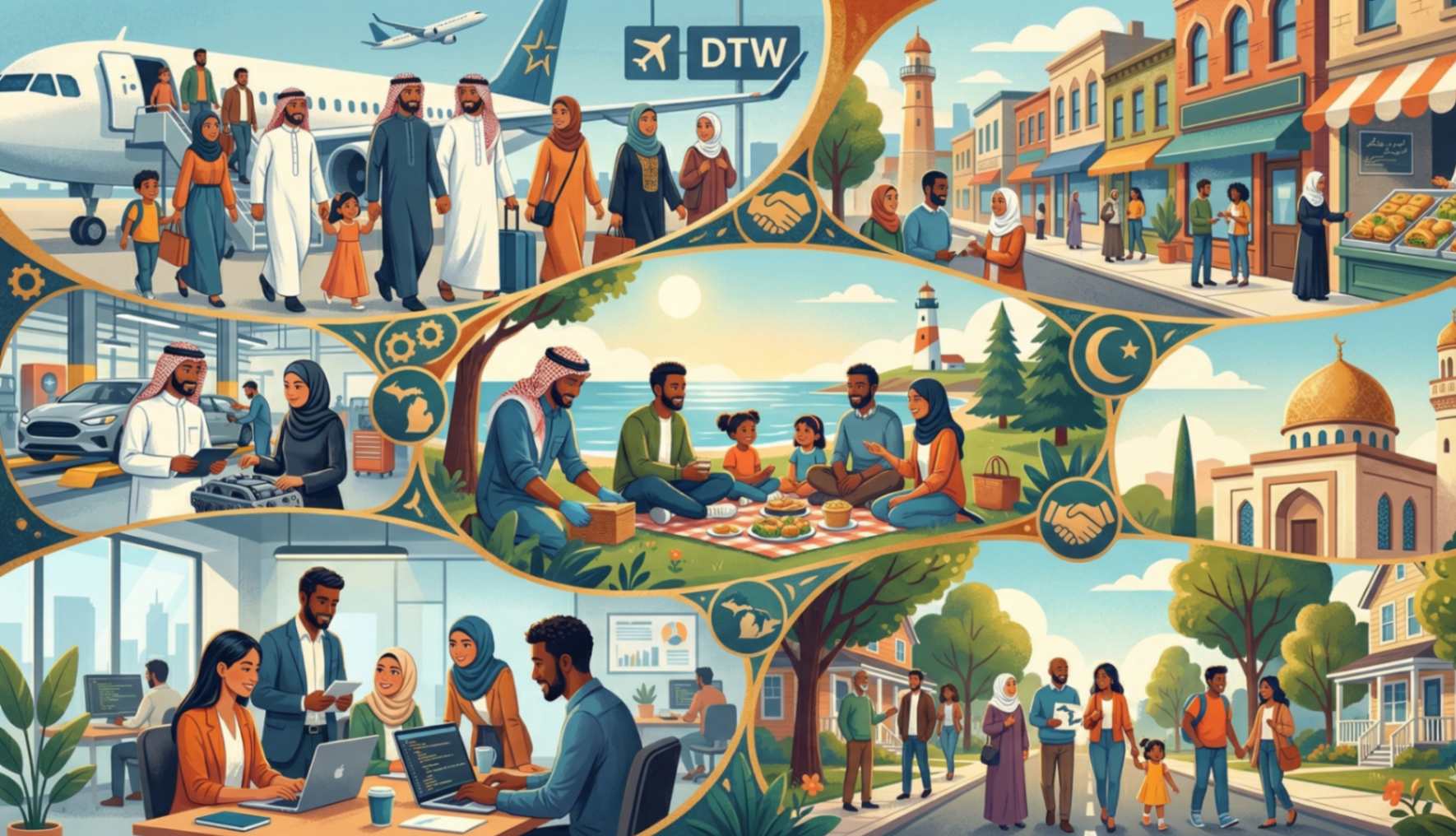
🔍 What You'll Find in This Guide (And Why Michigan Might Be Your Answer)
Let me tell you about the first time I walked down Warren Avenue in Dearborn.
I had been in America for years. I had lived in cities where being Arab meant being a minority—sometimes welcomed, sometimes not. Then I turned onto Warren Avenue, and I stopped walking. The storefronts were in Arabic and English. The smell of shawarma and fresh bread hung in the air. A billboard for a law firm was written in Arabic script. A teenager in a hijab passed me on the sidewalk, laughing with her friends in a mix of Arabic and English. And from somewhere down the street, I heard the adhan.
I wasn't in Beirut or Amman or Cairo. I was in Michigan. And I felt, for the first time since leaving the Middle East, that I was home.
Michigan is not just another state on the map. For Arabs in America, it is the closest thing to a cultural and demographic anchor this country has. Dearborn alone has one of the largest Arab populations anywhere outside the Arab world—over 40% of the city's residents are of Arab descent. The Arabic language is embedded in daily life here in a way that exists nowhere else in the United States.
I'm Hussein Abdullah, founder of "Arabs in America." Over fifteen years, I've watched Michigan—and Dearborn specifically—serve as the entry point, the safety net, and the long-term home for tens of thousands of Arab families. This guide is built from their experiences.
Here's exactly what you'll get:
- Michigan at a Glance: Geography, climate, and why Arabs choose this state.
- The History of Arabs in Michigan: How the auto industry built the largest Arab community in America.
- Where Arabs Actually Live: Dearborn, Dearborn Heights, Detroit, Ann Arbor, Hamtramck, Canton, Livonia—mapped and explained.
- Mosques and Islamic Centers: A directory of the major institutions that anchor community life.
- Islamic Schools and K-12 Education: Options that combine academic excellence with Islamic identity.
- Jobs and the Michigan Economy: Automotive, healthcare, education, and small business—where Arabs are building careers.
- Cost of Living and Housing: Michigan's competitive advantage over coastal states.
- Social Life and Family Activities: Festivals, restaurants, shopping, and outdoor life.
- Studying in Michigan: University of Michigan, Wayne State, community colleges, and what they cost.
- Quick Comparison Table: Michigan vs. California vs. New York vs. Texas.
- Practical Tips for Newcomers: Winter survival, community resources, and what to know before you move.
- Real Stories from Arabs in Michigan: Those who built lives here and what they learned.
- Hussein's Honest Take: Is Michigan right for your family?
Michigan is not the most glamorous state. The winters are long. But for an Arab family seeking community, affordability, and opportunity, it may be the smartest choice in America.
Chapter One: Michigan at a Glance—The State That Can Feel Like Home
| Fact | Detail |
|---|---|
| Location | Great Lakes region, sharing long water and land boundaries with Canada. |
| Nickname | The "Great Lakes State"—surrounded by four of the five Great Lakes, with the world's longest freshwater coastline. |
| Capital | Lansing |
| Population Centers | Detroit, Dearborn, Ann Arbor, Grand Rapids |
| Climate | Four distinct seasons. Winters are long and harsh (November–April, heavy snow possible). Summers are mild and excellent for outdoor life. |
| State Income Tax | Flat 4.25% |
| Why Arabs Choose Michigan | Large, institution-rich communities; dense mosque networks; accredited Islamic schools; durable industrial jobs; and housing costs far below coastal states. |
Hussein's Take: Michigan's winter is the price of admission. Pay it with a good coat and snow tires, and you unlock one of the most affordable, community-rich states in America for Arab families.
🔗 For comparison with other states:
Chapter Two: History of Michigan's Arab Community—A Success Story Rooted in Industry
Arab presence in Michigan is not accidental. It is tied directly to the state's economic history.
- Late 19th century: Henry Ford's auto plants drew workers from Syria, Lebanon, and Palestine to assembly lines. Many families settled near the Rouge complex in Dearborn.
- After 1948: Michigan absorbed successive waves of Palestinians seeking stability.
- 1975 onward: Lebanon's civil war pushed large new arrivals.
- 1990s–2000s: The first Gulf War and later geopolitical shifts brought a major Iraqi community (including Chaldean and Shiite networks) into Detroit and its suburbs.
- 2011 to today: Conflict in Syria and Yemen brought thousands more families.
- 2026 estimates: Roughly 300,000+ people of Arab origin live in Michigan, with about half concentrated in Dearborn and adjacent suburbs—creating real political and economic influence.
This deep-rooted history means that Michigan's Arab community is not a recent transplant. It is a multi-generational, institutionally mature community with political representation, business networks, and cultural infrastructure that newer Arab communities in other states are still building.
Chapter Three: Key Michigan Cities for Arabs—Where People Actually Live
If you are researching the best Michigan cities for Arab families, the map is clear: southeast Michigan is the core.
🥇 Dearborn—"Capital of Arabs in America"
- Why it matters: One of the world's largest Arab urban concentrations outside the Arab world. Local leadership, schools, and public life reflect deep community roots.
- Neighborhoods: Heavy density in East Dearborn and the Dix corridor.
- Warren Avenue: Miles of Lebanese restaurants, bakeries, cafés, halal butchers, law offices, and mosques. Bilingual signage is the norm.
- Social rhythm: Businesses often slow on Friday prayer; Arabic is part of everyday street life.
🥈 Dearborn Heights
- A natural residential extension of Dearborn with a very large Arab population.
- Advantage: Rent and purchase prices are often slightly lower than core Dearborn while staying minutes from community services.
🥉 Detroit
- The broader "Motor City" continues reinvestment and growth in 2026.
- Hamtramck: A small city surrounded by Detroit and a diversity icon—the first U.S. city to elect a Muslim-majority city council, with very large Yemeni and Bangladeshi communities.
Ann Arbor
- A polished college town anchored by the University of Michigan.
- Community profile: Large Arab student networks plus professionals, physicians, and faculty.
Canton and Livonia
- Quiet, upscale suburbs attracting many second-generation families who want space and strong public schools while staying connected to southeast Michigan's Arab economy.
Chapter Four: Mosques and Islamic Centers in Michigan
Religious infrastructure is a major reason Muslim families move here. For a point of comparison with another major mosque network, see our guide to mosques in California.
| Mosque / Center | Location | Key Services |
|---|---|---|
| Islamic Center of America | 19500 Ford Rd, Dearborn, MI 48128 | Largest mosque in North America. Prayer, marriage support, family counseling, multilingual programming. |
| Islamic Center of Dearborn Heights | Dearborn Heights | Very active for suburban families, strong youth education focus. |
| Islamic Association of Greater Detroit (IAGD) | Canton | Major suburban mosque with youth and athletics programming. |
| Islamic Center of Ann Arbor | Ann Arbor | Serves UMich students and the academic community. |
| Hamtramck Islamic Center | Hamtramck | Strong Yemeni and Asian Muslim presence; public adhan permitted under local ordinance. |
Chapter Five: Islamic Schools and K-12 Education
Michigan offers unusually strong options for families who want both academic rigor and Islamic identity.
| School | Location | Focus |
|---|---|---|
| Star International Academy | Dearborn Heights | Balances Islamic values with strong academic outcomes. |
| Universal Academy | Detroit | Diverse student body with intensive Arabic and Islamic studies tracks. |
| Michigan Islamic Academy | Ann Arbor | Rigorous environment suited to university-town families. |
| Iqra Academy | Dearborn | Focused on Islamic identity and Arabic literacy. |
Public schools: Dearborn Public Schools are a unique case—halal meal options, respect for Islamic holidays, and ESL supports that ease the transition for newcomers still building English skills.
Chapter Six: Jobs and the Michigan Economy
Two engines dominate the job market in 2026:
- Automotive manufacturing: Ford, GM, and Stellantis still employ huge workforces. Demand continues for mechanical engineers, software engineers (EV and autonomy), technicians, and administrators. Factory roles can deliver solid income and strong union healthcare for newcomers still improving English.
- Healthcare: Major systems like Henry Ford Health and Beaumont are among the state's largest employers; Arab physicians and nurses often find competitive pay and stable demand.
- Higher education: Faculty and research hiring, especially around Ann Arbor and Detroit.
- Small business: Restaurants, grocery, contracting, and gas stations remain classic pathways—many Arab entrepreneurs build wealth through retail and services tied to community demand.
🔗 For broader job search strategy: Work in America for new immigrants
Chapter Seven: Housing and Cost of Living—Michigan's Competitive Advantage
Total living costs can run 30%–50% lower than in California or New York.
| Expense | Dearborn Area | Notes |
|---|---|---|
| 2-BR Rent | $1,200–$1,800 | Dearborn Heights often $1,000–$1,500 |
| Home Purchase | $200,000–$300,000 | Well below national coastal benchmarks |
| State Income Tax | Flat 4.25% | |
| Halal Groceries | Competitive pricing | Dense Arab grocery competition |
🔗 For detailed budget breakdowns:
Chapter Eight: Social Life and Family Activities
- Dearborn Arab Festival: Draws tens of thousands from across the U.S.
- Eid celebrations: Major mosques and halls become celebration spaces, sometimes with street closures and parades.
- Shopping: Fairlane Town Center (Dearborn), Somerset Collection (Troy). Markets like Super Greenland and Al-Haramain cover spices, produce, halal meat, and imports.
- Restaurants: Al-Ameer (nationally recognized Lebanese classics), Cedarland (family favorite for shawarma), Shatila Bakery (Dearborn icon for baklava and knafeh).
- Outdoors: Great Lakes beaches in summer; winter sports like ice skating become family rituals.
Chapter Nine: Studying in Michigan as an Arab Student or Parent
| Institution | Location | Notes |
|---|---|---|
| University of Michigan (Ann Arbor) | Ann Arbor | Top-ranked globally. Large, active Arab student associations. |
| University of Michigan–Dearborn | Dearborn | Michigan degree credibility in the heart of the Arab community. |
| Wayne State University | Detroit | Strong in medicine, sciences, and engineering. |
| Henry Ford College | Dearborn | Smart economic starting point—low cost, then transfer to UMich or Wayne State. |
Chapter Ten: Quick Comparison—Michigan vs. Other States (Monthly Costs for a Family of Four)
| Item | Michigan (Dearborn) | California (LA) | New York (Brooklyn) | Texas (Houston) |
|---|---|---|---|---|
| 2-BR Rent | $1,500 | $3,200 | $3,800 | $1,800 |
| Food (approx.) | $800 | $1,300 | $1,500 | $900 |
| Transport/Fuel | $300 | $500 | $200–$600 | $350 |
| Halal Grocery | Excellent & affordable | Available but pricey | Available but pricey | Strong & reasonable |
| Overall Affordability | Very high savings relief | High cost pressure | High cost pressure | Strong savings |
Chapter Eleven: Practical Tips for Newcomers
- Respect winter. Invest in a real winter coat, snow-ready footwear, and verify heat and vehicle readiness before November.
- Start near community if English is still developing. Dearborn or Dearborn Heights reduces isolation and speeds practical problem-solving.
- Join local groups. Facebook groups like "Dearborn Arabs" or "Michigan Arabs" often surface housing, first jobs, and reliable used cars.
- Use community nonprofits. Organizations like ACCESS help with legal navigation, English classes, and health navigation for new arrivals.
- Plan to drive. Outside core Detroit transit corridors, Michigan is car-dependent; a license and vehicle are baseline needs.
Chapter Twelve: Real Stories from Arabs in Michigan
📖 Samir's Story (Lebanon)
Samir, a Lebanese restaurant owner in Dearborn, arrived in 2005. "I started as a dishwasher at Al-Ameer. Fifteen years later, I opened my own place on Warren Avenue. Dearborn is the only city in America where I could build a business entirely in Arabic and English. My customers are Lebanese, Iraqi, Palestinian, Yemeni—and Americans who love our food. This city gave me everything."
📖 The Al-Hashimi Family (Iraq)
The Al-Hashimi family, refugees from Baghdad, resettled in Dearborn Heights in 2017. "We arrived with nothing. The mosque community found us an apartment. A neighbor helped my husband get a job at Ford. Our children are in Dearborn Public Schools, thriving. We own our home now. Michigan is not just where we live. It's where we became Americans."
Frequently Asked Questions (FAQ)
Q1: How many Arabs live in Michigan? A: Roughly 300,000+ people of Arab origin, with about half concentrated in Dearborn and adjacent suburbs.
Q2: What is the best city in Michigan for Arab families? A: Dearborn is the cultural and demographic heart. Dearborn Heights offers slightly lower costs with the same community access. Ann Arbor is ideal for academics and professionals.
Q3: Are there Islamic schools in Michigan? A: Yes—Star International Academy, Universal Academy, Michigan Islamic Academy, and Iqra Academy are among the strongest in the country.
Q4: What jobs are available for Arabs in Michigan? A: Automotive manufacturing (Ford, GM, Stellantis), healthcare (Henry Ford Health, Beaumont), higher education, and small business ownership.
Q5: Is Michigan affordable compared to other states? A: Yes. Total living costs are 30%–50% lower than California or New York. Homeownership is achievable on a middle-class income.
Q6: How cold does Michigan get? A: Winters are harsh—heavy snow from November into April is common. Invest in proper winter gear and snow tires.
Q7: Can I live in Dearborn without strong English? A: To a significant degree, yes. Arabic is widely spoken, and many services are available bilingually. However, English proficiency expands job opportunities considerably.
Q8: What is the largest mosque in Michigan? A: The Islamic Center of America in Dearborn, often described as the largest mosque in North America.
Conclusion: Michigan—America's Arab Anchor
Michigan remains a defining hub for Arabs in America: scale, mosque and school infrastructure, housing affordability that supports saving and ownership, and durable employment in automotive and healthcare.
A final word from Hussein Abdullah: I've lived in and written about Arab communities across this country. Nothing compares to Michigan for density, institutional depth, and sheer cultural familiarity. If you want a state where Arabic is part of commercial street life, where mosques shape neighborhood rhythms, and where you can buy a home on a middle-class salary while your children attend an Islamic school, Michigan—and specifically Dearborn—should be at the top of your list.
🔗 Continue Exploring:
- Arabs in New York: Complete Guide
- Arabs in Indiana: Complete Guide
- Arabs in Utah: Complete Guide
- Cost of Living in Michigan 2026
- Work in America for New Immigrants
Share your Michigan story: Are you planning a move to Michigan—or already living in Dearborn or another Michigan city? What has your experience been like? Leave your story in the comments below. Your insight could help the next Arab family make one of the most important decisions of their lives.
Author: حسين عبد الله
Hussein Abdullah is a web developer and specialized content writer with more than eight years of experience enriching Arabic digital content. He combines an analytical programming mindset with a deep passion for writing to deliver accurate, reference-quality guides. On Arabian in USA (عرب في أمريكا), he focuses on simplifying complex steps for new immigrants and sharing reliable information on housing, work, and financial setup—so every newcomer has a trustworthy path toward stable life in the United States.


Continue reading
- Top 10 Best States for Muslims in America: Ultimate Guide (Updated 2026)
- Top 7 Best States for Arabs in America: Ultimate Guide (Updated 2026)
- Living in Michigan 2026: Ultimate Guide for Arabs and Immigrants (Housing, Jobs, Schools, Mosques)
- Muslim Population in America 2026: Complete State-by-State Guide, Statistics & Interactive Map
- Cost of Living in Michigan 2026: Rent, Transportation, Taxes & Monthly Budget for Arab Families
- Work in America for New Immigrants 2026: The Complete Guide from Day One to Your Dream Career [Step-by-Step Plan]