Arabs in Indiana 2026: Complete Guide to Community, Mosques, Jobs, and Living Costs
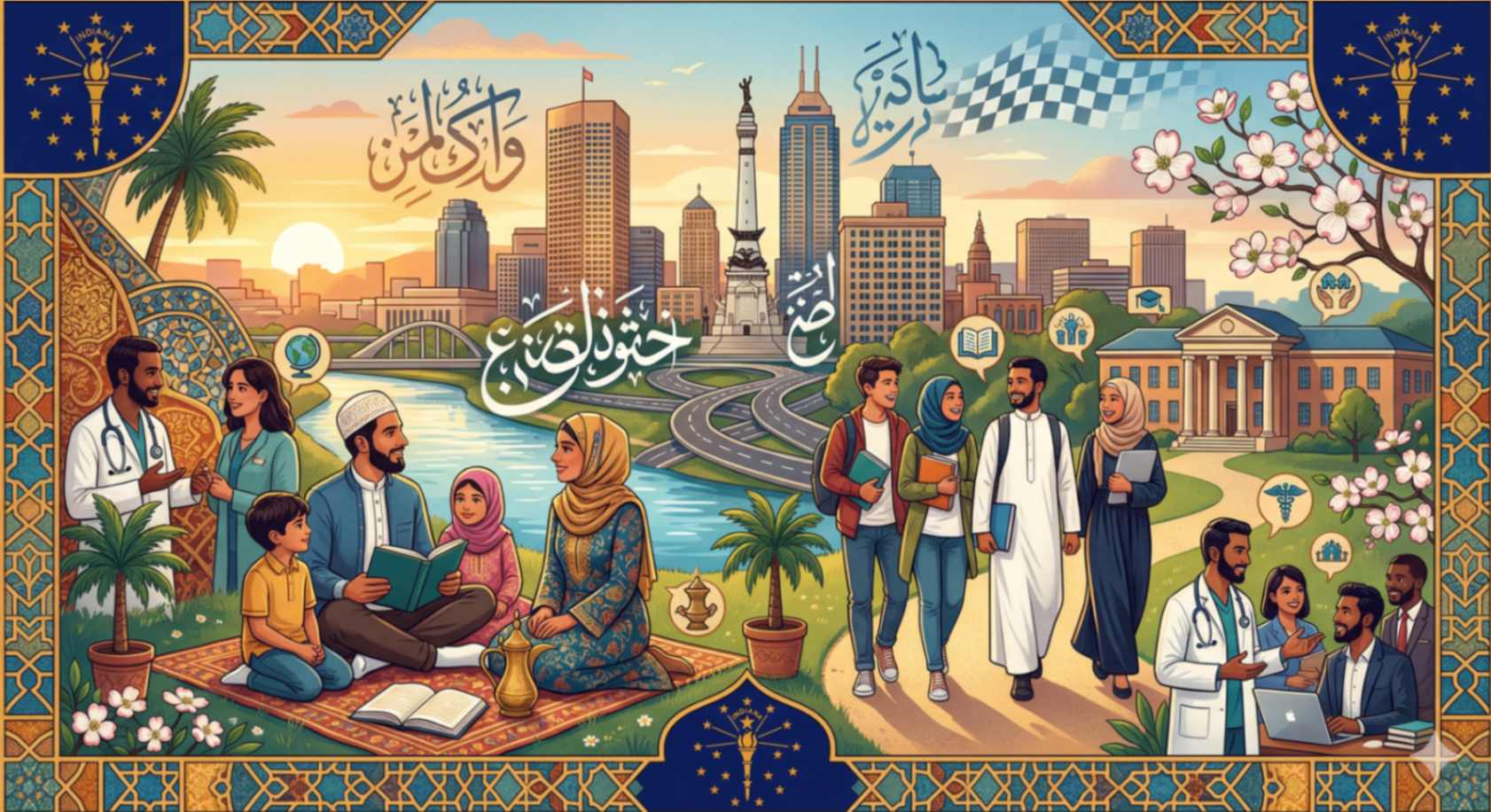
🔍 What You'll Find in This Guide (And Why Indiana Might Surprise You)
Let me be honest with you. When Arab families ask me where to settle in America, the conversation almost always starts with the same three states: Michigan, California, and Texas. Dearborn. Anaheim. Houston. These are the names everyone knows.
But here's what I've learned over fifteen years of helping Arabs relocate across this country: The best decision isn't always the most obvious one.
Indiana is not the first state that comes to mind. It doesn't have the Arab density of Dearborn or the glamour of Los Angeles. But what it does have is quietly attracting a growing number of Arab families—and they're staying.
I'm Hussein Abdullah, founder of "Arabs in America." I've visited Indiana's mosques, walked through its Arab grocery stores in Indianapolis, and talked with families who traded the high costs of Chicago for the stability of Carmel and Fishers. This guide is built from those conversations.
Here's exactly what you'll get:
- Why Indiana is Gaining Traction: The economic and lifestyle factors driving Arab families to the Hoosier State.
- Community Snapshot 2026: Estimated population, national backgrounds, and where Arabs actually live.
- Best Cities for Arab Families: Indianapolis, Carmel, Fishers, Fort Wayne, South Bend—ranked and explained.
- Mosques and Islamic Centers: A complete directory of where to pray, learn, and connect.
- Education Planning: Public schools, Islamic schools, and how Indiana's school-choice system works for you.
- Real Job Sectors: Where the demand actually is—logistics, healthcare, pharma, engineering, and entrepreneurship.
- Cost of Living Breakdown: Rent, home ownership, and daily expenses compared to Illinois and Michigan.
- Practical Relocation Tips: A step-by-step plan for your move.
- Real Stories from Indiana Arabs: Families who made the move and what they learned.
- Hussein's Honest Verdict: Is Indiana right for your family?
Indiana might not be the first name on your list. But by the end of this guide, it might be the smartest.
Chapter One: Why More Arabs Are Choosing Indiana in 2026
When people discuss Arab-friendly U.S. states, Michigan, California, and Texas usually lead the conversation. But in 2026, Indiana has become a serious and practical option for families looking for affordability, stability, and long-term growth.
The Indiana Advantage
| Factor | Indiana | California | Illinois (Chicago) | Michigan (Detroit) |
|---|---|---|---|---|
| Cost of Living | Low to Moderate | Very High | High | Moderate |
| Housing Affordability | Excellent | Poor | Moderate | Good |
| Arab Community Size | Medium (Growing) | Large | Large | Very Large |
| Job Market Diversity | Strong | Strong | Strong | Solid |
| Family Suburban Fit | Very Strong | Mixed | Mixed | Strong |
| Tax Burden | Manageable | High | High | Moderate |
Indiana offers a mix that many families want: lower living costs than most coastal states, a strong central location near Chicago and Detroit, a diverse economy spanning industry, logistics, healthcare, pharma, and engineering, a family-friendly suburban lifestyle, and a growing Arab-Muslim ecosystem with better services each year.
Hussein's Take: I've seen families move from a $2,500/month cramped apartment in Chicago to a 4-bedroom house with a yard in Fishers for $1,800/month. The money they save on housing alone funds their kids' Islamic school tuition. That math is hard to argue with.
🔗 For broader state comparisons:
Chapter Two: Arab Community in Indiana (2026 Snapshot)
The Arab community in Indiana is no longer small or temporary. It has quietly grown into a stable, established presence.
- Estimated population: Community estimates and local organizations place the Arab population in Indiana above 50,000, with steady growth driven by secondary migration from higher-cost states.
- Community backgrounds are diverse: Palestinian, Lebanese, Syrian, Egyptian, Iraqi, Jordanian, and North African communities are all represented, creating a rich cultural mix.
- Main concentrations: The Indianapolis metro area (including Carmel, Fishers, and Greenwood) is the primary hub. Additional meaningful clusters exist in Fort Wayne and South Bend.
This growth has strengthened access to halal food, social networks, and family-oriented services. You can now find multiple Arab grocery stores, halal butcher shops, and restaurants serving authentic Middle Eastern cuisine in Indianapolis alone.
📖 Real Story: The Khaled Family's Move from Chicago
Abu Khaled, a Palestinian engineer, moved his family from Bridgeview, Illinois, to Fishers, Indiana, in 2023. "We loved the Arab community in Bridgeview," he told me. "But we had five kids in a three-bedroom apartment. We couldn't afford to buy a house there. In Fishers, we bought a five-bedroom home for what a two-bedroom condo would cost in Chicago. There's a mosque 10 minutes away. My kids are in excellent public schools. We still drive to Bridgeview for specialty groceries once a month—it's only two hours. Best decision we ever made."
Chapter Three: Best Indiana Cities for Arab Families
🥇 Indianapolis
The state capital and the biggest service and job hub. Indianapolis offers better job density, more halal markets and restaurants, and stronger community infrastructure than anywhere else in the state. The city proper has diverse neighborhoods, and the surrounding suburbs provide excellent family environments.
🥈 Carmel and Fishers
These are top-tier suburbs north of Indianapolis. They offer excellent public schools rated among the best in the state, high safety scores, and strong family-living quality. The Arab community presence here is growing noticeably, with several Islamic centers within a 15-20 minute drive.
🥉 Greenwood
A practical housing choice for families wanting more space with access to the metro area. Home prices here are notably lower than in Carmel or Fishers, while still providing access to Indianapolis jobs and amenities.
Fort Wayne
Indiana's second-largest city with relatively lower costs and an active Arab-Muslim presence. The Islamic Center of Fort Wayne serves as a community anchor. Job opportunities in healthcare and manufacturing are solid.
South Bend
A university-influenced city (home to the University of Notre Dame) with student and academic diversity, including Arab and Muslim representation. The Islamic Society of South Bend provides community infrastructure.
Chapter Four: Mosques and Islamic Centers in Indiana
Indiana offers a solid and growing Islamic infrastructure. These centers support more than prayer—they offer Quran and Arabic programs, youth and family initiatives, community networking, and Ramadan and Eid programming.
| Islamic Center | Location | Key Services |
|---|---|---|
| Islamic Center of Indianapolis | Indianapolis | Five daily prayers, Jummah, weekend school, community events |
| Masjid Al-Salam | Indianapolis | Prayers, educational programs |
| Masjid Indiana | Indianapolis | Community services, youth programs |
| Islamic Center of Fort Wayne | Fort Wayne | Prayers, community anchor for northeastern Indiana |
| Islamic Society of South Bend | South Bend | Serves the university community and local Muslims |
For comparison with a larger ecosystem, see Mosques in California 2026.
Chapter Five: Education and School Planning for Arab Families
Education is usually the #1 relocation factor for families. In Indiana, most households choose between:
- High-performing public schools in selected districts — Carmel, Fishers, and Zionsville schools consistently rank among the top in the state.
- Islamic/private or supplementary weekend education — Several mosques offer weekend Arabic and Quran programs.
Indiana's school-choice framework (including voucher programs) can reduce private-school pressure for qualifying families, making planning more flexible than in some neighboring states.
🔗 For deeper education strategy:
Chapter Six: Jobs in Indiana—Where Real Demand Exists
Logistics and Transport
Indiana's "Crossroads of America" position keeps demand strong in transport and supply chain roles. CDL drivers, warehouse managers, and logistics coordinators are consistently in demand.
Healthcare
Stable demand for physicians, nurses, and allied health professionals across major systems like IU Health, Community Health Network, and Ascension St. Vincent.
Pharma and Life Sciences
Indianapolis remains a major center for pharmaceutical and biomedical employment. Eli Lilly is headquartered here, along with numerous biotech firms.
Engineering and Manufacturing
Strong opportunities in mechanical, civil, and industrial engineering. Companies like Cummins and Rolls-Royce have significant Indiana operations.
Entrepreneurship
Growing demand for halal restaurants and bakeries, Arab grocery and retail, real-estate and relocation services, and translation and newcomer support services.
🔗 For comparison with a larger but more competitive market:
Chapter Seven: Cost of Living and Housing in Indiana
Indiana's strongest advantage remains affordability. Here's how it breaks down:
| Expense Category | Indiana (Monthly Estimate) | Illinois/Chicago (Monthly Estimate) |
|---|---|---|
| Rent (3-BR House) | $1,500 - $2,200 | $2,500 - $3,800 |
| Median Home Price | $280,000 - $350,000 | $350,000 - $620,000 |
| Utilities (Elec, Gas, Water, Internet) | $250 - $350 | $300 - $450 |
| Groceries (Family of 4) | $900 - $1,200 | $1,100 - $1,400 |
For many families, Indiana offers better value per dollar than high-cost states. The money saved on housing can fund education, travel, or community activities.
Chapter Eight: Family and Social Life
Indiana can support a stable family lifestyle with active community events during Islamic seasons, parks and outdoor spaces, youth activities, and lower noise and congestion than major coastal cities. This makes it attractive for households prioritizing long-term stability over urban excitement.
Chapter Nine: Practical Relocation Tips
- Choose neighborhood strategy first — School quality, commute time, and proximity to your nearest mosque should drive your location decision.
- Join local Arab/Muslim groups before moving — Facebook groups and mosque WhatsApp communities exist for most Indiana cities. They're invaluable for insider knowledge.
- Start job applications early — Ideally 2-3 months before your planned move to reduce transition risk.
- Prepare for winter — Indiana winters are real. Budget for heating costs and invest in proper winter clothing and snow tires.
- Use Indiana's location advantage — Indianapolis is roughly 3 hours from Chicago, 2 hours from Cincinnati, and 4.5 hours from Detroit. Weekend trips to larger Arab communities are entirely feasible.
Frequently Asked Questions (FAQ)
Q1: How large is the Arab community in Indiana? A: Community estimates place the Arab population above 50,000, concentrated primarily in the Indianapolis metro area, with growing clusters in Fort Wayne and South Bend.
Q2: Are there enough halal food options in Indiana? A: Yes, particularly in Indianapolis. Multiple Arab grocery stores, halal butcher shops, and Middle Eastern restaurants serve the community. Options are more limited—but present—in smaller cities.
Q3: What are the best school districts for Arab families? A: Carmel Clay Schools, Hamilton Southeastern (Fishers), and Zionsville Community Schools are top-rated and popular with Arab families.
Q4: Is Indiana safe for Muslims and Arabs? A: Generally, yes. The Indianapolis metro area and its northern suburbs are safe and diverse. As with any relocation, visiting beforehand and talking to community members directly is recommended.
Q5: How does Indiana compare to Illinois for Arab families? A: Indiana offers significantly lower housing costs, lower taxes, and less congestion than Chicago. The trade-off is a smaller—but growing—Arab community and fewer halal dining options.
Q6: Where are the main mosques in Indiana? A: The Islamic Center of Indianapolis, Masjid Al-Salam, and Masjid Indiana serve the capital region. Fort Wayne and South Bend each have active Islamic centers.
Q7: What jobs are most available for immigrants in Indiana? A: Logistics/transport, healthcare, manufacturing, and pharmaceutical jobs are consistently in demand. Entrepreneurship in halal food and Arab retail is also a growing path.
Q8: Are there Islamic schools in Indiana? A: While Indiana has fewer full-time Islamic schools than Michigan or California, several mosques operate weekend Arabic and Quran programs. Some families combine public schooling with supplementary Islamic education.
Conclusion: Is Indiana Right for Your Family?
In 2026, Indiana is no longer a secondary option for Arab families. It is a strategic choice for people seeking affordability, family safety, and sustainable economic opportunity.
If you plan your move around neighborhood quality, school performance, and job alignment, Indiana can be one of the strongest long-term relocation outcomes in the Midwest.
A final word from Hussein Abdullah: I've watched the Arab community in Indiana grow from a tiny, scattered presence into a self-sustaining ecosystem. The families who moved here a decade ago now own businesses, lead community organizations, and have raised children who are thriving in top universities. Indiana rewards patience. It rewards families who value stability over flash. If that sounds like you, it's worth a serious look.
🔗 Continue Your Research:
- Best State to Live in America for Arabs (2026)
- Best State for Muslims in America (2026)
- Islamic Schools in America 2026
- Best Banks for New Immigrants in America
Share your experience: Are you an Arab living in Indiana? What city did you choose, and what has your experience been like? Leave your story in the comments below—it could guide the next family considering this move.
Author: حسين عبد الله
Hussein Abdullah is a web developer and specialized content writer with more than eight years of experience enriching Arabic digital content. He combines an analytical programming mindset with a deep passion for writing to deliver accurate, reference-quality guides. On Arabian in USA (عرب في أمريكا), he focuses on simplifying complex steps for new immigrants and sharing reliable information on housing, work, and financial setup—so every newcomer has a trustworthy path toward stable life in the United States.


Continue reading
- Top 7 Best States for Arabs in America: Ultimate Guide (Updated 2026)
- Muslim Population in America 2026: Complete State-by-State Guide, Statistics & Interactive Map
- Top 10 Best States for Muslims in America: Ultimate Guide (Updated 2026)
- Work in America for New Immigrants 2026: The Complete Guide from Day One to Your Dream Career [Step-by-Step Plan]
- How to Build Credit Score in America from Zero in 2026: Complete Guide for New Immigrants
- Arabs in Michigan 2026: Complete Guide to Community, Cost of Living, Study, and Work