

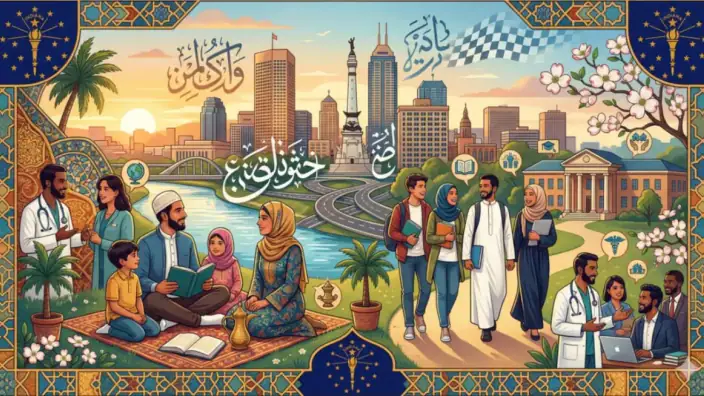
What this guide covers
- Introduction to the "Hoosier State" and its robust economy in the heart of the Midwest
- Comprehensive analysis of the highly affordable cost of living and moderate tax system
- Detailed comparison of the best cities and suburbs for families (Indianapolis, Carmel, West Lafayette)
- Jobs, salaries, and the massive impact of the pharmaceutical, logistics, and manufacturing sectors
- Elite university education, public school dynamics, and the highly organized Islamic community (ISNA Headquarters)
- A 90-day settlement plan focusing on administrative setup and winter preparedness
- Frequently Asked Questions (FAQ) regarding safety, weather, and local culture
Introduction: Indiana in 2026 – Midwestern Stability at the Lowest Cost
Known affectionately as "The Hoosier State," Indiana is located in the American Midwest. For decades, the state has been famous for its vast cornfields, a profound love for basketball, and the iconic Indy 500 motor race. However, by 2026, Indiana has successfully engineered a highly balanced, modern economy. Capitalizing on its central geographic location—earning it the motto the "Crossroads of America"—the state has become a national powerhouse in advanced manufacturing, biotechnology, pharmaceuticals, and logistics.
For the Arab immigrant and professional, Indiana represents a financially brilliant safe haven. It consistently ranks as one of the top 10 most affordable states in the U.S. It offers moderate taxes and a real estate market that allows new immigrants to purchase spacious, comfortable homes in a fraction of the time it would take in coastal states like New York or California, or even neighboring Illinois.
The social environment in Indiana leans conservative, emphasizing traditional Midwestern values focused heavily on family, community, and neighborly politeness. In the capital city of Indianapolis and its affluent northern suburbs, you will find a highly organized, influential Arab and Islamic community. This is massively supported by the presence of the national headquarters of the Islamic Society of North America (ISNA) in Plainfield, providing a robust religious and social infrastructure that makes settling in Indiana a seamless and deeply comforting experience for immigrant families.
Cost of Living in Indiana: The Ultimate Competitive Advantage
The primary catalyst driving families from expensive coastal cities and neighboring Chicago into Indiana is its unparalleled affordability. Your dollar stretches significantly further here, allowing for accelerated wealth accumulation and a higher quality of life.
1. Housing and Real Estate Costs
The real estate market in Indiana is exceptionally accessible. Even in the most prestigious suburbs surrounding the capital, home prices remain highly reasonable compared to national averages.
Average Rental and Home Purchase Prices (2026 Estimates):
| City / Suburb | 1-Bedroom Apartment Rent | 2-Bedroom Apartment Rent | Average 3-Bedroom Home Price |
|---|---|---|---|
| Indianapolis (City Center) | $1,000 - $1,300 | $1,250 - $1,600 | $250,000 |
| Carmel / Fishers (Upscale) | $1,500 - $1,800 | $1,800 - $2,300 | $480,000 |
| West Lafayette (College Town) | $1,100 - $1,400 | $1,300 - $1,700 | $310,000 |
| Fort Wayne | $850 - $1,100 | $1,050 - $1,350 | $210,000 |
2. Utilities and Public Services
- Heating (Essential in Winter): Indiana winters are cold, frequently bringing snow and sub-freezing temperatures for several months. Central heating, primarily powered by natural gas, is essential. Monthly utility bills (covering electricity, gas, water, and trash) for a standard home range from $180 to $260.
- Internet: High-speed broadband and fiber-optic networks are widely available, typically costing between $60 and $80 per month.
3. Transportation and Insurance
- Absolute Car Dependency: Indiana's infrastructure is built entirely around the automobile. Public transit (like the IndyGo bus system in the capital) is highly limited and does not effectively serve the sprawling suburbs. Owning a car is a non-negotiable requirement for daily life.
- Fuel and Auto Insurance: Thanks to its proximity to major refineries and its crossroads location, gas prices in Indiana are generally among the lowest in the nation. Auto insurance is also highly affordable, averaging between $1,200 and $1,500 annually for comprehensive coverage.
4. The Tax System: Moderate and Stable
Indiana is known for its highly favorable and predictable tax environment:
- Individual Income Tax: The state employs a low, flat income tax rate of 3.05% (with legislative plans to reduce it further by 2027). Note that many individual counties levy a small additional local income tax (usually between 1% and 2%).
- Property Tax: Property taxes are strictly regulated. The state constitution caps property taxes on a primary residence at exactly 1% of its assessed gross value, shielding homeowners from the volatile tax spikes seen in neighboring states.
- Sales Tax: The statewide sales tax is 7%, and local counties do not add surtaxes on top of this. Most importantly, groceries and unprepared food items are entirely exempt from the sales tax.
Best Cities and Suburbs for Arabs and Immigrants
Economic and community life is heavily concentrated in Central Indiana (Greater Indianapolis), flanked by several vital university and industrial cities.
1. The Northern Suburbs (Hamilton County) - Luxury and Elite Schools
Encompassing cities like Carmel, Fishers, and Noblesville.
- Characteristics: Carmel and Fishers are consistently ranked among the absolute best places to live in the United States. They feature pristine infrastructure (famous for their extensive use of traffic roundabouts), absolute safety, and public school districts that are universally ranked as the best in the state.
- The Community: These suburbs are the preferred destination for Arab physicians, engineers, and academics. They host modern Islamic centers and provide an incredibly comfortable, high-end environment for raising children.
2. Indianapolis - The Capital and Commercial Hub
The largest city in the state and the center of state government.
- Characteristics: Offers diverse housing options and a bustling downtown. It is home to massive hospital networks, corporate headquarters, and urban university campuses like IUPUI.
- Challenges: Some public schools within the city limits (Indianapolis Public Schools) struggle with lower ratings, and certain urban neighborhoods experience higher crime rates. Consequently, many immigrant families choose to live in the affluent suburbs and commute to downtown Indy for work.
3. West Lafayette - The Global Academic Center
Located northwest of the capital, it is the proud home of Purdue University.
- Characteristics: A vibrant, highly secure college town characterized by massive cultural diversity due to the influx of international students, researchers, and faculty.
- The Community: Boasts a large, highly influential Arab academic and student population. The local Islamic center is exceptionally active, and halal food options are easily accessible to cater to the diverse university demographic.
4. Bloomington
Located south of the capital, serving as the flagship campus for Indiana University (IU).
- Characteristics: A picturesque, culturally rich city surrounded by rolling hills and state forests. It has a strong artistic vibe, a large international community, and is an excellent settlement choice for researchers and university staff.
5. Fort Wayne
The second-largest city in the state, located in the northeast.
- Characteristics: Offers an exceptionally low cost of living. The economy is heavily anchored by defense contracting (e.g., BAE Systems), advanced manufacturing, and healthcare.
- The Community: A quiet, family-oriented city with a growing Arab and Islamic community, perfect for those looking to purchase a home and establish a career at the absolute lowest possible cost.
Jobs and Salaries: The Engines of Indiana's Economy in 2026
Indiana's economy is rock-solid, heavily reliant on advanced manufacturing, pharmaceuticals, and global logistics.
Prominent Employment Sectors:
- Pharmaceuticals and Biotechnology: Indianapolis is the global headquarters for Eli Lilly and Company, one of the largest pharmaceutical corporations in the world. This giant, along with a vast network of surrounding biotech startups, provides thousands of elite, high-paying roles for chemists, clinical pharmacists, process engineers, and data scientists.
- Advanced Manufacturing: Indiana is fundamentally an industrial state. Facilities manufacturing aircraft engines (Rolls-Royce) and automotive assembly plants (Subaru, Honda, Toyota) provide incredibly stable engineering, technical, and supply chain jobs.
- Logistics and Transportation: Due to its central geographic location and the massive FedEx hub at the Indianapolis International Airport, the supply chain, warehousing, and freight management sectors are among the largest employers in the state.
- Healthcare: Massive hospital networks like IU Health and Ascension St. Vincent continuously expand to meet population needs, offering immense opportunities for medical professionals.
Average Expected Annual Salaries (2026 Estimates):
- Pharmaceutical Researcher / Chemical Engineer: $95,000 - $145,000
- Industrial / Mechanical Engineer: $80,000 - $125,000
- Registered Nurse (RN): $70,000 - $95,000
- Logistics / Supply Chain Manager: $75,000 - $115,000
- Software Developer: $85,000 - $130,000
Education and Mosques: Deep Community Roots and Global Academia
Indiana is distinguished by its world-class higher education institutions and a highly institutionalized Islamic presence that impacts the entire nation.
1. Universities and Higher Education
- Purdue University: Located in West Lafayette, it is globally recognized as one of the premier engineering and computer science universities in the world. It produces elite technical talent highly coveted by top-tier aerospace and tech firms.
- Indiana University Bloomington (IU): Internationally renowned for its Kelley School of Business, the Jacobs School of Music, and extensive environmental and public policy programs.
- IUPUI (Indiana University–Purdue University Indianapolis): A premier urban research university located in downtown Indy, heavily focused on medical, dental, and life sciences research (undergoing a planned structural separation by 2026).
2. Public Schools and Educational Choice
Hamilton County suburbs boast public schools that consistently rank among the top in the nation. Furthermore, Indiana strongly supports "School Choice." The state provides expansive voucher programs (Choice Scholarships) that allow many middle- and low-income families to send their children to elite private or full-time Islamic academies at little to no out-of-pocket cost.
3. Mosques and Islamic Centers
The Islamic infrastructure in Indiana is historic and incredibly well-organized:
- Islamic Society of North America (ISNA) Headquarters: Located in Plainfield (a western suburb of Indy). Housing the headquarters of the largest Islamic umbrella organization in the continent transforms Indiana into a vital hub for national Islamic conferences and events.
- Al-Fajr Mosque (Islamic Center of Indianapolis): Serves the diverse urban community within the city limits.
- Al-Huda Foundation: Located in Fishers, this modern, expansive center provides comprehensive services, youth programs, and a vibrant community hub for affluent families in the northern suburbs.
- Full-Time Islamic Schools: The state features several excellent full-time Islamic schools, such as the MTI School of Knowledge in Indianapolis.
- Halal Food Availability: Halal butchers, Arab grocers, and Middle Eastern restaurants are abundant, especially in Indianapolis and the major university towns. Furthermore, because Chicago is only a 3-hour drive away, many Indiana residents occasionally make weekend trips to "Little Palestine" in Illinois for massive bulk shopping.
The First 90-Day Plan: A Practical Guide to Settlement
Settling in Indiana is generally smooth and stress-free due to the lack of severe urban congestion, but it requires immediate preparation for the climate and administrative duties.
Month 1: Strict Administrative Setup
- Obtain a Social Security Number (SSN): Visit the nearest federal SSA office immediately to secure this vital number for payroll and background checks.
- Driver's License (BMV): The Bureau of Motor Vehicles (BMV) handles licensing. You must book an appointment and secure your local driver's license quickly, as a car is your only lifeline in this state.
- Purchase a Winter-Ready Vehicle: If you are arriving in the fall or winter, purchasing an All-Wheel Drive (AWD) or 4-Wheel Drive (4WD) vehicle is highly recommended to safely navigate snow and ice. Ensure the heating systems and tires are in excellent condition.
- Open a Bank Account: Head to major national banks like Chase or prominent regional banks like Fifth Third Bank to open your checking accounts.
Month 2: Housing and Family Preparation
- Secure a Rental: The rental market in Indiana is far less aggressive than on the coasts. If you do not have a U.S. Credit Score, providing a formal Offer Letter from a reputable employer or offering to pay a slightly higher security deposit will usually smoothly bypass credit requirements with local property managers.
- Initiate Credit Building: Apply immediately for a Secured Credit Card to begin establishing your American credit history.
- Prepare for the Midwestern Winter: Indiana winters require specific gear. Do not bring winter coats from overseas; wait until you arrive to purchase high-quality, heavily insulated Parkas, thermal gloves, and waterproof snow boots from local American retailers to ensure your family stays warm.
Month 3: Healthcare and Community Integration
- Health Insurance: Activate your employer-sponsored health insurance and select a Primary Care Physician (PCP) within respected local networks like IU Health.
- Community Integration: Visit the ISNA headquarters or local mosques like Al-Huda. The Arab and Muslim community in Indiana is highly interconnected. Established immigrants here are incredibly generous with advice regarding the best local pediatricians, reliable auto mechanics, and family-friendly parks.
- School Registration: If you have children, ensure all immunization records are translated and verified to guarantee immediate enrollment into the highly-rated suburban public school districts.
Frequently Asked Questions (FAQ) About Living in Indiana
Q: Is the weather in Indiana depressing and unbearable? A: Indiana experiences four very distinct seasons. The winter (December through March) is undeniably cold, snowy, and occasionally overcast, but it is not as severe as winters in Minnesota or Alaska. The state’s infrastructure is perfectly equipped to handle snow. Conversely, Spring and Fall are visually spectacular and highly pleasant, while Summers are warm and perfect for enjoying the state's numerous lakes and state parks.
Q: Is Indiana a safe state for immigrant families? A: The suburbs surrounding Indianapolis (such as Carmel, Fishers, and Zionsville) and the major university towns are consistently ranked among the safest, cleanest communities in the entire United States. Higher crime rates are strictly isolated to specific, well-known urban neighborhoods in central Indianapolis and the far-northern city of Gary, both of which are easily avoidable.
Q: Is there racism or Islamophobia in Indiana? A: Politically, Indiana is a conservative (red) state, and rural areas are predominantly white and traditional. However, the capital, the affluent northern suburbs, and the university towns are highly diverse, highly educated, and welcoming. The presence of ISNA's national headquarters has normalized the Muslim presence in the state. Midwesterners are famous for their polite, neighborly demeanor, and overt discrimination is exceedingly rare in professional and daily life.
Q: Are salaries in Indiana much lower than in major coastal states? A: In absolute numbers, salaries may appear 15% to 20% lower than in New York or San Francisco. However, when you factor in the drastically lower cost of housing, affordable everyday expenses, and moderate taxes, the actual purchasing power of an Indiana salary is significantly higher. You will be able to save money, buy a home, and build wealth much faster here than in an expensive coastal city.
Q: Is Indiana boring compared to larger states? A: Indiana is engineered for a quiet, stable, and highly comfortable "family-oriented" lifestyle. If you are seeking endless skyscrapers, ocean beaches, or a chaotic, vibrant nightlife, Indiana will feel too quiet. The state revolves around community events, massive sporting events (basketball, auto racing), state parks, and shopping. However, if you crave big-city excitement, Chicago is only a 3-hour drive away, making it the perfect destination for an exciting weekend getaway.
In 2026, Indiana stands as a model of quiet, affordable Midwestern success. It offers the Arab professional and family a rare opportunity to achieve the "American Dream" rapidly—purchasing a spacious home, educating children in elite schools, and building a stable, lucrative career in vital sectors like pharmaceuticals and manufacturing—all within a secure, faith-friendly, and highly welcoming community.