Boston University for Arabs 2026: Complete Guide to Admission, Scholarships, and Student Life
🔍 What You'll Find in This Guide (And Why BU Might Be Your Launchpad)
Let me tell you about a conversation I had recently with an Arab father from Dubai. His daughter had been accepted to three American universities. He was torn. "BU is the most expensive," he said. "Is it worth it?"
I asked him one question: "What does your daughter want to do after graduation?" She wanted to work in biomedical research, eventually launching her own biotech startup. I told him: "Then BU is not an expense. It's an investment with a measurable return."
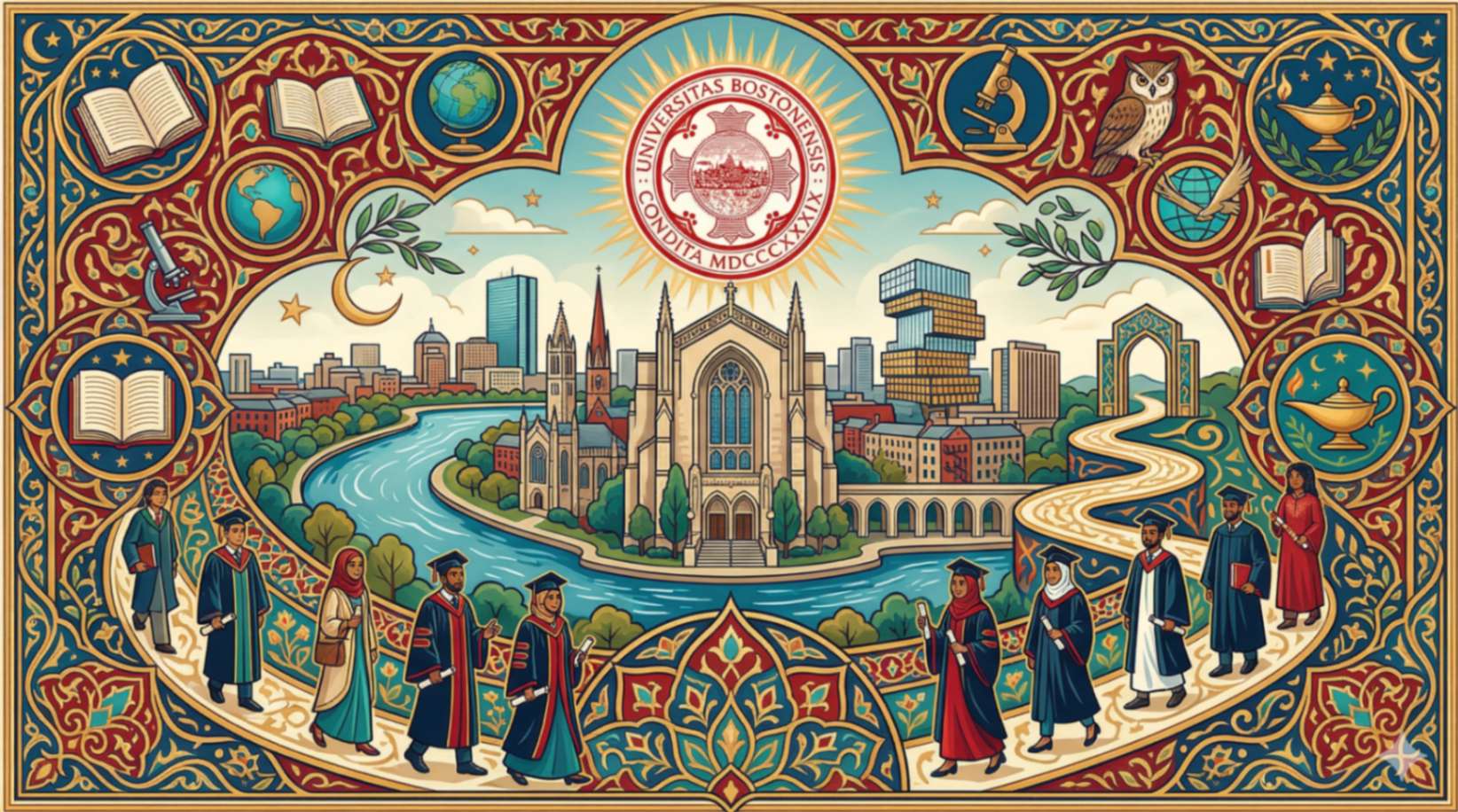
Boston University sits on a mile-and-a-half stretch of the Charles River. It is surrounded by a biotech and innovation ecosystem that is arguably the densest on the planet. It is a ten-minute train ride from Harvard and MIT. And it has been quietly building one of the most diverse and professionally successful Arab student communities in the United States.
I'm Hussein Abdullah, founder of "Arabs in America." Over fifteen years, I've watched Arab students choose BU, struggle through the first Boston winter, find their footing in the Arab student community, and graduate into careers at companies you've heard of. This guide is built from their experiences.
Here's exactly what you'll get:
- Why BU Matters for Arab Students: The strategic advantages of BU's location, network, and Arab community.
- High-Demand Majors: The programs where Arab students are concentrated and succeeding.
- Admission Requirements Decoded: Undergraduate and graduate—GPA, tests, essays, and what "competitive" really means.
- Application Windows: When to apply, and why early matters.
- The Real Cost of BU: Tuition, living expenses, and what you'll actually pay.
- Scholarships and Funding: Merit aid, graduate assistantships, and Arab government sponsorship paths.
- Student Life for Arabs and Muslims: Community, prayer spaces, halal food, and winter survival.
- Work Options (CPT/OPT): How to legally work during and after your degree.
- Real Stories from Arab BU Students: Those who walked this path and what they learned.
- Hussein's Honest Take: Is BU worth it for an Arab student?
BU is not cheap. It is not easy to get into. But for the right student—one who wants to be in the middle of a global innovation ecosystem, who wants a degree that employers recognize instantly, and who wants to be part of a supportive Arab community—it can be transformational.
Quick BU Profile: What You're Signing Up For
| Fact | Detail |
|---|---|
| Founded | 1839 |
| Type | Private research university |
| Location | Main campus along the Charles River, Boston, Massachusetts |
| Total Enrollment | ~34,000 (undergraduate + graduate) |
| International Students | ~25% of total enrollment, from over 130 countries |
| Arab Student Presence | Significant and growing, with active cultural and religious organizations |
| Acceptance Rate | Highly selective (~14-18% in recent cycles) |
| Campus Setting | Urban, integrated with the city of Boston |
Chapter One: Why BU Matters for Arab Students
Boston University is not Harvard. It is not MIT. And that's precisely the point. BU occupies a unique niche in Boston's academic ecosystem: a private research university with world-class faculty, strong professional programs, and a campus culture that is more diverse and less insular than its Ivy League neighbors across the river.
For Arab students, BU offers several strategic advantages:
-
Location in the heart of Boston's innovation corridor. BU's campus sits directly on the Charles River, adjacent to the Longwood Medical Area (home to Harvard Medical School, Boston Children's Hospital, and Dana-Farber Cancer Institute) and a short T ride from Kendall Square (the epicenter of American biotech). For students in health sciences, engineering, or business, this proximity translates into internships, research opportunities, and job offers.
-
A mature, established Arab and Muslim student community. Unlike campuses where Arab students are a tiny, scattered minority, BU has a visible, active, and organized Arab presence. The Arab Student Association (ASA) and the Islamic Society of Boston University (ISBU) provide built-in community from day one.
-
Strong professional outcomes. BU graduates are recruited by Boston's finance, healthcare, tech, and media employers. The university's career services and alumni network are robust, and the BU name carries weight on a resume—especially on the East Coast.
-
Flexibility for international students. BU is experienced in handling F-1 visa students, CPT/OPT authorizations, and the specific needs of international applicants. The international student office is well-resourced and responsive.
Hussein's Take: I've seen BU work particularly well for Arab students who are professionally ambitious but don't want the hyper-competitive, pressure-cooker culture of some other elite schools. BU is rigorous, but it's also collaborative. The Arab students I know who thrived there did so because they found community quickly and leveraged the university's location for internships and networking.
🔗 Related Planning Resources:
- Arabs in Boston 2026: Complete Community Guide
- Boston Tourism for Arabs
- Travel to Boston: Flights, Trains, and Airport Transfers
- Boston Weather 2026: Four Seasons Guide
Chapter Two: High-Demand Majors for Arab Applicants
Arab students at BU tend to concentrate in fields with strong professional outcomes and clear career pathways. These are the programs where you're most likely to find a supportive peer network and established Arab alumni.
| Field | Why Arab Students Choose It | Key BU Programs |
|---|---|---|
| Business and Finance | Strong ROI, family business connections, clear career path | Questrom School of Business |
| Engineering and Computer Science | High demand, STEM OPT extension eligibility | College of Engineering |
| Data Science and Analytics | Growing field, strong job market | Faculty of Computing & Data Sciences |
| Communication and Media | BU's communication program is nationally ranked | College of Communication |
| Health and Biomedical Sciences | Boston's healthcare ecosystem is unmatched | Sargent College of Health & Rehabilitation Sciences |
| International Relations and Economics | Relevant to diplomacy, government, and NGO careers | Pardee School of Global Studies |
Chapter Three: Admission Requirements Overview
Undergraduate Admission
BU practices holistic admission. This means they evaluate your entire application, not just your grades.
| Component | What BU Looks For |
|---|---|
| GPA and Academic Rigor | Strong grades in a challenging curriculum. Arab students from national systems (Thanaweya Amma, Baccalaureate, Tawjihi) should present their credentials clearly. |
| Standardized Tests | BU has a test-optional policy for many programs. However, strong SAT/ACT scores can strengthen an application. Check the latest policy for your specific program. |
| English Proficiency | TOEFL (minimum ~90-100 iBT) or IELTS (minimum ~7.0) is required for non-native speakers. Competitive applicants often exceed these minimums. |
| Essays | The personal statement is your opportunity to stand out. Write about something authentic—your background, your values, your aspirations. Avoid clichés. |
| Letters of Recommendation | Typically two letters from teachers who know you well, plus a counselor recommendation. |
| Extracurricular Activities | Quality over quantity. Show impact and leadership in whatever you've done. |
Graduate Admission
| Component | What BU Looks For |
|---|---|
| Undergraduate GPA | Competitive, typically 3.0/4.0 minimum, with higher expectations for top programs. |
| GRE/GMAT | Required by some programs, optional for others. Check your specific department. |
| English Proficiency | TOEFL/IELTS required for non-native speakers. |
| Statement of Purpose | The most important document. Clearly articulate why BU, why this program, and what you'll contribute. |
| Letters of Recommendation | Academic and professional references that speak to your ability to succeed in graduate-level work. |
Chapter Four: Core Application Windows (Typical)
| Track | Approximate Window |
|---|---|
| Early Decision I | November (binding) |
| Early Decision II | January (binding) |
| Regular Decision | January |
| Transfer | March |
Graduate deadlines vary significantly by school and department. Check your specific program's website. Some have rolling admissions; others have strict fall deadlines as early as December.
Hussein's Take: If BU is your first choice, apply Early Decision. It signals commitment and can marginally improve your odds. But only do this if you're absolutely certain and you've had an honest conversation with your family about finances. ED is binding. You don't want to be accepted and then realize you can't afford it.
Chapter Five: Tuition and Total Cost Reality
Let's be direct: BU is expensive. It is a private university in one of America's most expensive cities. Here's what you need to budget for (2025-2026 academic year estimates; budget for 3-5% annual increase):
| Expense Category | Estimated Annual Cost (2026) |
|---|---|
| Tuition and Fees | ~$65,000 - $68,000 |
| Room and Board (on-campus) | ~$18,000 - $20,000 |
| Health Insurance | ~$4,000 - $5,000 |
| Books, Supplies, Personal | ~$2,000 - $3,000 |
| Total Estimated Annual Cost | ~$89,000 - $96,000 |
Cost-Saving Strategies:
- Off-campus housing after year one: Many BU students move into shared apartments in Allston, Brighton, or Brookline after their first year. This can reduce housing costs by 20-30%.
- Roommate arrangements: Sharing a room or apartment significantly cuts costs.
- Summer courses at community colleges: Some general education requirements can be fulfilled at lower-cost community colleges and transferred in (verify with BU advising first).
Chapter Six: Scholarships and Funding Routes
Merit Scholarships
BU offers a limited number of merit-based scholarships to highly competitive undergraduate applicants. The Trustee Scholarship and Presidential Scholarship are the most prestigious, covering full or partial tuition. These are awarded at the time of admission; no separate application is required. Competition is intense.
Graduate Assistantships and Fellowships
Many graduate programs offer teaching assistantships (TA), research assistantships (RA), or fellowships that provide a tuition waiver and a living stipend in exchange for work. These are your best path to funding a graduate degree at BU. Contact your specific department directly to ask about availability.
Arab Government Sponsorship
Several Arab governments sponsor students to study at U.S. universities. These include:
- Saudi Arabia: Saudi Arabian Cultural Mission (SACM) sponsorships.
- UAE: Various emirate-level scholarship programs.
- Kuwait: Kuwait Ministry of Higher Education scholarships.
- Qatar: Qatar Foundation and government-sponsored programs.
Check with your country's ministry of education or cultural attaché in Washington, D.C. for eligibility requirements and application procedures.
🔗 For more scholarship strategies: How to get a scholarship in America
Chapter Seven: Student Life for Arab and Muslim Students at BU
Community Organizations
- Arab Student Association (ASA): Social events, cultural celebrations, and peer support for Arab students.
- Islamic Society of Boston University (ISBU): Religious programming, prayer coordination, and community service.
Prayer and Religious Life
- On-campus prayer spaces: BU has designated interfaith spaces. ISBU coordinates Jummah prayers on campus.
- Nearby mosques: The ISBCC in Roxbury is a 15-minute T ride. ISB Cambridge serves the broader university community.
Halal Food
- On-campus: BU's dining halls have improved halal options, but availability can be inconsistent. Contact dining services ahead of arrival to discuss your needs.
- Off-campus: The Allston/Brighton area adjacent to BU has one of Boston's densest halal food clusters—shawarma, falafel, and Middle Eastern groceries are readily available.
Winter Survival
Boston winters are real. Invest in a proper winter coat, waterproof boots, and learn to layer. The first winter is the hardest. Every subsequent one gets easier.
🔗 For deeper community context: Arabs in Boston: Complete Community Guide
Chapter Eight: Work Options for International Students (CPT/OPT)
On-Campus Employment
- Up to 20 hours/week during the academic semester.
- Full-time during breaks and summer vacation.
- Available from your first semester.
Curricular Practical Training (CPT)
- Allows you to work off-campus in a job directly related to your major.
- Must be authorized by BU's International Students and Scholars Office (ISSO).
- Typically used for internships and co-op programs.
Optional Practical Training (OPT)
- Up to 12 months of work authorization after graduation.
- STEM OPT Extension: Graduates in STEM-designated fields (engineering, computer science, data science, many health sciences) can apply for an additional 24 months of OPT—giving you up to 3 years of post-graduation work authorization.
- This is a critical pathway for Arab students who want to gain U.S. work experience before returning home or pursuing permanent residency.
Chapter Nine: Real Stories from Arab BU Students
📖 Layla's Story (Saudi Arabia)
Layla, a biomedical engineering major from Jeddah, graduated from BU in 2024. "I chose BU because of its location near the Longwood Medical Area. I did a summer internship at a Harvard lab, which turned into a full-time research position after graduation. BU's career services helped me with my CPT authorization and resume. The Arab Student Association was my home for four years. I met my best friends there."
📖 Omar's Story (Jordan)
Omar, an MBA candidate at Questrom from Amman, told me: "I came to BU with a government scholarship from Jordan. The program is intense, but the network I've built here—with other Arab students, with professors, with visiting executives—is worth more than the tuition. I already have a job offer in Dubai before graduation. BU opened that door."
📖 Noura's Story (Egypt)
Noura, a journalism graduate student from Cairo, shared: "I was nervous about being visibly Muslim on an American campus. The Islamic Society at BU made the transition so much easier. They helped me find halal food options, connected me with other hijabi students, and organized an iftar during Ramadan that made me feel like I was home. Academically, the College of Communication is outstanding. I published my first piece in a Boston newspaper through a class project."
Chapter Ten: Five High-Impact Tips Before Applying
- Start your timeline early. Begin researching BU programs, preparing for TOEFL/IELTS, and drafting essays at least 12-18 months before your intended start date.
- Build a standout personal statement. Write about something uniquely yours—your background, your journey, your aspirations. Generic essays get generic results.
- Secure your language scores in advance. Don't leave TOEFL/IELTS to the last minute. A strong score is a gatekeeper—it won't get you in, but a weak score will keep you out.
- Talk to current Arab BU students. Join Facebook groups, LinkedIn networks, or reach out to the BU Arab Student Association. Their practical insights are worth more than any official brochure.
- Finalize a realistic financial plan before committing. Know exactly where your funding is coming from—family savings, scholarships, government sponsorship, or loans—before you sign an acceptance letter. BU is too expensive for financial surprises.
Frequently Asked Questions (FAQ)
Q1: Is a BU degree valued internationally? A: Yes. BU is globally recognized, particularly strong in the Middle East and Asia. The BU name carries weight on a resume, especially on the East Coast and in finance, healthcare, and media industries.
Q2: How hard is it to get into BU as an international student? A: Highly competitive. BU's overall acceptance rate hovers around 14-18%. International applicants face additional scrutiny on English proficiency and financial documentation.
Q3: Can international students get financial aid at BU? A: Undergraduate international students are generally not eligible for need-based U.S. federal aid, but BU offers merit scholarships and some international-specific awards. Graduate funding through assistantships and fellowships is more accessible.
Q4: Is Boston weather manageable for Arab students? A: Yes, with proper preparation. The first winter is an adjustment. Invest in a proper coat (not a fashion coat—a real winter coat), boots, and layers. By your second winter, you'll be giving advice to new arrivals.
Q5: Are there halal food options on campus? A: BU Dining has improved halal offerings, but they can be inconsistent. The Allston/Brighton neighborhood adjacent to campus has excellent halal restaurants and Middle Eastern groceries.
Q6: Can I work while studying at BU? A: Yes. On-campus employment (up to 20 hours/week during the semester) is permitted on an F-1 visa. CPT and OPT provide pathways for off-campus work related to your field of study.
Q7: How does BU compare to Harvard or MIT for Arab students? A: BU is less selective and more diverse than Harvard/MIT. It offers stronger professional programs in certain fields (communication, business, health sciences) and a more collaborative, less pressure-cooker culture. The choice depends on your field and personal fit.
Q8: Is there an Arab student community at BU? A: Yes, a robust and active one. The Arab Student Association and Islamic Society of Boston University are both well-established and welcoming to new students.
Conclusion: Is BU Worth It for You?
For Arab students in 2026, BU can be a high-return academic path if approached strategically: strong application quality, early planning, and a clear funding model. It is not the cheapest option. It is not the easiest to get into. But for the student who wants to be in the center of a global innovation ecosystem, who wants a degree that employers recognize, and who wants to be part of a supportive Arab community, BU delivers.
A final word from Hussein Abdullah: I've watched Arab students arrive at BU nervous, uncertain, and overwhelmed. Four years later, I've watched them walk across the graduation stage with confidence, job offers, and a network that spans continents. BU is not for everyone. It is expensive. It is demanding. But for the student who comes prepared—academically, financially, and mentally—it can be one of the best decisions they ever make.
🔗 Continue Your BU Planning:
- How to get a scholarship in America
- How to open a US bank account as a new immigrant
- How to build your credit score from scratch
- Arabs in Boston: Complete Community Guide
- Boston Weather 2026: Four Seasons Guide
Share your BU story: Are you a current or former BU student from an Arab country? What was your experience like—admission, community, winter survival? Leave your story in the comments below. Your insight could guide the next Arab student making this life-changing decision.
Author: حسين عبد الله
Hussein Abdullah is a web developer and specialized content writer with more than eight years of experience enriching Arabic digital content. He combines an analytical programming mindset with a deep passion for writing to deliver accurate, reference-quality guides. On Arabian in USA (عرب في أمريكا), he focuses on simplifying complex steps for new immigrants and sharing reliable information on housing, work, and financial setup—so every newcomer has a trustworthy path toward stable life in the United States.


Continue reading
- How to Get a Scholarship in America in 2026? A Complete A-to-Z Guide for Arab Students
- Muslim Population in America 2026: Complete State-by-State Guide, Statistics & Interactive Map
- Work in America for New Immigrants 2026: The Complete Guide from Day One to Your Dream Career [Step-by-Step Plan]
- Top 10 Best States for Muslims in America: Ultimate Guide (Updated 2026)
- Top 7 Best States for Arabs in America: Ultimate Guide (Updated 2026)
- Stanford University for Arab Students 2026: The Ultimate Guide to Admissions, Scholarships, Costs, and Campus Life