Arabs in Texas 2026: The Ultimate Guide to the Community, Best Cities, Jobs & Life
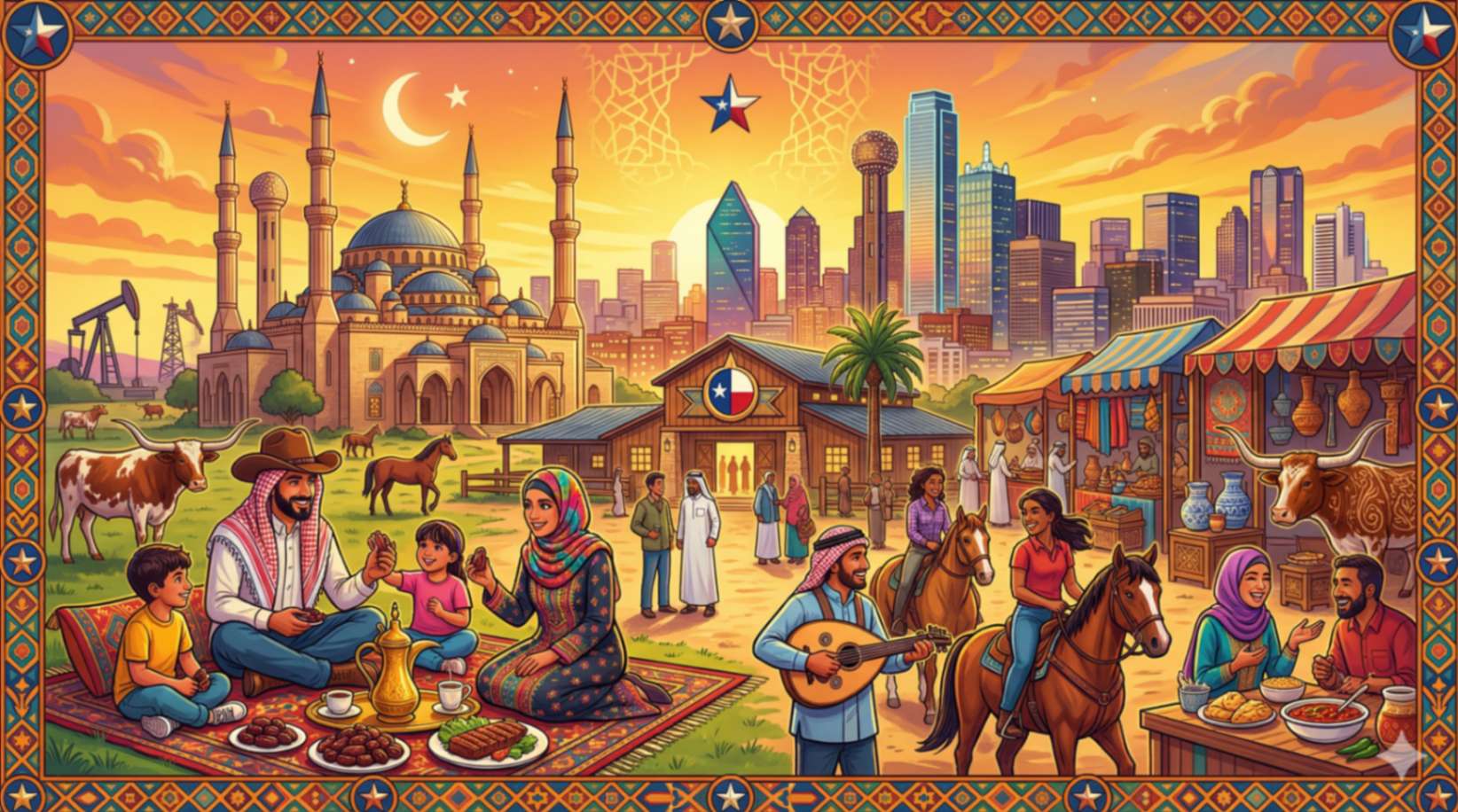
Arabs in Texas 2026: The Complete Guide to the Community, Best Cities, Jobs & Life
Picture this. A young Lebanese engineer lands at Houston’s George Bush Intercontinental Airport on a sweltering August afternoon. He’s never been to America. His English is decent, his savings are modest, and his dreams are massive. He has a distant cousin who promised to pick him up — the cousin is late. As he waits outside, sweating through his shirt, a taxi driver notices his lost expression. The driver, a Palestinian from Ramallah, strikes up a conversation in Arabic. Within ten minutes, he’s heard about the best halal shawarma on Hillcroft, which mosque has the most active youth group, and who’s hiring at the Texas Medical Center. He hasn’t even left the airport yet, and a community has already wrapped its arms around him.
This is the story of Arabs in Texas. It doesn’t start in a corporate boardroom or a government office. It starts at the arrivals curb. It starts in the mosque parking lot, the halal butcher shop, the Saturday Arabic school, and the backyard barbecue where someone’s aunt insists you try her mandi recipe. Texas, more than almost any other American state, has built an Arab ecosystem that is not just large — but deeply functional, multigenerational, and genuinely welcoming.
According to the Arab American Institute (AAI) and community-based counts updated through migration-pattern data from the Migration Policy Institute in 2026, approximately 300,000 to 350,000 Texans now claim Arab heritage. Greater Houston alone may exceed 150,000. It is a number that places Texas in the top tier of Arab-American states, rivaled nationally only by Michigan — and arguably surpassing it in economic diversity and sheer geographic space to grow. This guide maps that community comprehensively: where it lives, where it prays, where it works, where it sends its children to school, and how you can join it without making the expensive mistakes I’ve watched too many newcomers make.
خلاصة حسين: Over 15 years of watching Arab families relocate across America, I've noticed a clear pattern. The ones who choose Texas don't just survive — they expand. The no-state-income-tax paycheck, the affordable housing, and the booming job market create a compound effect. You earn more, keep more, and your money stretches further toward the things that actually build a life: a home, a business, or your children's education.
🔍 What You'll Get in This Article
- 📍 A complete geographic map of Texas Arabs — the exact neighborhoods in Houston, Dallas, Austin, San Antonio, and El Paso where Arabic is a street language
- 🕌 A directory of the strongest mosques and Islamic schools — including the elite Brighter Horizons Academy in Plano, widely considered among the best in the nation
- 💼 The real employment picture — which sectors are hiring Arabs right now, realistic salary bands in energy, tech, and healthcare, and why Texas dominates medical and engineering careers
- 💰 The truth about the "no state income tax" advantage — and the property-tax tradeoff you must budget for before buying a home
- 🛒 A taste of home — the legendary Phoenicia market in Houston, the best mandi and shawarma spots, and where to find Eid celebrations that feel like the Middle East
- 🏠 Rent and home price comparisons across all major cities — so you choose based on numbers, not hype
- 🌪️ Critical climate and safety advice — how to survive Texas summer heat, hurricane season, and the winter ice storms nobody warns you about
Pair this guide with Living in Texas: The Daily Life Guide for Arabs for the full housing, utility, transit, and school-quality deep-dive. For a national comparison, check Best States for Arabs in America and Best States for Muslims in America. If you're weighing Texas against the coasts, read Living in California and High-Demand Jobs in California.
Chapter One: Texas at a Glance — Why Arabs Keep Choosing It
Before we zoom into neighborhoods and paychecks, let’s frame the big picture. What makes Texas structurally different for an Arab family, not just compared to the Middle East, but compared to other U.S. states?
| Texas Characteristic | What It Means for Arabs |
|---|---|
| Second-largest state by population (30M+) | Endless variety of lifestyles, from dense urban to rural homesteading |
| Second-largest state by land area (268,596 sq mi) | Space is abundant; you can actually afford a backyard |
| No state income tax | Your paycheck is 8-13% larger than in California or New York, all else equal |
| Long, very hot summers (90-105°F) | Familiar to Middle Eastern families; AC is non-negotiable |
| Mild winters (40-70°F) | No snow shoveling, minimal winter depression |
| Major international airports (IAH, DFW, AUS) | Direct flights to the Middle East via Doha, Dubai, and Istanbul |
سعاد, a Syrian teacher who relocated from cold Minnesota to Houston, tells me: "I didn't realize how much winter was draining my soul until I moved. In Minnesota, I'd spend six months indoors. In Houston, my kids swim in our apartment pool in November. The weather here is closer to Damascus than to Chicago. That matters for your mood, your health, your whole family energy."
Why Arabs specifically move to Texas (the five-pillar logic):
- Jobs that hire immigrants. Energy, healthcare, and technology are enormous, growing, and accustomed to foreign-born workers. The Texas Medical Center alone employs over 106,000 people — more than the population of many small cities.
- Affordability that makes the American Dream possible. According to Zillow and RentCafe 2026 data, Texas home prices and rents run 30-40% below California for comparable space, while salaries in professional fields often differ by only 10-15%. The math is irrefutable.
- The tax advantage is real — but requires strategy. No state income tax means a household earning $100,000 keeps an extra $8,000-$13,000 annually compared to California or New York. However, property taxes in Texas are high. We'll address exactly how to manage this tradeoff.
- An existing Arab community of massive scale. This isn't a pioneering mission. You're moving into a zone where the halal grocery is already stocked, the mosque already runs a weekend school, and your neighbor might already speak your dialect.
- A cultural climate of growth and optimism. Texas, fairly or not, projects a spirit of "you can build something here." Arab entrepreneurs — restaurateurs, real estate developers, medical-practice owners — have consistently translated this cultural permission into generational wealth.
Chapter Two: The Arab Texas Story — Migration Waves That Built a Community
The Arab presence in Texas did not appear overnight. It was layered, wave after wave, over more than a century. Understanding this history helps you understand why Houston's Hillcroft Avenue feels like it does, and why the Plano mosque parking lot is packed on Fridays.
The Early Peddlers (Early 1900s)
The first Arab footprints in Texas belong to Levantine Christians — Lebanese, Syrians, Palestinians — who arrived as peddlers, selling goods door-to-door across the vast Texas landscape. They were not wealthy. They worked brutally hard, often walking miles between ranch houses with packs on their backs. But they accumulated capital, learned American commercial rhythms, and eventually opened the first Arab-owned dry-goods stores, groceries, and restaurants. Many of the oldest Arab families in Houston and Dallas trace their Texas roots to these peddler grandfathers.
The Post-1948 & Post-1967 Waves
The creation of Israel in 1948 and the Six-Day War in 1967 sent Palestinian professionals — teachers, engineers, physicians — into diaspora. A significant number chose Texas, attracted by the emerging oil economy and the availability of medical residencies and engineering positions. They did not come as refugees in the modern sense; they came as skilled professionals seeking stability. They bought homes, joined PTAs, and built the first purpose-driven mosques.
د. عمر, a retired Palestinian cardiologist in Houston whose father practiced at Texas Medical Center starting in 1973, reflects: "My father told me he chose Houston because the hospital offered him a residency when few other places would. But he stayed because he found 50 other Palestinian families within a ten-mile radius. They started a Saturday Arabic school in someone's living room. That school now has its own building."
The Lebanese Civil War (1975-1990)
The Lebanese exodus brought another surge — this time heavily entrepreneurial. Lebanese families opened restaurants, bakeries, and construction firms across Houston and Dallas. Many of the beloved Lebanese eateries still operating today trace their origins to this wave.
The Iraq Wars & Displacement (1990s-2000s)
The Gulf War in 1991 and the 2003 U.S. invasion of Iraq produced a generation of Iraqi immigrants and refugees. Detroit received the largest share, but Texas absorbed thousands, particularly in Dallas and Houston, where manufacturing and logistics jobs provided entry points, and Arabic-speaking networks offered familiarity.
The Arab Spring & Syrian Crisis (2011-Present)
The most recent major wave — Syrians, Yemenis, Egyptians fleeing political upheaval and economic collapse — has added tens of thousands to the Texas Arab community since 2011. These families are often highly educated (Syrian doctors, Egyptian engineers) but arrive with shattered finances and must rebuild credentials and savings simultaneously.
The 2026 Snapshot
The layered immigration has produced a rare demographic blend: a Texas Arab community that includes multigenerational American families whose grandfathers peddled dry goods in 1910, alongside newly arrived Syrian refugees whose children will graduate from Texas high schools in 2027. It is a community that spans class, dialect, sect, and immigration status — and it functions precisely because of this diversity, not in spite of it.
Chapter Three: The Geographic Heart — Where Arabs Live in Texas
Texas is not one Arab community. It is five, each with its own personality, economic engine, and neighborhood geography.
Houston: The Undisputed Arab Capital of Texas
خلاصة حسين: If you want the deepest Arab cultural immersion in Texas — the place where you can forget you're in America for ten minutes while you buy za'atar and argue about football in Arabic with the shopkeeper — it's Houston. No other Texas city comes close in density and institutional completeness.
Estimated Arab population: 150,000-180,000.
The Hillcroft Corridor (Southwest Houston): This is the beating heart. Stretching along Hillcroft Avenue between Westpark Tollway and Bellaire Boulevard, this corridor is often called "Arab Street" or "Little Arabia." You will find Palestinian bakeries, Iraqi kebab houses, Egyptian juice shops, Syrian sweet makers, Yemeni mandi restaurants, and halal butchers side by side. The signage is in Arabic and English. Friday afternoons, the area pulses with families heading to lunches and shopping.
Sugar Land: An affluent, master-planned suburb southwest of Houston with a massive concentration of Arab and South Asian Muslim families. Exceptional public schools, low crime, and a beautiful mosque (Islamic Center of Sugar Land) draw professionals — especially engineers working in the Energy Corridor. Home prices are higher here than in many other Houston suburbs, reflecting the premium on schools and safety.
Katy & Cypress: Fast-growing western and northwestern suburbs absorbing younger Arab families priced out of Sugar Land's market or preferring newer construction. Multiple Islamic centers and weekend Arabic schools serve these expanding communities.
Clear Lake / Pearland: Southeast corridor hubs, with strong Arab presence tied to NASA's Johnson Space Center and the medical complexes.
Jobs anchor: The Texas Medical Center (world's largest medical complex), the Energy Corridor (ExxonMobil, Shell, BP, Chevron), and Houston's massive port and logistics infrastructure.
Rent snapshot: Two-bedroom apartment typically $1,400-$2,200 monthly, depending on school district and proximity to job centers. Home purchase: $300,000-$450,000 for a four-bedroom single-family in a good school zone.
Dallas-Fort Worth (DFW): The Professional Powerhouse
Estimated Arab population: 80,000-100,000.
The DFW Metroplex is bigger than Houston by land and spreads its Arab community across multiple suburban nodes rather than one concentrated corridor. The dominant impression is professional: engineers, IT specialists, corporate managers, and medical professionals.
Richardson: Often considered the historic Arab center of DFW. Masjid al-Islam and a dense cluster of Arab groceries, bakeries, and restaurants line the streets. Richardson's long-standing Arab community is complemented by a strong South Asian Muslim presence, creating one of the most diverse Muslim corridors in the country.
Plano: The upscale sister city to Richardson, with newer homes and elite public schools. Plano is home to Brighter Horizons Academy (BHA), arguably the flagship Islamic school in Texas and one of the most respected in the United States. Arab families who prioritize academic rigor and Islamic education together gravitate to Plano.
Irving: More working-class and diverse than Plano, with a very large South Asian and Arab Muslim population centered around the Islamic Center of Irving (ICI). Valley Ranch, a neighborhood within Irving, is a vibrant Muslim community with a strong sense of neighborly interdependence.
Frisco, Allen, Arlington: Booming suburbs absorbing Arab families as the metroplex expands northward.
Jobs anchor: Telecom (AT&T, Verizon), aviation (American Airlines HQ), defense (Lockheed Martin), semiconductor (Texas Instruments), and a sprawling corporate-services economy.
Rent snapshot: Two-bedroom $1,500-$2,300. Home purchase: $350,000-$500,000 for a four-bedroom in a top school district.
هادية, a Lebanese-American who grew up in Richardson and now works in Plano, says: "My dad came here in the 1980s to work at Texas Instruments. He chose Richardson because he heard Arabic was spoken in the apartment complex. That complex still exists. Now I'm raising my own kids five miles away in Plano, sending them to BHA. Two generations, same geography. That's Texas for Arabs — it holds you."
Austin: The Young Tech Magnet
Estimated Arab population: 20,000-30,000 and growing rapidly.
Austin's Arab community is younger, more secular on average, and heavily concentrated in technology, academia, and government. It lacks the older, multigenerational feel of Houston or Dallas, but compensates with energy and optimism.
Key employers: Dell, Apple, Google, Tesla, Oracle, IBM, and hundreds of startups in "Silicon Hills." The University of Texas at Austin drives both education and employment.
Limitations: Fewer Islamic schools, fewer halal restaurant options, and a smaller mosque infrastructure than Houston or DFW. For some families, this is a dealbreaker. For young professionals, it's an acceptable tradeoff for the career opportunities and Austin's unique culture.
Rent snapshot: The most expensive in Texas — two-bedroom $1,800-$2,500. Home purchase: $450,000-$650,000 for a four-bedroom.
San Antonio: The Affordable Alternative
Estimated Arab population: 15,000-20,000.
A smaller but stable Arab community, anchored by the Islamic Center of San Antonio. The military-medical complex (USAA, Valero, Fort Sam Houston) provides stable professional employment. The cost-of-living advantage is San Antonio's superpower — it is the most affordable major Texas city for housing.
El Paso
Estimated Arab population: 5,000-8,000. Smaller, rooted in cross-border trade and small business. An overlooked but functional entry point for Arabic-speaking entrepreneurs in import/export.
Chapter Four: Mosques and Islamic Centers — The Spiritual Infrastructure
A community's health is measured by its institutions. Texas' mosques, particularly in Houston and DFW, are well-built, well-attended, and function as genuine community hubs — not just prayer spaces.
Houston Metro Mosques
- Islamic Center of Houston (Main Center): One of the oldest and largest, serving a multi-ethnic congregation.
- Masjid Al-Huda (Hillcroft area): A central hub for the Arab community, with packed Jummah prayers and active programming.
- Islamic Center of Sugar Land: A stunning, modern mosque complex serving one of the most affluent Muslim suburbs in the country. Weekend school, youth activities, and community health fairs are regular.
- Islamic Center of Pearland: Growing with the community.
- Masjid Bilal: Serves a diverse, heavily African-American Muslim community with strong interfaith and community-service emphasis.
Dallas-Fort Worth Metro Mosques
- Islamic Center of Dallas (Richardson): The anchor mosque for the Arab and broader Muslim community in Richardson.
- Islamic Center of Irving (ICI): Enormous, diverse, and extremely active. ICI runs a massive weekend school and community food pantry.
- Islamic Center of Plano: Serves Plano's professional Muslim families with strong education programming.
- Masjid Ibrahim (North Dallas): Large Arab congregation.
- Masjid Al-Farooq: A growing community hub.
Austin & San Antonio
- Islamic Center of Austin: Central mosque for the capital city's community.
- Noor Islamic Center (Austin): North Austin hub.
- Islamic Center of San Antonio: Anchors the Alamo City's Muslim life.
Chapter Five: Islamic Schools — A Generation Being Built
The availability of high-quality Islamic schools is one of the strongest draws for Arab families. Texas delivers:
Houston:
- Al-Huda Academy (K-12): Among the most established full-time Islamic schools in the state.
- Iqra Academy, Al-Salam School, West Houston Islamic School: Each serving specific geographic clusters.
Dallas-Fort Worth:
- Brighter Horizons Academy (BHA) - Plano: This school deserves special recognition. Founded in 1989, BHA now serves Pre-K through 12th grade with rigorous academics, Quran memorization, and athletics. Its graduates routinely attend top-tier universities. For Arab families who prioritize Islamic education without sacrificing college readiness, BHA is a national benchmark.
- Al-Noor School, Dallas Islamic School: Additional strong options.
Austin:
- Austin Islamic Academy: Smaller but growing, reflecting the community's expansion.
San Antonio:
- San Antonio Islamic School: Serving the community with faith-aligned education.
For a complete national overview, read Islamic Schools in America: The Complete Guide.
خلاصة حسين: If your children's education is your absolute top priority and you're choosing a Texas city around it, Plano (DFW) is the clear winner due to BHA. If you want strong Islamic education plus a massive Arab cultural environment, Houston is the play.
Chapter Six: The Jobs Engine — Where Arabs Work in Texas
Texas' economy is not a one-trick pony. It was built on energy but has long since diversified into medicine, technology, defense, and logistics. For Arabs, certain sectors consistently dominate employment patterns.
Energy: The Traditional Powerhouse
Houston is the global Energy Capital. ExxonMobil, Shell, Chevron, BP, ConocoPhillips, and Halliburton all maintain massive Houston operations. Roles for Arab professionals — many of whom come from energy-producing nations and possess relevant petroleum-engineering and geoscience degrees — include:
- Petroleum/Reservoir Engineer: $90,000-$140,000+
- Geoscientist/Geophysicist: $85,000-$130,000+
- Project Manager (Energy): $100,000-$150,000+
- HSE Specialist, Supply Chain Manager, Financial Analyst: Broad opportunities.
The Energy Corridor, along I-10 west of downtown Houston, is the geographic hub.
Healthcare and Medicine: The Growth Engine
The Texas Medical Center (TMC) in Houston is the world's largest medical complex — 106,000+ employees, 50+ institutions including MD Anderson Cancer Center, Baylor College of Medicine, and Houston Methodist. Arab physicians, nurses, pharmacists, and researchers are deeply embedded in TMC's workforce. Additional medical hubs in DFW (UT Southwestern, Baylor Scott & White) and San Antonio (Methodist, University Health) multiply opportunities.
- Physician (various specialties): $200,000-$350,000+
- Registered Nurse: $65,000-$90,000
- Pharmacist: $110,000-$135,000
- Allied health and lab techs: $40,000-$70,000
Technology: Austin and Dallas Soar
Dell, Apple, Google, Tesla, Oracle, and IBM all maintain major Austin operations. Dallas hosts AT&T, Texas Instruments, and a booming cybersecurity sector. Coding bootcamps, university CS programs, and a startup ecosystem fuel the pipeline.
- Software Engineer: $80,000-$130,000
- Cybersecurity Analyst: $85,000-$125,000
- Data Scientist: $90,000-$140,000
- IT Project Manager: $85,000-$125,000
Aviation, Defense, and Corporate Services
DFW is a global aviation hub (American Airlines, Southwest Airlines). Defense contractors (Lockheed Martin, Bell, Raytheon) operate heavily in DFW. Corporate headquarters — Toyota North America, McKesson, JCPenney — sustain thousands of professional-services jobs.
Entrepreneurship: The Arab-American Sweet Spot
Texas' regulatory climate is famously business-friendly, and Arab Texans have built enduring businesses across generations:
- Restaurants and food: From Fadi's in Houston to Ali Baba in Dallas, Arab cuisine has become mainstream.
- Halal grocery and import: The Phoenicia market in Houston is a destination, not just a store. It's over 50,000 sq ft of imported foods, fresh bakeries, and cultural hub.
- Medical practices, real estate development, auto dealerships, construction firms, trucking companies — all classic Arab-American entrepreneurial lanes that continue to grow.
For broader job search and resume guidance, read Work in America: New Immigrant Strategy and How to Write a U.S. Resume.
Chapter Seven: The Money Equation — Tax Advantage vs. Property Tax Reality
"Texas has no state income tax!" is the sentence every potential mover hears. It is true, and it is meaningful — but it is also incomplete.
How Much You Actually Save
A family earning $100,000 annually avoids:
- ~$8,000-$9,000 in California state income tax
- ~$6,000-$7,000 in New York state income tax
- ~$5,000-$6,000 in Illinois state income tax
Over a decade, that's $50,000 to $90,000 in additional savings or investment capacity — easily a down payment on a home.
The Property Tax Tradeoff
Texas funds local services (schools, counties, cities) through property taxes. Effective property tax rates in Texas are among the highest in the nation, often 1.5% to 2.5% of assessed home value annually. On a $400,000 home, that's $6,000 to $10,000 per year.
My strategic advice: When you hear "no state income tax," mentally convert that to "I need to buy a slightly less expensive home than I might elsewhere to keep my total tax burden manageable." The tax advantage still overwhelmingly favors most Texas taxpayers compared to high-tax states, but only if you budget the property tax honestly from day one.
Directional Cost-of-Living Numbers (2026)
| Expense | Houston | Dallas | Austin | San Antonio |
|---|---|---|---|---|
| 2BR Apt Rent | $1,400-$2,200 | $1,500-$2,300 | $1,800-$2,500 | $1,200-$1,800 |
| 4BR Home Purchase | $300k-$450k | $350k-$500k | $450k-$650k | $250k-$350k |
| Annual Property Tax (est.) | 1.8%-2.2% | 1.8%-2.3% | 1.7%-2.1% | 1.9%-2.4% |
For the complete daily-life cost breakdown — groceries, utilities, health insurance, gasoline — read Living in Texas: The Daily Life Guide.
Chapter Eight: Social Life, Food, and Family Culture
If you're Arab, food is love. Texas understands this, or at least the Texas Arab community has enforced it.
The Legendary Phoenicia Market (Houston)
This is not a grocery store. It is a cultural institution. Over 50,000 square feet of imported goods from Lebanon, Syria, Egypt, Palestine, Jordan, Turkey, and beyond. The fresh pita bakery, the olive bar, the spice aisle that smells like a Damascus souk — Phoenicia is where Houston Arabs go to remember and where non-Arabs go to discover. If you move to Houston and do not visit Phoenicia, you are doing it wrong.
The Restaurant Map
- Houston: Fadi's (Lebanese buffet), Al-Aseel (Iraqi), Cafe Lili (Lebanese), Ya Hala (Lebanese), Mary'z (Lebanese), and countless Yemeni mandi houses.
- Dallas: Ali Baba (Mediterranean), Afrah (Lebanese), Dimassi's (Lebanese buffet), Bilad Bakery (Iraqi).
- Austin: Peace Bakery, Tarbouch, Kismet Cafe (halal fast-casual).
- San Antonio: Jerusalem Grill, Al-Dimashqi.
Arab Festivals and Community Events
- Houston Arab Festival: Annual celebration with music, food, cultural exhibits, and thousands of attendees.
- Dallas Arab Festival: Similar scale, reflecting the DFW community's energy.
- Eid gatherings: Enormous community prayers at convention centers and mosques. The Eid bazaars — where vendors sell clothes, sweets, and decorations — are community institutions unto themselves.
نورة, an Egyptian mother in Sugar Land, smiles as she tells me: "The first Eid after we moved to Houston, I was sad because I thought my kids would miss the Egyptian Eid feeling. Then we went to the Eid prayer at the George R. Brown Convention Center. Thousands of people. Women in beautiful jalabiyas. Children running everywhere. The khutbah in Arabic and English. Afterward, we went to a friend's house for kahk and tea. My daughter turned to me and said, 'Mama, this is just like Eid back home.' I cried. Good tears."
Outdoor Life
Texas parks, lakes, and Gulf Coast beaches offer family recreation that doesn't cost a fortune. Galveston Island, an hour from Houston, is the classic weekend escape. State parks like Enchanted Rock and Palo Duro Canyon draw hikers and campers. The sheer space of Texas means you can actually get away — something that can feel impossible in the cramped coastal megacities.
Chapter Nine: The Climate Reality — Heat, Hurricanes, and the Ice Storm Nobody Warned You About
Texas weather is extreme, but in ways that many Middle Eastern families find manageable — with two critical caveats.
The Summer Heat
From June through September, temperatures routinely hit 95-105°F across most of the state. Houston adds Gulf humidity that makes 98°F feel like 110°F. This is not "go to the beach" weather every day — it's "stay inside between 2 PM and 6 PM" weather. Your air conditioning system is not a luxury. It is a survival appliance. Budget for maintenance. Change your filters. Know who to call when it breaks.
The Gulf Coast Hurricane Reality
Houston and the coastal corridor face hurricane risk every year from roughly June through November. Hurricane Harvey (2017) devastated parts of Houston with catastrophic flooding. You must understand your flood zone before renting or buying. Some Arab families learned this lesson the hardest possible way — losing homes, cars, and irreplaceable belongings. Flood insurance is separate from standard homeowners insurance. Get it if you are anywhere near a floodplain.
Winter Surprises
In February 2021, Winter Storm Uri paralyzed the entire state. Temperatures plunged into the single digits. The electric grid failed. Pipes burst in millions of homes. Arab families accustomed to Middle Eastern climates were caught completely off guard. The lesson: Texas winters are generally mild, but when cold hits, the infrastructure is underprepared compared to northern states. Have emergency supplies — blankets, water, non-perishable food, and portable chargers — even if you live in Houston or Austin.
Chapter Ten: Six Strategic Tips for Arab Newcomers to Texas
-
Do not underestimate the heat and hurricane prep. AC is not optional. Flood insurance is not optional if you're near the coast or in a flood-prone zone. Emergency kits are mandatory.
-
Budget the property tax, not just the mortgage. When calculating whether you can afford a $400,000 home, add $7,000-$9,000 annually in property taxes to your mental spreadsheet. This is the price of no state income tax.
-
Choose your city based on your life stage, not hype. Houston for community-immersion and medical/energy careers. DFW for elite Islamic schools and corporate diversity. Austin for young tech professionals comfortable with a smaller Arab footprint. San Antonio for maximum housing affordability.
-
Buy a reliable used car immediately. Texas is enormous. Public transit is negligible outside a few inner-city cores. You cannot function — work, mosque, groceries, schools — without a vehicle. Budget $15,000-$22,000 for a reliable Japanese sedan.
-
Redirect your tax savings deliberately. The extra $8,000-$13,000 you keep annually because Texas has no state income tax should not disappear into lifestyle inflation. Max out retirement contributions, build your emergency fund, or save for a down payment. The tax advantage only compounds if you treat it as strategic capital.
-
Plug into the Arab community in your first 30 days, not your first 6 months. Join the Facebook group "Arabs in Houston" or "Arabs in DFW" before you even land. Attend the first Friday prayer you can. Introduce yourself. Ask for recommendations for a mechanic, a doctor, a landlord. Texas Arabs are famously willing to help newcomers — but they need to know you exist.
Frequently Asked Questions: Arabs in Texas
Q: How many Arabs live in Texas in 2026? A: Community estimates and organizations like the Arab American Institute place the statewide figure between 300,000 and 350,000 people of Arab heritage. Houston alone likely hosts 150,000 to 180,000.
Q: Where is the densest Arab concentration? A: Greater Houston, specifically the Hillcroft corridor in Southwest Houston and the suburbs of Sugar Land, Katy, and Pearland. In DFW, the Richardson-Plano-Irving triangle forms the core.
Q: Which Texas city is genuinely best for an Arab family? A: It depends entirely on your priorities:
- Deepest Arab community and food: Houston
- Strongest Islamic schools and polished suburbs: Plano/Richardson (DFW)
- Young tech professionals seeking career velocity: Austin
- Maximum housing affordability: San Antonio
Q: Is Texas genuinely safe for Muslims and visibly Arab families? A: The major metropolitans — Houston, Dallas, Austin, San Antonio — are highly diverse, and Muslims work across medicine, engineering, business, and academia with strong institutional support. As always, neighborhood selection matters. Research specific zip codes and visit potential neighborhoods before committing.
Q: Is "no state income tax" really as good as it sounds? A: Yes, for most families. A household earning $100,000 keeps roughly $8,000-$13,000 more annually than in a high-tax state. However, property taxes are high. The net financial position still strongly favors Texas for most middle-class and upper-middle-class families.
Q: How does Texas compare to California for Arab families? A: California offers coastal beauty, a more moderate climate, and established Arab communities in Southern California. Texas counters with dramatically lower housing costs, no state income tax, and a business climate often perceived as more immigrant-entrepreneur friendly. For a side-by-side, read Living in California: Arabs Daily Life.
Q: Can I find Arabic-speaking doctors and professionals in Texas? A: In Houston and DFW, absolutely. The Arab medical professional community is enormous. Arabic-speaking providers exist in almost every specialty, particularly at Texas Medical Center institutions.
Q: Are there direct flights from Texas to the Middle East? A: Yes. Houston (IAH) and Dallas (DFW) have direct flights to Doha (Qatar Airways), Dubai (Emirates), and Istanbul (Turkish Airlines). Austin is adding more international routes but currently has fewer direct Middle East options.
Q: How do Texas public schools treat Muslim students? A: Varies enormously by district. Elite suburban districts like Sugar Land, Plano, and Richardson generally accommodate prayer requests, Ramadan considerations, and halal dietary needs with growing familiarity. Research specific schools and ask the administration directly during your home search.
Q: What's the single biggest mistake Arab newcomers make in Texas? A: Underestimating both the summer heat and the hurricane risk. The heat is not "warm" — it can be life-threatening without AC. The hurricanes are not abstractions — Harvey displaced thousands of families. Prepare seriously.
Q: Is Texas good for Arab entrepreneurs? A: Exceptionally so. The regulatory and tax environment is business-friendly. Arab-owned restaurants, grocery chains, medical practices, real estate firms, and trucking companies thrive here.
Q: Can I buy a home in Texas without a U.S. credit history? A: It is challenging but possible with FHA loans and alternative credit documentation. Some lenders in Houston and DFW have experience with foreign nationals. Start building your credit immediately upon arrival using secured cards and credit-builder loans. See Build Credit from Scratch.
Q: What about smaller Texas cities like El Paso or Corpus Christi for Arabs? A: They have small but present Muslim communities. They're viable with a specific job offer but offer far less Arab cultural infrastructure — fewer halal restaurants, smaller mosques, and limited Islamic schools.
Q: Is Texas politically hostile to immigrants? A: State-level political rhetoric can be sharp, but the lived experience in diverse major cities differs materially. Major Texas metros vote differently from statewide averages and have robust immigrant-support organizations, including CAIR-Texas.
Conclusion: Texas for People Who Want Room to Build
I've spent 15 years watching Arab families choose their American home. Texas is not perfect. The summers are brutal. The property taxes sting. The hurricanes are real. And if you arrive without a car, your life will be miserable until you get one.
But I have also watched families arrive in Houston with modest savings and, within five years, own homes in Sugar Land. I have watched software engineers in Austin take a pay cut from California salaries but raise their living standards because their rent halved. I have watched parents in Plano weep at their children's graduation from Brighter Horizons Academy, knowing their kids have both faith and academic futures intact.
Texas does not force you to choose between being fully Arab and fully American, between economic ambition and religious identity, between professional success and community belonging. It is large enough, diverse enough, and job-rich enough to hold all of it.
This is why the community here is 300,000 strong and growing. Because Texas, for all its extremes, rewards the builders. And Arab Texans, across generations and across professions, have proven themselves to be exactly that.
Your turn: Are you already in Texas, or planning a move? Which city does your family prefer — Houston, Dallas, Austin, or San Antonio — and why? What did you learn the hard way that you'd warn a newcomer about? Share your story below. Someone else is reading this, weighing the biggest decision of their life, and your experience might be the clarity they need.
🔗 Explore More Guides for Your American Journey
- Living in Texas: The Complete Daily Life Guide for Arabs — Housing costs, utilities, transit, schools, and climate in full detail
- Best States for Arabs in America — How Texas stacks up against Michigan, California, and others
- Best States for Muslims in America — Islamic infrastructure compared across all 50 states
- Living in California: Arabs Daily Life Guide — The coastal alternative explored
- High-Demand Jobs in California — Compare Texas energy and tech salaries with the West Coast
- Work in America for New Immigrants — Job search strategy, visa realities, and resume preparation
- Islamic Schools in America: The Complete Guide — National overview of faith-aligned education
- Build Credit Score from Scratch in the USA — Essential for renting, buying a home, and loan qualification
Author: حسين عبد الله
Hussein Abdullah is a web developer and specialized content writer with more than eight years of experience enriching Arabic digital content. He combines an analytical programming mindset with a deep passion for writing to deliver accurate, reference-quality guides. On Arabian in USA (عرب في أمريكا), he focuses on simplifying complex steps for new immigrants and sharing reliable information on housing, work, and financial setup—so every newcomer has a trustworthy path toward stable life in the United States.


Continue reading
- Living in Texas 2026: The Complete Arab & Immigrant Guide to Housing, Jobs, Schools & Mosques
- Top 10 Best States for Muslims in America: Ultimate Guide (Updated 2026)
- Cost of Living in Texas 2026: The Complete Immigrant's Guide to Rent, Taxes, and a Real Monthly Budget
- How to Rent an Apartment Without a Credit Score in Texas? Comprehensive Guide for Immigrants 2026
- Top 7 Best States for Arabs in America: Ultimate Guide (Updated 2026)
- Muslim Population in America 2026: Complete State-by-State Guide, Statistics & Interactive Map