How to Get a Green Card in the US 2026: The Ultimate Guide to Pathways, Requirements, and Steps
📋 What You're About to Discover (And Why This Guide Is Different)
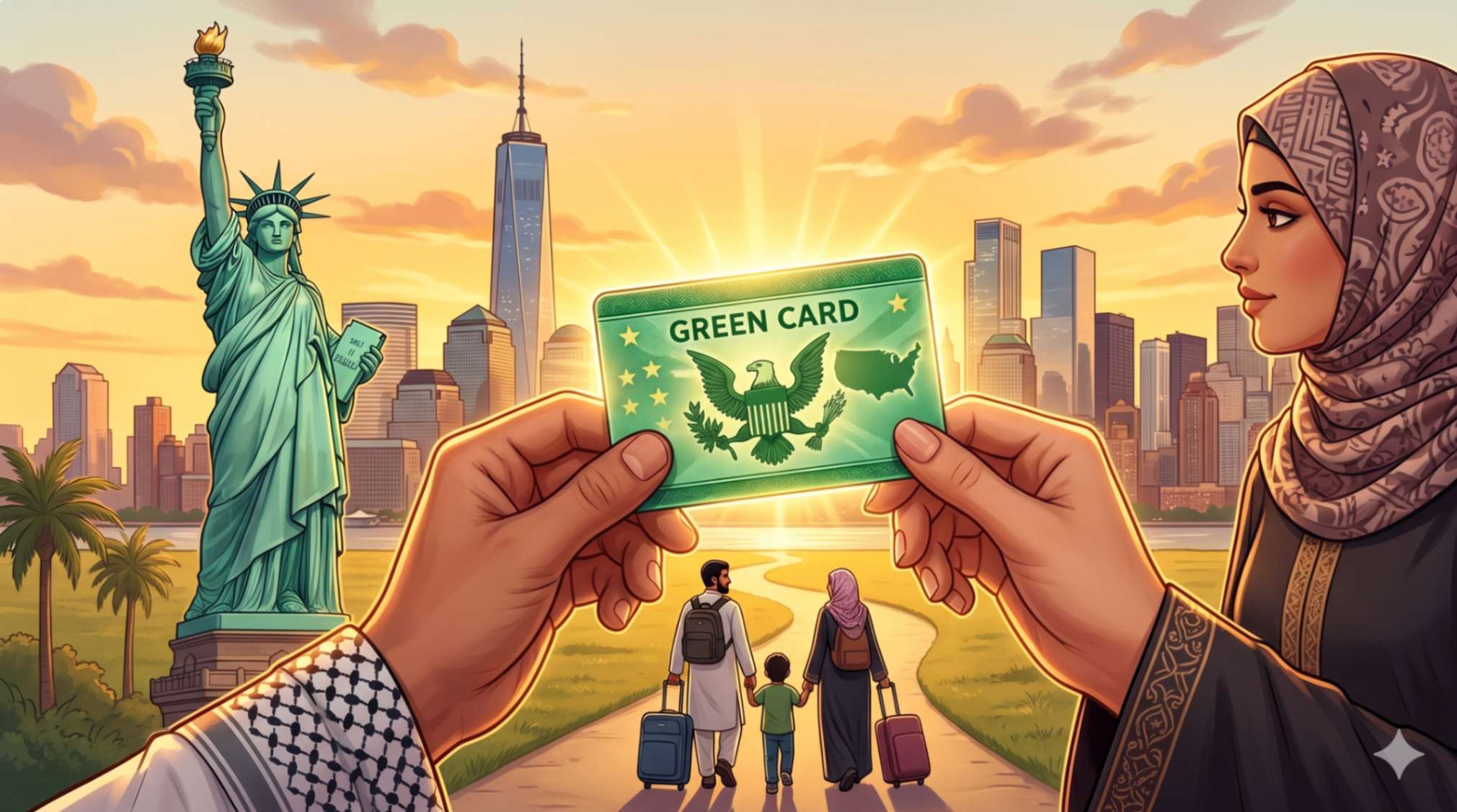
Imagine holding a key. Not a key to a house or a car, but a key to an entire continent. A key that unlocks the doors to the world's largest economy, its most prestigious universities, and a life of stability and opportunity. That key is the Green Card—the United States Permanent Resident Card.
But here's the question that keeps millions awake at night: How do I actually get one?
I'm Hussein Abdullah, founder of "Arabs in America." For over fifteen years, I've dedicated my professional life to demystifying the U.S. immigration labyrinth for Arab applicants. I've witnessed the full spectrum of this journey: the engineer who secured his Green Card through an EB-2 NIW without a sponsor, the mother who was finally reunited with her children after years of waiting, the young man who beat the odds and won the DV Lottery. And I've also seen dreams crushed—not by ineligibility, but by a single missing piece of information.
This guide is not a dry recitation of visa categories. It is a strategic field manual. I will lay out every major legal pathway, explain the real-world advantages and pitfalls of each, identify who benefits most, and give you realistic timelines. Inside this guide, you will find:
- A Complete Dissection of the Five Primary Green Card Pathways: Detailed explanations and practical comparisons for each route.
- Family-Based Immigration Demystified: Who can sponsor you? And what are the actual wait times, not the theoretical ones?
- Employment Visas (EB-1, EB-2, EB-3) Decoded: A clear breakdown of each category, with a special deep dive into the EB-2 NIW—the "golden ticket" for skilled Arab professionals that requires no employer sponsor.
- The DV Lottery: Your free, annual shot at a Green Card. I'll tell you exactly how to play the game correctly.
- The EB-5 Investor Visa: Exactly how much capital you need, and the significant risks you must understand.
- The Practical Mechanics (I-485 vs. Consular Processing): What happens after your eligibility is established? Where do you file? What forms do you need?
- Life After the Green Card: Your rights, your non-negotiable responsibilities, how to protect your status from being revoked, and the precise timeline to U.S. citizenship.
- Real Stories (Names Changed): Authentic accounts of Arabs who navigated this path—their successes and their costly mistakes.
- The Expanded FAQ: Answers to over 20 real questions from our community members.
- Hussein's Unfiltered Take: At the end of each pathway, I'll give you my personal, battle-tested assessment.
This guide is your compass in the complex world of U.S. immigration. Read it carefully. Identify your strongest path. And take your first concrete step.
Chapter One: What Exactly Is a Green Card? (And Why Is It Worth the Fight?)
The Permanent Resident Card, universally known as the "Green Card" due to its historical color, is official proof that you are a Lawful Permanent Resident (LPR) of the United States. Its official form number is I-551.
This small, plastic card grants you rights that are nearly identical to those of a U.S. citizen, with two key exceptions: you cannot vote in federal elections, and you cannot hold certain sensitive federal government jobs. Critically, it is the mandatory prerequisite for applying for full U.S. citizenship (naturalization).
📊 Table 1: The Five Primary Green Card Pathways—A Quick Comparison
| Pathway | Best For | Estimated Cost (Range) | Typical Processing Time | Key Advantage |
|---|---|---|---|---|
| Family | Spouses, parents, children, siblings of U.S. citizens/LPRs | $1,000 - $2,500+ (fees) | Immediate - 20+ years | Fastest for immediate relatives. |
| Employment | Skilled professionals, researchers, executives | $2,000 - $15,000+ (fees/legal) | 1 - 10 years | EB-1 and EB-2 NIW offer self-petition. |
| DV Lottery | Natives of eligible countries (includes most Arab nations) | Free to enter | ~1 year after selection | Easiest and cheapest. Random selection. |
| Investment (EB-5) | High-net-worth individuals | $800,000+ (investment) + fees | 3 - 5 years | No employer or family sponsor needed. |
| Asylum | Individuals facing persecution in home country | Low to Moderate | 1+ year after asylum grant | For those already in the U.S. |
Hussein's Take: Choose your path based on your strongest asset. Do you have a U.S. citizen parent or spouse? Pursue the family route. Do you have an advanced degree or extraordinary professional achievements? Focus on employment. Have neither? The DV Lottery is your golden, cost-free gateway.
🔗 Related Reading: Once you understand the pathways, learn about the crucial interview stage in our Ultimate US Embassy Interview Guide.
Chapter Two: Pathway One—Family-Based Green Cards (The Human Connection)
This is the most common and deeply personal path to a Green Card. It relies on having a close relative who is either a U.S. citizen or a Green Card holder willing to file a petition (Form I-130) to sponsor you. However, "family reunification" is not a single, fast track. There are two distinct tiers.
1. Immediate Relatives of U.S. Citizens—The Fast Lane
This category is exclusively for the closest relatives of U.S. citizens (not Green Card holders). The massive advantage is that there is no annual cap on the number of visas issued, meaning there is no long waiting list beyond standard USCIS processing times.
| Relative | Sponsor Must Be | Approximate Wait Time (2026) |
|---|---|---|
| Spouse | U.S. Citizen | 12 - 24 months |
| Unmarried Children (Under 21) | U.S. Citizen | 12 - 24 months |
| Parents (Mother and Father) | U.S. Citizen (Age 21+) | 12 - 24 months |
Crucial Marriage Nuance: If you have been married to your U.S. citizen spouse for less than two years on the day your Green Card is approved, you will receive a "Conditional Green Card" valid for only two years. Within the 90-day period before this card expires, you and your spouse must jointly file Form I-751 to "remove the conditions" and prove that your marriage is genuine and ongoing, not a sham for immigration purposes.
2. Family Preference Categories—The Long Queues
These categories are subject to strict annual numerical limits (quotas) . Because demand far exceeds supply, this creates waiting lists that can stretch for years, and for some nationalities, even decades. Your place in line is determined by your Priority Date—the date USCIS received your relative's I-130 petition.
| Category | Description | Estimated Wait Time (2026) |
|---|---|---|
| F1 | Unmarried adult sons and daughters (21+) of U.S. Citizens | 7 - 10 years |
| F2A | Spouses and unmarried children (under 21) of Green Card Holders | 3 - 5 years |
| F2B | Unmarried adult sons and daughters (21+) of Green Card Holders | 7 - 10 years |
| F3 | Married sons and daughters (any age) of U.S. Citizens | 12 - 15 years |
| F4 | Brothers and Sisters of U.S. Citizens (sponsor must be 21+) | 15 - 20+ years |
Hussein's Take: If you fall into the F4 category (sibling of a U.S. citizen), do not put your life on hold waiting for this Green Card. The wait can exceed two decades. Use that time to build a strong professional profile that could qualify you for an employment-based Green Card (like EB-2 NIW) or apply for the DV Lottery every single year.
Chapter Three: Pathway Two—Employment-Based Green Cards (The Merit Track)
If you are a doctor, engineer, researcher, professor, multinational executive, or even a skilled tradesperson, the Employment-Based (EB) immigrant visas are your golden ticket. They are divided into five preference categories. I'll focus on the top three that are most relevant for Arab professionals.
🔹 EB-1 (First Preference)—For the Elite
This is the "top tier." It's reserved for three specific sub-groups:
- EB-1A: Individuals with Extraordinary Ability in the sciences, arts, education, business, or athletics. Major Advantage: You can self-petition. No job offer or employer sponsor is required.
- EB-1B: Outstanding Professors and Researchers. Requires a job offer from a U.S. university or research institution.
- EB-1C: Multinational Managers and Executives. Requires you to have worked for a related foreign entity for at least one year.
How do you prove "Extraordinary Ability"? You must demonstrate that you have "risen to the very top of your field." USCIS requires evidence meeting at least 3 out of 10 specific criteria, such as: receipt of major international awards, publication of scholarly articles, serving as a judge of the work of others, or commanding a significantly high salary compared to peers.
🔹 EB-2 (Second Preference)—The Goldmine for Arab Professionals (Especially NIW)
- Standard EB-2: Requires an Advanced Degree (Master's or Ph.D.) or a Bachelor's degree plus 5 years of progressive experience. It requires a U.S. employer sponsor and a lengthy, complex PERM Labor Certification process to prove no qualified U.S. workers are available.
- EB-2 National Interest Waiver (NIW): This subcategory is exploding in popularity among Arabs in 2026. It allows you to self-petition. You do not need an employer sponsor, a job offer, or the PERM process. You must prove that your work is of "substantial merit" and "national importance" to the United States.
Who is a perfect fit for EB-2 NIW?
- Physicians and medical researchers working on public health issues.
- Engineers in fields like renewable energy, artificial intelligence, and cybersecurity.
- Entrepreneurs founding startups that will create U.S. jobs.
- PhD holders with a strong publication record.
🔹 EB-3 (Third Preference)—For Skilled Workers and Professionals
- EB-3(A): Skilled Workers: Positions requiring at least two years of training or experience.
- EB-3(B): Professionals: Positions requiring a U.S. Bachelor's degree or its foreign equivalent.
- EB-3(C): Unskilled Workers: Positions requiring less than two years of training. This category has extremely long wait times.
Hussein's Take: If you have a Master's degree or higher and work in a field of strategic importance (STEM, healthcare, etc.), consult an immigration attorney immediately about your potential eligibility for EB-2 NIW. This pathway gives you complete control over your destiny, free from reliance on a fickle employer sponsor.
🔗 For more on working in the U.S.: Read our detailed guide on Work in the USA for New Immigrants
Chapter Four: Pathway Three—The Diversity Visa (DV) Lottery (The Game of Chance)
This is the path everyone knows. It is the simplest, cheapest, and fastest route to a Green Card—if Lady Luck smiles upon you.
- What is it? A State Department program awarding 55,000 Green Cards annually by random computer draw to natives of countries with historically low immigration rates to the U.S.
- Who is eligible? The vast majority of Arab countries are eligible, including Egypt, Algeria, Morocco, Jordan, Iraq, Sudan, Yemen, Libya, Tunisia, Lebanon, Syria, and Palestine. (Note: Applicants are charged to their country of birth, not citizenship).
- What are the requirements? Only a high school diploma (or equivalent 12-year education) OR two years of qualifying work experience.
- What does it cost? Entry is 100% FREE. Never pay anyone a single dollar to "submit" an entry for you.
📖 For detailed, step-by-step application guides:
- The Master General Guide: How to Apply for the US DV Lottery 2027: The Ultimate General Guide
- Country-Specific Guides: (Select your country of birth)
Hussein's Take: Never neglect the DV Lottery. It is your free, recurring annual opportunity. Be meticulous with the photo and your personal data. Hope for the best, but prepare as if your life depends on the accuracy of your entry.
Chapter Five: Pathway Four—The EB-5 Immigrant Investor Visa (The Financial Fast Track)
If you have significant capital and want to bypass the complexities of employer sponsorship or family queues, the EB-5 Immigrant Investor Program offers a direct route.
- Minimum Investment: $800,000 if investing in a commercial enterprise located in a Targeted Employment Area (TEA) —defined as a rural area or an area with high unemployment (at least 150% of the national average). Otherwise, the minimum is $1,050,000.
- Job Creation Requirement: Your investment must create or preserve at least 10 full-time jobs for qualifying U.S. workers within a two-year period.
- Conditional Green Card: You initially receive a conditional Green Card valid for two years. Before it expires, you must file Form I-829 to remove the conditions, providing extensive documentation proving that your investment was sustained and the required jobs were created.
Warning: This path is legally and financially complex. It requires specialized immigration and investment counsel. There is substantial financial risk, including the potential loss of your entire investment if the project fails to meet USCIS job creation requirements.
Chapter Six: Pathway Five—Asylum and Refugee Status (The Humanitarian Path)
Individuals who are physically present in the United States (or at a port of entry) and have suffered persecution—or have a well-founded fear of future persecution—in their home country based on:
- Race
- Religion
- Nationality
- Political Opinion
- Membership in a Particular Social Group
...may apply for Asylum by filing Form I-589 within one year of their last arrival in the United States.
- The Path to a Green Card: Exactly one year after the date of the final approval granting you asylum status (Asylee), you become eligible to apply for a Green Card by filing Form I-485 (Adjustment of Status).
Important Note: Asylum law is exceptionally complex and subject to frequent policy changes. Obtaining counsel from a qualified immigration attorney who specializes in asylum cases is absolutely essential.
Chapter Seven: The Processing Mechanics—What Happens After You Qualify?
Once you have an approved underlying petition (e.g., I-130 for family, I-140 for employment) or you win the DV Lottery, the process of actually obtaining the Green Card splits into two distinct paths based on your physical location.
1. Adjustment of Status (AOS)—If You Are Already Inside the United States
If you are physically present in the U.S. on a valid, unexpired nonimmigrant visa (such as an F-1 student visa, H-1B work visa, or B-2 tourist visa), you may be eligible to file Form I-485 (Application to Register Permanent Residence or Adjust Status) with USCIS.
Advantages of AOS:
- You remain in the U.S. with your family throughout the entire processing period.
- You can concurrently file Form I-765 (Application for Employment Authorization) to receive an Employment Authorization Document (EAD) , allowing you to work legally while your Green Card is pending.
- You can concurrently file Form I-131 (Application for Travel Document) to receive Advance Parole, allowing you to travel internationally without abandoning your pending I-485 application.
2. Consular Processing—If You Are Outside the United States
If you are living abroad, your approved petition is sent to the National Visa Center (NVC) . You will receive instructions to pay fees and complete the online immigrant visa application, Form DS-260. You will then be scheduled for an interview at the U.S. Embassy or Consulate in your home country.
At the Interview:
- You must present original civil documents (birth certificates, marriage certificates, police clearances) with certified English translations.
- You must complete a medical examination with an embassy-approved Panel Physician.
- If the Consular Officer approves your visa, your passport will be stamped with an Immigrant Visa. When you enter the U.S. on this visa, you officially become a Lawful Permanent Resident. Your physical Green Card will be mailed to your U.S. address within 4-8 weeks.
🔗 Detailed Preparation Guide: Prepare thoroughly for this critical step by reading our Ultimate US Embassy Interview Preparation Guide
Chapter Eight: Life After the Green Card—Rights, Responsibilities, and the Road to Citizenship
Congratulations! You have your Green Card. But the journey isn't over. There are golden rules you must know and follow.
✅ Your Rights as a Lawful Permanent Resident (LPR)
- Live permanently in any of the 50 U.S. states.
- Work in any job or profession (except for certain federal positions restricted to citizens).
- Travel freely outside the U.S. and return.
- Petition to sponsor your spouse and unmarried children for Green Cards.
- Receive full protection under U.S. federal, state, and local laws.
⚠️ Your Non-Negotiable Responsibilities
- Obey all laws: Any serious criminal conviction can make you deportable and lead to the loss of your Green Card.
- File U.S. Income Taxes: You must report your worldwide income to the Internal Revenue Service (IRS) every year and pay any taxes owed.
- Register with Selective Service: All male LPRs between the ages of 18 and 26 must register.
- Maintain the U.S. as Your Permanent Residence: This is the most critical and often misunderstood rule. If you depart the U.S. for a continuous period of more than 6 months, CBP officers may question your intent to maintain residence upon your return. If you remain outside the U.S. for more than one continuous year without first obtaining a Re-entry Permit (Form I-131) , you risk being deemed to have abandoned your Green Card, and it can be revoked.
📖 Real Story: How a Long Trip Cost Samer His Green Card
Samer, a Jordanian engineer, obtained his Green Card through employment. He traveled to Jordan for a family emergency. His stay extended, and he ended up remaining outside the U.S. for 14 months. He did not have a Re-entry Permit. Upon his return at Chicago O'Hare Airport, the CBP officer questioned him extensively. His explanation was deemed insufficient to overcome the presumption of abandonment. His Green Card was confiscated, and he was forced to return to Jordan. Do not let this happen to you. If you anticipate being outside the U.S. for more than 6-12 months, apply for a Re-entry Permit before you leave.
🇺🇸 The Path to U.S. Citizenship (Naturalization)
After holding your Green Card and maintaining continuous residence, you become eligible to apply for U.S. citizenship (Form N-400) if you meet the following criteria:
- Time Requirement: 5 years as a Lawful Permanent Resident (or 3 years if you obtained your Green Card through marriage to a U.S. citizen and are still living with your spouse).
- Physical Presence: You must have been physically present in the U.S. for at least half of the required period (e.g., 30 months out of the 5 years).
- Continuous Residence: You must not have taken any trips outside the U.S. that were longer than 6 months (which break continuity).
- Good Moral Character: You must not have a serious criminal record.
- Pass the Naturalization Test: You must demonstrate a basic knowledge of U.S. history and government (civics) and the ability to read, write, and speak basic English.
Chapter Nine: Frequently Asked Questions (FAQ) About the Green Card
Q1: What is the absolute fastest way to get a Green Card? A: Marriage to a U.S. citizen, or qualifying for an EB-1A visa (Extraordinary Ability). Both categories have no waiting list for a visa number.
Q2: Can I work while my Green Card application is pending? A: If you are inside the U.S. and filed Form I-485, you can concurrently file Form I-765 for an Employment Authorization Document (EAD). Once approved, the EAD allows you to work legally.
Q3: How much does it cost to apply for a Green Card? A: It varies. The filing fee for Form I-485 (Adjustment of Status) is currently $1,440 (including biometrics). The fee for Form I-130 (Family Petition) is $675 (paper) or $625 (online). There are additional fees for medical exams and translations.
Q4: What is the difference between a conditional and a permanent Green Card? A: A conditional Green Card (2-year validity) is issued to spouses married for less than two years at the time of approval, and to EB-5 investors. Conditions must be removed before the card expires. A permanent Green Card (10-year validity) is issued to all other categories.
Q5: Can I lose my Green Card? A: Yes. The most common reasons are: abandoning your residence by staying outside the U.S. for more than one year without a Re-entry Permit, or being convicted of certain serious crimes.
Q6: Do I need an immigration attorney? A: For complex cases (e.g., EB-2 NIW, EB-5, or if you have a prior criminal or immigration violation), yes, strongly recommended. For straightforward cases (e.g., sponsoring a parent or a simple DV Lottery win), many people successfully file on their own with careful research.
Q7: I won the DV Lottery. Can I adjust status if I'm already in the U.S.? A: Yes, provided you are in valid nonimmigrant status at the time you file Form I-485.
Q8: What is a Priority Date? A: It is the date USCIS received your underlying petition (I-130 or I-140). This date determines your place in the waiting line for a visa number in capped categories.
Q9: What is the Visa Bulletin? A: A monthly publication by the State Department showing which Priority Dates are "current" (eligible to proceed with the final Green Card application).
Q10: How long does it take to get the physical Green Card after approval? A: After an approved AOS interview inside the U.S., the card typically arrives by mail in 2-4 weeks. After entering the U.S. on an Immigrant Visa, it arrives in 4-8 weeks.
Q11: Can I travel immediately after receiving my Green Card? A: Yes. The Green Card itself, along with your passport, is your re-entry document.
Q12: I am a Green Card holder. Can I sponsor my parents? A: No. Only U.S. citizens can sponsor parents. You must naturalize and become a U.S. citizen first.
Q13: What is Form I-864 (Affidavit of Support)? A: A legally binding contract signed by a sponsor (in family-based cases) proving they have the financial means to support you and prevent you from becoming a "public charge."
Q14: Does a Green Card automatically lead to U.S. citizenship? A: No. You must proactively file Form N-400 and meet all naturalization requirements (5 years/3 years).
Q15: Where can I check the status of my Green Card case? A: On the official USCIS website (uscis.gov) using the Receipt Number printed on your notices.
Conclusion: The Green Card Is the Beginning, Not the End
Securing a U.S. Green Card is, without question, one of the most significant achievements in an immigrant's life. It is official recognition that you are a part of the American fabric, entitled to pursue happiness and prosperity. But remember this: the Green Card is not the final destination. It is the vehicle that allows you to build a secure and dignified life for yourself and your loved ones.
In this guide, I have tried to draw you a complete map of all the roads leading to this dream. Whether your path is family, merit, chance in the lottery, or investment, the common keys to success are knowledge, patience, and meticulous precision.
A final word from Hussein Abdullah: I have witnessed Arab immigrants achieve extraordinary success in every corner of this country. The surgeon in Cleveland. The software engineer in Silicon Valley. The restaurant owner in Dearborn. The student who became a tenured professor. They all started with a dream and a piece of paper. Your Green Card is that first piece of paper. Make it the beginning of your own remarkable success story.
We want to hear from you! Do you have a specific question about any of the Green Card pathways? Or have you experienced a success or a complication on your journey? Leave your comment below. Our community is here to learn from one another.

Author: حسين عبد الله
Hussein Abdullah is a web developer and specialized content writer with more than eight years of experience enriching Arabic digital content. He combines an analytical programming mindset with a deep passion for writing to deliver accurate, reference-quality guides. On Arabian in USA (عرب في أمريكا), he focuses on simplifying complex steps for new immigrants and sharing reliable information on housing, work, and financial setup—so every newcomer has a trustworthy path toward stable life in the United States.


Continue reading
- US Embassy Interview for DV Lottery 2027: The Ultimate Step-by-Step Guide
- How to Apply for the US DV Lottery 2027 from Libya: The Ultimate Green Card Guide
- How to Apply for the US DV Lottery 2027 from Morocco: The Ultimate Green Card Guide
- How to Apply for the US DV Lottery 2027 from Oman: The Ultimate Green Card Guide
- Top 10 Best States for Muslims in America: Ultimate Guide (Updated 2026)
- Living in California 2026: The Complete Guide for Arabs & Immigrants [Housing, Jobs, Education & Mosques]