US Embassy Interview for DV Lottery 2027: The Ultimate Step-by-Step Guide
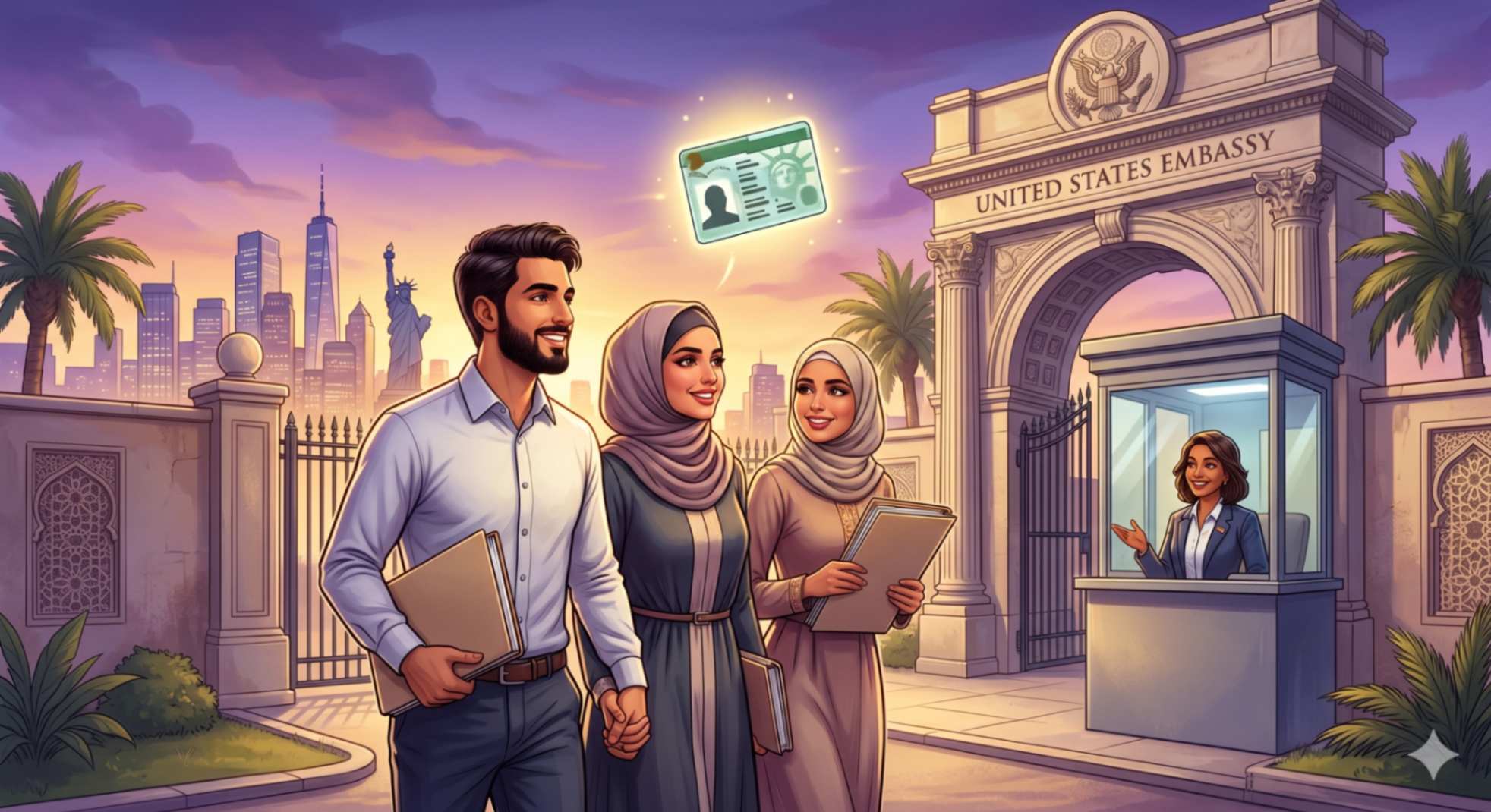
🔍 What You'll Get in This Article (What's Inside)
Let me be brutally honest with you. I'm Hussein Abdullah, founder of "Arabs in America." Over the past fifteen years, I have personally guided hundreds of DV lottery winners through the nerve-wracking process of the U.S. Embassy interview. I've celebrated the approvals, and I've witnessed the devastating tears of those who were turned away—not because they weren't qualified, but because they made a preventable mistake.
Here is the hard truth: Winning the lottery means absolutely nothing if you fail the interview.
I've seen winners show up with expired medicals. I've seen them forget a police certificate from a country they lived in ten years ago. I've seen them stammer and freeze when the Consular Officer asks a simple question about their work. Don't let that be you. This guide is built to make sure you walk into that embassy with the calm confidence of someone who knows exactly what's coming.
Here's exactly what I've packed into this comprehensive resource for you:
- A Clear Post-Selection Roadmap: A step-by-step timeline from the moment you see "You have been randomly selected" to the day you receive your 2NL interview letter.
- The DS-260 Form Demystified: Critical warnings about the most common—and most dangerous—mistakes winners make when filling out this essential form.
- The Definitive Medical Exam Guide: Where to go, what to bring, how much it costs, and the exact list of required vaccinations so you don't get blindsided.
- The Ultimate Document Checklist: A detailed table of every single document you need (original + copy + certified translation), with notes you won't find on any government website.
- Psychological Preparation for the Big Day: What to wear, how to behave inside the embassy, and how to project confidence even when you're nervous.
- The Consular Question Bank with Model Answers: Over 15 of the most frequently asked questions, plus the optimal way to answer them concisely and truthfully.
- Decoding the Outcomes: What "Approved" really means, what "221g Administrative Processing" entails, and what to do if you face a visa refusal.
- Real Human Stories (Anonymized): You'll read authentic accounts of winners who succeeded and those who failed, so you can learn from their experiences.
- Expanded FAQ Section: Direct answers to over 15 of the most pressing post-selection questions I receive every day.
- Hussein's Personal Verdict: At the end of each phase, I'll give you my unfiltered "Hussein's Take"—the practical wisdom I've earned from years in the trenches.
This is the guide I wish every single one of my clients had read before their interview. Take your time with it. Absorb it. And walk into that embassy ready to claim your American dream.
Phase 1: Life After Winning (From Euphoria to Action)
Congratulations! You've seen the words that millions only dream of: "You have been randomly selected for further processing..." Take a moment. Breathe. Celebrate. Then, put the celebration on hold and let's get to work. The path ahead requires meticulous precision, and your timeline is driven by a single, crucial number.
Your Case Number (found on your selection letter) dictates everything. It typically looks like this: 2027AF00012345 (Year + Region Code + Numeric Sequence).
- Low Case Numbers (e.g., below 10,000) will likely get interview slots very early (October - December). You need to move fast.
- Mid-Range Numbers will likely get slots in the middle of the fiscal year (January - May).
- Very High Numbers may wait until the end of the fiscal year (June - September). Be aware that some high numbers may never get an interview if the 55,000 visas are exhausted first.
1. Submitting Form DS-260 (The Immigrant Visa Application)
Your first official action is to complete Form DS-260 online via the Consular Electronic Application Center (CEAC). You will find the link on your selection page. This is the formal application for your immigrant visa.
Critical Warnings When Filling Out the DS-260:
- Perfect Consistency is Mandatory: The information you enter here must match the information you provided on your original DV entry (DS-5501) letter for letter. A different spelling of your name, a wrong birth date, or a discrepancy in your marital history will raise immediate red flags and can lead to a finding of misrepresentation.
- List All Family Members: This is non-negotiable. You must list your spouse and all unmarried children under the age of 21, even if they are not planning to immigrate with you. Omitting a family member is grounds for visa denial.
- Answer Security Questions with Brutal Honesty: You will be asked about criminal history, political affiliations, and communicable diseases. This is not the time for creative editing. A lie discovered here results in a permanent bar from the United States.
After successful submission, you will see a DS-260 Confirmation Page with a barcode. Print this immediately and file it securely.
2. The Kentucky Consular Center (KCC)
Once you submit the DS-260, the Kentucky Consular Center (KCC) takes over processing. Generally, you will hear nothing from them until your case number is approaching "current" status. Do not panic if months go by in silence.
Important Note: If you have a major life change after submitting your DS-260 (e.g., a new marriage, a new baby, a divorce), you must notify the KCC immediately by email at KCCDV [at] state [dot] gov. Include your full Case Number in the subject line.
3. Monitoring the Visa Bulletin
Do not just wait passively for an email. Learn to read the Visa Bulletin, published monthly by the U.S. Department of State at travel.state.gov. In the "Diversity Visa (DV) Category" section, find your region. When the "Cut-off Number" for your region is higher than your Case Number, your turn for an interview has arrived or is imminent.
4. The 2NL (Second Notification Letter)
When your number is current, you will receive an email from KCC instructing you to log back into the CEAC portal. There, you will find your official Interview Appointment Letter (2NL). This letter states the exact date, time, and location of your interview at the designated U.S. Embassy or Consulate.
Hussein's Take: Do not procrastinate on the DS-260. Fill it out carefully within the first week of winning. Then, start gathering your documents immediately. Time flies when you're waiting for a visa, and the winners who prepare early are the ones who succeed. Also, familiarize yourself with our guide on How to Get a Green Card in the USA to know what awaits you after arrival.
Phase 2: The Medical Examination (Non-Negotiable)
You will be turned away at the embassy door if you have not completed your medical exam. This is a mandatory, rigid process that differs significantly from a standard physical check-up.
Where to Go
You must go exclusively to a physician approved by the U.S. Embassy in your country (a "Panel Physician"). A list of approved physicians is available on the official website of the U.S. Embassy in your country. Do not waste time and money at a regular hospital.
What Happens During the Exam?
- General Physical Exam: To screen for communicable diseases of public health significance.
- Blood and Urine Tests: Specifically for syphilis, gonorrhea, and tuberculosis (TB).
- Chest X-Ray: Required for most applicants aged 15 and older to check for active tuberculosis.
- Vaccination Review: This is crucial. The physician will review your vaccination history and administer any missing doses required for U.S. immigration. The required vaccines include (age-dependent):
- Tetanus and Diphtheria (Td/Tdap)
- Measles, Mumps, Rubella (MMR)
- Hepatitis B
- Varicella (Chickenpox)
- Influenza (during flu season)
- COVID-19
Pro Tip: Bring your old childhood vaccination records (even if they are faded or in another language). This can save you hundreds of dollars in unnecessary repeat vaccinations.
The Sealed Envelope
After the exam, the physician will give you either:
- A sealed envelope marked "To the U.S. Embassy Only."
- Or, they will transmit the results electronically (depending on the post).
⚠️ Red Alert: Do NOT open the sealed medical envelope. Opening it invalidates the entire exam. You will have to pay for and redo the entire process.
Cost of the Medical Exam
The medical exam is not free. Costs vary by country and physician but typically range from $200 to $500 USD per adult, including the required vaccinations. Confirm the total cost when you schedule your appointment.
Phase 3: The Ultimate Document Checklist (Get This Right)
This is the core of your preparation. An incomplete or disorganized file is the fastest way to delay or derail your case. The golden rule: Any document not in English must be accompanied by a certified English translation.
Table 1: Complete DV Lottery Interview Document Checklist
| Required Document | Critical Notes and Details |
|---|---|
| 1. Passport | Must be valid for at least 6 months beyond the intended date of entry into the US. Bring old/expired passports as well. |
| 2. Appointment Letter (2NL) | Printed directly from the CEAC portal. This is your ticket to enter the embassy. |
| 3. DS-260 Confirmation Page | The page with the barcode that appears after you submit the form online. |
| 4. Recent Photographs | Two identical, recent (taken within 6 months) 2x2 inch (5x5 cm) color photos. White background. Same strict specs as the original lottery photo. |
| 5. Birth Certificate | Original birth certificate (or certified extract) for every applicant. Must list full name, date and place of birth, and names of both parents. |
| 6. Educational Qualification | Original diploma/certificate that made you eligible (High School Diploma, Baccalaureate, etc.). |
| 7. Work Experience Evidence (If Applicable) | If you qualified via work experience, bring official letters on company letterhead detailing your job title, duties, and dates of employment (proving 2 years in the last 5). |
| 8. Police Certificates | Required for every applicant aged 16 or older. You need one from: • Your country of current residence. • Any country where you have lived for more than 6 consecutive months since turning 16. Certificates must be recent (issued within the last year). |
| 9. Civil Documents | • Original Marriage Certificate (if married). • Divorce Decree or Death Certificate (if previously married and marriage ended). |
| 10. Military Records | For male applicants (if applicable): Certificate of completion of service, final exemption, or valid deferment. |
| 11. Financial Evidence | Crucial! To satisfy the "Public Charge" rule and prove you won't become dependent on government benefits: • Best Option: Form I-134 (Affidavit of Support) from a U.S. sponsor (relative or friend), along with their tax returns and proof of income. • Alternative: Personal bank statements showing substantial savings, OR a valid Job Offer Letter from a U.S. employer. |
Phase 4: The Interview Fee (DV Fee)
- The Diversity Visa application fee is $330 USD per person. This applies to every applicant, including infants.
- How to Pay: You pay this fee at the embassy on the day of your interview, usually at a cashier window before you see the Consular Officer. Most embassies accept payment in cash (local currency or USD) or by credit card (Visa/Mastercard). Check your specific embassy's website for accepted payment methods.
- Refundable? No. The fee is non-refundable, even if your visa application is ultimately refused.
Hussein's Take: Organize your documents in a clean, transparent plastic folder with dividers. Put originals in one section and photocopies/translations in another. A well-organized file makes a powerful, positive first impression on the embassy staff and the Consular Officer.
Phase 5: Interview Day and the Consular Officer's Questions
Judgment Day. It's normal to feel nervous. But remember, preparation is the antidote to fear. You have done the work. Now, it's time to execute.
📖 Real Story #1: Nadia and the Power of Preparation
Nadia, an engineer from Egypt, shared her experience: "I was a wreck the night before. I couldn't sleep. But I had followed every piece of advice. I had my file perfectly organized in a clear folder. I had rehearsed my answers to common questions until they felt natural. When I stood at the window, the officer was calm and professional. He asked, 'What is your profession? Where will you stay in America?' I answered clearly and confidently. He glanced at my documents for a minute, then looked up and said, 'Your visa is approved. Congratulations.' I floated out of that embassy. The secret was preparation. When you're ready, the fear melts away."
Step-by-Step on Interview Day
- Arrive On Time: Arrive no more than 15-30 minutes before your scheduled appointment. Do not be late, but arriving hours early is unnecessary.
- Security Screening: You will pass through strict, airport-style security. Prohibited Items: Mobile phones, smartwatches, laptops, headphones, and lighters. Most embassies do not have storage facilities. Leave your phone at your hotel or with a companion.
- Initial Document Intake: A local staff member (not the Consular Officer) will initially collect your passport, photos, and key documents for a preliminary check.
- Fee Payment and Biometrics: You will pay the $330 fee at the cashier window. Then, you'll proceed to another window to have your ten fingerprints scanned electronically.
- The Consular Interview: This is the moment. You will stand before a glass window and speak to the American Consular Officer via a microphone. You will first be asked to raise your right hand and swear an oath that your information is truthful.
🎯 Common Consular Questions and How to Answer Like a Pro
The officer is not your adversary. They have a checklist: identity, eligibility, no fraud. The interview typically lasts 3-5 minutes. Here's what to expect and how to handle it.
| Expected Question | How to Answer with Confidence and Brevity |
|---|---|
| What is your highest level of education? | "I have a Bachelor's degree in Mechanical Engineering." OR "I completed high school (Baccalaureate)." Keep it simple. No long stories. |
| Where do you currently work? | "I work as a [Job Title] at [Company Name]." Be honest. If you are between jobs, say so. |
| Are you married? When did you get married? | Answer directly. If you married after winning, be prepared for follow-up questions and have proof of a genuine relationship ready (wedding photos, joint lease, photos with family). A suspicious marriage timeline is a top reason for denial. |
| Which state do you plan to go to? | Name a specific city and state. Example: "I plan to go to Dearborn, Michigan, because I have a cousin there." Never say, "I don't know" or "Anywhere." |
| Do you have relatives or friends in the US? | Be truthful. "Yes, I have an uncle in Paterson, New Jersey." This is not a negative. It can be a positive support structure. |
| What is your plan to work in the US? | Show ambition and realism. "I am a plumber. I plan to find work in a construction or maintenance company. I have savings to support myself while I look." |
| How will you support yourself financially at first? | This is the "Public Charge" question. Present your Form I-134 if you have it, or state clearly: "I have personal savings of $XX,XXX (offer to show bank statement) and I have a job offer letter from ABC Company." |
Hussein's Take: Follow the 3C Rule: Be Confident, Concise, and Candid. Do not volunteer information you haven't been asked for. Answer the question and stop talking. The officer values directness and honesty.
Phase 6: The Possible Outcomes (What Happens Next)
At the end of the interview, the officer will usually inform you of the decision immediately or hand you a paper explaining your case status. There are three possibilities.
1. ✅ Approved
- The Scenario: The officer smiles and says, "Congratulations, your visa has been approved."
- What Happens: The officer keeps your passport to print the Immigrant Visa. You will receive a slip with instructions on how your passport will be returned (usually via a premium courier service like Aramex or DHL within 3-10 business days). You will also receive a sealed brown envelope (Immigrant Visa Packet). Do NOT open this envelope. You will hand it to the CBP officer at the U.S. airport when you land.
2. 🟡 Administrative Processing (221g)
- The Scenario: The officer gives you a colored slip (often yellow or blue) and says, "Your case requires additional administrative processing."
- What It Means: This is not a denial. It is a temporary hold. Common reasons include:
- A missing document (you are instructed to submit it later).
3. ❌ Refused / Denied
- The Scenario: The officer returns your passport and hands you a white letter explaining the refusal.
- Common Reasons for Denial:
- Failure to meet the education or work experience requirement.
- Discovery of fraud or misrepresentation (fake documents, sham marriage).
- A criminal record involving serious crimes or drug offenses.
- Failure to overcome the "Public Charge" presumption.
- Can You Appeal? Consular decisions on immigrant visas are final and generally not subject to judicial appeal. If the denial was not due to fraud or a permanent ineligibility, you may apply again in a future DV lottery.
Phase 7: Post-Approval (You're Almost There!)
You have the visa-stamped passport in your hands. You are almost an American Permanent Resident. But two critical steps remain.
1. Pay the USCIS Immigrant Fee
Before you board your flight to the U.S., you must go online to the USCIS website and pay a fee of $235 USD per person. This fee covers the production and mailing of your physical, plastic Green Card to your U.S. address after you arrive.
- Official Payment Site: my.uscis.gov/uscis-immigrant-fee
- Warning: If you fail to pay this fee, your Green Card will never be mailed to you. You will have to apply for a replacement later and pay a much higher fee (over $500).
2. Check Your Visa Expiration Date
Look at the Immigrant Visa printed in your passport. Find the "Expiration Date." This date is 6 months from the date of your medical examination (not the interview date). You must physically enter the United States before this expiration date. If you arrive even one day late, the visa is void, and you lose your Green Card status permanently.
3. Arrival in the USA (Port of Entry)
When you land at your first U.S. airport, proceed to the "Visitors and New Immigrants" line. The Customs and Border Protection (CBP) officer will ask a few routine questions, take your fingerprints, and stamp your passport with an I-551 stamp. This stamp serves as temporary proof of your Permanent Resident status for one year, valid for work and travel while you wait for the plastic Green Card to arrive in the mail at the address you provided.
Phase 8: Real Human Stories (Learn from Others)
📉 Real Story #2: Samir's Marriage Mistake
Samir, a winner from Jordan, shared his painful lesson: "I won the lottery and was overjoyed. I was engaged at the time, and two months after winning, we got married. I didn't think to notify the KCC or update my file until the interview. At the interview, the officer grilled me about the wedding date, our relationship history, and asked for proof. I was unprepared and flustered. I had no wedding photos with me. The officer suspected it was a 'sham marriage' for visa purposes. My visa and my wife's visa were both denied. I lost my once-in-a-lifetime chance because I didn't prepare a proper file to prove my relationship was real."
📈 Real Story #3: Siham's Proactive Success
Siham, a pharmacist from Morocco, told us: "I was terrified of the 'Public Charge' issue because I knew no one in the US. I followed the advice on this site and started searching for jobs online before my interview. I contacted an Arabic-owned pharmacy in Michigan, explained my situation, and sent my CV. They were impressed and sent me a formal Job Offer Letter. When the Consular Officer asked about my financial plan, I simply placed the job offer on the counter. He smiled and said, 'Excellent preparation.' My visa was approved in minutes."
Phase 9: Frequently Asked Questions (FAQ)
Q1: I got married after winning the lottery. Can I add my spouse for the interview? A: Yes, provided the marriage took place before your interview. You must notify the KCC immediately and be prepared to present strong evidence at the interview proving the marriage is legitimate and not solely for immigration benefits.
Q2: How long does it take to get my passport back after approval? A: Typically 3 to 10 business days, depending on the courier service and the embassy's workload.
Q3: Can I do the medical exam in a country different from my interview country? A: It is strongly recommended to do the medical exam in the country where your interview will take place, using a Panel Physician approved by that specific embassy.
Q4: My son turned 21 while waiting for the interview. Can he still come with us? A: The Child Status Protection Act (CSPA) protects children who "age out" during the immigration process. As long as he was under 21 at the time you filed the initial DS-260, he remains eligible.
Q5: How long does "Administrative Processing" (221g) usually take? A: There is no standard timeline. It can range from a few weeks to over a year. Patience is required, and there is generally no way to expedite it.
Q6: I have an old, minor criminal record (e.g., a bounced check). Will this affect me? A: You must disclose it. The officer will evaluate the nature of the offense. Minor misdemeanors generally do not result in a visa denial. Serious felonies and any drug-related offenses will.
Q7: How much money should I show in my bank account? A: There is no fixed magic number, but the amount should reasonably demonstrate your ability to support yourself (and your family) for 3-6 months without public assistance. A minimum of $10,000-$15,000 per adult is a common benchmark. An I-134 from a sponsor is stronger evidence.
Q8: Do I need to book my flight before the interview? A: Absolutely not. Do not purchase non-refundable airline tickets until you have your passport back with the visa physically stamped in it.
Q9: The officer kept my passport and said "approved," but I haven't received it in over a month. What now? A: You may have been placed in Administrative Processing after the interview. Contact the embassy via the email provided on their website to inquire.
Q10: What is the USCIS Immigrant Fee, and when do I pay it? A: It is a $235 fee paid online to USCIS to cover the production of your physical Green Card. It should be paid before you travel to the US to ensure the card is produced and mailed promptly.
Q11: I traveled to the US, and my address changed. How do I update it for my Green Card? A: You can update your address with the CBP officer when you land at the airport. If you've already entered the US, file Form AR-11 online with USCIS within 10 days of moving.
Q12: How long is the Immigrant Visa valid for travel? A: It is valid for 6 months from the date of your medical exam. Check the date carefully; it is not 6 months from the interview date.
Q13: Can I travel to a different state than the one my sponsor lives in? A: Yes. As a Permanent Resident, you have the right to live and work anywhere in the United States.
Q14: What happens if I forget to pay the $235 USCIS fee before I travel? A: Your Green Card will not be produced. You will eventually need to file Form I-90 and pay a significantly higher fee (over $500) to get a replacement card.
Q15: What if I can't find a sponsor for the I-134 form? A: An I-134 is not strictly mandatory, but it is the strongest evidence. If you don't have one, focus on building a strong alternative: personal bank statements, proof of assets, and, ideally, a US job offer letter.
Conclusion
The U.S. Embassy interview is the final, decisive gateway between the dream of winning the lottery and the reality of starting a new life in America. It is not an inquisition designed to trap you; it is a verification process to confirm your qualifications and the integrity of your application. As we've covered in exhaustive detail, success in this interview is not a matter of luck. It is a direct result of meticulous preparation, absolute accuracy, and unwavering honesty.
From organizing your documents into a pristine file, to rehearsing the answers to anticipated questions, to completing the medical exam and paying the correct fees on time... every small, deliberate step you take brings you closer to hearing the word "Approved."
A final word from Hussein Abdullah: I know the anxiety you're feeling. I know the weight of this moment. But I also know that thousands of Arab immigrants before you have walked this exact path, felt this same fear, and succeeded because they were prepared. You can be one of them. Read this guide again. Take notes. And walk into that embassy with your head held high, knowing you have done everything in your power to secure your family's future.
Share your journey or ask your question! Do you have a specific question about your country's embassy procedures? Or have you already had your DV interview and want to share your story to help others? Leave a comment below. Our shared experiences are the most powerful tool we have. Best of luck
Author: حسين عبد الله
Hussein Abdullah is a web developer and specialized content writer with more than eight years of experience enriching Arabic digital content. He combines an analytical programming mindset with a deep passion for writing to deliver accurate, reference-quality guides. On Arabian in USA (عرب في أمريكا), he focuses on simplifying complex steps for new immigrants and sharing reliable information on housing, work, and financial setup—so every newcomer has a trustworthy path toward stable life in the United States.


Continue reading
- How to Apply for the US DV Lottery 2027: The Ultimate General Guide
- How to Get a Green Card in the US 2026: The Ultimate Guide to Pathways, Requirements, and Steps
- Immigration to the United States from Morocco in 2026: A Complete Guide to Every Path, Requirement, and Step
- Top 7 Best States for Arabs in America: Ultimate Guide (Updated 2026)
- Immigration to the USA from Brazil 2026: Complete Guide to All Paths, Requirements, and Procedures
- Living in California 2026: The Complete Guide for Arabs & Immigrants [Housing, Jobs, Education & Mosques]