Immigration to the United States from Morocco in 2026: A Complete Guide to Every Path, Requirement, and Step
Important Legal Disclaimer: This article is for general informational and awareness purposes only and does not constitute legal advice. United States immigration law is highly complex, subject to frequent and sometimes abrupt change, and its application is intensely fact-specific. Readers are strongly and unequivocally advised to consult with a qualified, licensed United States immigration attorney who is a member in good standing of the American Immigration Lawyers Association (AILA) before taking any action or making any decision that may affect their immigration status or prospects.
Is the "American Dream" Still Attainable for Moroccan Youth in 2026?
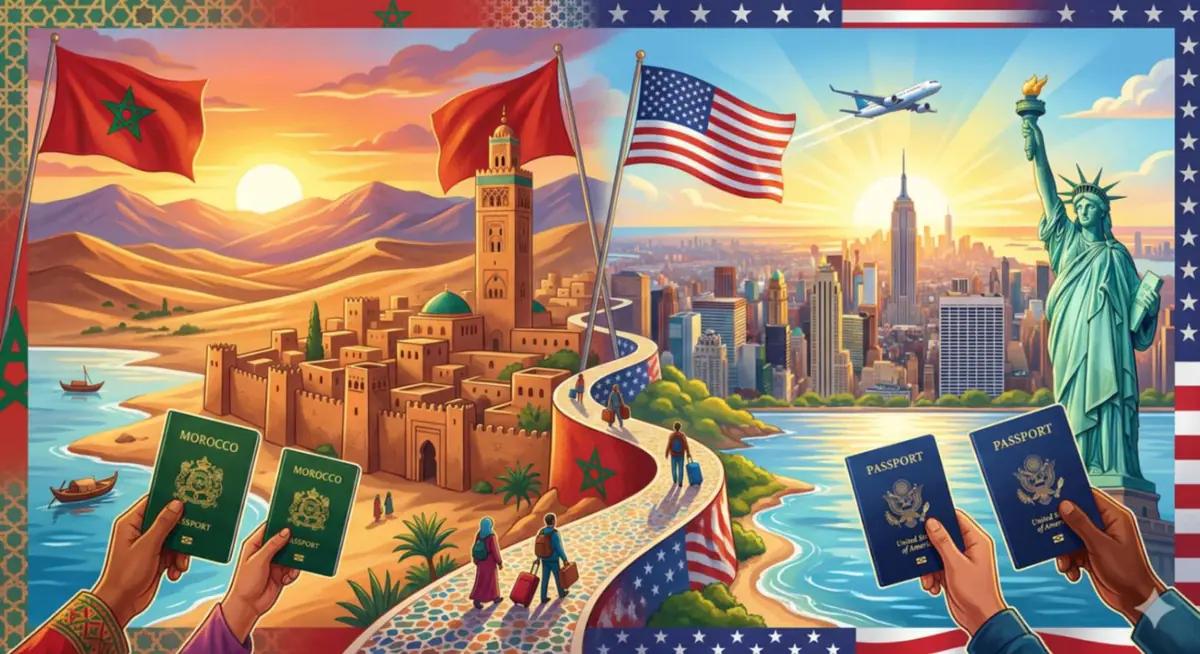
America. That legendary, persistent, and almost mythic dream that captivates the collective imagination of thousands of Moroccans, year after relentless year. From the winding, ancient alleyways of Tangier that embrace the Mediterranean Sea, to the ceaseless, dynamic economic pulse of Casablanca, from the serene administrative elegance of Rabat's boulevards to the vibrant, teeming heart of Jemaa el-Fna square in red-hued Marrakesh, a singular, resonant, and universally posed question echoes persistently in the conversations of ambitious youth and hopeful, forward-looking families alike: "How does one legally, reliably, and permanently immigrate to the United States of America? What are the concrete, viable, and actionable pathways that genuinely exist in the year 2026? And is it truly, realistically possible to secure that most coveted of documents—the Permanent Resident Card, the 'Green Card'?"
The encouraging and empirically supported truth is that the Kingdom of Morocco stands as one of the leading Arab nations from which a steady, active, and demonstrably successful stream of legal immigration flows to the United States. Current, reliable estimates indicate that the Moroccan diaspora community in America now comfortably exceeds the threshold of 100,000 individuals of Moroccan origin or nationality, distributed with notable success and influence across major American urban centers and metropolitan regions, including New York, Washington, D.C., Los Angeles, and Houston. Over the course of decades, Moroccan immigrants and their descendants have consistently demonstrated a remarkable and well-documented capacity for rapid, positive, and productive integration, achieving distinguished levels of success and prominence across a diverse and vital spectrum of sectors, including small business entrepreneurship and franchising, technology and digital innovation, academia and advanced scientific research, and the broad and essential service economy. While the path to immigration is undeniably not strewn with rose petals, and demands the exercise of meticulous strategic planning, legendary reserves of patience, and a precise, up-to-date legal understanding of ever-shifting procedures, the doors are demonstrably multiple and varied. They remain open and accessible to those individuals who possess the requisite determination and the correct, actionable knowledge.
Within the expansive and meticulously detailed confines of this comprehensive 2026 guide, the reader shall be methodically and sequentially escorted through the entire, intricate process of immigration to the United States from Morocco. Every legally sanctioned and currently viable pathway shall be deconstructed, analyzed, and explicated with unwavering clarity and precision: commencing with the great annual beacon of hope represented by the "Lottery"—the Diversity Visa (DV) Program—which provides the path of least procedural resistance for those lacking pre-existing familial or employment ties; proceeding through the strategically vital employment-based visa categories meticulously designed for skilled professionals and individuals of extraordinary ability (H-1B, L-1, O-1); navigating the emotionally resonant and legally complex terrain of family-based sponsorship and reunification; exploring the deliberate, calculated, and highly effective deployment of U.S. higher education as a strategic, long-term bridge to lawful employment and eventual permanent settlement (F-1 Student Visa and OPT); and concluding with the solemn, demanding, and narrowly circumscribed avenue of humanitarian asylum—a pathway reserved exclusively for those specific, individual applicants whose documented circumstances demonstrably and compellingly satisfy the exacting, statutorily defined legal criteria. Furthermore, this guide shall furnish a detailed enumeration of the precise documentary requirements, a realistic and comprehensive estimation of all associated fees and financial outlays, and a curated collection of strategic imperatives and practical wisdom designed to maximize the probability of a successful outcome at the crucial consular interview, while simultaneously providing the essential countermeasures and protective strategies required to identify, evade, and neutralize the pervasive and predatory schemes of fraudsters, unlicensed consultants, and illicit actors who systematically exploit the profound aspirations of the vulnerable. In cognizance of the fact that enduring stability within the United States is predicated upon a holistic foundation encompassing both secure legal status and sound financial integration, consultation of the following foundational guides is strongly recommended: How to Get Your SSN in America in 2026, How to Open a Bank Account in America as a New Immigrant, and Work in America for New Immigrants.
Chapter One: An Analytical and Comprehensive Overview of Immigration from Morocco to the United States (History, Demographics, and Principal Hubs)
To properly contextualize and accurately assess the nature and dynamics of Moroccan immigration to the United States, it is first necessary to cultivate a clear and nuanced understanding of its historical trajectory, its current demographic scale and composition, and the specific geographic centers where the community has coalesced. Such an understanding provides a realistic framework for evaluating individual prospects and formulating a coherent long-term strategy.
- The Historical Arc of Moroccan Migration to the United States: The United States was not, historically, the primary or preferred destination for the Moroccan emigrant, who, owing to geographic proximity, deep-seated colonial and post-colonial ties, and linguistic affinities, overwhelmingly favored destinations within Western Europe—most notably France, but also Spain, Belgium, the Netherlands, and Italy. The initial, numerically limited vanguard of Moroccan migration to America began to materialize during the late 1960s and the 1970s. This early cohort was composed predominantly of government-sponsored scholarship students, diplomatic personnel and their families, and a scattering of highly skilled professionals. The true demographic surge, however—the transformative and statistically significant acceleration in the volume of Moroccan immigration—occurred during the latter half of the 1990s and the opening years of the new millennium. This surge was propelled primarily by two synergistic and powerful catalysts: the widespread proliferation of awareness and participation in the Diversity Visa (DV) Lottery Program, and a marked increase in both the availability and the awareness of international scholarship and fellowship opportunities at American universities.
- Estimated Size and Composition of the Moroccan Diaspora Community (2026 Projections): Current, reliable demographic estimates, synthesized from data published by authoritative migration policy institutes, the U.S. Census Bureau's ongoing American Community Survey, and the internal records maintained by Moroccan-American community and cultural organizations, indicate that the total population of individuals of Moroccan origin or nationality who maintain lawful and permanent residence within the United States now comfortably exceeds 100,000 persons. This community is distinguished by demonstrably high levels of educational attainment, a pronounced and culturally ingrained spirit of entrepreneurship and self-reliance, and the existence of robust, highly functional, and deeply embedded networks of mutual aid and social solidarity that provide an invaluable support structure for newly arrived compatriots.
- Principal Geographic Concentrations of the Moroccan Community (Where to Locate the Familiar Scent and Spirit of Home):
- The State of New York: This state encompasses one of the largest and most densely concentrated Moroccan populations. Specific neighborhoods serve as vibrant cultural and commercial epicenters: notably Astoria in the borough of Queens, and Bay Ridge in the borough of Brooklyn. Within these enclaves, a visible and thriving Moroccan commercial and cultural ecosystem flourishes, replete with restaurants offering authentic, aromatic couscous, tagines, and harira; bustling cafés redolent with the fragrance of fresh nana mint tea; and specialty grocery stores importing halal provisions and cherished products directly from the homeland (the area is often affectionately and colloquially referred to as "Little Morocco").
- The Greater Washington, D.C. Metropolitan Area (The DMV): This region is home to a substantial, influential, and rapidly growing community of Moroccan professionals, white-collar workers, employees of major international financial institutions and development organizations, and successful entrepreneurs and business owners. The population is heavily concentrated in the Northern Virginia suburbs (specifically the cities and counties of Arlington, Alexandria, and Fairfax) and in the adjacent Maryland suburbs (notably Montgomery County and Prince George's County).
- The State of California: Particularly the greater Los Angeles metropolitan area and the San Francisco Bay Area (encompassing Silicon Valley). These dynamic and globally significant economic regions exert a powerful and specific gravitational pull, attracting a significant cohort of highly skilled Moroccan professionals, entrepreneurs, and innovators working in the technology, entertainment, scientific research, and digital media sectors.
- The State of Texas: The major metropolitan economies of Houston and Dallas. Substantial numbers of Moroccans are employed here in the expansive oil and gas exploration and production sector, the broader energy industry, and the rapidly growing technology and healthcare ecosystems.
- The State of Florida: The metropolitan areas of Orlando, Miami, and Tampa. This state serves as a favored and increasingly popular destination for Moroccan families seeking a warmer, more familiar subtropical climate, a more relaxed and family-oriented pace of life, and a generally more affordable cost of living compared to the major northeastern or Californian hubs.
- The State of Illinois: The city of Chicago and its affluent northern suburban corridor host an active, engaged, and well-integrated Moroccan community.
- The Principal Catalysts and Motivations for Emigration: The underlying motivations driving this sustained transatlantic movement are diverse, multifaceted, and deeply personal. They range from the fundamental and pragmatic pursuit of specialized, high-demand professional opportunities offering levels of compensation and career advancement that are not readily available within the domestic labor market, to the profound and deeply held aspiration to pursue advanced graduate studies and cutting-edge research at the world's preeminent academic institutions. Other powerful and deeply human drivers include the compelling desire to provide one's children with access to a world-class, English-language education and the attendant opportunities it affords, the poignant and often urgent imperative of reuniting families that have been fragmented and dispersed by prior waves of migration, and, of course, the fortuitous and life-altering stroke of serendipity represented by the successful selection in the annual Diversity Visa Lottery.
Chapter Two: Pathway One – The Diversity Visa (DV) Lottery: The Preeminent Annual Hope, Offering the Path of Least Procedural Resistance and Lowest Direct Cost
This singular pathway—widely and colloquially known throughout Morocco simply as "The Lottery" (al-lotri)—represents the annual dream of multitudes and constitutes the most procedurally straightforward, the least financially burdensome, and consequently, the most eagerly sought-after mechanism available to Moroccan nationals for securing lawful permanent residence and obtaining the coveted Green Card.
- A Precise Definition of the Diversity Visa (DV) Lottery Program: Formally designated the Diversity Immigrant Visa Program, this is an annual, congressionally mandated initiative administered by the U.S. Department of State. Its explicit statutory purpose is to enhance the diversity of the immigrant population admitted to the United States. The program achieves this objective by making available, via a strictly randomized, computer-generated lottery drawing, a total of up to 55,000 immigrant visas (Green Cards) each fiscal year. These visas are distributed exclusively to qualified nationals of countries that have historically exhibited low rates of immigration to the United States.
- Is the Kingdom of Morocco Designated as an Eligible Country for Participation in the DV-2026 Program? The answer is an unequivocal and resounding yes. Fortuitously, the Kingdom of Morocco continues to be firmly and consistently included on the annually published list of eligible countries. Moroccan citizens reliably and deservedly secure a substantial and commendable share of the available visas through this program each year. Historically, the number of Moroccan selectees has consistently fallen within a significant band, typically ranging from 2,000 to 4,000 individuals annually.
- The Foundational Eligibility Requirements (Applicants Must Satisfy One of Two Criteria):
- The Country of Birth Criterion: The applicant must have been physically born within the sovereign territory of the Kingdom of Morocco. (Alternatively, under specific and narrowly defined cross-chargeability rules, an applicant born in a non-eligible country may be able to claim derivative eligibility based upon the country of birth of their accompanying spouse, or, in certain limited circumstances, that of a parent).
- The Education or Qualifying Work Experience Criterion (Substantive Qualification): The applicant must provide verifiable documentary evidence establishing either:
- Successful completion of a formal course of secondary education that is demonstrably equivalent to the completion of a 12-year course of elementary and secondary education in the United States. For Moroccan applicants, this requirement is unambiguously satisfied by the attainment of the Moroccan Baccalaureate Certificate (Shahadat al-Bakaloria).
- In the alternative, and only if the secondary education requirement is not met, the applicant must furnish verifiable documentary evidence of having been engaged in paid, full-time employment for a cumulative period of at least two full years within the immediately preceding five-year period, in a specific occupation or trade that, according to the authoritative classifications maintained by the U.S. Department of Labor's O*NET Online database, customarily requires a minimum of two years of specific training, apprenticeship, or prior work experience to attain the requisite level of competent performance.
- The Critical and Immutable Registration Window: The electronic registration portal is open, free of any charge whatsoever, for a strictly limited and inviolable period of approximately one calendar month each year. The registration period customarily commences in the early days of October and concludes in the early days of November. (For the avoidance of doubt, the registration period that opens in October of 2026 is designated for the DV-2028 program). Submissions received either before the official opening time or after the official closing time are categorically and automatically rejected by the system.
- A Detailed, Step-by-Step Protocol for Successful Electronic Registration:
- Procure a recently captured (taken within the preceding six months), high-resolution digital photograph of the applicant that conforms with meticulous, pixel-level precision to the exhaustive, technically specific, and rigorously enforced image standards published by the U.S. Department of State. (Requirements concerning background color, lighting, head positioning, neutral facial expression, and the strict prohibition of eyewear or non-religious head coverings are absolute and non-negotiable).
- Access the sole, exclusive, and official website designated for this program:
dvprogram.state.gov. Applicants must be exceedingly vigilant and wary of the proliferation of fraudulent look-alike or phishing websites designed to mimic the official portal. The registration process on this official site is entirely free of charge. - Upon successful completion and submission of the electronic entry form, the system will generate a unique alphanumeric Confirmation Number (consisting of 16 characters). This number is of paramount and irreplaceable importance. It constitutes the sole and exclusive key by which the applicant may subsequently ascertain the outcome of the lottery. It must be recorded, preserved, and safeguarded with the utmost care, as its loss is irremediable.
- Applicants must retain their Confirmation Number and, beginning in May of the calendar year immediately following the registration period, return to the official
dvprogram.state.govwebsite to utilize the "Entrant Status Check" portal to learn whether their entry has been selected. - In the affirmative event that the entry is selected (i.e., the applicant "wins" the lottery), the selectee will be directed to complete the online Immigrant Visa and Alien Registration Application (Form DS-260) with absolute accuracy and candor. Subsequently, the selectee must patiently await notification from the Kentucky Consular Center (KCC) regarding the scheduling of a formal visa interview appointment and a mandatory medical examination. Critically, all immigrant visa processing for Moroccan nationals is conducted exclusively at the U.S. Consulate General in Casablanca.
- A Strenuous and Repeated Warning Against Pervasive Fraudulent Schemes: The act of registering for the Diversity Visa lottery on the official U.S. Department of State website is, and always has been, completely, unequivocally, and one hundred percent free of charge. Any private internet café proprietor, self-styled "visa consultancy" agency, travel agency, or social media page that solicits or demands payment of any sum—under any pretext—be it for "facilitating registration," "guaranteeing a favorable selection outcome," or claiming to possess a "reserved quota" or a "secret method" to increase the odds of success, is perpetrating a knowing and deliberate fraud. The selection process is executed by an automated, randomized computer algorithm at the Kentucky Consular Center. No external human agency possesses the capacity to influence, manipulate, or alter the outcome.
Chapter Three: Pathway Two – Family-Based Sponsorship and Reunification
In the event that an individual possesses a qualifying relative—one whose blood or legal relationship falls within the statutorily defined and recognized categories—who has already established lawful and permanent residence or citizenship within the United States, this pathway constitutes the most natural, secure, and enduringly stable route to lawful permanent residence.
- The Legal and Operational Definition of Family-Based Sponsorship: This process is formally initiated through the filing of a legal petition (officially designated as Form I-130, Petition for Alien Relative) by the qualifying, U.S.-based relative (the "Petitioner" or "Sponsor") with the United States Citizenship and Immigration Services (USCIS). Through this sworn and legally binding petition, the sponsor formally requests that the federal government recognize the validity and bona fide nature of the claimed familial relationship and, upon the satisfactory completion of all legal and procedural prerequisites, grant the foreign national relative (the "Beneficiary") an immigrant visa, thereby permitting their lawful admission to the United States as a Permanent Resident for the express purpose of family reunification.
- The Statutorily Defined Categories of Qualifying Familial Relationships (Determined by the Legal Status of the Petitioner):
- United States Citizens (U.S. Citizens): Possess the broadest and most encompassing sponsorship privileges under current immigration law. They are legally empowered to file petitions on behalf of the following classes of relatives:
- Their Spouse (leading to a CR1 or IR1 Immigrant Visa).
- Their Children, regardless of the child's current age or marital status (i.e., minor children, unmarried adult children, and married adult children).
- Their Parents (both father and mother, provided the petitioning U.S. Citizen is at least 21 years of age).
- Their Siblings (Brothers and Sisters).
- Lawful Permanent Residents (Green Card Holders): Their sponsorship authority is more circumscribed. They are legally permitted to file petitions on behalf of:
- Their Spouse.
- Their Unmarried Children (irrespective of the child's age). They may not petition for parents or siblings.
- United States Citizens (U.S. Citizens): Possess the broadest and most encompassing sponsorship privileges under current immigration law. They are legally empowered to file petitions on behalf of the following classes of relatives:
- The Realistic and Anticipated Temporal Horizon (From the Fastest to the Most Protracted Category):
- Immediate Relatives of United States Citizens: This legally defined and privileged category encompasses the spouse, the parents, and the unmarried children under the age of twenty-one of a U.S. citizen. Crucially, this category is exempt from any annual statutory limitation or numerical quota on the availability of immigrant visas. Consequently, the administrative processing of these petitions is comparatively expeditious, with a typical adjudication timeframe ranging from twelve to twenty-four months from the date of initial filing.
- The Family Preference Categories: This residual classification encompasses all other qualifying familial relationships not classified as "Immediate Relatives." This includes the adult children (both unmarried and married) of U.S. citizens, the adult unmarried children of Lawful Permanent Residents, and, most notably, the siblings of U.S. citizens (designated as the Fourth Preference, or F4, category). These categories are strictly governed by a complex system of annual numerical limitations (quotas) and per-country ceilings. As a direct and unavoidable result, substantial and often protracted waiting lists, formally tracked via the Department of State's monthly Visa Bulletin, are the norm. For beneficiaries chargeable to Morocco, the waiting period for a visa to become available in the sibling (F4) category can be profoundly lengthy, frequently extending from seven to fifteen years, and in certain cases, potentially even longer.
- The Sequential Procedural Steps in Granular Detail:
- The qualifying U.S.-based petitioner initiates the process by accurately completing, signing, and filing Form I-130 with the appropriate USCIS Service Center, accompanied by the requisite, non-refundable filing fee and a comprehensive evidentiary package substantiating both the petitioner's U.S. citizenship or lawful permanent resident status and the bona fide, legally recognized nature of the claimed familial relationship (e.g., marriage certificates, birth certificates).
- Upon USCIS's adjudication and formal approval of the Form I-130 petition—a process that may itself require several months or even years, depending upon the specific preference category and current caseloads—the entire approved case file is electronically transferred to the National Visa Center (NVC) in Portsmouth, New Hampshire, for pre-processing.
- The NVC assumes responsibility for coordinating the collection of all required immigrant visa application fees, biographical information forms (including the online Form DS-260), and the critically important civil and financial supporting documentation. This includes instructing the petitioner to submit the legally binding Affidavit of Support (Form I-864) , which serves as an enforceable contract between the petitioner and the U.S. government guaranteeing that the sponsored immigrant will be maintained at an annual income level of at least 125% of the federal poverty guidelines and will not become a public charge.
- Upon the successful completion of all NVC pre-processing requirements and the availability of a visa number (for those categories subject to numerical limits), the NVC will coordinate with the U.S. Consulate General in Casablanca to schedule the final, decisive visa interview appointment. The applicant must also undergo a mandatory medical examination performed by a U.S. Consulate-approved panel physician in Morocco.
- Following a successful interview and the issuance of the immigrant visa foil affixed to the applicant's Moroccan passport, the beneficiary may travel to the United States. Upon admission at a U.S. port of entry, they will be formally processed as a Lawful Permanent Resident and will subsequently receive their physical Green Card by mail at their designated U.S. residential address.
Chapter Four: Pathway Three – Employment-Based and Extraordinary Ability Visas (H-1B, L-1, O-1)
For the ambitious, highly educated Moroccan professional who possesses an advanced university degree, demonstrable and sought-after professional experience, and specialized skills that are in demand within the U.S. labor market, the United States opens its doors wide through a sophisticated array of employment-based visa categories. These visas are not merely temporary work permits; they are strategic instruments that can, and frequently do, serve as a meticulously planned and highly effective pathway to eventual lawful permanent residence (a Green Card).
1. The H-1B Visa (Specialty Occupation)
- Fundamental Prerequisites: The applicant must, at a minimum, hold the equivalent of a United States Bachelor's Degree (or higher) in a specific field of study that is directly, intrinsically, and demonstrably related to the particular duties and responsibilities of the prospective employment. The absolute sine qua non, however, is the successful procurement of a formal, binding, and detailed offer of employment (Job Offer) from a U.S.-based sponsoring entity (the "Petitioner" or "Sponsor") that is both willing and demonstrably financially capable of undertaking the substantial legal, administrative, and financial obligations associated with the H-1B visa process.
- Sectoral Opportunities for Moroccan Professionals: This visa category is in particularly high and sustained demand within several key, strategically important sectors of the U.S. economy that align well with Moroccan professional expertise. These sectors include, but are not limited to: software engineering and application development; physicians (who have successfully completed the rigorous USMLE sequence and secured a U.S. residency position); academic researchers and postdoctoral fellows; advanced programming and cybersecurity specialists; and certain specialized fields of finance and accounting.
- The Paramount Challenge: The Annual Numerical Limitation and Consequent Randomized Selection (The H-1B Cap Lottery): The global demand for H-1B visas vastly, chronically, and systematically outstrips the rigidly limited annual supply established by congressional statute. A rigid annual cap restricts the number of new H-1B visas that may be issued each fiscal year to 65,000 (with an additional allocation of 20,000 visas reserved exclusively for beneficiaries who possess a Master's degree or higher earned from an accredited U.S. institution of higher education). As a direct and unavoidable consequence of this profound and persistent imbalance between supply and demand, USCIS is compelled to conduct an annual, randomized, computer-generated lottery (utilizing an electronic registration system) each spring to select the relatively small number of petitions that will be accepted for substantive adjudication.
- Period of Authorized Stay and the "Dual Intent" Doctrine: The H-1B classification is initially granted for a period of up to three years and is eligible for one extension of stay for an additional period of up to three years, yielding a maximum permissible continuous stay in H-1B status of six years. Critically, the H-1B is a "Dual Intent" visa category, meaning that an H-1B worker may lawfully pursue permanent resident status (a Green Card) through employer sponsorship under the EB-2 or EB-3 preference categories while simultaneously maintaining their temporary H-1B nonimmigrant status. During this period, the sponsoring employer may initiate the Green Card process on behalf of the employee.
2. The L-1 Visa (Intracompany Transferee)
- Fundamental Prerequisites: The applicant must provide compelling documentary evidence demonstrating that they have been continuously employed for at least one full year within the immediately preceding three-year period by a qualifying multinational corporation, or by its parent company, affiliate, branch, or subsidiary, in a capacity that is demonstrably either executive, managerial, or involves specialized and proprietary knowledge. The applicant must be seeking admission to the United States to render services in a similar executive, managerial, or specialized knowledge capacity to a parent, branch, affiliate, or subsidiary of that same multinational organization.
3. The O-1 Visa (Individuals with Extraordinary Ability or Achievement)
- Fundamental Prerequisites: This visa category is narrowly and exclusively reserved for that select cohort of individuals who can furnish extensive, compelling, and independently verifiable documentary evidence demonstrating that they have risen to the very pinnacle of their respective fields and have achieved sustained national or international acclaim and recognition for extraordinary achievements. The qualifying fields of endeavor are limited to the sciences, arts (including the performing arts and the motion picture/television industry), education, business, or athletics.
- Appropriate Candidates from Morocco: This pathway may be suitable for a limited but highly accomplished group of Moroccan nationals, including, for example: internationally renowned academic researchers whose published work has garnered widespread citation and global recognition in top-tier peer-reviewed journals; acclaimed visual artists, musicians, or performers who have received prestigious awards and whose work has been exhibited or featured at major international festivals and venues; and elite professional athletes who have achieved Olympic or world championship medals. The evidentiary burden for an O-1 petition is exceptionally high, requiring the meticulous assembly of a voluminous and compelling dossier comprising extensive press coverage, proof of nationally or internationally recognized prizes or awards, and authoritative, detailed expert advisory opinions from recognized leaders in the field.
Chapter Five: Pathway Four – Higher Education in America as a Deliberate, Strategic, and Long-Term Bridge to Permanent Settlement (F-1 Visa)
The pursuit of higher education in the United States via the F-1 Student Visa is correctly and widely viewed as the single most intelligent, sustainable, and strategically sound long-term investment pathway available to ambitious Moroccan youth. While it entails significant upfront financial costs and a demanding academic commitment, it represents a meticulously calculated and entirely lawful strategy for achieving full, deep, and lasting integration into the fabric of the American professional economy and, ultimately, for securing lawful permanent residence over a multi-year, carefully managed timeline.
- The Foundational Steps for Commencing the Academic Journey from Morocco:
- The prospective student must first identify suitable academic programs and successfully navigate the competitive admissions process at accredited U.S. institutions of higher education. This invariably requires achieving competitive scores on standardized examinations of English language proficiency, such as the TOEFL iBT or IELTS Academic, and, depending upon the level and program of study, achieving competitive scores on the requisite standardized aptitude and achievement tests, such as the SAT (for undergraduate admissions) or the GRE/GMAT (for graduate and professional school admissions).
- Upon securing formal, unconditional admission, the institution's Designated School Official (DSO) will issue the Certificate of Eligibility for Nonimmigrant Student Status (Form I-20).
- Following receipt of the Form I-20 and payment of the mandatory SEVIS I-901 fee, the student must apply for an F-1 nonimmigrant student visa. The visa interview will be conducted at the U.S. Embassy in Rabat or the U.S. Consulate General in Casablanca, as directed.
- The Demonstration of Adequate Financial Capacity (The Single Most Formidable and Pervasive Obstacle): The applicant bears the unequivocal and legally non-delegable burden of presenting clear, credible, and independently verifiable documentary evidence demonstrating the possession of (or lawful access to, through a documented and qualified financial sponsor) sufficient, unencumbered liquid financial resources to cover the entire estimated cost of attendance for the first full academic year (or the entire duration of the program, if less than one year). This comprehensive cost calculation, as meticulously detailed on the Form I-20, encompasses not only tuition and mandatory fees but also estimated living expenses (room and board), health insurance premiums, books, supplies, and incidental personal expenses. These aggregate annual costs vary enormously depending upon the specific institution and its geographic location, but they typically fall within a broad and often daunting range of $25,000 to $50,000 USD or even considerably more. Furthermore, the applicant must persuasively demonstrate to the Consular Officer's satisfaction that their genuine and sole intention is to pursue a full course of study and subsequently depart the United States upon completion of their authorized stay (i.e., establishing Nonimmigrant Intent).
- Scholarship and Fellowship Opportunities Available to Exceptionally Meritorious Moroccan Students (The Golden Key to Circumventing the Financial Hurdle):
- The Fulbright Foreign Student Program: This remains the preeminent and most prestigious U.S. government-sponsored international educational exchange program. It provides comprehensive, fully-funded scholarships (encompassing tuition, living stipends, health insurance, and international travel) for outstanding Moroccan students seeking to pursue Master's or Doctoral degrees or to conduct non-degree advanced research at U.S. universities. Applications are administered in Morocco through the binational Moroccan-American Commission for Educational and Cultural Exchange (MACECE) in Rabat.
- The Mastercard Foundation Scholars Program: This transformative initiative provides holistic, fully-funded scholarships (encompassing all academic and living costs, travel, and comprehensive support services) to exceptionally talented yet economically disadvantaged young people from across the African continent (including Morocco) to pursue undergraduate and graduate studies at a network of partner universities in the United States and globally.
- Athletic Scholarships (Athletic Aid) and Institutional Merit-Based Financial Aid: Highly skilled and nationally/internationally competitive Moroccan athletes may be actively recruited by U.S. collegiate athletic programs and offered substantial or full scholarships. Additionally, many U.S. universities themselves directly offer a wide variety of competitive, merit-based financial assistance packages and awards specifically designed to attract the most academically promising international students.
- The Formalized Pathway from F-1 Student to Lawful Permanent Resident (The Long-Term Strategic Sequence):
- Optional Practical Training (OPT): Upon the successful completion of each ascending level of academic study, F-1 students are eligible to apply to USCIS for up to 12 months of post-completion Optional Practical Training authorization. This provides a crucial period of lawful, full-time, off-campus employment in a position directly and integrally related to the student's major field of study.
- The STEM OPT Extension: For students whose earned degree falls within a field of study designated on the Department of Homeland Security's official STEM Designated Degree Program List (encompassing Science, Technology, Engineering, and Mathematics, as well as certain qualifying medical, analytical, and agricultural fields), an application may be made for a one-time, 24-month extension of the post-completion OPT period. This yields a cumulative total of 36 months (three full years) of lawful post-graduate employment authorization.
- It is during this strategically vital and generously extended window of three years of lawful, degree-related employment that the student's U.S. employer, having had ample opportunity to directly observe, evaluate, and materially benefit from the graduate's demonstrated skills, work ethic, and unique contributions, is best positioned and most strongly incentivized to undertake the formal and costly sponsorship process for a longer-term employment visa (most commonly the H-1B) and, eventually, to initiate the multi-stage labor certification (PERM) and immigrant petition processes leading to the coveted Green Card.
Chapter Six: Pathway Five – Humanitarian Asylum in the United States
The pathway of asylum constitutes a distinct, highly specialized, and deeply solemn form of international protection. It is a legal construct deeply rooted in both the fabric of domestic U.S. statutory law and the solemn treaty obligations the United States has assumed under international humanitarian and refugee law instruments. It is a pathway that must be approached and rigorously understood strictly within its precise, narrow, and exactingly enforced legal framework as it exists in 2026. It must emphatically not be misconstrued, misrepresented, or cynically exploited as a facile, expedient, or alternative "shortcut" for general economic or social immigration.
- A Critically Important and Highly Nuanced Observation Regarding the Specific Context of Morocco: It is of paramount and overriding importance to recognize and internalize that, within the prevailing analytical frameworks employed by both international human rights bodies and the U.S. immigration adjudication apparatus, the Kingdom of Morocco is generally assessed as a nation characterized by a significant degree of relative political stability and institutional functionality. As a direct and profoundly consequential result of this prevailing "country conditions" assessment, asylum applications predicated upon generalized, non-specific, vague, or broadly socioeconomic grievances are rejected in the overwhelming majority of cases, often summarily. Conversely, a very narrow and highly specific subset of intensely personal, exceptionally well-documented, and factually complex individual cases may, under certain circumstances, still possess a viable and legally cognizable path to a successful outcome. Illustrative, though not exhaustive, examples of such potential cases might include: individuals facing credible, direct, and personal threats of lethal violence due to their documented religious conversion and active practice of a minority faith; political activists, human rights defenders, or investigative journalists who have been specifically targeted, detained, or subjected to judicial harassment or credible death threats directly linked to their legitimate, peaceful advocacy; or members of distinct and recognized particular social groups who can demonstrate a pattern of severe, particularized, and officially tolerated persecution that the state is demonstrably either unwilling or unable to prevent.
- Who Is Legally Eligible to Apply for and Potentially Be Granted Asylum in the United States? The statutory definition is precise and narrow: Any person who is already physically present within the territorial jurisdiction of the United States (regardless of their particular manner of arrival or current, formal immigration status—including those who entered lawfully on a visitor's visa) may apply for asylum. To succeed, the applicant must, through their own credible and internally consistent testimony and the presentation of compelling and probative corroborating evidence, persuasively demonstrate to the satisfaction of the designated adjudicating authority that they have endured specific instances of past persecution, or that they harbor a demonstrably "well-founded fear" of being subjected to future persecution, should they be forcibly returned to Morocco. This fear of persecution must be demonstrably and causally connected to one or more of five specific, exhaustive, and statutorily protected grounds: race, religion, nationality, membership in a particular social group (PSG), or political opinion.
- The Condensed and Foundational Procedural Sequence:
- The applicant must first establish actual, undeniable physical presence within the territorial confines of the United States.
- The applicant must then complete and file a formal, sworn Application for Asylum and for Withholding of Removal (Form I-589) with the United States Citizenship and Immigration Services (USCIS). This filing must, by statute, occur within exactly one year (365 days) of the applicant's most recent date of physical arrival in the United States. Failure to meet this strict, jurisdictional filing deadline, absent the successful demonstration of narrowly defined and legally recognized "changed circumstances" materially affecting eligibility or truly "extraordinary circumstances" directly causing the delay, will result in the automatic and summary dismissal of the asylum application.
- The applicant must then endure an often protracted, psychologically taxing, and indeterminate waiting period, which may extend for many months or even several years, before being scheduled for a non-adversarial, yet rigorous and searching, interview with a trained Asylum Officer at a designated USCIS Asylum Office. During this interview, the officer will meticulously probe the applicant's narrative, test its internal and external consistency and credibility, and demand the presentation of any and all available corroborating documentary or physical evidence (e.g., medical records documenting injuries, authenticated police reports, credible threatening communications, press articles).
- In the event that the Asylum Officer issues a denial of the application (a common outcome for cases deemed insufficiently documented or credible), the case is not necessarily concluded. The applicant will typically be placed in formal removal proceedings before the Executive Office for Immigration Review (EOIR), and the case will be referred de novo to an Immigration Judge (IJ). At this juncture, the proceedings transform from a non-adversarial interview into a formal, adversarial courtroom hearing, where an attorney representing U.S. Immigration and Customs Enforcement (ICE) will argue in opposition to the grant of asylum. The applicant possesses the fundamental right to legal representation by counsel of their own choosing (at their own expense) and, in certain limited circumstances defined by statute and regulation, a right of appellate review by the Board of Immigration Appeals (BIA).
- A Solemn and Uncompromising Legal Admonition: The act of fabricating, embellishing, or knowingly misrepresenting any material fact in support of an asylum claim constitutes the serious federal felony offense of Asylum Fraud. A formal finding of fraud or willful misrepresentation will not only result in the immediate and categorical denial of the asylum application and the institution of expedited removal (deportation) proceedings but will also trigger the imposition of a lifetime statutory bar prohibiting the individual from ever lawfully returning to or obtaining any future immigration benefit in the United States. It is an absolute, non-negotiable imperative to seek confidential, privileged counsel from a licensed, experienced, and reputable U.S. immigration attorney specializing in asylum and complex removal defense litigation before taking any definitive action whatsoever on this high-stakes pathway. (For a more granular, step-by-step exposition of the procedural intricacies, refer to the dedicated article: How to Apply for Asylum in America).
Chapter Seven: The Essential and Standardized Portfolio of Documentation Required for U.S. Visa Applications and the Consular Interview
Irrespective of the specific visa classification being sought—whether it be through the Diversity Visa Lottery, family-based sponsorship, academic study, or professional employment—the applicant must prepare and maintain an organized, consistent, and readily accessible portfolio of core documentary evidence. This meticulous preparation is a fundamental prerequisite for a smooth and efficient application process.
- A Current, Valid Moroccan Passport: The passport must be unexpired, in good physical condition, and must possess a remaining period of validity that extends for at least six full months beyond the applicant's intended date of departure from the United States or the anticipated completion date of their authorized period of stay.
- Recent Passport-Style Photographs (5 x 5 cm format): These photographs must have been recently captured (within the preceding six months) and must adhere with absolute, uncompromising, pixel-level precision to the exhaustive and rigorously enforced technical specifications mandated by the U.S. Department of State (requirements concerning exact dimensions, pure white or off-white background, lighting, head positioning, neutral facial expression, and the strict prohibition of eyeglasses, tinted contact lenses, or digital alteration).
- The Printed Confirmation Page of the Completed Electronic Application Form:
- For Nonimmigrant Visa applications (e.g., B1/B2 Tourist, F1 Student, H-1B/L-1 Temporary Worker), this is the confirmation page for the properly submitted Form DS-160.
- For Immigrant Visa applications (e.g., DV Lottery selectees, Family-Sponsored beneficiaries), this is the confirmation page for the properly submitted Form DS-260.
- Comprehensive and Verifiable Evidence of Civil Status and Identity:
- The applicant's original, long-form Birth Certificate (complete copy), accompanied by a complete, accurate, and certified, sworn English translation.
- The original Marriage Certificate (complete copy), if applicable, accompanied by a certified, sworn English translation.
- Certified copies of any final Divorce Decrees or death certificates of previous spouses, if applicable, accompanied by certified, sworn English translations.
- The Moroccan Police Clearance Certificates (Fiche Anthropométrique and Casier Judiciaire): These documents, certifying the absence (or presence) of a criminal record in Morocco, are exclusively and mandatorily required for all categories of immigrant visa applications (Green Card cases). They are obtained from the relevant Moroccan judicial and security authorities.
- Comprehensive and Verifiable Evidence of Financial Capacity and Enduring Ties:
- For Immigrant Visa Applications: The legally binding Affidavit of Support (Form I-864) executed by the U.S. petitioner, accompanied by their most recent U.S. federal income tax returns (IRS Form 1040) and supporting documentation (W-2s, 1099s).
- For Nonimmigrant Visa Applications (B1/B2 and F-1): The applicant must be prepared to present persuasive documentary proof of strong, enduring, and substantial ties to Morocco. This is the most critical element in overcoming the statutory presumption of immigrant intent. Acceptable and highly probative evidence includes: a formal, detailed Employment Verification Letter on official company letterhead; recent and consistent pay stubs; comprehensive personal bank account statements demonstrating consistent financial activity and a healthy balance; the Registre de Commerce (Commercial Register extract) for business owners; and notarized property ownership deeds (Titres Fonciers or Actes de Propriété) for significant real estate holdings.
Chapter Eight: A Consolidated Estimate of Financial Costs for the Immigration Journey from Morocco (Fiscal Year 2026)
The successful execution of an immigration plan from Morocco to the United States necessitates meticulous and realistic financial forecasting, prudent budgeting, and the accumulation of adequate, readily accessible monetary resources. The following table provides a consolidated, good-faith estimate of the principal, anticipated costs, denominated in United States Dollars (USD).
| Nature of Expense / Procedural Step | Estimated Cost Range (USD) | Critical Ancillary Notes and Contextual Caveats |
|---|---|---|
| DV Lottery Immigrant Visa Fee (Post-Selection) | $330 | Payable strictly at the U.S. Consulate General in Casablanca on the date of the interview, in U.S. Dollars or the equivalent in Moroccan Dirhams. This fee is non-refundable, regardless of the final adjudication outcome. |
| Family-Based Immigrant Visa Fees | $535 (Form I-130) + $325 (Visa Fee) | The Form I-130 filing fee is paid electronically to USCIS. The immigrant visa application fee is paid online to the National Visa Center (NVC). |
| Nonimmigrant Visa Application Fee (MRV Fee) (e.g., B1/B2, F1) | $185 | This fee must be paid at a designated local bank in Morocco prior to scheduling the visa interview appointment. It is non-refundable. (Note: The SEVIS I-901 Fee for F-1 students is an additional, separate cost of approximately $350). |
| Mandatory Medical Examination (Immigrant Visas Only) | $200 - $300 | This examination may only be conducted by a physician whose name appears on the official, restricted list of U.S. Consulate General-approved panel physicians in Casablanca. |
| International Airfare (Casablanca - U.S. Destination) | $700 - $1,200 | Highly variable based upon seasonality, advance purchase timing, and specific routing. Royal Air Maroc (RAM) offers convenient direct flights from Casablanca's Mohammed V International Airport (CMN) to New York (JFK), Washington, D.C. (IAD), and Miami (MIA). |
| Initial Settlement Costs (First Two Months in the U.S.) | $5,000 - $8,000 | This estimated sum is intended to cover the non-recurring, upfront costs of: first month's rent, refundable security deposit (typically equivalent to one month's rent), the purchase of a modest, reliable used vehicle (often a necessity in most U.S. locales), and essential, basic living expenses until the receipt of the first regular U.S. paycheck. |
Chapter Nine: The Consular Interview at the U.S. Consulate General in Casablanca – Strategic Imperatives for a Successful Outcome
For Moroccan nationals, all immigrant visa applications (including DV Lottery selectees and family-sponsored beneficiaries) are processed exclusively at the U.S. Consulate General in Casablanca. (Certain nonimmigrant visa interviews, such as for F-1 student visas, may be conducted at the U.S. Embassy in Rabat, as directed by the appointment system). The brief, personal, face-to-face interview with the American Consular Officer represents the definitive, watershed moment—the final, most critical filter—in the adjudication of the visa application. The following strategic imperatives are offered to maximize the probability of a favorable outcome.
- The Foundational Imperative of Unwavering Composure and Concise, Direct Responsiveness: U.S. Consular Officers conduct a high volume of interviews daily and operate under significant time constraints. The applicant must listen attentively to each question, formulate a response that is direct, truthful, and strictly confined to the scope of the inquiry, and avoid the temptation to launch into lengthy, unsolicited, or digressive narratives.
- The Absolute and Non-Negotiable Requirement of Unvarnished Veracity and Complete Transparency: Any demonstrable falsehood, misrepresentation, or material omission discovered during the interview process—including, but not limited to, the presentation of a fraudulently obtained or altered financial document such as a bank statement—will result not only in the immediate and summary refusal of the visa application but will also trigger the entry of a formal finding of Misrepresentation or Fraud into the applicant's permanent immigration record. This finding carries a devastating and enduring penalty, typically resulting in a ten-year or even lifetime statutory bar to any future admission to or immigration benefit from the United States.
- The Strategic Selection of Language for the Interview: Applicants are legally entitled to conduct their interview in English, French, or Moroccan Arabic/Darija (as the Consulate routinely provides on-demand or pre-scheduled telephonic interpretation services). The most prudent tactical approach is to select the language in which the applicant feels most articulate, most confident, and most fully in command of nuance, thereby minimizing the risk of miscommunication.
- The Presentation of a Meticulously Organized Documentary File: All original civil and financial documents should be assembled, organized, and presented in a clean, logical, and readily accessible manner (e.g., in a clear plastic folder or expanding file). The certified, sworn English translations should be placed immediately behind the corresponding Arabic or French originals. Crucially, documents should only be proffered to the Consular Officer when a specific document is expressly requested. Do not wave papers or present unsolicited documents.
- A Critical and Decisive Consideration for B1/B2 Tourist and F-1 Student Visa Applicants: A foundational principle of U.S. immigration law (codified in Section 214(b) of the Immigration and Nationality Act) mandates that the Consular Officer must presume, as an initial and rebuttable matter of law, that every applicant for a nonimmigrant visa harbors the secret, undisclosed intention of abandoning their foreign residence and remaining permanently in the United States. The applicant's sole, overarching, and dispositive objective during the few brief minutes of the interview is to successfully marshal and present sufficient credible evidence to rebut and overcome this powerful legal presumption. The focus must remain laser-sharp on demonstrating the strength, depth, and compelling nature of the applicant's professional, financial, familial, and social "Strong Ties" to Morocco, which collectively and convincingly guarantee their timely and certain return to their homeland upon the conclusion of their authorized temporary stay.
Chapter Ten: Four Essential Prophylactic Measures and Protective Rules to Avoid Pervasive Fraudulent Schemes in Morocco
Regrettably, the intense, palpable, and widely shared aspiration to realize the dream of immigration from Morocco to the United States has spawned a thriving, ruthlessly exploited, and highly sophisticated ecosystem of fraudulent consultants, unlicensed agencies, and predatory actors within Morocco. The following uncompromising, non-negotiable rules must be internalized and rigorously adhered to as essential self-protection measures.
- The Diversity Visa (DV) Lottery Registration Is, and Has Always Been, Exclusively and Entirely Free of Charge: The U.S. government assesses absolutely no fee whatsoever for the act of submitting an electronic entry for the Diversity Visa program. Any internet café, travel agency, self-styled "visa consultancy" office, or social media page that solicits or demands payment of any sum—under any pretext—for the act of "registering" an applicant, or for promising to "increase your odds of winning" or claiming to possess a "guaranteed method," is perpetrating a knowing and deliberate fraud. The selection process is fully automated and random.
- Be Advised That No Legitimate U.S. Government Entity Communicates Visa Lottery Results via Unsolicited WhatsApp Messages, Emails, or Telephone Calls Demanding Payment: The U.S. Consulate General in Casablanca will not contact you via WhatsApp, SMS text message, or unsolicited email to inform you of a DV lottery win, nor will it ever demand that you remit funds via Western Union or any other informal money transfer service to secure your visa. The sole, exclusive, and official mechanism for ascertaining the results of the DV lottery is the "Entrant Status Check" portal on the official
.govwebsite, which can only be accessed using the applicant's unique, private Confirmation Number.
❓ People Also Ask
Q: Is it considered easy or straightforward for Moroccan nationals to immigrate to the United States in 2026? A: The term "easy" has no legitimate place in the lexicon of U.S. immigration for nationals of any country. The U.S. immigration system is objectively among the most sophisticated and well-structured globally, yet it is simultaneously the most complex, multi-layered, and bureaucratically demanding. Multiple clear and lawful pathways demonstrably exist, but each pathway mandates the strict and demonstrable satisfaction of rigorous, specific eligibility criteria. Success requires meticulous long-range planning, diligent and accurate preparation, and the exercise of considerable patience.
Q: What are the historical and current approval rates for B1/B2 Tourist Visa applications submitted by Moroccan nationals? A: Approval rates exhibit annual fluctuation based upon a multitude of factors. However, based upon historical data published by the U.S. Department of State, the refusal rate for Moroccan B1/B2 applicants has generally fluctuated within a range of 30% to 45%. A significant proportion of refusals are predicated upon INA Section 214(b) , which codifies the applicant's failure to present sufficient credible evidence of compelling "Strong Ties" to Morocco. A documented history of prior compliant travel to countries with rigorous visa regimes (e.g., the Schengen Area, the United Kingdom) demonstrably strengthens an application.
Q: Is it legally possible to immigrate to the United States without having obtained the Moroccan Baccalaureate (High School Diploma)? A: Yes, but the available options become demonstrably more limited. An individual lacking a Baccalaureate is statutorily ineligible to participate in the Diversity Visa (DV) Lottery, unless they can independently satisfy the stringent alternative requirement of demonstrating two years of qualifying, skilled work experience within the preceding five years, as defined by the O*NET database. The most common and prominent pathway for individuals lacking advanced academic credentials is Family-Based Sponsorship (e.g., as the spouse of a U.S. citizen).
Q: Are there legal mechanisms that allow Moroccan nationals to work in the United States on a strictly temporary or seasonal basis? A: Yes, several such mechanisms exist. The Kingdom of Morocco is included on the eligibility lists for both the H-2A visa program (designed for temporary or seasonal agricultural workers) and the H-2B visa program (designed for temporary, non-agricultural seasonal workers in industries such as hospitality, landscaping, and seafood processing). However, participation in these programs requires that the prospective worker first secure a formal offer of employment from a specific U.S. employer who has successfully demonstrated to the U.S. Department of Labor a genuine, temporary shortage of available U.S. workers and has obtained the requisite certification. The J-1 Exchange Visitor Program also offers excellent opportunities for university students through programs such as Summer Work and Travel.
Q: Which specific U.S. state or metropolitan area is most frequently recommended as an optimal initial point of settlement for newly arrived Moroccan immigrants? A: The optimal choice is entirely contingent upon the individual's professional qualifications, personal priorities, and lifestyle preferences.
- For young professionals and entrepreneurs seeking immediate, diverse employment opportunities, a vibrant and dynamic atmosphere, and the unparalleled support infrastructure of a large, established Moroccan and North African community with readily accessible public transportation, the New York City metropolitan area (particularly the borough of Queens) is consistently and strongly recommended.
- For highly skilled professionals, engineers, software developers, and those working in the technology and innovation sectors, the State of California (and specifically the San Francisco Bay Area/Silicon Valley) offers a globally unparalleled concentration of opportunity. (For further context, refer to the article: In-Demand Jobs in California).
- For academics, researchers, government employees, professionals working in international organizations, and families seeking a high quality of life, excellent public schools, and a more tranquil, suburban environment, the Greater Washington, D.C. Metropolitan Area (particularly Northern Virginia) is a highly favored and well-regarded destination.
Q: Do the U.S. Embassy in Rabat and the U.S. Consulate General in Casablanca both issue all categories of U.S. visas? A: The responsibilities are distinct and clearly delineated. The U.S. Consulate General in Casablanca is the exclusive processing post for all Immigrant Visa applications (including those arising from the DV Lottery and family-based petitions). The U.S. Embassy in Rabat and the Consulate General in Casablanca both process Nonimmigrant Visa applications (such as B1/B2 tourist visas, F1 student visas, and temporary work visas like H-1B and L-1).
Q: What is the approximate adjudication timeframe for a family-based immigrant visa petition (Form I-130) filed on behalf of a Moroccan beneficiary? A: The processing duration is highly dependent upon the specific familial relationship category. Petitions for Immediate Relatives of U.S. citizens (spouse, parents, unmarried children under 21) are not subject to numerical visa limitations and are processed with relative expedition, typically requiring a period of 12 to 24 months. Petitions falling within the numerically limited Family Preference categories (e.g., adult children, siblings) are subject to extensive backlogs and per-country limitations, and current wait times for Moroccan beneficiaries often extend from 7 to 15 years or more.
Q: What specific quantum of liquid funds must be demonstrated to satisfy the financial capacity requirement for an F-1 Student Visa? A: The applicant must provide credible, verifiable documentary evidence of possessing sufficient unencumbered funds to cover the total, all-inclusive estimated cost of attendance for the first full academic year, as precisely itemized and certified by the Designated School Official (DSO) on Form I-20. This aggregate cost typically falls within a broad range of $25,000 to $50,000 USD or more, contingent upon the specific institution and its geographic location.
Q: At which specific medical facilities or physicians' offices in Morocco must the mandatory medical examination for an immigrant visa be performed? A: This specialized examination may only be performed by a physician whose name appears on the official, restricted, and periodically updated list of U.S. Consulate General-approved "Panel Physicians" for Casablanca. The applicant will be formally provided with this list at the appropriate stage of visa processing.
Q: Can an individual submit a formal application for Asylum to the United States from within the territory of Morocco (e.g., by presenting themselves at the U.S. Embassy in Rabat or the Consulate in Casablanca)? A: No, categorically, unequivocally, and without exception. Asylum, as a legal construct under U.S. and international law, is a form of protection that may only be formally requested by an individual who is already physically present within the sovereign territorial jurisdiction of the United States or who presents themselves at a designated U.S. port of entry. The process of seeking protection from outside the United States is an entirely separate mechanism known as Refugee Resettlement.
Q: What are the most effective and recommended methodologies for a Moroccan national to achieve a high level of English language proficiency in preparation for emigration or academic study? A: The attainment of functional fluency requires a sustained, multi-faceted, and disciplined approach. Recommended strategies include: consistent daily engagement with free language-learning applications (e.g., Duolingo, Memrise); immersive and intentional consumption of American film and television media utilizing English (not Arabic or French) subtitles; regular and active listening to specialized educational podcasts (e.g., VOA Learning English, BBC Learning English); and active pursuit of spoken practice through enrollment in reputable English language institutes (such as the American Language Centers in Morocco) or participation in online language exchange platforms.
Q: What is the approximate cost of a one-way airline ticket from Casablanca to the United States? A: The cost is variable but typically falls within a range of $700 to $1,200 USD. The final price is influenced by seasonality, advance purchase timing, and the specific routing. Royal Air Maroc (RAM) operates convenient direct flights to major East Coast gateways, including New York (JFK), Washington, D.C. (IAD), and Miami (MIA).
Q: Are international students in F-1 status permitted to engage in employment while pursuing their studies in the United States? A: Yes, but subject to strict regulatory limitations. F-1 students are generally authorized to accept on-campus employment only, for a maximum of 20 hours per week during periods of full-time academic enrollment. They may be permitted to work full-time (over 20 hours per week) during official university vacation periods and annual breaks.
Q: What is the STEM OPT Extension, and why is it of such critical strategic importance? A: The STEM OPT Extension is a program that permits F-1 students who have earned a qualifying degree in an approved Science, Technology, Engineering, or Mathematics (STEM) field to apply for a one-time, 24-month extension of their standard 12-month post-completion Optional Practical Training (OPT) authorization. This provides a cumulative total of 36 months (three full years) of lawful, post-graduation employment authorization in their field. This extended period is strategically vital, as it provides a substantially larger window of opportunity for the graduate to demonstrate their value to a U.S. employer and for that employer to successfully sponsor them for an H-1B visa and, ultimately, a Green Card.
Q: What specific precautions should be taken to definitively avoid falling victim to fraudulent schemes related to the Diversity Visa (DV) Lottery?
A: Adherence to two simple, non-negotiable rules provides complete protection: (1) Registration for the DV program is performed exclusively and personally on the official U.S. Department of State website (dvprogram.state.gov). (2) No payment of any kind is ever required or requested for the act of registration. The results of the lottery are communicated exclusively through the same official website's "Entrant Status Check" portal. Any deviation from these two principles indicates a fraudulent scheme.
Q: Does a United States citizen possess the legal right to petition for his or her parents to obtain Lawful Permanent Residence (Green Cards)? A: Yes, absolutely. A U.S. citizen (but not a Lawful Permanent Resident) who is at least 21 years of age has the unequivocal right to file an immediate relative petition (Form I-130) on behalf of each of their biological or adoptive parents. As an immediate relative petition, it is not subject to numerical visa limitations, and the overall processing time typically ranges from twelve to twenty-four months.
❓ Frequently Asked Questions About Immigration from Morocco to the United States (FAQ)
Q: Is the process of immigrating to the United States considered easy or straightforward for Moroccan nationals in 2026?
A: No immigration process to the United States is accurately characterized as "easy." The U.S. immigration system is arguably the most advanced and structured in the world, yet it is simultaneously the most complex, multi-layered, and bureaucratically demanding. While multiple distinct and lawful pathways demonstrably exist, each pathway mandates the strict and demonstrable satisfaction of a unique and often demanding set of specific eligibility criteria—whether academic, familial, or based upon professional skills and employer sponsorship. Success requires meticulous long-range planning, diligent and accurate preparation, and the exercise of considerable patience.
Q: What are the historical and current approval rates for B1/B2 Tourist and Business Visitor visa applications submitted by Moroccan nationals?
A: Refusal rates exhibit annual variation based upon a multitude of factors. However, based upon historical data, the refusal rate for Moroccan B1/B2 applicants has generally fluctuated within a range of 30% to 45%. A significant proportion of refusals are predicated upon INA Section 214(b) , which codifies the applicant's failure to present sufficient credible evidence of compelling "Strong Ties" to Morocco—professional, financial, familial, and social connections that would guarantee their timely departure from the United States. A documented history of prior compliant travel to countries with rigorous visa regimes (e.g., the Schengen Area, the United Kingdom) demonstrably strengthens an application.
Q: Is it legally possible to immigrate to the United States without having obtained the Moroccan Baccalaureate (High School Diploma)?
A: Yes, but the available options become demonstrably more limited. An individual lacking a Baccalaureate is statutorily ineligible to participate in the Diversity Visa (DV) Lottery, unless they can independently satisfy the stringent alternative requirement of demonstrating two years of qualifying, skilled work experience within the preceding five years, as defined by the O*NET database. The most common and prominent pathway for individuals lacking advanced academic credentials is Family-Based Sponsorship (e.g., as the spouse of a U.S. citizen).
Q: Are there legal mechanisms that allow Moroccan nationals to work in the United States on a strictly temporary or seasonal basis?
A: Yes, several such mechanisms exist. The Kingdom of Morocco is included on the eligibility lists for both the H-2A visa program (temporary/seasonal agricultural workers) and the H-2B visa program (temporary, non-agricultural seasonal workers). However, participation requires that the prospective worker first secure a formal offer of employment from a U.S. employer who has successfully obtained a temporary labor certification from the U.S. Department of Labor. The J-1 Exchange Visitor Program also offers opportunities for university students through programs such as Summer Work and Travel.
Q: Which specific U.S. state or metropolitan area is most frequently recommended as an optimal initial point of settlement for newly arrived Moroccan immigrants?
A: The optimal choice is entirely contingent upon the individual's professional qualifications, personal priorities, and lifestyle preferences.
- For young professionals and entrepreneurs seeking immediate, diverse employment opportunities and the unparalleled support infrastructure of a large, established Moroccan community with excellent public transit: New York City (particularly Queens).
- For highly skilled professionals, engineers, and software developers: the State of California (especially the San Francisco Bay Area/Silicon Valley). (Refer to: In-Demand Jobs in California).
- For academics, researchers, and families seeking a high quality of life and excellent schools: the Greater Washington, D.C. Metropolitan Area (particularly Northern Virginia).
Q: Do the U.S. Embassy in Rabat and the U.S. Consulate General in Casablanca both issue all categories of U.S. visas?
A: The responsibilities are distinct. The U.S. Consulate General in Casablanca is the exclusive processing post for all Immigrant Visa applications (DV Lottery, family-based). The U.S. Embassy in Rabat and the Consulate General in Casablanca both process Nonimmigrant Visa applications (tourism, study, temporary work).
Q: What is the approximate adjudication timeframe for a family-based immigrant visa petition (Form I-130) filed on behalf of a Moroccan beneficiary?
A: The processing duration is highly dependent upon the specific familial relationship category. Petitions for Immediate Relatives of U.S. citizens typically require a period of 12 to 24 months. Petitions falling within the numerically limited Family Preference categories (e.g., siblings) are subject to extensive backlogs, and current wait times for Moroccan beneficiaries often extend from 7 to 15 years or more.
Q: What specific quantum of liquid funds must be demonstrated to satisfy the financial capacity requirement for an F-1 Student Visa?
A: The applicant must provide credible evidence of sufficient funds to cover the total, all-inclusive estimated cost of attendance for the first full academic year, as certified on Form I-20. This cost typically ranges from $25,000 to $50,000 USD or more.
Q: At which specific medical facilities or physicians' offices in Morocco must the mandatory medical examination for an immigrant visa be performed?
A: This examination may only be performed by a physician whose name appears on the official, restricted list of U.S. Consulate General-approved "Panel Physicians" for Casablanca. The applicant will be provided with this list at the appropriate stage.
Q: Can an individual submit a formal application for Asylum to the United States from within the territory of Morocco?
A: No, categorically and unequivocally. Asylum may only be requested by an individual who is already physically present within the sovereign territorial jurisdiction of the United States or at a U.S. port of entry.
Q: What are the most effective and recommended methodologies for a Moroccan national to achieve a high level of English language proficiency?
A: A sustained, multi-faceted approach is essential, including daily use of language-learning applications, immersive media consumption with English subtitles, active listening to educational podcasts, and seeking opportunities for spoken practice through local language institutes or online platforms.
Chapter Eleven: Empirically Grounded Success Narratives and Verifiable Experiences from the Moroccan Community in America
Narrative 1: From a Fortuitous DV Lottery Selection to the Realization of an Entrepreneurial Dream (Fatima from Marrakesh) "Fatima," a determined woman from the vibrant city of Marrakesh, possessed no advanced academic degrees or formal professional credentials. What she did possess, however, was an abundance of resilience, an unyielding work ethic, and a deep, inherited mastery of traditional Moroccan cooking and baking, passed down through generations. Her life's trajectory was irrevocably altered when she was selected in the Diversity Visa Lottery. She meticulously navigated the subsequent procedural requirements, successfully completed her interview at the U.S. Consulate in Casablanca, and arrived in Astoria, Queens, New York. Her entrepreneurial journey began modestly—operating from her small apartment kitchen, preparing and selling authentic Moroccan breads (khobz), msemen, and baghrir to neighbors and friends within the local community. The exceptional quality of her products and her warm, personal reputation spread rapidly by word of mouth. Through disciplined frugality and unwavering dedication, she accumulated sufficient savings to lease a small, modest storefront. Today, six years after her arrival, Fatima is the proud owner and operator of a thriving and beloved neighborhood Moroccan bakery, which provides stable employment for four members of the community. Fatima reflects: "The lottery gave me the golden ticket—the single, precious opportunity. But the true secret to my success has been unrelenting hard work and an absolute, unshakeable faith in my own traditional skills. Moroccan women are strong, resourceful, and resilient; we possess the capacity to succeed and flourish anywhere we set our minds."
Narrative 2: How the Prestigious Fulbright Scholarship Unlocked the Doors to MIT (Oussama from Rabat) "Oussama," an exceptionally brilliant and intellectually driven young man from the capital city of Rabat, harbored a profound and long-nurtured ambition to conduct advanced research in the rapidly evolving field of artificial intelligence at one of the world's most preeminent academic institutions. Following an intensely competitive and rigorous selection process, he was awarded the highly prestigious Fulbright Scholarship, administered in Morocco by MACECE. This comprehensive, fully-funded award enabled him to enroll in a Master of Science program at the Massachusetts Institute of Technology (MIT) . The financial security and academic validation provided by the Fulbright grant allowed him to devote his complete and undivided attention to his research, free from the crushing burden of financial anxiety. Upon the successful completion of his degree, his exceptional talent and MIT credentials were immediately recognized, and he received a compelling employment offer from a cutting-edge technology startup in Silicon Valley. He is currently progressing along the well-defined path toward employer-sponsored permanent residence (a Green Card). Oussama affirms: "The Fulbright Scholarship was far more than just financial assistance; it was a globally recognized and highly respected seal of approval—a powerful vote of confidence that, quite literally, unlocked every subsequent door. My most fervent and unequivocal advice to every serious, dedicated, and hardworking Moroccan student is simply this: Research these opportunities thoroughly and apply."
Narrative 3: The Long, Arduous, and Ultimately Triumphant Journey of a Determined Engineer Turned Successful Business Owner (Rachid from Casablanca) "Rachid," a qualified civil engineer from the bustling economic capital of Casablanca, initially entered the United States on a B2 Tourist Visa. Facing a convergence of difficult personal and professional circumstances, he made the complex and fraught decision to pursue an adjustment of his immigration status. His initial years in the U.S., spent in the Northern Virginia suburbs of Washington, D.C., were characterized by immense personal sacrifice and relentless, physically demanding labor. He began his American life working as a general laborer for a small, local construction and remodeling company. He dedicated his evenings and weekends to the painstaking, self-directed study of English in the quiet refuge of the public library, while simultaneously immersing himself in the intricacies of U.S. building codes and construction practices. After several years of grueling work, disciplined saving, and the gradual improvement of his language and professional skills, he successfully obtained his General Contractor's license in the Commonwealth of Virginia. Today, a decade after his uncertain arrival, Rachid is the sole proprietor and proud owner of a well-regarded and steadily growing construction and remodeling firm that provides stable, gainful employment for twenty individuals. He has achieved the quintessential American dream of homeownership. Rachid's summation is characteristically laconic and profound: "My path was never smooth or easy. It was a long, hard, and often discouraging road. But this country, America, rewards those who persevere, who work tirelessly, and who refuse to give up. Patience, endurance, and unwavering commitment to hard work—these are, ultimately, the true keys."
Conclusion: The Dream Is Demonstrably Attainable—But Only Through Strategic Awareness, Meticulous Planning, and Unwavering Commitment
In conclusion, the preponderance of the evidence presented within this exhaustive and meticulously detailed analysis renders a clear, unambiguous, and resounding verdict: The profound and deeply held dream of immigration to the United States from Morocco is emphatically not, in the year 2026, an insurmountable impossibility, a mere fantasy, or a will-o'-the-wisp. It is, rather, a legitimate, tangible, and demonstrably achievable strategic objective for those individuals who possess the discipline to engage in meticulous, forward-looking planning, the intellectual curiosity to acquire a deep and nuanced comprehension of the governing legal and procedural frameworks, and the unwavering integrity and commitment to pursue only those pathways that are firmly grounded in lawfulness and legitimacy. The journey is a precise and demanding legal and administrative odyssey, not a simple purchase of an airline ticket. From the serendipitous, random window of opportunity presented annually by the Diversity Visa Lottery to the meritocratic pathways forged through academic and professional excellence, and culminating in the enduring stability offered by the solemn bonds of family reunification, the United States—a nation fundamentally built, sustained, and perpetually renewed by immigrants—continues to open its doors to the qualified, the serious, the determined, and the resilient.
Thousands upon thousands of Moroccan men and women who embarked upon this very journey in decades past crossed the vast Atlantic Ocean and successfully navigated these same complex procedures. They have established themselves, flourished, and constructed remarkable and inspiring success stories in every corner of the United States, all the while preserving and cherishing their rich Moroccan cultural heritage and identity, and taking immense pride in their positive and productive integration into the multifaceted tapestry of American society.
The journey toward the "American Dream" does not commence at the moment of boarding the aircraft in Casablanca. It must commence in this precise moment, from this very place of informed contemplation. It begins with a careful and thorough reading of this guide, the strategic selection of the specific, lawful pathway that most accurately aligns with your unique personal circumstances, verifiable qualifications, and deeply held aspirations, the meticulous and honest preparation of your documentary portfolio, and the cultivation of an indomitable spirit that refuses to yield to the inevitable frustrations of bureaucratic inertia or the temporary setback of an isolated consular refusal.
An Earnest Invitation to Collective Discourse and the Perpetuation of Shared Wisdom: Is the reader currently preparing to submit an entry for the upcoming Diversity Visa Lottery and seeking clarification on the photograph specifications or the registration process? Has the reader personally navigated the crucible of a visa interview at the U.S. Consulate General in Casablanca and possesses a hard-won insight, a strategic tip, or a cautionary tale to share? Or, if the reader is already a resident of the United States, what single, indispensable piece of counsel—the one "golden" piece of advice—would you offer to your fellow compatriots in Morocco who now gaze westward with a mixture of hope and trepidation? Contributions of insight, narratives of personal experience—whether triumphant or cautionary—and even lingering, unresolved questions are warmly, gratefully, and respectfully solicited within the commentary section provided below. Let this collaborative endeavor serve to enrich and animate this guide, transforming it into a dynamic, perpetually relevant, and genuinely useful living repository of guidance for every Moroccan son and daughter who seeks to write a new and hopeful chapter in their life's journey.
Author: حسين عبد الله
Hussein Abdullah is a web developer and specialized content writer with more than eight years of experience enriching Arabic digital content. He combines an analytical programming mindset with a deep passion for writing to deliver accurate, reference-quality guides. On Arabian in USA (عرب في أمريكا), he focuses on simplifying complex steps for new immigrants and sharing reliable information on housing, work, and financial setup—so every newcomer has a trustworthy path toward stable life in the United States.


Continue reading
- Muslim Population in America 2026: Complete State-by-State Guide, Statistics & Interactive Map
- Top 10 Best States for Muslims in America: Ultimate Guide (Updated 2026)
- Top 7 Best States for Arabs in America: Ultimate Guide (Updated 2026)
- Immigration to the United States from Algeria in 2026: A Complete Guide to Every Path, Requirement, and Step
- Immigration to the United States from Egypt in 2026: A Complete Guide to Every Path, Requirement, and Step
- Living in California 2026: The Complete Guide for Arabs & Immigrants [Housing, Jobs, Education & Mosques]