


![Arabs in Illinois 2026: The Complete Story of the Arab Community in Chicago and Its Suburbs [Comprehensive Guide]](/images/arabs-in-illinois-chicago-card.webp)
![Best Cities in Illinois for Arabs 2026: The Complete Guide to Arab Communities and Best Neighborhoods [5 Cities Compared]](/images/best-cities-illinois-arabs-2026-guide-card.webp)
![Best Job Sites in Illinois 2026: The Complete Guide for Job Seekers [11 Platforms with Direct Links]](/images/best-job-sites-illinois-card.webp)
![Cost of Living in Illinois 2026: The Complete Guide to Rent, Utilities, Taxes & Monthly Budget [Real Numbers]](/images/cost-of-living-illinois-2026-guide-card.webp)
![How to Get a Driver's License in Illinois 2026: The Complete Guide for New Immigrants [Step-by-Step]](/images/drivers-license-illinois-2026-guide-card.webp)
![Housing in Illinois 2026: The Complete Guide to Renting, Buying, and the Best Neighborhoods for Arabs [Full Roadmap]](/images/housing-in-illinois-card.webp)
![Life in Illinois 2026: The Complete Guide for Arabs & Immigrants [Housing, Work, Education, Mosques]](/images/life-in-illinois-arabs-card.webp)
![Living Without English in Illinois 2026: The Complete Guide for New Immigrants with Limited English [Practical Plan]](/images/living-without-english-illinois-2026-guide-card.webp)
![Apartment Without Credit in Illinois 2026: The Complete Guide to Renting Without a Credit History for New Immigrants [9 Proven Solutions]](/images/apartment-without-credit-illinois-card.webp)

What this guide covers
- Introduction to Illinois and its position as the heart of the Midwest in 2026.
- Detailed analysis of the high cost of living (specifically in Chicagoland) and the reality of property taxes.
- The best cities and suburbs, featuring "Little Palestine" and the affluent western suburbs.
- Jobs, salaries, and the massive concentration of the Finance, Logistics, and Tech sectors.
- Elite university education, public school dynamics, and deeply rooted Islamic community life.
- A 90-day settlement plan for administrative setup, mastering public transit (CTA), and surviving the winter.
- Frequently Asked Questions (FAQ) regarding safety, taxation, and the infamous cold.
Introduction: Illinois in 2026 – The Engine of the Midwest
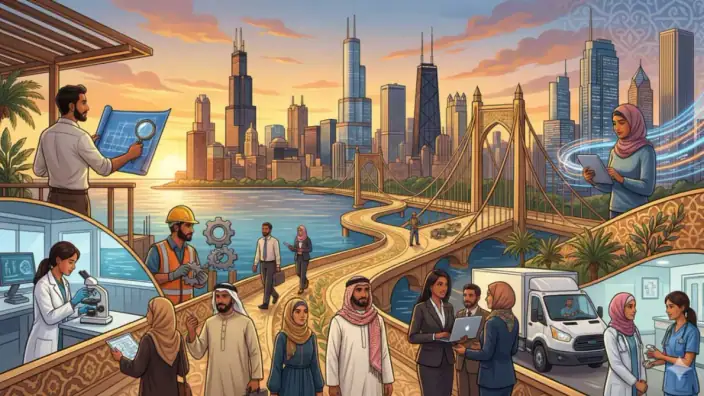
Situated in the absolute heart of the American Midwest, Illinois is a state of striking contrasts; it is where vast, endlessly flat agricultural plains meet one of the most magnificent and important metropolises in the world: Chicago. In 2026, Chicago—the "City of Big Shoulders"—continues to dominate the state's economy, standing as a global titan of finance, commerce, transportation, and technology, and reigning as the third most populous city in the United States.
For the Arab immigrant, Illinois (and specifically the Greater Chicagoland area) represents a destination with a profound and lengthy history. The Arab diaspora here is not composed merely of recent arrivals; it is an integral, foundational piece of the state's commercial and cultural fabric, stretching back decades. In the surrounding suburbs, you will discover fully integrated Arab communities, massive commercial districts that rival those in the Middle East, and some of the largest and most influential Islamic institutions in North America.
However, living in Illinois requires strict financial realism. The state is renowned for its significant tax burdens—particularly regarding exorbitant property taxes—and the notoriously brutal Chicago winter demands physical resilience and adaptability. Yet, for those who can successfully navigate these challenges, Illinois offers limitless professional opportunities, a public transit system far superior to most U.S. cities, and academic institutions that produce the nation's elite minds, making it a formidable launchpad for realizing the "American Dream."
Cost of Living in Illinois: A Powerful Economy and Heavy Taxes
The cost of living in Illinois is entirely dependent on geography. Residing in downtown Chicago or its northern suburbs places you in one of the most expensive regions in the country. Conversely, living in central or southern Illinois (Downstate) is exceptionally affordable. Because the vast majority of immigrants settle in the Greater Chicagoland area, this guide focuses heavily on that region.
1. Housing and Real Estate Costs
The real estate market in Chicagoland is incredibly diverse, ranging from ultra-luxury high-rises overlooking Lake Michigan to spacious, quiet, single-family homes in the sprawling suburbs.
Average Rental and Home Purchase Prices (2026 Estimates):
| City / Suburb | 1-Bedroom Apartment Rent | 2-Bedroom Apartment Rent | Average 3-Bedroom Home Price |
|---|---|---|---|
| Downtown Chicago (The Loop) | $2,200 - $3,000 | $3,000 - $4,500 | $600,000+ (Luxury Condos) |
| Naperville (Western Suburb) | $1,700 - $2,200 | $2,100 - $2,800 | $550,000 |
| Oak Lawn/Bridgeview (SW) | $1,300 - $1,700 | $1,600 - $2,200 | $350,000 |
| Evanston (Northern Suburb) | $1,800 - $2,400 | $2,300 - $3,200 | $650,000+ |
| Peoria (Central Illinois) | $900 - $1,100 | $1,100 - $1,400 | $180,000 |
2. Utilities and Public Services
- Heating (The Absolute Priority): Illinois winters are brutally cold and last for several months (from November through April). Reliance on central heating (predominantly natural gas) is intense. Utility bills for a standard apartment during the peak of winter can easily exceed $200-$300 per month.
- Internet: High-speed broadband and fiber services typically range from $60 to $80 per month.
3. Transportation and Transit (Chicago's Major Advantage)
- Public Transit (CTA and Metra): Chicago possesses one of the most comprehensive and efficient public transit networks in America. The iconic "L" trains cover the city extensively, while the Metra commuter rail system seamlessly connects the distant suburbs to downtown. Many urban residents live entirely car-free, saving thousands of dollars annually.
- Vehicles and Insurance: If you choose to live in the suburbs, a car is mandatory. Be warned: vehicle registration fees and parking costs in downtown Chicago are exorbitant (monthly parking garage spots frequently exceed $300).
4. The Tax System: The Primary Challenge
Taxes are the most significant financial grievance among Illinois residents:
- Property Tax: Illinois levies the second-highest property tax rate in the entire United States (averaging between 2.2% and 2.5% of the property's assessed value). This means purchasing a $400,000 home could saddle you with an annual tax bill approaching $10,000. While these taxes heavily fund excellent public schools, they place a massive, permanent burden on family budgets.
- Individual Income Tax: The state utilizes a flat income tax rate, holding steady at approximately 4.95%.
- Sales Tax: The base state sales tax is 6.25%. However, when combining county and municipal taxes (especially within the city of Chicago), the total sales tax paid at the register can reach up to 10.25%, marking it as one of the highest in the country.
Best Cities and Suburbs for Arabs and Immigrants
The Arab population is heavily concentrated in the Greater Chicagoland area. Residential choices generally fall into three primary suburban zones that cater exceptionally well to families:
1. The Southwest Suburbs - The Arab Capital
Encompassing towns like Bridgeview, Oak Lawn, Orland Park, and Tinley Park.
- Characteristics: Offers a very reasonable cost of living and affordable real estate compared to the northern suburbs, alongside solid public school districts.
- The Community: Bridgeview is affectionately and famously known as "Little Palestine." This region is the historical stronghold and beating heart of the Arab diaspora in Illinois. Entire boulevards are lined with authentic Arab restaurants, massive sweet shops, halal butcheries, and the colossal Mosque Foundation. Moving here guarantees you will never experience a day of cultural homesickness.
2. The Western Suburbs - Affluence and Elite Schools
Encompassing cities like Naperville, Oak Brook, and Downers Grove.
- Characteristics: Naperville is consistently ranked as one of the absolute best cities in America to raise a family. The public school systems here are phenomenal, safety is absolute, and the area serves as a major hub for medical and technological corporate campuses.
- The Community: These suburbs heavily attract Arab professionals, physicians, and engineers. The Islamic presence is highly organized and modern, featuring excellent community centers. However, the cost of housing and property taxes here are significantly higher than in the southwest.
3. The Northern Suburbs - Elite Academia and Lakeside Living
Encompassing cities like Evanston, Skokie, and Morton Grove.
- Characteristics: Situated along the shores of Lake Michigan, these suburbs offer proximity to Northwestern University. The environment is highly cultured, progressive, and exceptionally refined.
- Challenges: Real estate prices are astronomical, and property taxes are staggering. These areas are generally suited for established academics, executives, and those with very high incomes.
4. Downtown Chicago (The Loop / River North)
- Characteristics: Ideal for singles and young professionals. Offers a fast-paced, highly walkable urban lifestyle with immediate access to world-class public transit, corporate banking headquarters, and global tech firms.
- Challenges: Extremely high rent, premium living costs, and varying safety challenges in surrounding neighborhoods requiring constant urban awareness.
Jobs and Salaries: A Diverse and Global Economy in 2026
The economy of Greater Chicago is incredibly diversified; it does not rely on any single industry, making it exceptionally resilient against sector-specific economic downturns.
Prominent Employment Sectors:
- Financial Services and Banking: Chicago is a global financial titan, serving as the home to the Chicago Board Options Exchange (CBOE) and the Chicago Mercantile Exchange (CME). Global investment banks and trading firms generate thousands of high-paying roles in accounting, quantitative data analysis, and corporate finance.
- Logistics and Advanced Manufacturing: Leveraging its central geographic position as the ultimate North American hub for rail freight and aviation (O'Hare International Airport is one of the busiest in the world), the supply chain, transportation, and industrial engineering sectors are in a state of perpetual growth.
- Technology and Innovation: The tech sector in Chicago has exploded (particularly in FinTech and HealthTech). Global behemoths like Google and Salesforce have massively expanded their footprints in the city, drawing heavy engineering talent to the Midwest.
- Healthcare and Medicine: Chicago boasts massive, internationally recognized hospital networks and research institutes (such as University of Chicago Medicine and Northwestern Memorial Hospital), providing unparalleled job stability and elite opportunities for medical professionals.
Average Expected Annual Salaries (2026 Estimates):
- Financial Analyst / Economic Consultant: $85,000 - $140,000
- Software Engineer: $95,000 - $150,000
- Registered Nurse (RN): $75,000 - $110,000
- Industrial Engineer / Logistics Manager: $80,000 - $125,000
- IT Project Manager: $90,000 - $135,000
Education and Mosques: A Historic Legacy and Elite Institutions
Illinois provides formidable public education and hosts universities that rank among the absolute best globally, all supported by a highly institutionalized and organized Islamic community.
1. Universities and Higher Education
- University of Chicago (UChicago): Ranked consistently among the top 10 universities in the world. It is globally famous for its economics, physics, and law programs, having produced dozens of Nobel Laureates.
- Northwestern University: Located in Evanston, it is a highly prestigious private institution excelling in journalism (Medill), medicine, and business (Kellogg).
- University of Illinois at Urbana-Champaign (UIUC): The state's premier public flagship university (located in Central Illinois). Its Engineering and Computer Science programs are universally ranked among the absolute best in the United States.
- University of Illinois at Chicago (UIC): Offers excellent, accessible education in the heart of the city and boasts a massive, highly diverse population of international and Arab students.
2. Public Schools
As in most states, the quality of public schools is directly tied to local property taxes. Schools in affluent suburbs like Naperville (Districts 203 & 204) and Orland Park are exceptional and rival expensive private academies. Conversely, the massive Chicago Public Schools (CPS) system within the city limits faces significant disparities; consequently, many urban families fiercely compete for placement in elite "Selective Enrollment" magnet high schools.
3. Mosques and Islamic Centers
The Islamic infrastructure in Chicagoland is historic and massive:
- The Mosque Foundation (Bridgeview): Founded in the 1980s, this is the anchor of "Little Palestine." The complex is massive and operates two full-time Islamic schools (Aqsa School and Universal School), making it an educational and spiritual powerhouse.
- Islamic Center of Naperville (ICN): Serves the dense professional community in the western suburbs. It is one of the most dynamic centers in the state, offering extensive youth initiatives and educational programs.
- The Mecca Center (Willowbrook): A breathtakingly modern architectural center serving affluent families in the western suburbs.
- American Islamic College (AIC): Located in Chicago, offering fully accredited academic degree programs.
- Halal Food Availability: In regions like Oak Lawn, Bridgeview, and across Chicago proper, finding certified halal meat, authentic Middle Eastern dining, and specialty grocers presents absolutely zero challenge. The Arab community here is entirely and comprehensively self-sustaining.
The First 90-Day Plan: A Guide to Settlement and Surviving "Winter Shock"
Success in Chicago requires strict logistical preparation and the psychological fortitude to handle a fast-paced urban environment and severe weather.
Month 1: Administrative Setup and Transit Mastery
- Obtain a Social Security Number (SSN): Immediately visit the Social Security Administration to secure this foundational number.
- Master Public Transit (The Ventra Card): If you reside in Chicago or near commuter rail lines, purchase a "Ventra" card immediately to utilize the CTA (buses and "L" trains). Mastering the transit system will save you thousands of dollars in vehicle purchasing, maintenance, and parking costs.
- Driver's License (Illinois SOS): If you are settling in the suburbs, the Secretary of State (SOS) office is responsible for issuing driver’s licenses. Booking an appointment well in advance is highly recommended.
- Open a Bank Account: Visit major national banks (like Chase, which has a massive, dominant presence throughout Chicago) to open a checking account.
Month 2: Housing and Preparing for Severe Weather
- Securing a Rental: The Chicago rental market moves aggressively fast. If you lack a U.S. Credit Score, presenting a strong corporate Offer Letter or securing a local Co-signer is vital. In the Arab-heavy suburbs (like Bridgeview), it is incredibly easy to find Arab landlords or real estate agents who understand the immigrant experience and will rent directly based on trust or higher security deposits.
- Prepare for "Winter Shock": The Chicago winter is not a joke. The legendary winds sweeping off Lake Michigan (known locally as "The Hawk") make the cold feel piercingly brutal. Do not bring winter clothes from your home country; they will be useless. You must purchase heavy, extreme-cold weather gear (Down Parkas), thermal gloves, and insulated snow boots from specialized American retailers immediately upon arrival.
- Initiate Credit Building: Apply for a Secured Credit Card to instantly begin forging your U.S. credit history.
Month 3: Healthcare, Integration, and Networking
- Health Insurance: Activate your employer-provided health insurance and select a primary care physician within elite hospital networks like Northwestern Medicine or Rush University Medical Center.
- Community Integration: Dedicate your weekends to exploring the Bridgeview area. Praying, dining, and shopping in "Little Palestine" will quickly integrate you into a powerful local network. Building relationships here is crucial for finding better employment opportunities, identifying Arabic-speaking doctors, and locating trustworthy auto mechanics.
Frequently Asked Questions (FAQ) About Living in Illinois
Q: Is Chicago truly as dangerous and violent as the news portrays? A: Chicago is a massive, sprawling metropolis, and safety is entirely dependent on the specific neighborhood. Downtown (The Loop), the affluent northern neighborhoods, and the western and southwestern suburbs (where Arab families concentrate) are heavily policed, highly secure, and exceptionally safe. Unfortunately, violent crime is statistically concentrated in specific, historically marginalized neighborhoods on the city's South and West sides, which are easily identified and completely avoidable.
Q: Will the high taxes in Illinois prevent me from building wealth? A: Illinois property taxes and sales taxes are undeniably among the highest in the nation, meaning a significant portion of your income will go to the government. However, salaries in the Chicagoland area are commensurately high, and the baseline cost of real estate in the suburbs remains highly affordable compared to coastal cities like New York or Los Angeles. Building wealth is entirely possible, but it requires meticulous budgeting and strategically choosing a county/suburb with slightly lower tax burdens.
Q: Is the Chicago winter truly unbearable? A: The winter is undeniably long (stretching from November through April) and severe, requiring specific behavioral and wardrobe adaptations. However, the city is flawlessly engineered to handle it; snowplows run constantly, public transit remains operational, and buildings are heavily insulated and heated. The reward for enduring the winter is the Chicago summer (June to September), which is widely considered one of the most spectacular, vibrant, and festival-filled urban summers in the entire world, centered beautifully around Lake Michigan.
Q: Can I survive in Chicago without speaking fluent English? A: In the heart of "Little Palestine" (Bridgeview and Oak Lawn), it is entirely possible to go weeks without speaking a word of English. You will find Arab doctors, lawyers, mechanics, and grocery clerks everywhere. However, to integrate into the broader corporate economy, secure high-paying jobs in downtown Chicago, or navigate official government systems, achieving fluency in English is an absolute necessity for upward mobility.
Q: How do I rent an apartment in Illinois without a U.S. Credit Score? A: If you are applying to large, corporate-managed apartment complexes, they will strictly demand proof of high income (via an Offer Letter) or require you to pay two to three months of rent in advance to mitigate their risk. The massive advantage in Illinois is the strength of the Arab diaspora; it is highly common and easy to locate Arab landlords or bilingual real estate brokers who will bypass strict credit requirements based on employment verification or personal guarantees.
In 2026, Illinois remains a state that perfectly blends global economic power with profound community warmth. Despite the undeniable challenges of a severe winter and heavy taxation, the Greater Chicagoland area stands as one of the rare American destinations where an Arab immigrant can build an elite professional career in a world-class city, while simultaneously living within a deeply rooted diaspora that ensures they never feel too far from home.