How to Open a Phone Line in America in 2026? Complete Guide to the Best Carriers and Plans for New Immigrants
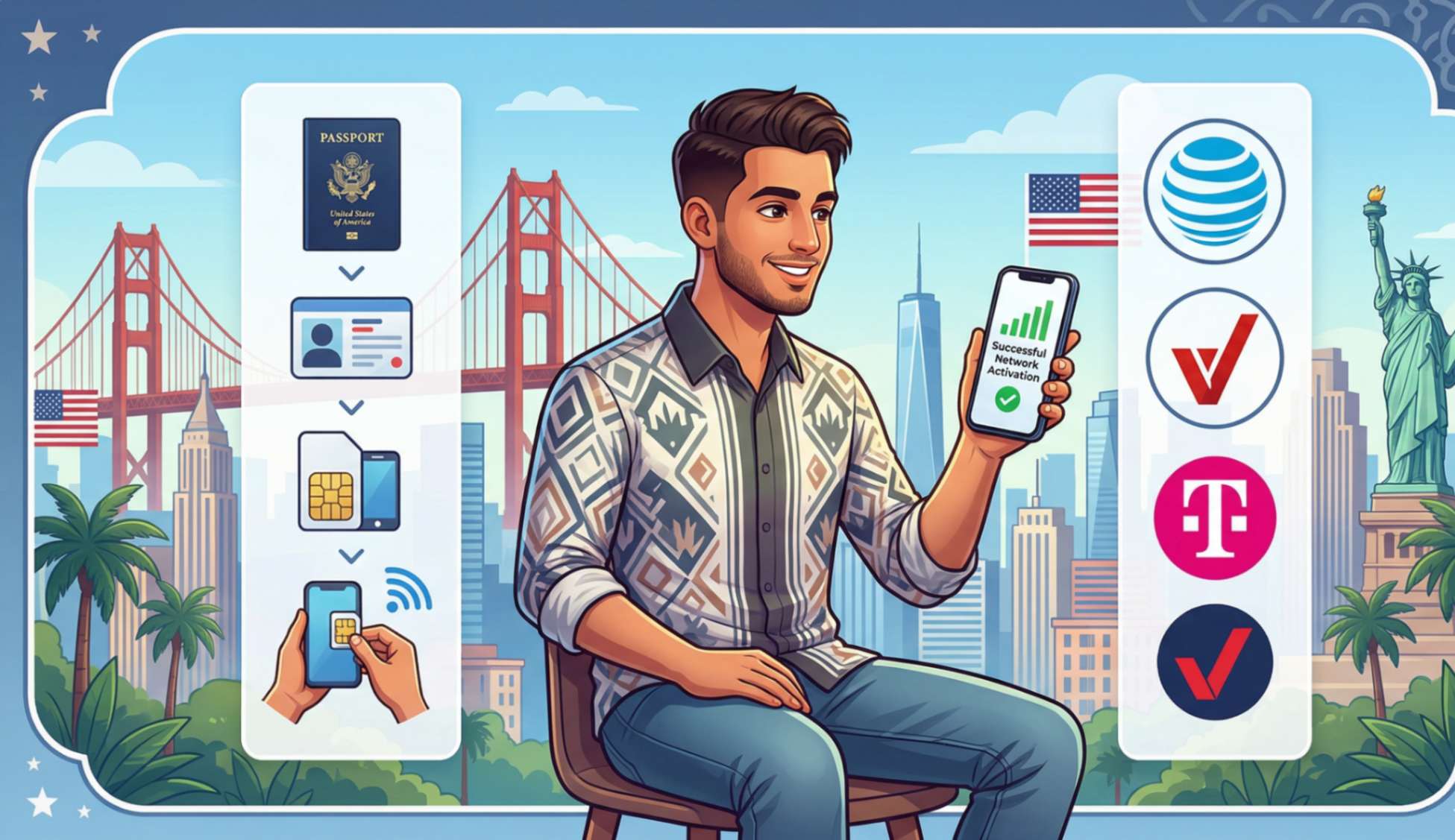
Did You Know That Arriving in America Without a U.S. Phone Number Means Near-Complete Digital Isolation?
The aircraft touches down at John F. Kennedy International Airport or Los Angeles International Airport. The gauntlet of Customs and Border Protection is navigated successfully. The arrival hall is entered, and a smartphone is retrieved with the intention of sending a reassuring message to family back home. Only then does the stark realization dawn: the SIM card from the home country registers no signal, or a warning flashes regarding astronomical International Roaming charges. Suddenly, the individual is acutely aware of being in a vast, new country, utterly bereft of an effective means of communication. A ride-share vehicle cannot be summoned via an application. A bank account cannot be readily opened, as it mandates a U.S. phone number for verification. Applications for employment cannot be submitted, for prospective employers require a local contact number. The individual is digitally marooned in a society that operates on the fundamental assumption of perpetual connectivity.
Within the United States, a mobile phone is not a luxury item or a mere entertainment device. It constitutes an essential instrument of survival, economic participation, and social integration. It serves as the primary gateway to essential banking services, navigation and mapping platforms, on-demand transportation and delivery applications, communication with nascent community networks, and, most critically, the ubiquitous Two-Factor Authentication (2FA) protocols without which access to governmental and financial accounts is rendered virtually impossible. Consequently, establishing a U.S. phone line is far from a trivial errand; it stands as one of the most consequential and time-sensitive logistical decisions to be executed within the initial hours or days following arrival.
Yet, a series of pertinent and entirely justified questions inevitably arise: How does one select an appropriate carrier? What is the substantive distinction between Prepaid and Postpaid service models? Is it feasible to activate a line in the absence of a Social Security Number (SSN) or any established domestic credit history? Which specific service plan aligns most effectively with the constrained budgetary realities of a newly arrived immigrant? These perplexing inquiries are systematically deconstructed and addressed with granular detail within this comprehensive 2026 guide. The practical, sequential steps for establishing a phone line are elucidated. An objective, side-by-side comparison of the most suitable wireless carriers is presented. The fundamental operational and financial differences between the various plan archetypes are clarified. And intelligent, actionable strategies for minimizing expenditure are furnished.
Recognizing that successful settlement in the United States is contingent upon the synergistic integration of multiple essential services, consultation of the following ancillary guides is strongly recommended: How to Get Your SSN in America in 2026?, as this document unlocks access to Postpaid plan options; How to Open a Bank Account in America as a New Immigrant 2026?, given that a U.S. phone number is indispensable for account verification; and How to Find Temporary Housing When Arriving in America 2026, because reliable communication is paramount for coordinating accommodation logistics.
Chapter One: Why a U.S. Phone Number Constitutes an Absolute Imperative, Not a Discretionary Convenience
Before delving into the granular specifics of carrier networks and service plans, the profound and multifaceted importance of possessing a U.S. phone number must be fully apprehended. Its function extends far beyond the mere facilitation of voice calls.
- Verification and Two-Factor Authentication (2FA): This represents the single most critical function. Virtually every essential service within the United States ecosystem mandates a U.S. phone number for the transmission of verification codes via Short Message Service (SMS) or automated voice calls. In the absence of such a number, it becomes operationally infeasible to open a bank account, activate credit or debit cards, access secure online portals maintained by government agencies (e.g., USCIS, Social Security Administration), or even establish accounts on freelance work platforms.
- The Labor Market and Employment Acquisition: When submitting an application for any position, irrespective of its seniority, the contact number furnished on the résumé or curriculum vitae must be a domestic U.S. number. Hiring managers and recruitment professionals will not, as a matter of standard practice, place calls to international numbers. The lack of a local contact number translates directly into the forfeiture of tangible employment opportunities.
- Banking and Financial Services: During the account opening process, the new account is inextricably linked to the customer's mobile phone number. This number is subsequently utilized for the transmission of real-time fraud alerts, the confirmation of high-value transactions, and the execution of password reset procedures. Without a U.S. phone number, the secure and efficient management of one's financial resources becomes unnecessarily complex and perilous.
- Logistics, Navigation, and Mobility: Geolocation and mapping applications (Google Maps, Waze) require a persistent and reliable cellular data connection to function with optimal efficacy. Ridesharing platforms (Uber, Lyft) and food delivery services (DoorDash, Uber Eats) are entirely inoperable without a U.S. phone number linked to the user account. Even the seemingly simple act of renting a vehicle frequently necessitates the provision of a local contact number.
- Social Integration and Familial Communication: Routine interaction with professional colleagues, neighbors, and members of the broader local community is conducted exclusively via U.S. phone numbers. Furthermore, internet-based messaging and calling applications, such as WhatsApp and Telegram, function with demonstrably greater reliability and feature-completeness when associated with a domestic U.S. number.
The Alternative Scenario (Costly and Impractical):
- International Roaming: The continued, exclusive reliance on a SIM card issued in one's country of origin while physically present in the United States represents the most expeditious pathway to catastrophic budgetary depletion. The tariff rates imposed by foreign carriers for international data roaming and voice calls are exorbitant. It is not uncommon for unsuspecting individuals to incur invoices totaling hundreds, or even thousands, of dollars within a distressingly short timeframe.
- Exclusive Reliance on Wi-Fi Networks: This approach renders the individual wholly dependent upon the incidental availability of unsecured public Wi-Fi hotspots in locations such as coffee shops, public libraries, and fast-food establishments. This translates into perpetual and unpredictable disruptions in connectivity, coupled with the complete inability to receive time-sensitive voice calls or text messages while in transit. This solution is fundamentally untenable for anyone actively seeking employment or engaged in professional activities.
Chapter Two: Quantifying Data Requirements: How Much Mobile Data Does a New Immigrant Actually Need?
Before committing to any specific service plan, a realistic and evidence-based projection of anticipated monthly cellular data consumption must be formulated. This exercise serves the dual purpose of preventing unnecessary expenditure on superfluous data allotments and avoiding entrapment by ostensibly "unlimited" plans that surreptitiously throttle data speeds upon exceeding a concealed threshold. In 2026, the average monthly data consumption per capita in the United States comfortably exceeds 20 gigabytes (GB). However, the consumption profile of a newly arrived immigrant may diverge significantly from this national average.
A Taxonomy of Approximate Usage Patterns:
- Very Light User (1-3 GB per month): This profile is characterized by a predominant reliance on stationary Wi-Fi networks located at the place of residence and the workplace. Cellular data is reserved exclusively for low-bandwidth activities: text-based messaging (WhatsApp/Telegram), the retrieval of email, and the perusal of news headlines. This pattern is commonly observed among individuals residing in dense urban corridors replete with publicly accessible Wi-Fi infrastructure.
- Light to Moderate User (3-8 GB per month): This individual leverages Wi-Fi at home but utilizes cellular data while mobile: employing Google Maps for public transit navigation, engaging moderately with social media platforms (Facebook, Instagram), and conducting brief, intermittent video calls.
- Moderate User (10-20 GB per month): This profile involves intensive cellular data utilization outside the confines of the home or office. Activities include daily consumption of short-form or long-form video content on platforms such as YouTube or TikTok, continuous streaming of music via Spotify or Apple Music during vehicular commutes, and persistent reliance on mapping applications for real-time navigation.
- Very Heavy User (30+ GB or "Unlimited"): This category encompasses individuals whose professional responsibilities necessitate perpetual mobility (e.g., rideshare drivers for Uber/Lyft, package delivery personnel). Their occupation requires that data-intensive work applications and navigation tools remain active throughout the entirety of the working day. They routinely stream high-definition (HD) video content and may utilize their smartphone as a mobile Hotspot to provide internet connectivity for other devices, such as a laptop computer. This usage profile unequivocally demands a genuinely "unlimited" data plan.
A Prudent Strategic Recommendation: The most judicious course of action for a newly arrived immigrant is to commence with a low-cost, moderate-data Prepaid plan (e.g., 5-10 GB). Contemporary smartphones (both iOS and Android) are equipped with native, built-in utilities that meticulously track and report monthly data consumption. Following a period of one to two months of direct empirical observation of actual usage patterns, the account can be seamlessly upgraded to a larger data tier or transitioned to an unlimited plan, should the demonstrable need materialize.
Chapter Three: The Complete Anatomy of the Prepaid Versus Postpaid Dichotomy
This binary choice constitutes the single most pivotal decision confronting any new immigrant navigating the U.S. wireless market. A nuanced comprehension of the operational and financial distinctions between these two service models is the key to selecting an appropriate plan and circumventing the perils of unmanageable debt.
📱 The Prepaid Service Model
- Mechanism of Operation: The cost of the selected service plan is remitted entirely in advance, prior to the commencement of the monthly billing cycle. Upon the depletion of the prepaid balance or the expiration of the service period, all services are automatically suspended until an additional payment is successfully processed. There are no subsequent invoices, and no enduring contractual obligations are created.
- Eligibility Prerequisites: Does NOT require a Social Security Number (SSN) in the overwhelming majority of instances. Does NOT necessitate a credit check. Account establishment can be effectuated using only a valid foreign passport at participating retail locations or directly via the carrier's mobile application.
- Cost Structure: Demonstrably and significantly more affordable. The advertised price is typically inclusive of all applicable taxes and regulatory surcharges. There are no hidden "Activation Fees" or opaque "Administrative Charges" buried in the fine print.
- Advantages: Absolute and granular control over the monthly telecommunications budget. Complete immunity from the phenomenon known as "Bill Shock." Unfettered ability to cancel service or migrate to a competing carrier at any juncture, without incurring punitive Early Termination Fees (ETFs).
- Disadvantages: Data traffic may be subject to a lower priority (Deprioritization) relative to that of Postpaid subscribers during periods of peak network congestion. This can manifest as temporary, situational reductions in data throughput speeds. Promotional offers involving subsidized financing for new flagship smartphones are not available.
- Optimal Suitability: Virtually every newly arrived immigrant during the initial 6-12 month settlement period. International students. Any individual lacking an SSN or established credit history. Any consumer prioritizing stringent, predictable control over recurring monthly expenditures.
📑 The Postpaid Service Model
- Mechanism of Operation: Wireless services are consumed first, and a detailed, itemized invoice is generated and delivered at the conclusion of the billing cycle for subsequent payment. This model operates on a contractual basis (often month-to-month but subject to a credit check).
- Eligibility Prerequisites: Typically requires a valid Social Security Number (SSN). Mandates a formal Credit Check. Applicants with a weak or entirely absent credit profile may be compelled to remit a substantial refundable Security Deposit, which can amount to several hundred dollars (up to $500 per line).
- Cost Structure: Base plan rates are inherently higher than comparable Prepaid offerings. A complex mosaic of federal, state, and local taxes and regulatory fees is appended to the monthly invoice (often adding 15-20% to the base plan cost). A non-negotiable "Activation Fee" (typically $30-$40 per line) is commonly assessed upon account initiation.
- Advantages: Data traffic is assigned a higher network priority, translating into superior and more consistent data speeds, particularly within congested urban environments. Eligibility for attractive, low-interest or zero-interest financing plans for the latest smartphone models. Access to generous promotional offers (e.g., "Buy One iPhone, Get One Free"). Inclusion of ancillary perks, such as complimentary subscriptions to popular streaming entertainment services (Netflix, Apple TV+, Hulu, Disney+).
- Disadvantages: Significantly greater financial commitment and exposure. The final monthly invoice amount is inherently variable and difficult to forecast with absolute precision. Steep penalties may apply for early service termination or the porting of a number to a different carrier. Vulnerability to "Bill Shock" in the event of exceeding plan limitations on data usage or inadvertently placing international calls.
- Optimal Suitability: Individuals who have achieved a degree of financial stability and successfully established a positive credit history (typically after 12-24 months of residency). Larger family units with four or more lines that can effectively leverage multi-line family plan discounts. Consumers who prioritize acquiring the absolute latest smartphone models and prefer the convenience of interest-free installment payment plans.
Chapter Four: A Cartography of the U.S. Wireless Carrier Landscape: The Major Players and the Value-Oriented Alternatives
The U.S. wireless telecommunications market is characterized by a distinct two-tiered structure: a small oligopoly of national Mobile Network Operators (MNOs) that own and operate the underlying physical network infrastructure, and a vast ecosystem of Mobile Virtual Network Operators (MVNOs) that lease wholesale network capacity from the MNOs and resell it to consumers at significantly reduced price points.
🏢 The Major Network Operators (MNOs)
1. Verizon:
- The Network: Consistently ranked by independent third-party evaluators as the premier network in the United States in terms of geographic coverage and overall reliability, particularly within rural, exurban, and remote interstate highway corridors.
- The Plans: Positioned at the apex of the market pricing hierarchy; unequivocally the most expensive option.
- Optimal Suitability: Individuals whose primary residence or frequent travel patterns place them in rural or topographically challenging areas where the coverage footprints of competing networks are known to be deficient. Consumers for whom unwavering network reliability constitutes a non-negotiable absolute priority, and who are willing to remit a substantial premium to secure it.
2. T-Mobile:
- The Network: Commands a leading position in the deployment of fifth-generation (5G) wireless technology, boasting the most extensive and fastest 5G coverage footprint within major metropolitan areas and their surrounding suburban rings. Has made substantial capital investments in rural coverage expansion following its corporate merger with Sprint.
- The Plans: Delivers arguably the most compelling value proposition, striking an optimal equilibrium between price and features. Its premium-tier service plans are distinguished by the inclusion of all taxes and regulatory fees within the advertised base price.
- Optimal Suitability: The vast majority of newly arrived immigrants whose settlement patterns are concentrated in cities and suburbs. The company also operates a highly regarded and competitively priced Prepaid brand, Metro by T-Mobile.
3. AT&T:
- The Network: A robust and exceptionally reliable nationwide network, representing a formidable and credible alternative to Verizon in terms of comprehensive coverage, with particular strength in the Southern and Midwestern regions of the country.
- The Plans: Pricing structures are broadly comparable to those of Verizon, albeit often accompanied by targeted discounts for employees of specific large corporations, as well as for healthcare professionals, military personnel, and first responders.
- Optimal Suitability: Consumers seeking a dependable and well-regarded alternative to Verizon at a marginally lower total cost of ownership. The company operates a highly successful value-oriented Prepaid brand, Cricket Wireless.
💸 The Value-Oriented Alternatives (MVNOs)
These entities do not possess their own physical tower infrastructure. Instead, they purchase wholesale access to the networks of the major MNOs and resell that capacity to consumers at a substantial discount. They represent the unequivocally optimal pathway for the budget-conscious new immigrant.
- Mint Mobile: Leases network capacity exclusively from T-Mobile. The absolute lowest-cost Prepaid option for subscribers willing to prepay for multiple months of service. Its pricing model is predicated on offering deeply discounted rates (commencing as low as $15 per month) in exchange for a commitment to prepay for service blocks of 3, 6, or 12 months. This represents an exceptional value proposition for individuals possessing the requisite lump-sum cash reserves.
- Visible: A wholly owned subsidiary of Verizon and utilizes its parent company's network on an exclusive basis. It offers a remarkably streamlined product portfolio consisting of only two plans: a base unlimited plan ($25/month) and a premium unlimited plan ($45/month) featuring enhanced data prioritization. Crucially, all advertised prices are inclusive of all applicable taxes and fees. This is an outstanding option for individuals requiring a genuinely unlimited data connection at a fixed, predictable, and low cost.
- Cricket Wireless: A wholly owned subsidiary of AT&T and operates on its parent company's network. Maintains a substantial network of physical retail storefronts, thereby facilitating in-person customer service and support interactions. Its multi-line family plans (e.g., four lines of unlimited data for $100 per month) are among the most competitively priced in the industry.
- Metro by T-Mobile: A wholly owned subsidiary of T-Mobile. Offers attractively priced unlimited data plans and frequently runs aggressive promotional campaigns featuring heavily discounted or even complimentary smartphones for new subscribers who port an existing number from a competing carrier.
- Tello / US Mobile: These carriers are distinguished by their provision of an unparalleled degree of flexibility in plan customization. Subscribers can precisely select the precise number of voice minutes and the exact quantum of high-speed data they require, paying only for those specific allotments. This model is ideally suited for very light data users or for individuals seeking a low-cost secondary line.
Chapter Five: A Comprehensive Comparative Matrix of Optimal Options for Immigrants (2026)
| Carrier | Underlying Network | Optimal Plan Type | Approx. Monthly Cost (Single Line) | Requires SSN? | Key Value Proposition for the New Immigrant |
|---|---|---|---|---|---|
| Mint Mobile | T-Mobile | Prepaid | $15 - $30 | No | Absolute lowest cost via multi-month prepayment |
| Visible | Verizon | Prepaid | $25 - $45 | No | Truly unlimited data at a fixed, low cost |
| Metro by T-Mobile | T-Mobile | Prepaid | $25 - $60 | No | Free or heavily subsidized phone offers for switchers |
| Cricket Wireless | AT&T | Prepaid | $25 - $60 | No | Excellent multi-line family plan value + physical stores |
| Tello / US Mobile | T-Mobile / Verizon | Prepaid | $5 - $30 | No | Highly flexible, customizable plans for light usage |
| T-Mobile | T-Mobile | Postpaid | $50 - $85 | Usually Yes | Taxes and fees included + free streaming perks |
| Verizon | Verizon | Postpaid | $70 - $100 | Usually Yes | Best-in-class coverage in rural and remote areas |
| AT&T | AT&T | Postpaid | $65 - $95 | Usually Yes | High reliability and professional discount eligibility |
Chapter Six: A Step-by-Step Procedural Guide to Activating a Phone Line in the Absence of an SSN or Credit History
The overwhelming majority of newly arrived immigrants possess neither an SSN nor any semblance of a U.S. credit history. This circumstance, however, presents absolutely no impediment whatsoever to obtaining high-quality, affordable wireless service. The prescribed and unobstructed pathway is the selection of a Prepaid service plan. The following steps delineate the practical execution:
- Identify the Target Carrier: Select a Prepaid carrier from the comparative matrix presented in Chapter Five, basing the decision upon an objective assessment of budget and projected data requirements. (e.g., Mint Mobile for maximum economy, Visible for guaranteed unlimited data).
- Choose the Acquisition and Activation Channel:
- Physical Channel (In-Person): Visit a retail location operated by the chosen carrier (e.g., a Metro or Cricket store) or a major big-box electronics retailer (e.g., Target, Walmart, Best Buy). Purchase an "Activation Kit," which typically contains a physical SIM card and an associated unique identifier.
- Digital Channel (Application-Based): Download the official mobile application of the chosen carrier (Mint Mobile, Visible, Tello). If the subscriber's smartphone is equipped with eSIM technology, the entire enrollment and activation process can be consummated entirely within the application environment in a matter of minutes, obviating the need for a physical SIM card altogether.
- Furnish Identification Documentation: During the activation workflow, the system will prompt the user to provide proof of identity. A current, unexpired foreign passport is universally accepted in approximately 99% of all Prepaid activation scenarios. The user may also be prompted to supply a U.S. mailing address (required for shipping a physical SIM card, if ordered, and for account record-keeping purposes).
- Select the Desired Plan and Remit Payment: Choose the specific service plan that aligns with the assessed needs. Input the requisite payment details, which may include a U.S.-issued debit card or an internationally enabled credit card. It should be noted that certain non-U.S. financial institutions may decline online transactions with U.S. carriers; therefore, utilizing a U.S.-based payment instrument is preferable if available.
- Complete Activation and Commence Usage: Upon the successful processing of the initial payment, service activation is typically instantaneous. If the device supports eSIM, the digital profile will be automatically downloaded and installed. If a physical SIM card is utilized, it must be inserted into the device's SIM tray and the device must be power-cycled.
Chapter Seven: Strategic Plan Selection Aligned with Specific Lifestyle Archetypes
No single service plan can be universally proclaimed as "optimal" for all users. The most judicious selection is one that is precisely tailored to the individual's unique, day-to-day usage paradigm.
- The Very Light User (Predominantly Wi-Fi-Dependent): The ideal solution lies in the customizable plans offered by Tello or US Mobile. A bespoke plan consisting of 1-2 GB of data and a minimal allocation of 100 voice minutes can be constructed for a monthly expenditure that may not exceed $5-$10.
- The Moderate User (Maps + Social Media): The Mint Mobile plan with a 5-15 GB data allocation delivers the most compelling value proposition. The effective monthly cost, when utilizing the multi-month prepayment option, is remarkably reasonable. A viable alternative is a plan from Metro by T-Mobile offering a fixed quantum of high-speed data followed by unlimited throttled data.
- The Heavy User (Genuinely Unlimited Data): The Visible base unlimited plan stands alone as the most cost-effective solution in this category. It delivers truly unlimited data on the premium Verizon network at a fixed, transparent, and predictable monthly price point, inclusive of all taxes and fees.
- Family Units (3 or More Lines): Cricket Wireless or Metro by T-Mobile consistently offer the most advantageous economics for family groups. Multi-line unlimited data plans for four lines frequently fall within the total cost range of $100-$120 per month, translating to an effective per-line cost of just $25-$30.
- Frequent Travelers or Individuals Requiring Dual SIM Functionality: The activation of a low-cost Prepaid eSIM for domestic U.S. data usage, while simultaneously retaining the physical SIM card from the home country for voice calls and SMS reception, represents a highly sophisticated and cost-avoidance strategy. This approach can yield savings of hundreds of dollars relative to incurring international roaming charges.
Chapter Eight: Professional-Grade Strategies for Minimizing Wireless Expenditure
- Initiate Service Invariably with a Prepaid Plan: There exists no logically defensible rationale for a newly arrived immigrant to enter into a binding Postpaid service contract before first establishing a domestic credit history and accurately assessing their real-world wireless usage requirements.
- Leverage Multi-Month Prepayment Discounts: Carriers such as Mint Mobile offer substantial financial incentives (discounts approaching 50%) for subscribers who are willing and able to prepay for extended service terms (e.g., 12 months). If the necessary liquid capital is available, this strategy can yield annual savings measured in hundreds of dollars.
- Capitalize on Multi-Line Family Plan Economies of Scale: Even in the absence of a traditional familial relationship, roommates, colleagues, and trusted friends can collectively establish a shared family plan account. The per-line cost is inversely correlated with the total number of lines on the account; adding more lines drives the individual unit cost downward.
- Enroll in Autopay to Secure Recurring Discounts: The vast majority of wireless carriers offer a modest but consistent monthly discount (typically $5-$10 per line) as an incentive for subscribers who enroll in automatic payment programs linked to a valid debit card or bank account.
- Utilize Over-the-Top (OTT) Applications for International Voice Calls: The U.S. wireless number should never be used to place direct-dial international calls to foreign destinations. Applications such as WhatsApp, Telegram, FaceTime Audio, and Google Voice provide high-definition voice and video calling capabilities at zero marginal cost, utilizing only the device's internet connection.
- Conduct Periodic Audits of Usage and Billing Statements: After an initial period of approximately three months, a deliberate review of actual data consumption figures should be undertaken. It is entirely possible that the subscriber is remitting payment for an unlimited data tier that is not being fully utilized. Significant savings can often be realized by simply downgrading to a more appropriately sized data plan.
Chapter Nine: Will Your Existing Handset Function Properly in the United States? (A Compatibility Primer)
Bringing a personally owned smartphone from one's country of origin for use within the United States is a viable proposition, albeit one subject to specific, non-negotiable conditions.
- The Handset Must Be "Unlocked": If the device is carrier-locked to a specific wireless network in the country of purchase, it will categorically refuse to operate with a U.S.-issued SIM card or eSIM profile. The original carrier from whom the device was acquired must be contacted to formally request a permanent unlock. This service is often provided free of charge upon the satisfactory completion of any associated contractual term.
- Compatibility with U.S. Radio Frequency Bands (Bands):
- Global System for Mobile Communications (GSM) networks, which form the basis of T-Mobile and AT&T service, are widely deployed internationally, and most modern handsets offer broad GSM band support.
- The principal area of concern lies in the specific LTE and 5G frequency bands deployed by U.S. carriers. Certain handset models manufactured explicitly for Asian or African markets may lack critical support for the primary frequency bands utilized in North America. This deficiency can manifest as severely degraded network coverage or frequent, unexplained service interruptions.
- How to Verify Compatibility: Reputable online resources, such as Kimovil.com or FrequencyCheck.com, can be utilized. By inputting the precise, exact model number of the handset in question, these tools will generate a detailed compatibility assessment, indicating the percentage of U.S. network bands supported by that specific device variant.
- A Pragmatic Counsel: If the existing handset is of advanced age (exceeding 3-4 years) or originates from a lesser-known, non-mainstream manufacturer, it may be prudent to proactively budget for the acquisition of a new or certified pre-owned device directly from within the United States. This ensures complete and verifiable network compatibility and optimizes the overall user experience.
Chapter Ten: eSIM Versus Physical SIM: Which Modality Better Serves the New Immigrant?
Embedded SIM (eSIM) technology has rapidly transitioned from a niche innovation to a mainstream standard feature on the majority of contemporary mid-range and premium smartphones. Its adoption confers distinct and strategically valuable advantages for the newly arrived immigrant.
- Instantaneous, Frictionless Activation: A Prepaid service plan from carriers such as Mint Mobile, Visible, or Tello can be researched, purchased, and fully activated entirely within the carrier's mobile application environment in a matter of mere minutes—potentially even before the user has physically exited the airport terminal. The logistical burden of locating a retail storefront to procure a physical SIM card is entirely eliminated.
❓ People Also Ask
Q: Can a U.S. phone line be opened without a Social Security Number (SSN)? A: Yes, with considerable ease. All Prepaid wireless carriers—including Mint Mobile, Visible, Cricket, Metro, and Tello—do not require an SSN. A valid foreign passport is generally accepted as the sole form of identification.
Q: What is the absolute cheapest unlimited data phone plan available in the U.S. in 2026? A: The base unlimited plan offered by Visible ($25 per month) represents the lowest-cost option for a truly unlimited data connection on a premium-tier network (Verizon).
Q: What is the functional difference between Prepaid and Postpaid service? A: Prepaid requires payment in advance of usage, does not necessitate an SSN or credit check, and is more economical. Postpaid involves remitting payment after usage (a monthly bill), typically requires an SSN and a credit check, and offers ancillary benefits such as device financing.
Q: Can a foreign smartphone be used on U.S. wireless networks? A: Yes, provided two conditions are met: 1) The device must be Unlocked. 2) The device must be compatible with the requisite U.S. LTE and 5G frequency bands. Compatibility can be verified via online tools such as Kimovil.com.
Q: Which carrier offers the most reliable coverage in rural areas of the United States? A: Verizon consistently ranks at the top of independent industry assessments for the breadth and reliability of its coverage footprint in rural and sparsely populated regions.
Q: Which wireless carrier is most suitable for international students? A: Mint Mobile or Visible. Both offer flexible, contract-free Prepaid plans with compelling economics, which aligns optimally with the budgetary constraints typical of the student demographic.
Q: What is eSIM technology, and is it advantageous for new immigrants? A: eSIM is a non-removable, embedded digital SIM. Yes, it is highly advantageous for new immigrants, as it permits near-instantaneous plan activation directly via a mobile application, obviating the need to locate a physical retail store or await the postal delivery of a physical SIM card.
Q: How can expenditure on a monthly wireless bill be effectively minimized? A: Commence service with a Prepaid plan. Capitalize on multi-month prepayment discounts. Form or join a multi-line family plan. Enroll in recurring Autopay discounts. Utilize Wi-Fi networks opportunistically.
Q: Can an existing phone number be retained when switching to a new wireless carrier? A: Yes, this process is formally termed "Number Porting." The account with the previous carrier must remain active and in good standing. The new carrier will request the account number and a dedicated Number Transfer PIN from the old carrier to initiate the porting process.
Q: What is meant by "Deprioritization" of mobile data? A: Deprioritization is a network management technique employed by carriers during periods of extreme network congestion. It involves temporarily reducing the data throughput speeds of certain subscriber classes (typically Prepaid and MVNO customers) to preserve network capacity for higher-priority Postpaid subscribers. The impact is generally noticeable only in exceptionally crowded venues, such as sports stadiums or major concert events.
Q: Is a long-term service contract necessary to obtain a favorable wireless plan? A: Absolutely not. The most advantageous and cost-effective wireless plans available in the U.S. market in 2026 are overwhelmingly of the Prepaid variety, which explicitly do not require any form of long-term contractual commitment.
Q: How much mobile data is realistically required on a monthly basis? A: This is contingent upon individual usage patterns. If Wi-Fi is readily available at home and work, 2-5 GB is likely sufficient. Frequent use of maps and social media while mobile typically necessitates 10-20 GB. Daily video streaming or hotspot usage requires an unlimited plan.
Q: Where can a U.S. SIM card be procured immediately upon arrival at the airport? A: At retail concessions located within the airport (e.g., Hudson News) or at nearby big-box electronics stores (Best Buy, Target, Walmart). However, the most expedient and economical method is often the over-the-air activation of an eSIM profile via a carrier's mobile application.
Q: Are there any government-sponsored programs that provide free or subsidized phone service to eligible immigrants? A: Yes, the federal Lifeline program and the Affordable Connectivity Program (ACP) offer monthly discounts on phone or internet service for qualifying low-income households. Certain categories of refugees and asylees may be eligible for these benefits.
Q: Which carrier is best for making international calls to the Arab world? A: Direct-dial international calls from a U.S. wireless number are generally cost-prohibitive. The recommended approach is to utilize OTT applications such as WhatsApp, Telegram, or Google Voice for free or low-cost international calling. Some specialized Prepaid carriers, like Ultra Mobile, offer plans that include bundled international calling credits.
❓ Frequently Asked Questions About Opening a Phone Line for Immigrants (FAQ)
Q: Is it genuinely possible to open a U.S. phone line without a Social Security Number (SSN) or any credit history?
A: Affirmative. This is the standard and intended pathway for newly arrived immigrants. All Prepaid wireless carriers—including Mint Mobile, Visible, Cricket, Metro, and Tello—neither require an SSN nor perform a credit check. Account establishment is routinely accomplished using only a valid foreign passport.
Q: What is the least expensive mobile phone plan currently available in the U.S. market for 2026?
A: Mint Mobile offers the lowest effective monthly cost for subscribers who opt for the 12-month prepayment plan (commencing at $15 per month). Tello provides highly customizable, low-cost plans starting at approximately $5-$6 per month for very light usage. Visible delivers the most affordable genuine unlimited data plan at $25 per month.
Q: What is the fundamental operational distinction between Prepaid and Postpaid wireless service?
A: Prepaid: Payment is rendered before service consumption. No contracts, no SSN requirement, no credit check, and demonstrably lower costs. Postpaid: Payment is rendered after service consumption (a monthly bill). An SSN and a credit check are typically required. Costs are higher, but the model offers ancillary benefits such as device financing and higher network priority.
Q: Can a personally owned smartphone brought from my home country be used in the United States?
A: Yes, contingent upon the satisfaction of two essential prerequisites: 1) The device must be carrier-unlocked (Unlocked). 2) The device's internal modem must be compatible with the specific LTE and 5G radio frequency bands (Bands) deployed by U.S. carriers. Online resources such as Kimovil.com can be employed to verify this compatibility.
Q: Which wireless carrier is regarded as having the most extensive and reliable network coverage?
A: Verizon is consistently recognized by industry analysts for its superior geographic coverage and reliability, particularly within rural, exurban, and remote areas. T-Mobile is widely acknowledged as the leader in the deployment and speed of 5G technology within metropolitan and suburban areas. AT&T provides a robust and reliable network that represents a strong alternative to Verizon.
Q: Which carrier is most strongly recommended for international students or newly arrived immigrants?
A: Mint Mobile and Visible are the two carriers most frequently and enthusiastically recommended for this demographic. Both operate on the Prepaid model, offer contract-free flexibility, and feature highly competitive and transparent pricing structures. Mint is optimal for those with access to upfront capital for multi-month prepayment. Visible is optimal for those requiring unlimited data at a fixed, predictable monthly cost.
Q: What precisely is eSIM technology, and does it offer tangible advantages over a traditional physical SIM card?
A: eSIM is an embedded, non-removable digital SIM. Yes, it offers demonstrable and significant advantages for the new immigrant. It enables the purchase and complete over-the-air activation of a U.S. wireless plan within minutes, directly via the carrier's mobile application. This eliminates the need to locate a physical retail store or await the postal delivery of a plastic SIM card.
Q: How can an existing phone number be retained when transitioning from one wireless carrier to another?
A: This procedure is formally designated as "Number Porting." The account with the previous carrier must not be terminated or canceled. The new carrier will require the provision of two specific pieces of information from the old carrier: the Account Number and a dedicated Number Transfer PIN. Upon providing these credentials to the new carrier, the number transfer process is initiated and typically concludes within a few hours to a few business days.
Q: How can the risk of "Bill Shock" or unforeseen, excessive charges be effectively mitigated?
A: 1) Commence wireless service with a Prepaid plan; this model provides an inherent firewall against unexpected charges. 2) If utilizing a Postpaid plan, exercise vigilance to ensure that the chosen data allotment is sufficient for actual usage patterns, or select a genuinely unlimited plan. 3) Never place direct-dial international voice calls from the U.S. wireless number; rely exclusively on internet-based OTT applications for international communication.
Q: What is the phenomenon of "Deprioritization" as it pertains to mobile data service?
A: Deprioritization is a temporary, network-side traffic management policy. During periods of intense network congestion, the carrier's systems may assign a lower priority to the data packets of certain subscriber classes (such as Prepaid and MVNO customers) in order to preserve a higher Quality of Service for premium Postpaid subscribers. The practical effect is a transient, situational reduction in data throughput speed, and it is typically only perceptible in locations of extreme population density.
Chapter Eleven: Verifiable, Real-World Success Narratives from the Immigrant Community
Narrative 1: Over-the-Air eSIM Activation from the Airport Terminal (Rami from Egypt) "Rami" arrived at Dallas/Fort Worth International Airport. Prior to his departure from Egypt, he had proactively downloaded the Visible mobile application to his iPhone. While standing at the baggage carousel awaiting his luggage, he launched the application, selected the $25 unlimited data plan, and provided images of his Egyptian passport and his internationally enabled credit card. Within a span of five minutes, his Visible eSIM profile was downloaded, installed, and fully active. He exited the terminal, requested an Uber via the application, and proceeded directly to his hotel without experiencing any logistical friction. Rami observed: "It was the simplest and fastest administrative transaction of my entire life. I never had to set foot inside a physical store."
Narrative 2: Maximizing Savings Through Strategic Multi-Month Prepayment (Fatima from Morocco) "Fatima," a Master's degree candidate in Chicago, Illinois, was actively seeking the most economical possible wireless service plan. A colleague recommended Mint Mobile. Although Fatima did not yet possess an SSN, she successfully established an account using only her Moroccan passport. She elected the 12-month prepayment option, remitting a lump sum of $180 (equivalent to $15 per month). Fatima recounted: "I was initially somewhat hesitant about the prospect of prepaying for an entire year of service. However, I have calculated that I saved well over $200 compared to even the cheapest competing monthly plan. The network performance in Chicago has been excellent."
Narrative 3: The Perilous and Costly Trap of International Roaming (Khaled from Jordan) "Khaled" arrived in New York City and opted to retain his Jordanian SIM card in his phone, erroneously believing that his modest roaming package would suffice. He utilized Google Maps extensively on a daily basis to navigate the city while viewing apartments, and he engaged in casual web browsing. Two weeks later, he received a frantic electronic notification from his bank in Jordan, alerting him that his mobile phone bill had reached a staggering total of $1,200 USD. Khaled lamented: "It was the financial shock of my life. I had absolutely no conception that international roaming charges could be so punitive and rapacious. Had I known, I would have purchased a local U.S. SIM card at the airport immediately upon arrival."
Conclusion
In summation, the act of establishing a U.S. phone line is emphatically not a mundane, bureaucratic formality. It is a foundational, strategic maneuver that enables both digital and practical integration into the fabric of American society. It is the indispensable key that unlocks the doors to seamless communication, essential identity verification, gainful employment, and access to the formal financial system.
Fortuitously, the U.S. wireless telecommunications market in 2026 is characterized by a robust ecosystem of flexible and diverse service options capable of accommodating virtually any budget, particularly those of newly arrived immigrants. There exists absolutely no justification for succumbing to the allure of binding, long-term service contracts or becoming ensnared in the trap of exorbitant monthly invoices. The demonstrably prudent and secure path forward is to initiate service with a Prepaid plan from a reputable, value-oriented carrier, to observe and measure actual consumption patterns empirically, and only then to consider upgrading or modifying the service tier as warranted.
The process of selecting an appropriate phone plan may initially appear bewildering and opaque. Yet, at its core, the decision tree is elegantly simple: accurately assess one's genuine needs, select a Prepaid carrier from the curated list, and complete the activation process within minutes. By executing this single, decisive action, the barrier of digital isolation is decisively breached, and the individual is empowered to embark upon their journey of settlement in the United States with confidence and clarity.
An Invitation for Community Discourse and Shared Experience: What has been your personal experience in establishing your first U.S. phone line? Which specific carrier did you ultimately select? Did you encounter any unforeseen difficulties related to network coverage or billing discrepancies? Contributions of personal narratives and practical advice are warmly welcomed in the comments section appended below. Your individual experience may well serve as the illuminating guidepost for a newly arrived immigrant who is reading these very words at this precise moment.
For further authoritative information pertaining to consumer rights and protections within the telecommunications sector, the official website of the Federal Communications Commission (FCC) may be consulted: www.fcc.gov.

Author: حسين عبد الله
Hussein Abdullah is a web developer and specialized content writer with more than eight years of experience enriching Arabic digital content. He combines an analytical programming mindset with a deep passion for writing to deliver accurate, reference-quality guides. On Arabian in USA (عرب في أمريكا), he focuses on simplifying complex steps for new immigrants and sharing reliable information on housing, work, and financial setup—so every newcomer has a trustworthy path toward stable life in the United States.


Continue reading
- How to Rent an Apartment Without a Credit Score in Texas? Comprehensive Guide for Immigrants 2026
- How to Rent an Apartment Without a Credit Score in California? Comprehensive Guide for Immigrants 2026
- How to Build Credit Score in America from Zero in 2026: Complete Guide for New Immigrants
- Muslim Population in America 2026: Complete State-by-State Guide, Statistics & Interactive Map
- How to Rent an Apartment Without a Credit Score in the USA? Complete Guide for New Immigrants 2026
- How to Get Health Insurance in America 2026? A Complete Guide to Types, Differences, and Enrollment