What to Do If You Face Fraud or Racism in America 2026: The Complete Immigrant's Guide to Rights, Reporting, and Recovery
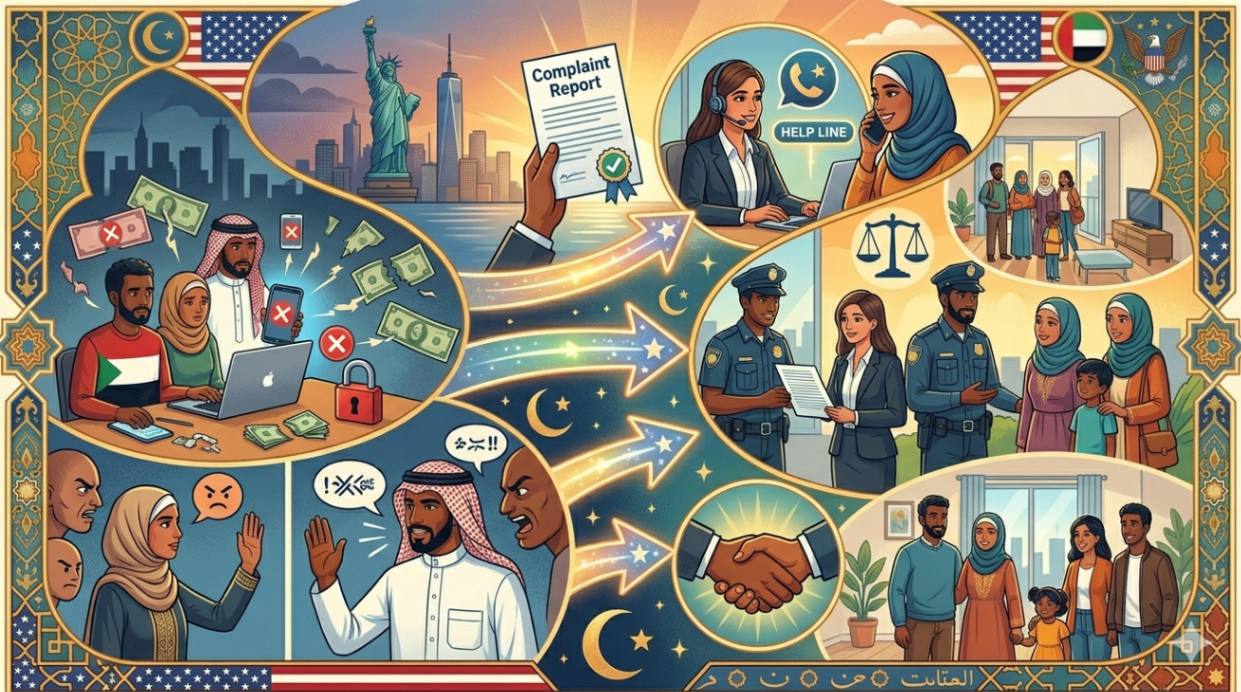
🔍 What You'll Get in This Article (Your Rights Protection Roadmap)
If you are an Arab or Muslim immigrant in the United States and you have experienced a financial scam or a racist incident—and you feel confused, violated, and unsure of your next steps—this guide is your complete survival manual. By the time you finish reading, you will know exactly:
- ✅ The immediate, correct actions to take in the critical first minutes and hours after an incident to protect your safety and preserve your evidence.
- ✅ How to document any incident of racism or fraud professionally and legally, creating a case file that is strong, credible, and difficult to dismiss.
- ✅ The precise legal distinctions between discrimination, harassment, hate speech, and hate crimes—and when an offensive act crosses the line into a prosecutable offense.
- ✅ The specific government agencies with jurisdiction over each type of violation (EEOC for employment, HUD for housing, FTC for fraud, FBI for hate crimes) and exactly how to file a formal complaint with them.
- ✅ Your full legal rights under federal and state civil rights laws, even if you are an undocumented immigrant.
- ✅ Sources of free or low-cost legal support for Arab and Muslim immigrants, including vital organizations like CAIR, ACLU, and Legal Aid societies.
- ✅ How to protect yourself from financial fraud, attempt to recover lost funds, and safeguard your identity with a credit freeze.
- ✅ Free, confidential mental health resources to help you process the trauma and emotional distress caused by these experiences.
- ✅ Real, inspiring stories from Arab immigrants who faced these exact situations and successfully navigated the system to protect their rights.
Let's ensure you are never left feeling powerless again.
🛡️ Introduction: When the "American Dream" Encounters a Nightmare
You came to the United States with hope as your carry-on luggage. You arrived on these shores driven by the promise of opportunity, the pursuit of safety, and the desire to build a stable, dignified life for yourself and your family. You began the hard, incremental work of starting over: navigating the bureaucracy for your documents, opening your first bank account, finding a place to live, and perhaps landing your first job. Then, without warning, the ground shifts beneath your feet. You find yourself the target of an elaborate financial scam that drains the savings you sacrificed years to accumulate. Or, you are confronted with a vicious, racist tirade on the street or a subtle, insidious act of discrimination in your workplace—an experience that chills you to the bone and makes you feel suddenly, profoundly unwelcome in the society you worked so hard to join.
These moments are disorienting, deeply painful, and uniquely isolating for a newcomer. Your mind races with paralyzing questions: Who do I even call? Do I, as an immigrant, even have the right to complain? What are the correct procedures? And the most terrifying question of all: Will speaking up somehow backfire and create legal problems for me or, worse, draw the attention of immigration authorities?
It is absolutely essential that you understand one fundamental truth from the very beginning: racial discrimination and financial fraud are not mere "moral failings," "cultural misunderstandings," or "minor inconveniences" to be brushed aside. At their core, they are explicit, direct, and often egregious violations of both federal and state law in the United States. The American legal system, for all its undeniable flaws and complexities, provides a robust arsenal of civil rights protections for individuals residing within its borders, including recent immigrants and, in many critical respects, even those who have not yet fully regularized their immigration status. In the United States, your silence is the currency that empowers the abuser and the fraudster. Speaking up and asserting your rights is the only path to accountability, deterrence, and personal justice.
You possess firmly established constitutional and statutory rights that trace their lineage back to the landmark Civil Rights Act of 1964 and other pivotal legislation. Furthermore, there exists a vast, interconnected network of federal and state enforcement agencies explicitly empowered to uphold these laws, alongside formidable civil rights organizations with decades of experience defending the rights of minorities and immigrants. These resources are available to stand with you, provide free or low-cost legal counsel, and hold wrongdoers accountable, irrespective of your specific immigration status. The magic key that unlocks the door to justice, however, is knowing precisely what steps to take, in what order, and how to document your experience in a manner that makes your case compelling and legally sound.
In this comprehensive, meticulously updated guide for 2026, we will walk you step-by-step through the process of responding to fraud or racism in America. We will clearly articulate your legal rights—many of which you may not even know you possess. We will teach you how to document an incident with a level of professionalism that makes your account virtually irrefutable. We will direct you with precision to the exact government agency you need to contact for each specific type of violation—because the agency for workplace discrimination is entirely different from the one for housing discrimination or financial scams. And finally, we will show you how to access the free legal and mental health support you need to rebuild your confidence, reclaim your rights, and continue your journey in this country with your head held high.
(Important Disclaimer: The information provided in this article is for general educational and awareness purposes only. It is not intended as, and should not be construed as, formal legal advice or a substitute for consultation with a qualified attorney. For complex legal matters or cases involving potential criminal penalties, you are strongly advised to seek counsel from an attorney specializing in the relevant area of law.)
📜 Chapter One: Know Your Enemy—Understanding the Legal Categories of Misconduct
To file an effective and legally sound complaint—and to ensure it reaches the government agency with the actual authority to act on it—you must first understand the precise legal classification of what you experienced. American law is not monolithic; it categorizes offenses motivated by bias or discriminatory intent into distinct buckets, each with its own enforcement agency and procedural pathway.
Discrimination: This refers to unfair or differential treatment of an individual (or a group) based solely on their membership in a legally "protected class." Federally protected classes explicitly include: race, religion, national origin, color, sex, age (40 and over), and disability. Some states and municipalities extend these protections further to include categories like immigration status or sexual orientation. Real-world examples of unlawful discrimination include:
- In Employment: Being categorically rejected for a job because your name is "Muhammad" or "Abdullah." Being fired from your position for taking a short break to pray or for wearing a hijab. Being repeatedly passed over for a well-deserved promotion in favor of less qualified colleagues of different backgrounds.
- In Housing: A landlord telling you over the phone that an apartment is still available, only to claim it was "just rented" moments after you arrive for a viewing and they see your appearance or hear your accent. A landlord demanding a higher security deposit or more months of upfront rent from you than they do from other applicants. For a deeper dive into your housing rights, see our guide on How to Rent an Apartment Without a Credit Score in America.
- In Public Accommodations: Being denied entry to or service at a restaurant, store, hotel, or mode of public transportation because of your perceived Arab or Muslim identity.
- In Education: Your children being subjected to unfair, biased treatment by teachers or school administrators due to their religious or ethnic background.
Harassment: This is unwelcome, hostile conduct that is so severe and pervasive that it creates a "hostile, intimidating, or offensive environment." Harassment is not limited to physical assault; it encompasses repeated offensive jokes, slurs, epithets, name-calling, the display of derogatory images or symbols, or deliberate social isolation based on a protected characteristic. For the conduct to be legally actionable, it must be more than a single, isolated, off-hand comment; it must be persistent and serious enough to fundamentally alter the conditions of the victim's employment, housing, or educational environment.
Hate Speech: This consists of words, symbols, or expressions that vilify or incite hatred or violence against a group based on their identity. This is where the law becomes nuanced and requires careful navigation. The First Amendment to the U.S. Constitution provides exceptionally broad protection for freedom of speech, even for speech that is deeply offensive, hateful, and repugnant. Consequently, a stranger shouting a racist insult at you on the street ("Go back to your country!") may not, in and of itself, constitute a criminal offense in many jurisdictions. It crosses the line into prosecutable territory only when it is coupled with a direct, credible, and imminent threat of physical violence ("I'm going to kill you" or "I'm going to beat you up") or when it constitutes incitement to imminent lawless action that is likely to produce such action.
Hate Crimes: This is the most serious category. A hate crime is a traditional, underlying criminal offense—such as assault, battery, arson, vandalism, or a direct threat with a weapon—that is committed with the added element of bias motivation. The perpetrator chose the victim or their property because of the victim's actual or perceived race, religion, national origin, or other protected characteristic. The critical differentiator is the motive. If someone physically attacks you while shouting anti-Arab or anti-Muslim slurs, or if they vandalize your car with a swastika and anti-Islamic graffiti, that is a federal hate crime. The penalties for hate crimes are significantly more severe than for the same underlying crimes committed without a bias motive.
🚨 Chapter Two: Your Immediate Emergency Protocol (The First Minutes and Hours)
Your reaction in the critical first minutes and hours following an incident is the single most important factor in determining the strength and trajectory of any potential legal case. Panic and confusion are your true enemies in this moment. Adhere to this protocol meticulously:
Step 1: Prioritize Physical and Psychological Safety Above All Else This is the non-negotiable golden rule. If you feel any direct or imminent threat to your physical safety or the safety of your family members, remove yourself from the situation immediately. Do not stand your ground to argue or confront the perpetrator. Do not attempt to be a hero. Retreat to a safe, populated, and well-lit location. If the threat is severe and immediate—such as the presence of a weapon, an actual physical assault in progress, or active pursuit—call the emergency number 911 without hesitation. When you speak to the operator, state clearly: "I am in danger. I am being assaulted/threatened, and I believe the motive is racist/anti-Muslim. I believe this is a hate crime." This last phrase is crucial because it alerts law enforcement to the specific nature of the crime from the outset.
Step 2: Document Everything with Obsessive Precision (Memory Fades; Paper Does Not) As soon as you are in a safe location, grab a pen and paper or open the notes application on your phone. Begin documenting every single detail you can recall about the incident before your memory begins to degrade and blur:
- Exact Date and Time: Day, month, year, and the precise hour and minute.
- Precise Location: The full street address, the name of the building or business, the floor or room number, the nearest intersection.
- Verbatim Language Used: Write down the exact words and phrases that were spoken precisely as they were uttered, no matter how vulgar or offensive, and in the original language they were spoken in.
- Detailed Description of the Perpetrator: Approximate height, weight and build, skin tone, hair color and style, eye color, any distinguishing features (tattoos, scars, prominent moles), the clothing they were wearing, their voice and any discernible accent.
- Capture Photo/Video/Audio Evidence: If the situation remains safe enough to do so from a distance without provoking the perpetrator, use your phone to discreetly record video or audio. This evidence is often irrefutable. If a vehicle is involved, immediately photograph the license plate.
Step 3: Do Not Retaliate with Physical or Escalating Verbal Force We fully understand the surge of righteous anger and humiliation you feel. However, the law can unfortunately turn against you if you lose control and respond with a shove, a punch, or even a barrage of aggressive, threatening language. In that scenario, you risk being recast in the police report from "victim" to "mutual combatant" or even "aggressor," particularly if officers arrive on the scene to find two people engaged in a heated physical or verbal altercation. Maintain your composure. Remember: your most powerful weapons are meticulous documentation and a formal legal complaint, not your fists. For guidance on proper conduct during law enforcement encounters, read our guide How to Avoid Legal Problems and Deal with Police in America.
Step 4: Report to the Correct Authority as Soon as Practicable The specific nature of the violation dictates which government agency has jurisdiction. Do not go to the local police to complain about workplace discrimination, and do not go to the EEOC to report a banking scam. The subsequent chapters of this guide will direct you with pinpoint accuracy to the correct agency for each situation.
💼 Chapter Three: Reporting Workplace Discrimination (Your Rights Under Title VII)
The primary federal law that protects you from discrimination in the workplace is Title VII of the Civil Rights Act of 1964. This landmark legislation explicitly prohibits employers with 15 or more employees from discriminating against any employee or job applicant on the basis of race, color, religion, sex, or national origin.
Real-World Examples of Workplace Discrimination Targeting Arabs and Muslims:
- Being categorically rejected for a position after a positive phone screening, with the interviewer's demeanor shifting abruptly upon seeing your name or appearance in person.
- Being denied a promotion or a deserved pay raise that is instead awarded to less qualified or less experienced colleagues from other backgrounds.
- Enduring repeated, unwelcome "jokes" or comments from coworkers or supervisors about your origins ("You Arabs are all terrorists"), your religion ("You guys pray too much"), or your accent, creating a hostile and unbearable work atmosphere.
- Being denied a reasonable accommodation for your religious practices, such as a short break for prayer or permission to wear a religious head covering like a hijab, without a demonstrable business necessity for the denial.
- Being abruptly and unfairly terminated from your job shortly after disclosing your religion or taking leave to visit family in your home country.
Your Action Plan for Filing a Formal Employment Discrimination Complaint:
- Internal Documentation is the Foundation: Assemble all physical evidence that corroborates your account. Save copies of all relevant emails and correspondence. Retain positive performance reviews that document your competence. Maintain a detailed, dated journal chronicling every discriminatory incident: the date, time, location, individuals present, and exactly what was said or done. This file is your most potent weapon.
- File a Formal, Written Complaint with Human Resources (HR): Most companies have internal procedures for handling discrimination complaints. Draft a formal, concise, and objective written complaint and submit it to your HR department. Never rely solely on a verbal complaint. Keep a copy of your written complaint and proof of its submission. This step is critical, as it demonstrates that you followed internal procedures—a factor that will be scrutinized if you later escalate the matter externally.
- File an Official Charge with the Equal Employment Opportunity Commission (EEOC): This is the federal agency charged with receiving, investigating, and mediating charges of workplace discrimination. You can file a charge online, by mail, or in person at one of their field offices.
- Official Website:
www.eeoc.gov - Phone:
1-800-669-4000 - Critical Deadline: You must file your charge with the EEOC within 180 calendar days from the date of the discriminatory act. In some states that have their own fair employment practices agencies (like California), this deadline may be extended to 300 days. Do not delay.
- Official Website:
- Consult with a Specialized Employment Attorney: After filing with the EEOC, or even prior to that step, it is highly advisable to seek a consultation with an attorney who specializes in employment discrimination law. Many such attorneys work on a "contingency fee" basis, meaning you pay no attorney's fees unless you win your case and receive a monetary settlement or award.
🏠 Chapter Four: Reporting Housing Discrimination (Your Rights Under the Fair Housing Act)
The federal Fair Housing Act prohibits discrimination in the sale, rental, or financing of housing based on race, color, national origin, religion, sex, familial status (having children under 18), and disability.
Examples of Housing Discrimination Targeting Arab and Muslim Renters:
- Seeing an advertisement for an available apartment, speaking with the landlord who confirms it's available, and then being told upon arrival for a viewing that it was "just rented," after the landlord sees your appearance or hears your accent.
- Being informed the unit is no longer available, while an American friend who calls shortly after you is told it is still on the market.
- A landlord demanding a higher security deposit, several months of prepaid rent, or imposing additional qualification requirements that are not applied to other prospective tenants.
- The landlord ignoring your repeated, documented complaints about racial or religious harassment from neighbors and failing to take any corrective action.
- Rental advertisements containing explicit or coded discriminatory language, such as "prefer European tenants" or "not suitable for large families."
Your Action Plan for Filing a Housing Discrimination Complaint:
- Documentation is Paramount: As always, document everything meticulously. Log the dates and times of phone calls. Save copies of all emails and text message exchanges. If possible, arrange for an American friend to call the same landlord about the same property shortly after your interaction to test for disparate treatment and document the result.
- File a Complaint with the U.S. Department of Housing and Urban Development (HUD): HUD is the federal agency responsible for enforcing the Fair Housing Act.
- Official Complaint Portal:
https://www.hud.gov/fairhousing - Phone:
1-800-669-9777 - Deadline: You have one full year from the date of the discriminatory act to file your complaint with HUD.
- Official Complaint Portal:
- Contact Your Local Fair Housing Center: In nearly every state, there are HUD-funded, non-profit Fair Housing Centers that provide free counseling, advocacy, and legal assistance to victims of housing discrimination. Search online for "Fair Housing Center + your city and state."
🏛️ Chapter Five: Discrimination in Public Accommodations and Commercial Spaces
Federal law (specifically Title II of the Civil Rights Act of 1964) guarantees all persons, regardless of race, color, religion, or national origin, the right to "full and equal enjoyment" of the goods, services, facilities, and privileges of places of public accommodation. This includes hotels, restaurants, theaters, retail stores, and public transportation.
If You Are Denied Service or Subjected to Racist Abuse in a Restaurant, Store, or Hotel:
- Prioritize Your Physical Safety and Withdraw Calmly: If you feel threatened or the situation is volatile, your safety is the overriding priority. Leave the premises calmly.
- Ask to Speak with the Manager: If the situation feels safe and the discriminatory conduct appears to be the action of a single rogue employee rather than an institutional policy, ask to speak with the manager on duty. Explain what occurred calmly and factually.
- Meticulously Document the Incident: Record the name and address of the establishment, the date and time of the incident, a description of the employee(s) involved, and the names and contact information of any witnesses.
- Official Reporting Channels for Serious or Systemic Violations:
- U.S. Department of Justice (DOJ) Civil Rights Division: You can file a complaint via their website:
www.justice.gov/crt - Major Civil Rights Organizations like the ACLU: The American Civil Liberties Union has affiliates in every state and can provide legal advice or even pursue litigation in cases of systemic discrimination.
- U.S. Department of Justice (DOJ) Civil Rights Division: You can file a complaint via their website:
⚖️ Chapter Six: Confronting Hate Crimes and Direct Threats (The Most Serious Category)
As established in Chapter One, a hate crime is a traditional criminal offense (assault, threat, vandalism) committed with the added element of bias motivation. This is the worst-case scenario and demands a decisive response.
Examples of Hate Crimes:
- An individual physically assaults you on the street while shouting anti-Arab or anti-Muslim slurs.
- An individual makes a direct, credible threat to kill you or cause serious bodily harm to you or your family members because of your religion or national origin.
- An individual vandalizes your car or home by spray-painting racist or anti-religious symbols (e.g., a swastika) or hateful written messages.
- The arson, bombing, or desecration of a mosque, synagogue, or church.
What to Do Immediately in a Hate Crime Scenario:
- Call 911 Immediately and Without Hesitation. This is an active criminal emergency.
- Do Not Disturb the Crime Scene: Do not attempt to clean up graffiti, repair damage, or move evidence before law enforcement officers arrive and have an opportunity to document and photograph the scene.
- Explicitly State the Bias Motivation to Responding Officers: When the police arrive, tell them clearly and unequivocally: "I believe this assault/vandalism was motivated by hate against my religion/my Arab origin. I want that documented as a hate crime in the police report." This statement is crucial for ensuring the incident is properly classified and investigated.
- Obtain a Copy of the Police Report and Its Report Number.
- Escalate the Report to the Federal Bureau of Investigation (FBI): The FBI is the primary federal law enforcement agency with jurisdiction to investigate civil rights violations, including hate crimes. You can submit a tip online at
tips.fbi.govor contact your local FBI field office. - Contact the Council on American-Islamic Relations (CAIR): CAIR has extensive experience and expertise in handling hate crimes targeting Muslims and Arabs. They can provide invaluable assistance in navigating interactions with law enforcement and the media. Their website is
www.cair.com.
💸 Chapter Seven: Responding to Financial Fraud and Scams (Recovering Funds and Protecting Your Identity)
New immigrants are often deliberately targeted by fraudsters who exploit their lack of familiarity with American laws, regulations, and financial systems. (For foundational advice on protecting your finances from the start, see our guide: How to Open a Bank Account in America as a New Immigrant).
The Most Common Types of Scams Targeting Arab Immigrants:
- Immigration "Notario" Fraud: Individuals falsely posing as licensed attorneys or accredited representatives who promise to expedite immigration cases or secure unlawful benefits in exchange for large sums of money, then either disappear or file incorrect paperwork that harms your case.
- Fake Job Offer Scams: Unsolicited, too-good-to-be-true job offers that require you to pay upfront "processing fees," "training fees," or "equipment costs" via irreversible methods.
What to Do Immediately If You Fall Victim to a Financial Scam:
- Cease All Payments Immediately.
- Contact Your Bank or Credit Card Issuer: Explain clearly that you were the victim of a fraudulent transaction. Inquire about your options to file a formal dispute or request a chargeback. The faster you act, the greater your chance of recovering your funds.
- File a Formal Report with the Federal Trade Commission (FTC): The FTC is the primary federal consumer protection agency that collects complaints about fraud and identity theft.
- Official Complaint Portal:
ReportFraud.ftc.gov - Phone:
1-877-382-4357
- Official Complaint Portal:
- File a Report with Your Local Police Department: This is especially important if the financial loss was substantial. Obtain a copy of the police report, as it may be required by your bank or by government agencies as proof that you are a victim of a crime.
- If Your SSN or Personally Identifying Information Was Compromised: Act immediately to prevent identity theft. Place a free Credit Freeze with all three major credit bureaus: Equifax, Experian, and TransUnion. A credit freeze restricts access to your credit report, making it significantly harder for identity thieves to open new accounts in your name. For a complete guide to building and protecting your credit, see How to Build a Credit Score in America from Scratch.
👥 Chapter Eight: Real Stories from the Front Lines (You Are Not Alone)
Hearing how others navigated similar crises can provide immense comfort and practical insight. Here are three composite stories based on the real experiences of Arab immigrants.
Story 1: Khalid and the Chicago Rental Scam
Khalid, a newly arrived Jordanian engineer, moved to Chicago in January 2026 for a job. He found a Craigslist ad for a stunning downtown apartment at a suspiciously low rent. The supposed "landlord" claimed to be out of state and required a $1,000 security deposit via Western Union to "hold" the unit. Something felt deeply wrong to Khalid. Recalling a warning he had read online, he searched public property records and discovered the unit was owned by a large real estate corporation, not an individual. When he confronted the scammer via text, the person vanished instantly. "I almost lost $1,000 that would have been a devastating financial blow," Khalid recalls. "I learned two ironclad rules: if a deal seems too good to be true, it is. And never, ever pay a single cent for a rental before you have physically walked inside the unit with the person who holds the keys."
Story 2: Fatima and Workplace Discrimination in Dearborn
Fatima, a talented Egyptian-American pharmacist who wears a hijab, worked at a large pharmacy chain in Dearborn. After months of exemplary performance, she was nominated for a promotion to shift manager. Her direct supervisor, however, ignored the nomination and selected a less experienced, non-hijab-wearing colleague instead. When Fatima inquired, the supervisor casually remarked, "I'm just worried the hijab might scare some of our regular customers." Fatima was deeply humiliated but refused to be a victim. She meticulously documented the incident and filed a formal, written complaint with the company's HR department, requesting a formal investigation. HR's investigation revealed the supervisor had a prior history of inappropriate comments. Disciplinary action was taken against him, and Fatima ultimately received her well-earned promotion. "If I had stayed silent," Fatima reflects, "he would have continued bullying me and others. The system is there to protect us, but we have to be brave enough to use it."
Story 3: Omar and a Hate Crime in Los Angeles
Omar, a Moroccan Uber driver, was waiting for a passenger in Los Angeles when an intoxicated man approached his car, began screaming anti-Arab slurs, and then viciously kicked the passenger door, leaving a large, visible dent before fleeing. Omar was terrified but managed to snap a quick photo of the fleeing man's license plate. He immediately called 911 and insisted that the responding officer document the incident as a hate crime. He then contacted CAIR, which connected him with a pro bono attorney. Thanks to the license plate photo, the perpetrator was identified and apprehended. He was ultimately charged with a hate crime misdemeanor and ordered to pay restitution for the damage. "It was a terrifying experience," Omar admits, "but I felt an incredible sense of empowerment knowing the law was on my side. I had no idea a simple license plate photo could deliver justice."
🏥 Chapter Nine: Tending to the Invisible Wounds (Mental Health Support After Trauma)
Being the target of a racist attack or a devastating financial scam is not merely a legal or financial problem; it inflicts genuine psychological and emotional wounds. Feelings of intense anger, persistent fear, anxiety, depression, and sleeplessness are entirely normal and expected reactions. Acknowledging these feelings and proactively seeking support is not a sign of weakness; it is an act of profound strength and self-care.
- SAMHSA National Helpline: This is a free, confidential, 24/7, 365-day-a-year service for individuals facing mental health or substance use disorders. The number is
1-800-662-4357. Translation services are available in many languages. - Crisis Text Line: If you prefer not to speak aloud, text the word
HOMEto741741from anywhere in the U.S. to connect with a trained crisis counselor via text message. - Muslim-Specific Mental Health Resources: The website
www.muslimmentalhealth.commaintains a directory of mental health professionals who are Muslim or who have cultural competency in working with Muslim clients.
📊 Table 1: Quick-Reference Guide to Reporting Agencies
| Type of Incident | Responsible Agency | Website / Phone | Filing Deadline |
|---|---|---|---|
| Workplace Discrimination | EEOC | www.eeoc.gov / 1-800-669-4000 |
180-300 days |
| Housing Discrimination | HUD | https://www.hud.gov/fairhousing / 1-800-669-9777 |
1 year |
| Hate Crime / Direct Threat | Local Police / FBI | 911 / tips.fbi.gov |
Immediately |
| Financial Scam / Identity Theft | FTC | ReportFraud.ftc.gov / 1-877-382-4357 |
As soon as discovered |
| General Civil Rights Violations | DOJ Civil Rights Div. | www.justice.gov/crt |
Varies by case |
| Legal Support for Muslims | CAIR | www.cair.com / 1-855-224-7244 |
As soon as possible |
❓ Chapter Ten: Frequently Asked Questions (FAQ)
Q1: I am an undocumented immigrant. Can I report a crime or a scam without being deported? A: In the vast majority of cases, yes. Many major police departments and "sanctuary cities" have explicit policies of not inquiring about the immigration status of crime victims or witnesses, as this encourages the reporting of crime and enhances public safety for everyone. Additionally, there is a special form of victim protection called a U-Visa, which is specifically designated for victims of certain qualifying crimes (including some hate crimes and fraud schemes) who are helpful to law enforcement in the investigation. We strongly advise you to consult with a trusted, reputable immigration attorney before making a report if you have serious concerns about your immigration status.
Q2: Can a witness statement really help my case if I have no other physical evidence? A: Absolutely, and profoundly so. The testimony of a neutral, disinterested third-party witness carries immense legal weight. If you can secure a witness, obtain their full name and reliable contact information.
Q3: Can any racist comment made on the street be the basis of a lawsuit? A: Not necessarily. As explained, the First Amendment protects a great deal of offensive speech. For an act to be legally actionable, it generally must be tied to a direct, imminent threat, constitute severe and pervasive harassment, or be an act of institutional discrimination (in employment or housing).
Q4: How much does it cost to file a complaint with the EEOC, HUD, or FTC? A: Filing a complaint with these federal government agencies is completely free of charge.
Q5: What if the local police refuse to take a report or dismiss my complaint? A: Unfortunately, this can happen. Calmly ask to speak to the shift supervisor. If the refusal persists, carefully document the names and badge numbers of the officers involved. Then, escalate your report directly to the relevant federal agency (e.g., the FBI for a hate crime or the EEOC for employment discrimination). Organizations like the ACLU and CAIR can provide assistance in these scenarios.
🏁 Conclusion: Do Not Let Fear Silence Your Voice or Steal Your Rights
In closing, we fully acknowledge that experiencing a racist incident or falling victim to a financial scam is a brutal, disorienting, and deeply painful ordeal. It can shake your confidence in yourself and your faith in the society around you. But it is absolutely critical that you internalize this core message: this unfortunate experience is not the end of your journey, nor is it proof that you are unwelcome in this country. To the contrary, the bedrock principle of the American system, for all its imperfections, is that the rule of law prevails, and that every individual—regardless of their origin, religion, or the color of their skin—possesses fundamental, enforceable rights.
In the United States, your silence is the currency that emboldens the abuser and the fraudster, giving them license to continue their harmful behavior against you and others. Your voice, however, backed by meticulous documentation and an accurate understanding of your legal rights, is your most potent and invincible weapon. Do not face this challenge in isolation. Leverage the extensive support network that exists precisely for this purpose: civil rights organizations, government enforcement agencies, volunteer attorneys, and your own local community.
The journey of responding to fraud or racism in America rests on three non-negotiable pillars: prioritize your physical and psychological safety above all else, document the incident with obsessive and neutral precision, and report the violation swiftly to the correct authority. Cling to these principles, and you will find that the law is a powerful ally.
A Call to Share and Build a Stronger Community: And now, we want to hear your voice. Have you personally faced a situation involving discrimination or an attempted financial scam here in the United States? How did you navigate it? What is the single most important piece of advice you would offer to a newly arrived immigrant who might encounter a similar situation? Please share your experience or your question in the comments section below (taking care not to share any sensitive personal identifying information). Your courageous act of sharing today could be the balm that heals another's wound, or the shield that protects an entire family from falling into a predator's trap. Together, we can forge a stronger, more resilient, and more rights-conscious Arab American community.

Author: حسين عبد الله
Hussein Abdullah is a web developer and specialized content writer with more than eight years of experience enriching Arabic digital content. He combines an analytical programming mindset with a deep passion for writing to deliver accurate, reference-quality guides. On Arabian in USA (عرب في أمريكا), he focuses on simplifying complex steps for new immigrants and sharing reliable information on housing, work, and financial setup—so every newcomer has a trustworthy path toward stable life in the United States.


Continue reading
- Muslim Population in America 2026: Complete State-by-State Guide, Statistics & Interactive Map
- Top 10 Best States for Muslims in America: Ultimate Guide (Updated 2026)
- Top 7 Best States for Arabs in America: Ultimate Guide (Updated 2026)
- Work in America for New Immigrants 2026: The Complete Guide from Day One to Your Dream Career [Step-by-Step Plan]
- Housing in Illinois 2026: The Complete Guide to Renting, Buying, and the Best Neighborhoods for Arabs [Full Roadmap]
- Apartment Without Credit in Illinois 2026: The Complete Guide to Renting Without a Credit History for New Immigrants [9 Proven Solutions]