Can You Work in America Without a Degree or Strong English? 2026: A Realistic Guide to Opportunities and Challenges
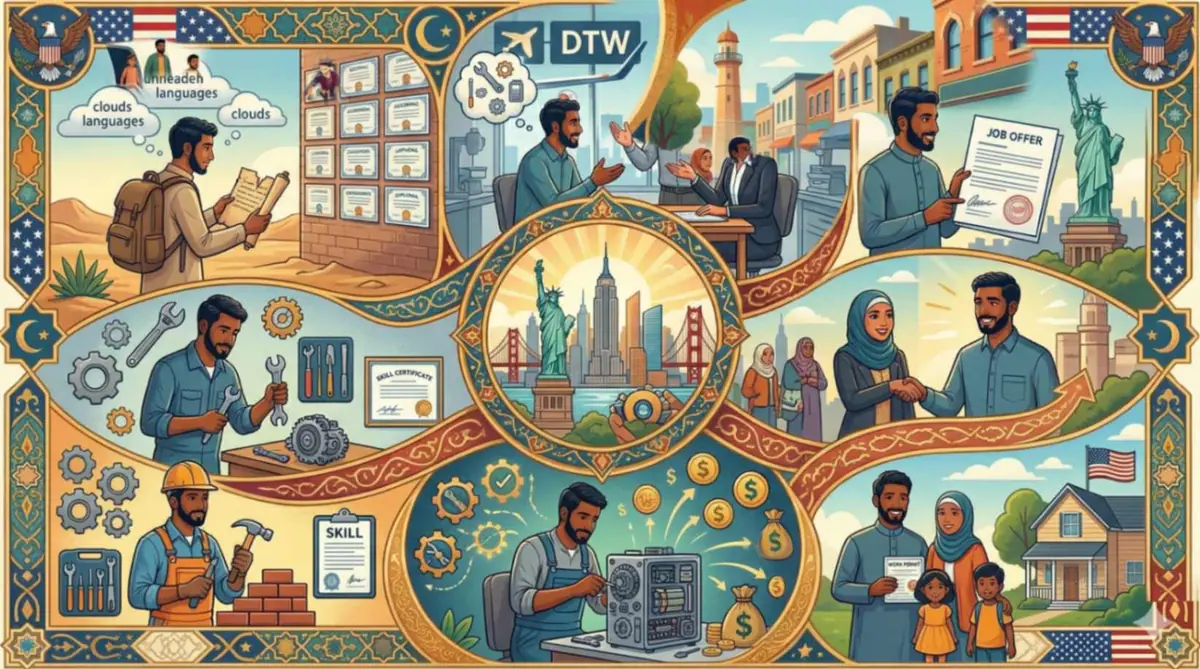
Can You Work in America Without a Degree or Strong English? 2026: A Realistic Guide to Opportunities and Challenges
Picture this scene for a moment...
You are standing inside an international airport somewhere in the United States. Maybe it's the organized chaos of JFK in New York, the sprawling terminals of LAX in Los Angeles, or the windy arrival gates of O'Hare in Chicago. You're holding a modest suitcase, and in your pocket rests the immigration paperwork you waited months—perhaps even years—to receive. Your eyes scan the surroundings, searching for something familiar. But all you find are signs written in a script that feels like a code you haven't cracked yet, and announcements over the PA system that sound like a blur of rapid-fire noise. Everyone around you seems to move with a confidence and purpose you desperately wish you shared.
And then, right there in that liminal space between your past life and your unknown future, a question lands in your chest with the weight of a boulder. It presses down on your ribs and steals your breath for a second. The question is simple, yet it carries the weight of every fear you've ever had: "What now? How am I going to survive here? I don't have an American degree. My English is barely enough to order a coffee. Will anyone hire me? Will I be able to pay rent? Am I going to fail?"
Take a deep breath. Close your eyes for just a few seconds. Then open them again and read these next words very carefully: You are not alone, and you have never been.
Every single day, thousands of new immigrants arrive on American soil. The overwhelming majority of them step off that plane with the exact same fears and the exact same limitations. They lack local credentials. They lack fluent English. Yet, despite these hurdles, millions of them didn't just survive; they built thriving futures. Some became business owners, some bought homes, and many put their children through prestigious universities. And for almost all of them, the journey didn't start in a corner office. It started with one thing: A humble, entry-level job that asked for nothing more than a strong back and a willing spirit.
This guide you are reading right now is a culmination of real-world experience, verified statistics from official 2026 data, and battle-tested advice from the field. We are going to answer the burning question: Can you work in America without a degree or strong English? But we won't stop at a simple "yes" or "no." We are going to walk you through every step of the labyrinth. You will discover:
- Which industries are practically rolling out the welcome mat for you, even if your English vocabulary is limited to a handful of words.
- Exactly how much money you can realistically expect to earn in your first year, and what a realistic monthly budget looks like after taxes.
- The physical and mental challenges you will absolutely face—and the concrete, actionable strategies to overcome them without breaking down.
- And most importantly: The strategic roadmap to transform this temporary, low-wage job into a genuine, stable, and upwardly mobile career.
But before we dive deep, I want to hand you three essential tools. Think of these as the foundation stones of your new life. Without addressing these, you can't legally or financially start working anyway. Bookmark these guides and come back to them immediately after you finish reading this article:
- How to Get Your SSN in America in 2026: A Step-by-Step Guide to Requirements and Procedures
- How to Open a Bank Account in America as a New Immigrant 2026: Best Banks and Step-by-Step Guide
- Working in America for New Immigrants: From Your First Day to Your Dream Job
Now, let's begin this journey together, one step at a time...
Chapter One: The Short Answer – Yes... But Let's Be Smart About It
Let’s not sugarcoat it or beat around the bush. The direct answer to the question "Can you work in America without a degree or strong English?" is:
Yes, absolutely. You can and you will find work. In fact, the market is hungry for you. However... there is a significant "however" that you must internalize if you want to avoid a harsh collision with reality.
Let’s break this answer down into three critical parts, because your psychological survival depends on understanding the nuance here.
Part 1: "Yes, You Can Work" – Why the Market Needs You
The American economy in 2026 is still grappling with what economists call a persistent "Labor Shortage." This isn't a shortage of software engineers or lawyers; it's a chronic, grinding shortage in specific sectors that literally keep the country running. These sectors rely on manual labor and physical presence, not academic credentials. According to a recent report from the Bureau of Labor Statistics (BLS) in early 2026, sectors like Food Services and Accommodation, Transportation and Warehousing, Construction, and Home Health Care are facing millions of unfilled job openings that simply cannot attract enough native-born workers.
Why don't Americans fill these jobs? It's a mix of factors: the work is physically demanding, the starting pay is often minimum wage, and the hours can be antisocial (nights, weekends, and holidays). This is precisely where you, the new immigrant, become not just an applicant, but a solution. Employers in these sectors need you as much as you need the paycheck. This dynamic means your chances of getting hired in these fields are exceptionally high—provided you are ready to work hard.
Part 2: "But..." – The Reality of the Jobs in Question
Let's be brutally honest. The jobs we are discussing here are not the cushy, air-conditioned office jobs you see in movies about Manhattan. They are not going to make you rich overnight. Here is the unvarnished truth:
- Physical Demands are the Baseline: Most of these roles require you to be on your feet for extended shifts (8, 10, sometimes 12 hours a day). You may be required to lift heavy objects repeatedly. You might work in sweltering heat (commercial kitchens), freezing cold (refrigerated warehouses), or under the direct glare of the sun (construction sites). The physical exhaustion in the first few weeks will be a shock to your system. That is normal.
- Pay Starts at the Bottom Rung: Do not expect an engineer's salary. Wages in these sectors typically range from $14 to $22 an hour, depending heavily on the state and the specific employer. This income is enough to cover basic necessities—a shared room, groceries, and a bus pass—but it requires meticulous budgeting. Significant savings usually come later, either through promotion or by picking up a skilled trade.
- Repetition and Monotony: Many of these tasks are repetitive. You might wipe down the same counter a thousand times a week, or place the same plastic component into the same box seven thousand times a day. This requires a specific kind of mental fortitude and the ability to find pride in a job well done, even if it's simple.
Part 3: "The Hidden Opportunity" – This is Your Launchpad, Not Your Destination
This is the single most important mindset shift you must make. Do not look at a job as a "Dishwasher" or a "Janitor" and see it as your final destiny or a mark of failure. See it for what it really is: A Gateway Job. It is the strategic vehicle that will allow you to accomplish three critical objectives in your first 12 to 24 months:
- Financial Survival: It provides immediate cash flow to secure housing and food. This stability is the bedrock of mental health. You cannot plan for a better future if you don't know where you're sleeping tonight.
- Cultural and Linguistic Immersion: Even if you speak zero English, you are hearing it for 40+ hours a week. Your ear adjusts to the rhythm of American speech. You observe how colleagues interact with supervisors, how they take breaks, how they handle conflict. This free, full-immersion "school" is more valuable than any paid language course.
- Establishing an American Work Record: In the U.S., having any verifiable job history with a paystub gives you immediate credibility. Future employers want to see that you are "employable"—that you understand what it means to show up on time, take direction, and complete a shift. That first job on your resume is the key that unlocks the next, better job.
According to a study published by the Pew Research Center in late 2025, the majority of first-generation immigrants who start in low-skill occupations successfully transition to middle- or high-skill roles within a 7 to 10-year window. The catalyst for that transition wasn't a foreign degree. It was a combination of gradual English acquisition and the deliberate pursuit of a specific trade skill (HVAC, Electrical, Plumbing, CDL) while working that first job.
So, the short answer remains: Yes, you will work. But the road starts at the bottom and climbs upward via strategic, deliberate steps. This guide is your topographical map for that climb.
Chapter Two: What Do You Actually Need in Your Toolkit Before Job Hunting?
You might be fixated on two barriers: "University Degree" and "Fluent English." But allow me to be direct with you: there are more urgent, foundational barriers that you must clear first. If you don't solve these, you can't even legally step onto the playing field, no matter how willing you are to wash dishes.
📜 Requirement #1: Legal Documents (Your Shield)
This is the bright red line that cannot be crossed or blurred. In the formal, legal U.S. job market, no reputable company can hire you without these documents. Working without them exposes you to personal and legal jeopardy that can capsize your entire American dream.
1. Employment Authorization Document (EAD):
- What is it? It's a small plastic card, similar to a driver's license, issued by U.S. Citizenship and Immigration Services (USCIS) . It is the government's way of saying: "Yes, this person is legally allowed to accept employment in the United States."
- Who gets one? Asylum applicants (after a waiting period), Asylees, Permanent Residents (Green Card holders), and certain visa categories (like F-1 students with specific authorization).
- A Stern Warning: NEVER, under any circumstances, work while on a Tourist Visa (B1/B2). This is a clear, explicit violation of federal immigration law. Working on a tourist visa constitutes a "Violation of Status." If caught, your visa will be revoked, you will be placed in removal proceedings (deported), and you will likely face a multi-year ban (up to 10 years) from re-entering the United States. Even if someone offers you "cash under the table," you are jeopardizing any future chance at a Green Card or Citizenship. Do not listen to anyone who tells you "everybody does it." That is a gamble with your entire future.
2. Social Security Number (SSN):
- What is it? A 9-digit number that serves as your "taxpayer ID" for life.
- Why is it non-negotiable? Without an SSN, an employer cannot legally run payroll. They cannot issue you a paycheck. They cannot withhold taxes. Furthermore, you cannot open a legitimate bank account, you cannot file a tax return to claim refunds (like the EITC), and you cannot build a credit history. Your entire financial life in America orbits around this 9-digit number.
- How to get it: Often, you can request an SSN card on the same application form you use for your EAD. If not, you must visit a local Social Security Administration (SSA) office in person. Please read our detailed, step-by-step guide on this process: How to Get Your SSN in America in 2026.
🧠 Requirement #2: The Immigrant Mindset (Your Mental Armor)
This requirement is intangible, yet it is arguably more important than any piece of paper. It is the difference between someone who burns out in two weeks and someone who builds an empire over two decades.
- Temporary Amnesia of Former Status: If you were a physician, an engineer, a lawyer, or a professor in your home country, you must accept that, for this brief moment in time, you are "A New Immigrant Looking for Work." This is not a demotion of your worth; it is a tactical retreat. Your degree and experience are not lost. They are just in "storage" until you can either credential them or learn enough English to use them. In the meantime, there is absolutely zero room for ego. Manual labor is not only respectable in America; it is the bedrock upon which the country was built. No one will look down on you for cleaning floors or lifting boxes. In fact, the American ethos deeply respects those who work with their hands.
- Obsessive Punctuality: American work culture is unforgiving regarding the clock. Arriving 5 minutes late is not a minor infraction; it is logged as a "Tardy." Three tardies can, and often do, lead to termination. This isn't cruelty; it's the system. Set multiple alarms. Account for traffic delays. Aim to be in the parking lot 15 minutes early. Your reliability is your #1 asset.
- Grit and Physical Acclimation: Your body will scream in protest during the first few weeks. Standing for 10 hours will make your feet feel like they're filled with broken glass. Lifting boxes will strain muscles you forgot existed. This is normal. Within 2 to 4 weeks, your body will adapt. You will gain a level of functional fitness you didn't know you were capable of. Do not quit in the first week because of physical pain. That is the sound of your body getting stronger.
🗣️ Requirement #3: The Bare Minimum English Threshold (Survival Mode)
Let's be realistic. If you know zero English words, your options are severely limited to: dishwashing in a loud kitchen, overnight office cleaning, or farm labor. But what is the "bare minimum" that opens the next tier of opportunities?
You do not need grammar rules. You do not need complex sentences. You need "Command and Signal" vocabulary.
Master these 20 words and phrases, and you can function in an Amazon warehouse or a busy restaurant kitchen:
- Yes / No
- I understand / I don't understand
- Please / Thank you / Sorry
- Here / There
- Start / Stop
- More / Enough
- Help
- Break
- Bathroom
- Watch out! (Safety)
Believe me, with just these words and some hand gestures, you can get through a shift. Your coworkers will understand. Many workplaces now have translation apps on standby for complex instructions.
And here is the beautiful part: The job itself is your best free English tutor. After just one week in a kitchen, you will have passively learned: Knife, Fork, Spoon, Plate, Hot, Cold, Chicken, Beef, Trash, Clean. This is "Workplace English," and it is far more valuable in the short term than academic textbook English. Do not stress about taking the TOEFL exam right now. Focus on surviving the shift. For a free plan to improve your English alongside work, check out: How to Learn English Fast for Free in America 2026.
Chapter Three: The Sector Map – Where Will You Actually Work?
We have arrived at the practical heart of this guide. Where are these jobs that don't ask for diplomas or fluency? Let's dissect each major sector with surgical precision: job descriptions, 2026 pay scales, the good, the bad, and exactly how to get your foot in the door.
🍕 1. Restaurants and Hospitality (The Immigrant University)
This industry is the classic starting point for millions. It's a fast-paced ecosystem and, by far, the easiest to enter quickly.
Detailed Job Breakdown:
A. Dishwasher (Kitchen Steward):
- The Work: You are the engine of the kitchen. You stand at the end of the line, facing a never-ending stream of dirty plates, pots, and pans. Your job is to blast them clean (using a high-pressure sprayer and an industrial machine) and get them back into circulation so the chefs can keep cooking. The environment is hot, humid, and loud.
- 2026 Pay Outlook: $13 to $18 per hour. In high-cost-of-living (HCOL) areas like Los Angeles, California or Seattle, Washington, minimum wage laws push this closer to $20/hr. If you are considering California, be sure to read our guide on Cost of Living in California so you understand how that paycheck translates to actual spending power.
- English Level: Almost zero required. Pointing and nodding go a long way.
- Pros: No experience needed. Free shift meal (huge savings on food costs). You get a front-row seat to observe professional chefs at work.
- Cons: Intense physical fatigue. Your hands will be in water and chemicals constantly (invest in good gloves and lotion).
- How to Land It: Walk into any busy restaurant (especially ethnic restaurants: Arabic, Mexican, Chinese) between 2 PM and 4 PM and ask for the manager. Say: "I am looking for a job as a dishwasher."
B. Prep Cook / Kitchen Helper:
- The Work: This is a step up the ladder. You prepare the ingredients before the dinner rush. Chopping vegetables (onions, tomatoes, lettuce), marinating meats, portioning pasta, and making simple sauces. You set up the "stations" for the line cooks.
- 2026 Pay Outlook: $14 to $20 per hour.
- English Level: Low to Intermediate. You need to know the English (or Spanish) names for basic food items and understand simple commands: "Slice the tomatoes thin." "We need more parsley."
- Pros: You learn the foundational skills of cooking. Slightly better pay and less wet/messy than the dish pit.
- Cons: More responsibility. If you prep the wrong amount or cut something incorrectly, it slows down the whole kitchen.
- How to Land It: Often, this is an internal promotion from Dishwasher. Show up early, stay late, and ask the chefs if you can help them with simple tasks. Management notices initiative.
C. Busser (Server Assistant):
- The Work: You work the dining room floor (Front of House). Your mission: clear and reset tables the second a customer leaves. You remove dirty plates, wipe the surface, and put down fresh silverware and napkins for the next guest. Speed is essential.
- 2026 Pay Outlook: $13 to $17 per hour + Tips. In many restaurants, servers tip out a percentage of their sales to the bussers, which can add $2 to $5 per hour to your base wage.
A Real Story from the Field: "Mahmoud," a young man from Egypt, arrived in Chicago, Illinois during the bitter winter of 2025. He had a business degree from Cairo but spoke almost no conversational English. He walked into a small Middle Eastern restaurant and asked for any work. The owner put him in the dish room. Mahmoud recalls: "I stood for 10 hours a day at that sink. The steam, the soap, the noise. I would go home and my arms felt like noodles. But I was never late. Not once. After three months, the owner saw my work ethic. He pulled me out of the pit and asked me to help the chef chop vegetables. By month nine, I was the chef's main prep guy." If you are looking at Illinois as a destination, read our full Work in Illinois 2026 Guide.
🏗️ 2. Construction and Skilled Trades (High Pay for Hard Work)
This sector is the backbone of America's infrastructure. If you aren't afraid of the elements—whether the blistering sun of a Texas summer or the biting wind off Lake Michigan—this is where you'll find the highest starting wages for unskilled labor.
Detailed Job Breakdown:
A. General Construction Laborer:
- The Work: You are the support system for the skilled tradesmen (carpenters, electricians, plumbers). Your day involves: digging trenches, hauling heavy materials (lumber, drywall, cement bags), cleaning up debris to keep the site safe, erecting scaffolding, and mixing concrete.
- 2026 Pay Outlook: $16 to $25 per hour. This varies wildly by state. In union-heavy states like New York and California, laborers can command $28-$30/hr. In right-to-work states like Texas and Florida, expect the $16-$20 range. See our guide on Cost of Living in Texas to understand how far that wage goes there.
- English Level: Very low. Instructions are often visual or single-word commands: "Move," "Lift," "Dig," "Stop." However, understanding safety terminology is crucial for your own wellbeing (Hard hat! Watch out! Falling!).
- Pros: Higher starting pay than restaurants. You don't need a fancy wardrobe. The Golden Ticket: You are working inches away from high-earning tradespeople. Watch them. Ask them (with gestures) about their tools. You are getting a free vocational education.
- Cons: Back-breaking labor with a higher risk of injury. Work is weather-dependent (rain or snow often means a lost day's pay).
- How to Land It: Visit large construction sites and ask for the "Site Superintendent." Alternatively, look for "Construction Staffing Agencies" online. You can also go to the parking lot of a Home Depot or Lowe's early in the morning—this is a well-known gathering spot for day laborers and contractors looking for same-day help.
B. Trade Helper (Electrician/Plumber/Carpenter Helper):
- The Work: You are the personal assistant to a licensed tradesman. You hand them tools, carry materials, hold the ladder, and clean up after their work.
- 2026 Pay Outlook: $15 to $22 per hour.
- English Level: Low, but you must learn the names of tools in English (Hammer, Screwdriver, Wrench, Drill, Pliers).
- Pros: This is the absolute best free vocational school in America. You are learning a "Trade" by osmosis. Today's Helper is tomorrow's Apprentice. In 3-5 years, that Apprentice becomes a licensed "Journeyman" earning $80,000 to $120,000+ per year.
- Cons: You do the heavy lifting while the expert does the "thinking" work.
- How to Land It: Apply directly to local electrical, plumbing, or HVAC companies. Search Indeed for "Trade Helper."
A Real Story from the Field: "Yousef," a skilled carpenter from Aleppo, Syria, arrived in Detroit, Michigan with no American papers to prove his trade. He started as a general laborer on a home renovation site, picking up trash and carrying lumber. He says: "The work was brutal, but I was just happy to be near wood again. On my breaks, I would watch the American framer. I pulled out my phone and showed him pictures of the intricate furniture I made back in Syria. He didn't understand my words, but he understood my hands." Within a year, Yousef was the framer's dedicated helper. Within three, they were partners on small projects. If you are in the Detroit area, dive into our Work in Michigan Guide.
📦 3. Manufacturing and Warehousing (Stability and Benefits)
Fueled by the insatiable growth of e-commerce (led by Amazon), massive fulfillment centers have become prime employment hubs for new immigrants. These jobs offer more structure and guaranteed hours than restaurants or construction.
Detailed Job Breakdown:
A. Warehouse Associate (Fulfillment Center Worker):
- The Work: You work inside a cavernous warehouse (some are over a million square feet). Your role rotates between: (1) Inbound: Unloading trucks full of merchandise. (2) Stowing: Scanning items and placing them on specific shelves using a handheld scanner. (3) Picking: Retrieving items from shelves based on a customer's online order. (4) Packing: Putting the items in a cardboard box and slapping a shipping label on it.
- 2026 Pay Outlook: $15 to $22 per hour. Amazon typically pays at the top of this range and offers health insurance benefits starting on Day 1—a massive advantage for an immigrant family.
- English Level: Nearly zero required. The work is directed by a scanner. The scanner screen shows a number. You find the shelf with that number. You scan the barcode. Repeat. You don't need to read English paragraphs.
- Pros: Job stability. Consistent schedule. Overtime paid at 1.5x rate. Access to decent health insurance.
- Cons: Physical fatigue (you will walk 10-15 miles per shift inside the warehouse). The work can be monotonous. Strict electronic monitoring of your productivity rate.
- How to Land It: Go directly to the Amazon Jobs website. Search for "Fulfillment Center" in your city. You can also apply through staffing agencies that supply workers to these warehouses.
B. Production Worker (Factory Line):
- The Work: You stand at a conveyor belt in a factory (automotive parts, food processing, electronics). You perform one specific, repetitive task all day long (e.g., snap a plastic cap onto a bottle, inspect a widget for defects, pack items into a tray).
- 2026 Pay Outlook: $14 to $20 per hour.
- English Level: Very low. Training is visual.
- Pros: Routine work. If you like knowing exactly what your day will look like, this is for you.
- Cons: Extreme monotony. Repetitive motion can lead to physical strain (Carpal Tunnel, back issues).
A Real Story from the Field: "Fatima," an Iraqi mother, arrived in Sacramento, California. She spoke no English. A temp agency sent her to a clothing distribution warehouse. She recalls: "I was terrified of the scanner gun. It beeped and flashed numbers. I didn't know what to do. But my supervisor, a Mexican woman who also spoke no English, just pointed at the screen, then pointed at the shelf. The numbers matched. That was it. I understood." Fatima worked there for six months, improved her English by listening to coworkers, and then moved on to a housekeeping job at a nearby hotel with better pay.
🚚 4. Transportation and Delivery (The Gig Economy Gateway)
This sector is the circulatory system of American commerce. If you possess a valid U.S. Driver's License, you are immediately employable.
Detailed Job Breakdown:
A. Delivery Driver (Food and Packages):
- Platforms: Uber Eats, DoorDash, Grubhub (Food); Amazon Flex, Walmart Spark (Packages).
- The Work: You turn on a smartphone app. An offer pops up: "Pick up from McDonald's, deliver to 123 Main Street." You accept. You pick up. You drop off. You get paid.
- 2026 Income Outlook: $15 to $25 per hour GROSS. This is crucial: This is not a salary. It is gross revenue. You must subtract: Gasoline, Vehicle Depreciation (your car loses value with every mile), Oil Changes/Tire Wear, and Commercial Auto Insurance (your personal policy likely won't cover you in an accident while delivering).
- English Level: Very low. The app tells you the restaurant name, the order number, and the address. You show the phone screen to the restaurant worker. You drop the food at the door.
- Pros: Ultimate flexibility. You are the boss of your own schedule. Excellent as a "Bridge Job" while you search for something more permanent.
- Cons: Income is unstable (some days are slow). You are destroying the value of your personal vehicle. No health insurance or paid time off.
- A Note on Uber/Lyft (Rideshare): AVOID THIS if your English is poor. Driving passengers requires real-time conversation, understanding directions, and managing customer service issues. Stick to food and packages until your English improves.
🧹 5. Cleaning and Janitorial Services (The Quiet Path)
These jobs are ideal for those who prefer working alone, away from the public eye, often with evening or overnight hours.
Detailed Job Breakdown:
A. Office Cleaner / Janitor:
- The Work: You work for a cleaning company contracted by office buildings. After the white-collar workers go home (5:00 or 6:00 PM), your team arrives. You vacuum floors, empty trash cans, clean restrooms, and dust surfaces.
- 2026 Pay Outlook: $14 to $20 per hour. Night shift often comes with a small pay differential.
- English Level: Almost none. You work off a checklist (often with pictures). Your supervisor communicates in basic terms.
- Pros: Quiet, independent work. You can wear headphones and listen to music, podcasts, or ESL lessons while you work. Night hours free up your mornings for job interviews or classes.
- Cons: Working nights can disrupt your sleep cycle and social life. Exposure to cleaning chemicals.
B. Hotel Housekeeper (Room Attendant):
- The Work: You clean guest rooms after checkout. Making beds, changing linens, scrubbing bathrooms, vacuuming carpets, restocking toiletries.
- 2026 Pay Outlook: $15 to $22 per hour (higher at luxury hotels or resorts).
- English Level: Very low. You get a list of room numbers. The "Do Not Disturb" sign is universal.
- Pros: Better pay than office cleaning. Hotel environment can be pleasant. Some hotels provide free staff meals.
- Cons: Physically demanding (constant bending, lifting mattresses, standing). Time pressure to clean a set number of rooms per hour.
A Real Story from the Field: "Nadia," a Jordanian woman, landed in Orlando, Florida. She took a job as a housekeeper at a hotel near the theme parks. She says: "I had to clean 15 rooms a day. My back ached like crazy. But sometimes, I'd find a $5 bill left on the pillow as a tip. That little bit of extra cash felt like a fortune." After a year, her English improved, and she was promoted to Housekeeping Supervisor.
Chapter Four: The Ultimate Comparison Table – Choose Your Weapon Wisely
To make this decision easier, we've condensed everything into a single comparison matrix. Review it carefully and choose the path that aligns with your physical capacity and life circumstances.
| Industry | Job Example | Average Hourly Wage* | Physical Demand | English Level Required | The Hidden Advantage |
|---|---|---|---|---|---|
| Restaurants | Dishwasher | $13 - $18 | Very High | Near Zero | Free shift meal; Path to Chef |
| Restaurants | Prep Cook | $14 - $20 | High | Low | Learn professional cooking skills |
| Construction | General Laborer | $16 - $25 | Very High | Very Low | Highest starting wage; Learn a Trade |
| Construction | Trade Helper | $15 - $22 | High | Low-Mid | Fast track to $100k career |
| Warehousing | Warehouse Associate | $15 - $22 | High | Near Zero | Stability + Day 1 Health Insurance |
| Manufacturing | Production Line | $14 - $20 | Medium | Very Low | Clear, predictable routine |
| Delivery | Food/ Package Driver | $15 - $25 (Gross) | Medium | Low | Complete schedule flexibility |
| Cleaning | Janitor/ Housekeeper | $14 - $22 | High | Near Zero | Quiet work; Evening hours |
*Important Note: Wages are 2026 estimates and vary significantly by state and city. High-cost areas (NYC, SF) pay more but cost more to live in. States like Texas and Ohio offer lower nominal wages but much higher purchasing power. Check our guide on the Best State to Live in America for Arabs for a detailed cost-benefit analysis.
Chapter Five: The Financial Reality Check – How Much Will You Actually Take Home?
Let's talk hard numbers. When you hear "$15 an hour," your brain might do this calculation automatically: $15 × 40 hours × 4 weeks = $2,400 per month.
That number, $2,400, is your Gross Income. But that is NOT the number you will see deposited into your bank account. Why? Because Uncle Sam takes his cut first, right off the top. Understanding these deductions is non-negotiable.
📉 Mandatory Payroll Deductions (As per Federal Law):
Based on guidelines from the Internal Revenue Service (IRS.gov) and the Social Security Administration (SSA.gov) , here is what will vanish from your paycheck before you ever see it:
-
Federal Income Tax:
- Rate: For low-income earners (which is where you'll start), this is roughly 10% to 12%.
- Golden Nugget: If you have children and meet certain income thresholds, you likely qualify for the Earned Income Tax Credit (EITC) . This is a refundable credit. When you file your taxes, the government might send you a check for several thousand dollars! Never skip filing your taxes, even if you think you owe nothing.
-
FICA Taxes (Social Security & Medicare):
- Rate: A flat 7.65% on every dollar you earn. This is non-negotiable.
- The Upside: This money isn't "lost." 6.2% goes to Social Security (your future retirement safety net). 1.45% goes to Medicare (your future health insurance when you turn 65).
-
State Income Tax:
- This varies dramatically:
- No State Income Tax: Texas, Florida, Nevada, Washington, Wyoming, Alaska. (Living here means you keep 5-10% more of your paycheck).
- State Income Tax Charged: California, New York, Illinois, Massachusetts, and many others.
- This varies dramatically:
🧾 A Real-World Net Pay Example:
Let's assume you live in Illinois and work full-time (40 hours/week) at $16.00/hour.
- Gross Monthly Pay: $16 × 40 × 4 = $2,560.
- Estimated Monthly Deductions:
- Federal Tax (10% estimate): $256
- FICA (7.65%): $196
- Illinois State Tax (4.95%): $127
- Total Deductions: $256 + $196 + $127 = $579.
- Net Monthly Pay (Take-Home): $2,560 - $579 = $1,981 (Roughly $2,000).
💡 How Will You Spend That $2,000?
- Rent (Shared Room in a House): $700 - $1,100 (highly dependent on city).
- Groceries (Cooking at home, no restaurants): $300 - $450.
- Transportation (Bus Pass or Gas for Car): $100 - $250.
- Cell Phone Plan (Budget carrier): $25 - $50.
- Miscellaneous/ Emergency: $100 - $200.
The Financial Verdict: In a mid-cost state, you can live on $2,000 a month, but you will be living close to the edge. You will cover your bills, but saving significant money will be extremely difficult in the first year. This is precisely why many new immigrants work Overtime (OT) —which pays 1.5x your hourly rate—or hold down two jobs simultaneously. That is the secret to the fast accumulation of capital that you see in successful immigrant communities.
If you are targeting a specific state, be sure to study our detailed cost of living breakdowns, such as: Cost of Living in Illinois or Cost of Living in California.
Chapter Six: How to Actually Find These Jobs – A Field Manual
Looking for new immigrant jobs in the USA is different than applying for a corporate role. You cannot sit at home, fire off resumes online, and wait for a response. These jobs are awarded to those who show initiative and get out of the house.
🗺️ Strategy #1: Temp Agencies (The Fast Lane)
This is the "insider trick" that everyone uses but few talk about. What are they? Private companies that act as a middleman between you and large corporations (factories, warehouses). You are technically an employee of the agency, but you work at the client's site.
-
Why is this the best option for a new immigrant?
- Speed: You can often start working the very next day after registering.
- Simplicity: The agency handles the complex HR paperwork and background checks.
- Exposure: You might work at a warehouse one week and a factory the next. You gain diverse experience quickly.
- Temp-to-Hire: If you perform well at the client site, the company will often offer you a direct, permanent position after 3-6 months, usually with a raise and better benefits.
-
How to Find Them: Open Google Maps. Search:
Staffing Agency near me. Go in person first thing in the morning. Bring: Passport, Social Security Card, EAD (or Green Card).
🚶♂️ Strategy #2: The Walk-In (Body Language Speaks Volumes)
This is extremely effective in Restaurants and Construction.
- The Method: Dress neatly. Walk into a restaurant between 2 PM and 4 PM (the slow period between lunch and dinner). Ask for the "Manager." Smile. Make eye contact. Shake hands firmly. Say clearly: "I am looking for a job. Dishwasher, Busser, anything."
- Why This Works: The manager sees a human being who made an effort. You are not just a faceless name in an email inbox. This "initiative" puts you ahead of 100 other applicants.
- Pro Tip: Print 20 simple paper resumes (even if it's just your name, phone number, and "Open to any position"). Hand it to the manager.
📱 Strategy #3: Online Tools (Craigslist & Indeed)
- Craigslist: Don't underestimate this old-school site. Go to the
Jobssection, thenFood/Bev/HosporGeneral Labor. You will find postings from small restaurant owners and contractors looking for "same day help." Warning: Beware of scams. Never pay money for a job offer. Never give out your bank information. - Indeed.com: Search using these simple, powerful keywords:
No experienceEntry levelImmediate hireWarehouseDishwasherConstruction laborer
- Use the
Easy Applyfeature to submit applications with one click.
👥 Strategy #4: The Arabic Community Network (Your Safety Net)
The Arab diaspora is your most powerful asset. Do not be shy.
- Facebook Groups: Search for
Arabs in [Your City Name]orEgyptian Community in New Jersey. Post a polite message: "Salam Alaikum, I am new to the city and looking for any work opportunity. I speak Arabic and I am a hard worker." You will be surprised by the flood of responses. - The Mosque/ Islamic Center: Go to Friday prayer. Introduce yourself to the Imam. Check the bulletin board. It is often plastered with "Help Wanted" ads for Halal restaurants, Arab grocery stores, and family businesses.
- Read our comprehensive guide on Arab American Communities to unlock the full power of this network.
Chapter Seven: The Challenges You Will Face and How to Conquer Them
Let's be frank one last time: This path is not a picnic. There are real, gritty challenges. But if you anticipate them, you can prepare for them. And if you prepare, they will not break you.
Challenge #1: Extreme Physical Exhaustion
- The Reality: In the first two weeks, you will come home feeling like you've been hit by a truck. Your feet will throb, your back will ache, and your hands will be raw.
- The Solutions:
- Invest in Work Shoes: Do not cheap out on footwear. Go to a specialized store (Skechers Work, Shoes for Crews) and buy non-slip, cushioned shoes designed for standing all day. This is the single most important piece of equipment you own.
- Epsom Salt Soak: Fill a basin with warm water and Epsom salt. Soak your feet for 15 minutes when you get home. It's magic for sore muscles.
- Prioritize Sleep: Your body repairs itself during sleep. Turn off the phone and get a solid 7-8 hours. This is non-negotiable for recovery.
Challenge #2: The Language Frustration Wall
- The Reality: A supervisor might bark a quick instruction, and you will freeze like a deer in headlights, having no clue what they just said. It is humiliating. It happens to everyone.
- The Solutions:
- The Smartphone Savior: Download Google Translate. Use the "Conversation Mode." Place the phone between you and the supervisor. It will translate in real-time. This is a 2026 magic trick.
- The Lifesaver Phrase: Memorize this sentence perfectly: "I am sorry, I am new and learning English. Can you please show me?" This sentence instantly diffuses anger and turns a potentially hostile interaction into a teaching moment.
- Smile: A genuine smile is universal. Even if you don't understand the words, a smile and a nod go a long way toward building rapport.
Challenge #3: The Risk of Wage Theft and Exploitation
- The Reality: There are unscrupulous employers (of all backgrounds) who prey on immigrants' fear and lack of legal knowledge. They might promise $15/hr, but at the end of the week, hand you $12/hr in cash and claim "taxes took the rest." This is a lie and it's illegal.
- The Solutions:
- Insist on a Paystub: A legal job provides a check with a detailed paystub. This stub is your legal right. It shows your hours, your gross pay, and exactly what was deducted for taxes.
- Know the Minimum Wage in Your State: Google it:
Minimum Wage [Your State] 2026. If an employer pays you less than this (even in cash), they are breaking the law. - Don't Fear Reporting: If your rights are violated, you can file a complaint with the U.S. Department of Labor (DOL) . The law protects you regardless of your immigration status (as long as you have work authorization).
Challenge #4: The Mental Battle (Ego vs. Reality)
- The Reality: You may have been a respected professional in your home country. Now you are scrubbing toilets. The mental weight of this identity shift can be crushing.
- The Solutions:
- Separate Identity from Task: Tell yourself every morning: "I am not this job. This job is my vehicle. It is the engine that will drive me to my destination." This is "survival mode," not "forever mode."
- Set Micro-Goals: Don't look at the 5-year plan. Look at this week. Goal: Learn 5 new English words related to my job. Goal: Save $50 this week. Small victories create momentum.
- Connect with Your Tribe: Talk to other immigrants. They understand the struggle. Isolation is the enemy.
Chapter Eight: The Evolution Roadmap – From "Worker" to "Tradesman"
Staying in a minimum-wage job for years is the only real strategic failure. These jobs are designed as stepping stones, not rest stops. Here is the 5-year roadmap that, if followed, will fundamentally change your economic trajectory.
🗓️ Year 1: Survival & Stability
- Job Goal: Secure any job that pays rent (Dishwasher, Warehouse, Janitor).
- Financial Goal: Open a bank account. Avoid debt. Save a tiny emergency fund ($500).
- Language Goal: Learn 100-200 survival/workplace words. Enroll in a free ESL class at the local library.
- Key Move: Obtain a U.S. Driver's License. This is the single most important document for unlocking better jobs.
- Related Link: How to Open a Bank Account in America as a New Immigrant.
🗓️ Year 2: Growth & Credit Building
- Job Goal: Move to a more stable company with benefits (Amazon, UPS, Costco) or become a Trade Helper.
- Financial Goal: Start building a Credit Score. Apply for a Secured Credit Card. This is critical for renting an apartment or buying a car. Read: How to Build a Credit Score from Scratch in the USA.
- Language Goal: Reach a basic conversational level.
- Key Move: Choose a "Trade" to focus on. Electrical? Plumbing? Trucking? Pick one.
🗓️ Year 3: Skill Acquisition
- Job Goal: Work full-time as a Helper in your chosen trade.
- Educational Goal: Enroll in a Community College Certificate Program for your trade. These are low-cost, evening/weekend classes designed for working adults.
- Financial Goal: Save for better tools or a better vehicle.
🗓️ Year 4: Certification & Licensing
- Job Goal: Become a Certified Technician or Journeyman. This requires passing a state exam.
- Financial Goal: The Big Leap. Your income doubles from $35k to $70k+.
- Language Goal: Master the technical English vocabulary specific to your trade.
🗓️ Year 5: Independence & Prosperity
- Career Goal: Either become an Independent Contractor (start your own small business) or a Supervisor at a large firm.
- Financial Goal: Qualify for a Mortgage to buy a house, or open a small business (Food Truck, Cleaning Company, Auto Repair).
- End Result: You no longer need this guide. You are now a stable, contributing member of the American middle class.
Chapter Nine: Stories from the Front Lines – When the Map Becomes Reality
We won't leave you with just theory. Here are three more real-world narratives of Arab immigrants who turned nothing into something.
Story One: Samer from Aleppo to California Restaurant Owner "Samer" landed in San Diego, California in 2023 with $300 and "Yes/No" English. He walked into an Italian bistro and begged to wash dishes. "On my first day, I broke three plates," Samer laughs now. "I was shaking with nerves, waiting to be fired. But the owner just clapped me on the shoulder and said, 'Relax, kid. It's just a plate.'" Samer showed up early every single shift and stayed late to scrub the floors without being asked. A year later, he was making pizza dough. Three years later, with a small loan from a friend, he opened a Halal food cart. In 2026, that cart has grown into two small brick-and-mortar shawarma shops. For more on California's food industry, read: Best Jobs for Arabs in California.
Story Two: Aisha from Morocco to Ohio Truck Driver "Aisha," a Moroccan mother of two, settled in Cleveland, Ohio. She didn't want a kitchen job. She heard about the driver shortage. She got her regular license, then enrolled in a CDL (Commercial Driver's License) school for 8 weeks. "I was the only woman in a hijab in that whole class," she recalls. "The instructor asked me, 'Are you sure you want to do this? It's a hard life.' I told him, 'I have kids to feed.'" Today, Aisha drives a local delivery truck. She is home every night. She makes $75,000 a year and just bought a small house for her children. See the opportunities in Work in Ohio.
Story Three: Khaled from Egypt to Licensed Electrician in New York "Khaled" was an electrical engineer in Cairo. He arrived in Queens, New York, expecting to find work in his field. He was shocked to find that no one cared about his Egyptian degree. He was overqualified but unemployable in his profession. Bitterly, he took a job as an Electrician's Helper for $18/hr. "It was a wound to my pride," he admits. "I had to hold the ladder for a guy who didn't finish high school. But I swallowed my pride and watched him." Khaled learned the American Electrical Code from his mentor. He joined the IBEW apprenticeship program. Four years later, Khaled is a licensed Journeyman Electrician earning over six figures. He looks back on that first job and knows it was the best education he ever got.
Chapter Ten: Frequently Asked Questions (FAQ) for New Immigrants
These questions are curated from real queries sent to "Arabs in America" readers. The answers are direct and actionable.
❓ Q: I'm on a Tourist Visa (B1/B2). Can I work "under the table" for cash just until I fix my status?
A: No. Absolutely not. This is the single most dangerous piece of advice circulating in immigrant communities. Working on a tourist visa is a violation of status. If caught, you will be deported and barred from re-entry for years. Even if you aren't caught, you will be asked under oath on future immigration applications: "Have you ever worked without authorization?" Lying is a crime. Telling the truth gets you denied. Do not trade your future for a few weeks of underpaid cash work. Wait for your EAD.
❓ Q: I live in an expensive state like California or New York. How can I possibly survive on $2,000 a month?
A: The only realistic solution in Year 1 is Shared Housing (Roommates). You cannot afford a studio apartment. You must rent a single room in a house or apartment shared with others (often other immigrants or students). This is how everyone starts. It cuts your rent in half and often splits utility costs. It is a temporary sacrifice for a permanent upgrade.
❓ Q: Can I drive for Uber Eats without a Social Security Number (SSN)?
A: No. All major gig platforms (DoorDash, Uber Eats, Amazon Flex) require an SSN and a background check. You cannot sign up without one.
❓ Q: I'm a young man alone, no family, no friends. Where do I even start?
A: Go to the Mosque or Arab Church in your city. This is your home base. Go for Friday prayer or Sunday service. After the service, find the Imam or Priest. Introduce yourself: "I am new here and I am alone. I need help." The community will wrap around you. You will find leads on rooms for rent, job openings, and instant friends.
❓ Q: What is the best state to start in for unskilled labor jobs?
A: It depends on your priority:
- Highest Minimum Wage (But High Rent): California, Washington.
- Strong Job Market + Large Arab Community + Balanced Cost: Michigan (Dearborn), Texas (Houston/Dallas), Illinois (Chicago Suburbs).
- Lowest Cost of Living (Easier to Save Money): Ohio, Indiana. Read our in-depth analysis: Best State to Live in America for Arabs 2026.
❓ Q: What is the cheapest way to send money back home?
A: Never use traditional banks for wire transfers. Their fees and exchange rates are terrible. Use specialized apps like Wise or Remitly. They use the real mid-market exchange rate and charge tiny, transparent fees. Read our full guide: Best Money Transfer Apps from the USA.
❓ Q: Are Arab employers more likely to exploit me?
A: Unfortunately, some employers (of all nationalities, including Arab) do exploit their own community members, banking on their need and lack of English. Know the law. Minimum wage is minimum wage. Overtime is 1.5x pay. If you are being exploited, you can contact organizations like the Arab American Institute (AAIUSA.org) or the American-Arab Anti-Discrimination Committee (ADC.org) for legal guidance.
🌟 Conclusion: A Message From the Heart
We have traveled a long road together in this guide, full of numbers, hard truths, stories of grit, and warnings of pitfalls. I hope that by the time you've reached this final section, the knot of anxiety in your stomach has loosened just a little bit. I hope the fog has lifted, and you can see the path ahead a little clearer.
Let me leave you with this final thought:
Working without a degree or strong English is not a life sentence. It is the opening chapter of your American story. It is a temporary phase with an expiration date. Millions walked this path before you, not because they were failures, but because they were smart enough to know that success in a new land begins with a humble first step on solid ground. The job of a "Dishwasher" or "Laborer" is not a source of shame. The only shame is staying at home, paralyzed by fear, watching your savings dwindle to zero.
It is 2026. You have technology in your pocket that translates languages in real-time. You have a vibrant, generous Arab community ready to support you. You have laws that protect your basic rights. All that is left is for you to take that first, hardest step. Walk out the door tomorrow morning. Go to the nearest shopping center or busy street. And ask that simple, brave question: "Do you have any work?" Those four words are the spark that lights the fire of your new life.
And now, it's your turn...
Share your story or your most pressing question in the comments below. Did you just arrive? What was the first job you found? What challenge nearly broke you? Your story might be the exact candle someone else needs to find their way through the darkness of their first night in America. Let's build this community together, so we can be the best support system for one another in this foreign land.
For further information regarding labor laws and immigrant worker rights, we highly recommend visiting the official website of the U.S. Department of Labor: www.dol.gov.

Author: حسين عبد الله
Hussein Abdullah is a web developer and specialized content writer with more than eight years of experience enriching Arabic digital content. He combines an analytical programming mindset with a deep passion for writing to deliver accurate, reference-quality guides. On Arabian in USA (عرب في أمريكا), he focuses on simplifying complex steps for new immigrants and sharing reliable information on housing, work, and financial setup—so every newcomer has a trustworthy path toward stable life in the United States.


Continue reading
- Work in America for New Immigrants 2026: The Complete Guide from Day One to Your Dream Career [Step-by-Step Plan]
- Muslim Population in America 2026: Complete State-by-State Guide, Statistics & Interactive Map
- Top 10 Best States for Muslims in America: Ultimate Guide (Updated 2026)
- Top 7 Best States for Arabs in America: Ultimate Guide (Updated 2026)
- Living Without English in Illinois 2026: The Complete Guide for New Immigrants with Limited English [Practical Plan]
- Working in California 2026: The Complete Guide to Jobs, Salaries & Immigrant Opportunities [Step-by-Step Career Plan]