What to Do If You Lose Your Official Documents in America 2026: The Complete Guide to Replacing Your Green Card, Passport, SSN, and Driver's License
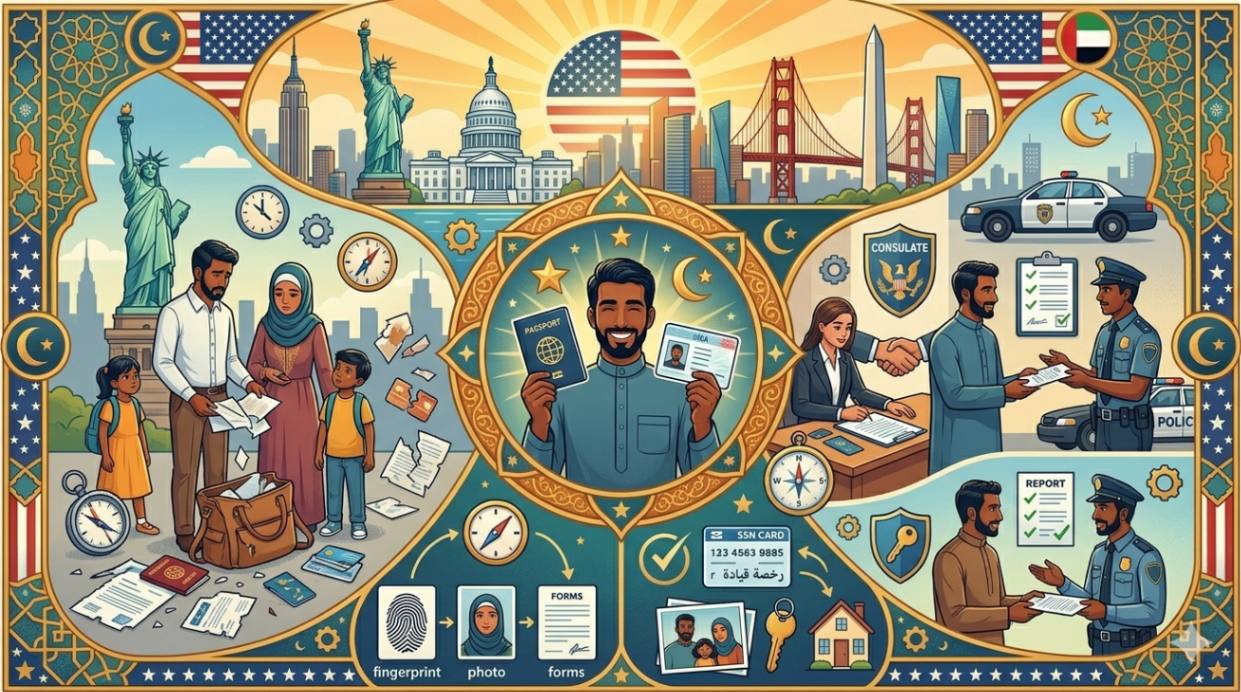
🔍 What You'll Get in This Article (Your Document Recovery Roadmap)
If you are an immigrant in the United States and your wallet has been lost or stolen—taking with it your Green Card, passport, Social Security card, or driver's license—and you are currently gripped by panic and confusion, this guide is your complete recovery playbook. By the time you finish reading, you will know exactly:
- ✅ The critical, immediate steps to take within the first 24 hours to protect yourself from identity theft and financial fraud.
- ✅ The precise, official procedures for replacing each specific document: Green Card (Form I-90), foreign passport, U.S. passport, Social Security card (Form SS-5), driver's license, Employment Authorization Document (EAD - Form I-765), and Naturalization Certificate (Form N-565).
- ✅ The exact government agencies responsible for each document, the expected fees, and the realistic processing timelines in 2026.
- ✅ How to obtain temporary, interim documents that allow you to travel, work, and prove your identity while you wait for the permanent replacement cards to arrive.
- ✅ A comprehensive emergency plan for the absolute worst-case scenario: losing every single one of your official documents simultaneously.
- ✅ Smart strategies for protecting yourself from identity theft, including placing fraud alerts and credit freezes with the major credit bureaus.
- ✅ Best practices for creating encrypted digital and secure physical backups of your critical documents to prevent this nightmare from ever happening again.
- ✅ Real, inspiring stories of Arab immigrants who lost their documents and successfully navigated the system to recover them.
Let's replace panic with a concrete, step-by-step plan.
😱 Introduction: That Heart-Stopping Moment of Realization
Picture this terrifying, all-too-common scenario: You are getting ready to leave your apartment on an ordinary morning, or you reach for your wallet to pay for your morning coffee at the café. Your hand instinctively goes to your back pocket or your purse, searching for the familiar bulge of your wallet. You pat the spot. Nothing. You stop, a flicker of annoyance crossing your mind. You check the other pocket. Still nothing. You begin to search in earnest now, a knot of dread forming in your stomach. You rifle through your entire bag, you check under the car seats, you retrace your steps mentally, and then the cold, brutal, horrifying truth washes over you: Your wallet is gone. Vanished. And this is infinitely worse than losing a few dollars and a couple of easily canceled bank cards. Inside that wallet, you were carrying—perhaps unwisely—your entire American life: your Green Card, your driver's license, and worst of all, possibly even your original Social Security card.
In that moment, your heart rate skyrockets. Your palms sweat. True, unadulterated panic sets in. A cascade of terrifying questions floods your brain: Was it stolen? Did I drop it somewhere? How will I prove who I am? How will I board a plane to visit my family back home? Does this mean I have lost my permanent residency status? Could someone use my documents to commit crimes in my name? This potent cocktail of fear, anger, and profound frustration is entirely understandable and completely normal.
But now, take a deep, slow breath. Pause for just a moment. It is critically important for you to know that you are not the first person to experience this waking nightmare, and you will, unfortunately, not be the last. Tens of thousands of individuals—citizens and immigrants alike—report lost or stolen official documents in the United States every single year. The reassuring and empowering news is that the American bureaucratic system, for all its complexities, has clear, well-defined, and established procedures for replacing each and every one of these documents. Losing your official papers in the United States is not the end of the world. It is not an indication that you have lost your legal status. And it is not a precursor to deportation. However, it is a genuine test of your composure and your ability to follow the correct procedures swiftly and methodically.
The complete secret to emerging from this predicament with minimal damage is this: Do not panic. Act quickly and intelligently. And begin in the correct sequence. In this comprehensive, potentially life-saving guide for 2026, we will hold your hand and walk you through the process step by step. We will tell you precisely what actions to take in the critical first twenty-four hours. We will detail, with painstaking precision, the official procedures for replacing each individual document—from your Green Card to your passport, your Social Security card, your driver's license, and beyond. We will show you how to protect yourself from the looming specter of identity theft, and how to secure temporary documentation that allows you to continue your life while you wait for the permanent replacement cards to arrive in the mail.
🚨 Chapter One: The Emergency Protocol—What to Do in the First 24 Hours
The hours immediately following the discovery of the loss are the most critical. Your swift, organized reaction can be the difference between a temporary administrative hassle and a full-blown identity theft catastrophe that wrecks your credit for years.
Step 1: Calm Down and Formulate a Clear Plan. Panic is your primary enemy in this moment. Panic leads to scattered, random actions and causes you to forget crucial steps. Sit down in a quiet place, take several deep, deliberate breaths, and remind yourself that every single document has a defined replacement procedure. This problem is solvable.
Step 2: Immediately Freeze or Lock All Your Bank and Credit Cards. This is your absolute highest financial priority. Open your banking apps on your smartphone immediately. Look for the option labeled "Freeze Card," "Lock Card," or "Report Lost/Stolen." Activate this feature for every single debit and credit card that was in your missing wallet. This action instantly prevents anyone from using your cards for fraudulent purchases. If you cannot do this via the app, call the 24/7 customer service number on the back of any other card you possess or visit your bank's website. You will eventually need to order replacement cards with new numbers, but freezing them now stops the immediate financial bleeding.
Step 3: File a Police Report, Especially If Theft is Likely. If you are reasonably certain your wallet was stolen (e.g., you felt a jostle in a crowd, you returned to find your car window smashed, or your bag was slashed), you should contact the non-emergency number for your local police department to file a report. Do not call 911 unless you are in immediate physical danger. Obtain a copy of the official police report or, at a minimum, the report number. This police report is an invaluable official document. Your home country's embassy will likely require it to issue a replacement passport. USCIS may ask for it as supporting evidence that your Green Card was not lost due to gross negligence. And it can be a crucial piece of evidence if your stolen identity is later used for criminal activities, helping to establish that you were a victim.
Step 4: Place an Immediate Fraud Alert on Your Credit Report. This is a simple, free, and critical step if your Social Security card (SSN) was in the lost wallet. A fraud alert requires any potential creditor or lender to take extra steps to verify your identity—usually by calling you directly at a phone number you provide—before opening any new credit account in your name. This makes it significantly harder for an identity thief to open fraudulent credit cards or take out loans. You only need to contact one of the three major credit bureaus (Equifax, Experian, or TransUnion) by phone or through their website to request an "Initial Fraud Alert." It will remain active for one full year, and the bureau you contact is legally required to notify the other two. For even stronger protection, you can place a separate Credit Freeze with each of the three bureaus.
Step 5: Prioritize Your Document Replacement Sequence. You cannot replace everything at once. A smart, logical sequence is essential:
- Primary Identity Document: If your foreign passport is lost, this is your absolute top priority. Without it, you cannot prove your identity to any other agency. Begin the process with your country's embassy or consulate immediately. If your passport was safely at home, you are in a much stronger position.
- Proof of Legal Status/Work Authorization: If you are a permanent resident and lost your Green Card, or if you urgently need your Employment Authorization Document (EAD) to continue working, this is your next critical step.
- All Other Documents: Driver's license, Social Security card, etc., can follow.
If you are still in the early stages of setting up your financial life, review our foundational guide: How to Open a Bank Account in America as a New Immigrant.
🟢 Chapter Two: Replacing a Lost or Stolen Green Card (Form I-551)
Losing the physical plastic Green Card is deeply unsettling, but it is absolutely vital to understand that it does not mean you have lost your underlying status as a Lawful Permanent Resident. You are still a permanent resident. You simply need to replace the proof of that status.
- Responsible Agency: U.S. Citizenship and Immigration Services (USCIS).
- Required Form: You must file Form I-90, Application to Replace Permanent Resident Card. The fastest and most recommended method is to file electronically through your online account at
my.uscis.gov. You can also file a paper application by mail. - Approximate Fees for 2026: The total fee (which includes the application filing fee and the biometrics services fee) is typically in the range of $415 to $540. You must verify the exact current fee on the official USCIS website before submitting your payment. In very limited circumstances, you may qualify for a fee waiver if you can demonstrate an inability to pay.
- Expected Processing Timeline: This is the most frustrating part of the process. Due to significant backlogs, processing an I-90 application and receiving your new plastic Green Card in the mail can take anywhere from 6 months to 18 months, and sometimes even longer, depending on the caseload at the USCIS Service Center handling your file.
- What to Do During the Long Wait (The Magic Solution: The Temporary I-551 Stamp):
You cannot remain for a year or more without any valid proof of your permanent resident status. You may need to travel internationally, or your employer may require updated proof of your work authorization (especially when completing or updating Form I-9). The solution is to obtain a temporary I-551 stamp (also known as an ADIT stamp) in your valid, unexpired foreign passport.
- After you file Form I-90, you will receive a Receipt Notice in the mail (Form I-797C).
- If you have an urgent and compelling need for proof of status (such as imminent international travel booked with a ticket, or an employer demanding proof), you can call the USCIS Contact Center at
1-800-375-5283. Explain your situation and request an urgent InfoPass appointment at your nearest USCIS Field Office. - When you attend the appointment, you must bring your valid foreign passport, the I-797C Receipt Notice, and compelling documentary evidence of your urgent need to travel or work.
- A USCIS officer will then place an inked, temporary I-551 stamp on a page of your passport. This stamp serves as valid, temporary proof of your lawful permanent resident status, typically for a period of one year (or until a specified expiration date). You can use this stamp to re-enter the United States after international travel and to prove your work eligibility.
🌍 Chapter Three: Replacing a Lost or Stolen Foreign Passport
Your foreign passport is your primary international identity document. The procedures for replacing it are governed entirely by the laws and regulations of your home country, not by the U.S. government.
- Responsible Agency: The nearest Embassy or Consulate of your country of citizenship located within the United States. Search online for:
"[Your Country Name] Embassy in Washington DC"or"[Your Country Name] Consulate in [Your City]". - Commonly Required Documents: Requirements vary significantly, but you will generally need:
- A Police Report: Most embassies strictly require a police report documenting the loss or theft of the passport. This is a safeguard against the misuse of the missing document. Do not go to the embassy without first obtaining this police report.
- Recent Passport-Sized Photographs: Taken to the specific dimensions and specifications required by your home country (these often differ from U.S. passport photo standards).
- Alternative Proof of Identity: Any other official document bearing your photograph and full name (e.g., a U.S. driver's license, a photocopy of your lost passport, or your birth certificate).
- Proof of Lawful Status in the U.S.: Such as your Green Card, a valid U.S. visa, or an I-94 record.
- A Completed Passport Replacement Application Form: Obtained from the embassy or consulate.
- Fees and Processing Time: These vary enormously from country to country. Fees can range from $50 to over $200. Processing times are equally variable; some embassies can issue a new passport in a few days or weeks, while others may take several months if passports are printed in the capital city and shipped.
- Extreme Emergency Travel (Emergency Travel Document): If you face a genuine, urgent, and documented emergency that requires immediate international travel (e.g., the death or grave illness of an immediate family member back home) and you cannot wait for a full-validity replacement passport, ask your embassy specifically about the possibility of issuing an Emergency Travel Document (sometimes called an "Emergency Passport" or "Laissez-Passer"). This is a temporary, limited-validity document that usually permits a single one-way trip back to your home country only.
🇺🇸 Chapter Four: Replacing a Lost or Stolen U.S. Passport
If you are a U.S. citizen and have lost your U.S. passport within the United States, the procedure differs from losing it abroad.
- Responsible Agency: The U.S. Department of State.
- Required Forms:
- Form DS-64 (Statement Regarding a Lost or Stolen U.S. Passport): This form serves as your official notification to the government that your previous passport is no longer in your control. Once this form is processed, the lost passport is electronically canceled and can never be used for travel again.
- Form DS-11 (Application for a U.S. Passport): This is the standard application for a new passport. Crucially, you must submit this form in person at an authorized Passport Acceptance Facility (such as many major U.S. Post Offices, county clerk's offices, or public libraries). You cannot apply by mail when replacing a lost passport.
- Required Supporting Documents: You must present proof of U.S. citizenship (such as a certified copy of your birth certificate or your original Certificate of Naturalization), a valid form of photo identification (such as your driver's license), one recent U.S. passport-sized photograph, and a copy of the police report (if one was filed).
- Approximate Fees for 2026:
- Application Fee (payable to the U.S. Department of State): Approximately $130 for a passport book.
- Execution Fee (payable to the Acceptance Facility): $35.
- Optional Expedited Service Fee: An additional $60.
- Processing Time: Routine processing generally takes 4 to 8 weeks. Expedited processing (for an additional fee) typically takes 2 to 3 weeks. If you have a confirmed, life-or-death emergency requiring international travel within 14 calendar days, you may be able to secure an extremely urgent appointment at a Regional Passport Agency by calling
1-877-487-2778.
🔢 Chapter Five: Replacing a Lost or Stolen Social Security Card (SSN Card)
Losing the paper Social Security card is an exceptionally common occurrence, but it carries significant risk if it falls into the wrong hands. The excellent news is that obtaining a replacement card is straightforward and entirely free.
- Responsible Agency: The Social Security Administration (SSA).
- Required Form: Form SS-5 (Application for a Social Security Card). You can download, print, and complete this form from the official SSA website.
- Fees: Completely Free ($0). Be highly suspicious of any website or individual who asks you for payment to replace a Social Security card—they are attempting to defraud you.
- How to Apply: In most cases, if you are simply requesting a replacement card with no changes to your personal information, you can now submit your application entirely online through your personal
my Social Securityaccount on the SSA website. If you are unable to do so online, you must submit the completed Form SS-5 and required original identity documents in person at a local SSA field office, or exceptionally, by mail. Never mail original documents unless absolutely necessary and you have complete trust in the postal service. - Processing Time: Once your application is accepted, processing and mailing the new card typically takes about 7 to 14 business days.
Two Critical Warnings:
- Losing the physical card does not change your Social Security number. Your SSN is permanently assigned to you for life. You are simply replacing the paper card that displays the number.
- Never, ever carry your Social Security card in your daily wallet. This is the golden rule of identity protection. Store it in an ultra-secure location in your home, such as a fireproof safe, and only remove it when you have an absolute, official need for it (e.g., on your first day at a new job to complete the Form I-9). For a deeper understanding of this critical number, read our guide: How to Get an SSN in America.
🚗 Chapter Six: Replacing a Lost or Stolen Driver's License
This is the document you will likely need most urgently on a day-to-day basis for mobility and as your primary form of identification within your state.
- Responsible Agency: The Department of Motor Vehicles (DMV) in your specific state of residence.
- Procedure: In the majority of states, you can conveniently request a duplicate or replacement license online through your state DMV's official website, provided your address has not changed and you have established an online account with them. Alternatively, you can visit a local DMV field office in person (but be prepared for the standard wait times).
- Approximate Fees: Replacement license fees are generally modest, ranging from $10 to $50 depending on the state.
- Timeline: If you apply in person, you will be issued a temporary paper driver's license immediately at the office. (If you apply online, you may be able to print this temporary license yourself). This paper interim document is fully valid for driving and identification purposes. Your permanent, new plastic driver's license will arrive by mail at the address you have on file with the DMV, typically within 1 to 4 weeks.
💼 Chapter Seven: Replacing a Lost or Stolen Employment Authorization Document (EAD)
If you are authorized to work based on an Employment Authorization Document (EAD) and you lose the physical card, this is an urgent matter because you cannot legally continue working without presenting updated, valid proof of your work authorization.
- Responsible Agency: USCIS.
- Required Form: Form I-765 (Application for Employment Authorization). On the form, you must select the option indicating that you are filing for a "Replacement of lost, stolen, or damaged employment authorization document."
- Approximate Fees: The filing fee is typically in the range of $470 to $520. (In very rare circumstances, a fee waiver may be available).
- Processing Timeline: Unfortunately, this is not a fast process. It can take anywhere from 3 to 8 months to receive a replacement EAD card.
- What to Do While You Wait (The Challenging Part): The Receipt Notice (Form I-797C) you receive from USCIS confirming that your replacement application has been filed does not, on its own, usually serve as a valid List C document for Form I-9 employment verification purposes when you are seeking a replacement of a still-valid card. (This is different from an automatic extension that may apply to certain renewal applications filed before the card's expiration). You must consult immediately with an experienced immigration attorney or your company's Human Resources department to understand the limited options available to you during this waiting period. In many cases, the only solution is to wait for the new card to arrive.
📜 Chapter Eight: Replacing a Lost or Stolen Certificate of Naturalization or Citizenship
This is a precious and irreplaceable-looking document that proves your acquisition of U.S. citizenship. Replacing it is both expensive and time-consuming.
- Responsible Agency: USCIS.
- Required Form: Form N-565 (Application for Replacement Naturalization/Citizenship Document).
- Approximate Fees: The filing fee is substantial, typically in the range of $505 to $555.
- Processing Timeline: This is a notoriously slow process, often taking 6 to 12 months or even longer.
- Crucial Advice: If you have already obtained a valid U.S. passport book or passport card since becoming a citizen, that passport serves as definitive and conclusive proof of your U.S. citizenship for virtually all purposes (including employment and international travel). You may never actually need to spend the significant money and wait the long processing time to replace the paper naturalization certificate unless you face a very rare situation that requires the original certificate specifically. Think carefully before undertaking this expense and delay.
🧩 Chapter Nine: The Absolute Worst-Case Scenario—Losing Everything at Once
If you lost a wallet or bag that literally contained everything—your foreign passport, Green Card, driver's license, and Social Security card—this is the most challenging scenario. But there is still a viable path forward. Adhere to this precise recovery sequence:
- First, Obtain the Police Report. This document is the cornerstone upon which all subsequent steps will be built. Get it immediately.
📊 Table 1: Quick Reference Guide for Replacing Lost U.S. Documents (2026)
| Lost Document | Responsible Agency | Required Form | Approximate Fee | Expected Timeline |
|---|---|---|---|---|
| Green Card (I-551) | USCIS | I-90 | $415 - $540 | 6 - 18 months |
| Foreign Passport | Your Embassy/Consulate | Country-Specific | $50 - $200+ | Days to Months |
| U.S. Passport | U.S. Dept. of State | DS-64 + DS-11 | $130 + $35 | 4 - 8 weeks |
| Social Security Card | SSA | SS-5 | Free ($0) | 7 - 14 business days |
| Driver's License | State DMV | State Form | $10 - $50 | Immediate (temp) + weeks |
| EAD Card | USCIS | I-765 | $470 - $520 | 3 - 8 months |
| Naturalization Certificate | USCIS | N-565 | $505 - $555 | 6 - 12 months |
👥 Chapter Ten: Real Stories of Document Loss and Recovery
Story 1: Samer and the Stolen Wallet in New York City
Samer, a Jordanian engineer, was on a business trip in Manhattan. In the jostling crowd of the subway, he realized his backpack was partially unzipped and his wallet was gone. Inside were his Green Card and driver's license. He panicked because he had a confirmed flight to visit his family in Amman in just three weeks. Remembering a friend's advice, he immediately went to a nearby NYPD precinct and filed a stolen property report, obtaining a copy. He then called USCIS and, after explaining his urgent travel situation, secured an emergency InfoPass appointment at the Manhattan Field Office. He brought his valid Jordanian passport (which he kept separately from his wallet), the police report, and a copy of his flight itinerary. At the appointment, the USCIS officer placed the crucial temporary I-551 ADIT stamp in his passport. "I was incredibly fortunate that my passport was separate," Samer reflects. "Without it, the disaster would have been far greater. That little ink stamp saved my trip home."
Story 2: Maryam and the Purse Snatching in Los Angeles
Maryam, a Lebanese mother of two, was shopping at a busy mall in Los Angeles. She momentarily turned to attend to her toddler, and in that split second, her entire purse was snatched from her shopping cart. Her wallet inside contained her Green Card, driver's license, and—against all advice—her Social Security card, which she carried "just in case." "The worst part was the immediate, paralyzing fear of identity theft because of that SSN card," Maryam says. She acted with remarkable speed: she used her banking app to freeze all her cards instantly, she reported the theft to mall security and the LAPD (obtaining a report number), and most importantly, she went online that same evening and placed a full Credit Freeze with all three major credit bureaus. "The representative at Experian was very kind and explained that the freeze was the strongest possible protection. That gave me some peace of mind. Replacing the physical documents took time and was a hassle, but at least I could sleep knowing nobody could open new accounts in my name."
Story 3: Khalid and the Missing Passport Two Days Before Departure
Khalid, a Saudi graduate student in Boston, was packing his bags for a long-awaited summer trip back to Saudi Arabia. The night before his scheduled flight, he realized with dawning horror that he could not locate his Saudi passport anywhere. He tore his apartment apart searching for it, to no avail. He felt his world collapsing. Early the next morning, he drove to the Saudi Consulate in New York City (having secured an emergency appointment by phone). He brought a photocopy of his lost passport's data page, new passport photographs, and a police report from Boston documenting the loss. "The consular staff were incredibly understanding," Khalid explains. "They explained they could not issue a full-validity replacement passport on the spot, but they could issue an Emergency Travel Document that would allow me to travel on my scheduled flight back to Saudi Arabia only." Khalid had to change his flight by just one day, collected the emergency document, and made it home. "It was a terrifying experience I will never forget," he says, "but I learned a lesson I'll never repeat: keep an encrypted digital scan of your passport in your email. It can be a lifesaver."
💡 Chapter Eleven: Golden Rules to Protect Yourself from This Nightmare
- The Golden Rule: Never Carry Your Social Security Card. Store it in a fireproof home safe or a secure, hidden location. It is the master key to your financial identity.
- Physically Separate Your Critical Documents. Do not carry your passport, Green Card, and driver's license all together in the same wallet or purse. Keep them in separate, secure locations (e.g., a locked bag compartment, a hotel safe, etc.).
- Create Encrypted Digital Backups. Take clear, high-resolution photographs or scans of the front and back of all your critical documents (passport data page, visa, Green Card front/back, driver's license, birth certificate). Store these images in a secure, encrypted cloud storage service (such as Google Drive, iCloud, or Dropbox with two-factor authentication enabled) and email a copy to yourself. In an emergency, you can access these copies from anywhere in the world.
- Keep Physical Photocopies in a Separate Secure Location. Place paper photocopies of your key documents with a trusted family member or in a safe deposit box at your bank.
- Consider Using an RFID-Blocking Wallet. These wallets contain a metallic mesh that prevents tech-savvy thieves from using handheld scanners to electronically skim information from your contactless credit cards and certain enhanced identification cards.
❓ Chapter Twelve: Frequently Asked Questions (FAQ)
Q1: Does losing the physical plastic Green Card mean I have lost my Lawful Permanent Resident status? A: Absolutely not. You remain a lawful permanent resident. The card is merely the proof of that status, not the status itself. You simply need to replace the proof by filing Form I-90.
Q2: Can I travel internationally without my Green Card while I wait for the replacement? A: It is strongly advised against and practically impossible to board a U.S.-bound flight. Airlines will not allow you to board a plane destined for the United States without valid proof of your permanent resident status (either the physical plastic Green Card or a temporary I-551 stamp in your passport). You must obtain the temporary I-551 ADIT stamp in your valid passport from USCIS before you travel.
Q3: Can I be deported simply for losing my official documents? A: No. You will not be placed in deportation proceedings solely because you lost your wallet. However, you could face temporary administrative detention if you are encountered by law enforcement (e.g., during a traffic stop or at an interior immigration checkpoint) and have absolutely no proof whatsoever of your lawful presence. Having the police report documenting the loss/theft, along with your USCIS Receipt Notice (I-797C) showing you have applied for replacements, will be extremely helpful in resolving such a rare encounter quickly.
Q4: What should I do if I find the original document after I have already reported it lost and obtained a replacement? A: Never, under any circumstances, attempt to use the old document. Once you have reported a passport or Green Card as lost or stolen to the issuing agency (USCIS or the Department of State), that document is electronically canceled in their systems. If you attempt to use it for travel or identification, the cancellation will be flagged, and you could face significant problems, including being denied boarding or being detained for questioning. You should securely destroy the old document (shred it into tiny pieces).
Q5: Can I pay the replacement fees in cash? A: Most federal agencies, including USCIS and the Department of State, do not accept cash payments for these applications. They typically accept payment via Cashier's Check, Money Order, or Credit/Debit Card (for online filings). State DMVs and the Social Security Administration may be more likely to accept cash or debit cards, but it is always safer to check the specific agency's payment policy beforehand.
🏁 Conclusion: Do Not Let Panic Steal Your Focus
In conclusion, there is no denying that losing your official documents in the United States—whether through misplacement or theft—is an exceptionally stressful and deeply anxiety-inducing experience. However, the most important truth you must hold onto is that this situation is not a dead end, and it is not an unsolvable catastrophe. It is an administrative and bureaucratic challenge that can be fully overcome if you remain calm, organized, and swift in taking the correct actions.
Always remember the three golden rules: Do not panic. Act immediately to protect yourself from fraud (by freezing bank cards and placing a fraud alert). And follow the official procedures to replace each document in the correct sequence (starting with your primary identity document). The system is designed to assist you in precisely these circumstances. Every single document has a clear, established pathway to replacement.
The journey of replacing lost documents may be long, tedious, and require considerable patience, but it will eventually conclude. And once you have recovered your papers, make the organization and protection of your documents an absolute top priority. Invest one hour of your time to create secure digital and physical backups. This small investment of time today can save you weeks of profound anxiety and disruption in the future.
A Call to Share and Build a Resilient Community: Have you personally experienced the loss or theft of your official documents in the United States? How did you navigate the situation? What is the single most valuable piece of advice you would offer to someone who is going through this frightening ordeal right now? Please share your story and your hard-won wisdom in the comments section below. Your contribution could be the calming, guiding light that helps another terrified individual find their way through the darkness.

Author: حسين عبد الله
Hussein Abdullah is a web developer and specialized content writer with more than eight years of experience enriching Arabic digital content. He combines an analytical programming mindset with a deep passion for writing to deliver accurate, reference-quality guides. On Arabian in USA (عرب في أمريكا), he focuses on simplifying complex steps for new immigrants and sharing reliable information on housing, work, and financial setup—so every newcomer has a trustworthy path toward stable life in the United States.


Continue reading
- Muslim Population in America 2026: Complete State-by-State Guide, Statistics & Interactive Map
- Top 10 Best States for Muslims in America: Ultimate Guide (Updated 2026)
- Top 7 Best States for Arabs in America: Ultimate Guide (Updated 2026)
- Work in America for New Immigrants 2026: The Complete Guide from Day One to Your Dream Career [Step-by-Step Plan]
- What to Do If You Face Fraud or Racism in America 2026: The Complete Immigrant's Guide to Rights, Reporting, and Recovery
- How Much Does It Cost for a Family to Live in California in 2026? A Complete Breakdown for New Immigrants